Showing posts with label Nocturnal animals. Show all posts

Wednesday, July 2, 2025

Rakali of the Riverbank by Stephanie Owen Reeder illustrated by Rachel Gregg


Just when you thought you had heard of every possible animal in Australia another one pops up. Of course we all know our platypus, another amphibious mammal, but what about the rakali? He is our largest native rodent. A rodent is an animal with strong incisor teeth for gnawing food. 

Bookseller blurb: Explore the night with Rakali as he hunts for food, patrols the riverbank and dodges threats. As the sun sets, Rakali prepares to patrol the riverbank. He is on a mission to fill his belly, protect his pups and keep his home safe. But he must face feral foxes, disease-carrying black rats and toxic cane toads. Will he make it safely back to his burrow before the sun rises? Rakali of the Riverbank is an engaging look at a night in the life of an Australian native water rat, and the challenges that these unique and charming creatures face.

This is another triumph for Stephanie Owen Reeder and, of course, CSIRO Publishing. Just so Stories

POST UPDAE: The rakali has won Australia's most Underrated Animal for 2025. 65,000 people voted over 15 days and the results ended in a list of ten - with the rakali declared winner. 

Things I learned from reading this book:

  • The rakali is one of Australia’s only mammals to safely enjoy a meal of the highly toxic cane toad. Intelligent and resourceful, the water rat flips the toad over to avoid the poisonous glands found on the back of the toad’s neck and uses surgical-like precision to neatly remove the heart, liver, and toxic gall bladder before eating the rest.
  • The rakali is one of only two amphibious mammals in Australia. The other is the platypus.
  • They are also known as a golden-bellied water mouse or native water rat.
  • Rakalis grow up to 60 cm long. Being the largest rat in Australia, they are useful to have around as they actually fight off introduced rats. You can tell them apart from introduced rats by their pale belly, mass of whiskers and the white tip on the end of their tail.
  • The name rakali comes from the Ngarrindjeri people of the Murray River in South Australia. 
  • They live beside estuaries, creeks, rivers, lakes and wetlands.
  • The female cares for two to four young while the male patrols his territory. He sleeps in a separate burrow. 
  • The scientific name is Hydromys chrysogaster
  • Waterproof fur that dries quickly once on land.
  • Elongated body shape which is perfectly adapted to glide through the water.
  • Small ears that can be folded against its head and whiskers that surround the face, which are highly sensitive and help it to forage underwater at night.
  • Partially webbed hind feet.
  • Can grow up to 70 cm in length from nose to tip of the tail and weigh a little over a kilogram (about the size of an adult platypus).
Further reading:


Image source: Ballarat Times

The format of this book is similar to the splendid Nature Storybooks (formerly called Read and Wonder). The main pages contain a narrative where we meet Rakali and see him hunting and protecting his territory and then on the final four pages you can read all about this curious animal and use the glossary to explore unfamiliar words. You can download the teachers notes here

The text in this book does give you all the facts about this little creature but it is expressed with very lyrical language:

Rakail's golden belly gleams as rays of light kiss the river goodnight.
A cape of ripples flows out behind him.
He charges at the toxic toad, sending the started creature sprawling on its back.
Moon shadows dance and a cool breeze ruffles his soggy fur.

And there are some fabulous words to explore with your reading companion such as hunkering, lurks, consume, humungous, abandoned, and gravelly sand.

Let's think for a moment about rodents - this could be a fabulous mini topic in your library. Some of my own favourite animals are rodents - the beaver; the capybara; the guinea pig; hamster; vole; squirrel; and porcupine. I also discovered there is a rodent called a kangaroo rat but this creature is not even Australian! It lives in North America. In Australia we have or have had at one time 57 different Australian rodents - I was utterly amazed to discover this.

Huge thanks to CSIRO Publishing for sending me a copy of this book. It was published just yesterday so it will be easy to find in your local bookstore. If your school buys a standing order of new titles this book will be included. You are sure to enjoy sharing this book with your youngest readers in your school library. I would begin my reading by talking about animal heroes - the rakali is a hero in my view because he is helping, in his own small way, with the elimination of those dreadful cane toads. 

Dr Stephanie Owen Reeder is the author of over 20 historical and environmental books for children, including Swifty and Sensational Australian Animals. She has won both the CBCA Book of the Year Award and the NSW Premier’s History Award.

Here is the list from Science week of the top ten most underrated animals from Australia - how many do you know?

1.Rakali
2.Palm cockatoo
3.Giant cuttlefish
4.Dugong
5.Marsupial mole
6.Turtle frog
7.Velvet worm
8.Great desert skink
9.Ghost bat
10.Short-finned eel

Sunday, April 30, 2023

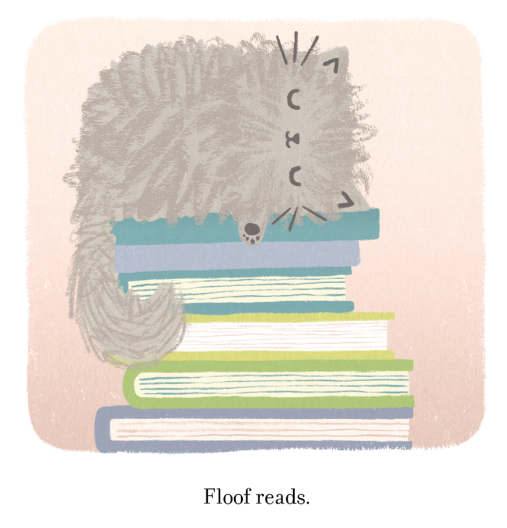
Floof by Heidi McKinnon


"Floof is floofy. Floof is very floofy. Floof is the floofiest! 

Good morning, Floof."

Floof (the book and the character) is so much fun. I am not at all a cat person but little Floof has brightened my day and captured my heart. I love her personality including her treachery when she takes the dog’s ball and gets up to all sorts of night time mischief. The style used for this book is simple and uncluttered keeping the focus firmly on Floof. Her name is just perfect and so much fun to say over and over.

The illustrations are so effective making Floof look so fluffy and her eyes are perfectly placed to convey her cheeky behaviour. This book has a delightful balance of words which say one thing and a text which goes so much further. You young reading companion is sure to laugh at all the naughtiness. 

We never meet her family but we feel their exasperation with this naughty cat in the background of so many pages. The mood is light and joyful.  Of particular note are the illustrations where we just see a paw or the tips of her ears, but even these tiny glimpses of Floof say so much. 

This book will fully engage any young reader or preschool group, it is written with a minimal but very effective text, and the layout of the illustrations is varied and interesting. Heidi McKinnon is not afraid to continue an illustration over centre of the page and she includes just the right amount of white space too. The end papers are a closeup of Floof's fluffy fur. 

Take a close look at the text quote at the start of this post. Notice the invented words, the repetition and the use of direct speech - the off stage narrator is speaking directly to Floof. 

Heidi McKinnon brings humour and joy to this splendid cat story. It’s a feel-good read for cat friends everywhere and will have you smiling with every page turn. With seriously cute (and floofy) illustrations in famously fabulous McKinnon style, you are going to wish you owned your very own Floof by the time you close the cover. Kids' Book Review

With humour and delight in equal proportions, this fun book will bring a smile to your face at each turn of the page. Red Reading Hub


You should also look for an earlier book by Heidi McKinnon - We found a Cat.

Wednesday, November 17, 2021

While you're Sleeping by Mick Jackson illustrated by John Broadley


"Oh, there's plenty needs doing at night time. 

There's plenty going on."

Who works in the night? I'm sure you can easily make a list and then you might pause to think of these people and offer your thanks that they keep our cities, shops, hospitals, factories, electricity sub stations, ambulance drivers, phone support people, and other services humming along while we are all tucked up snug and warm in our beds. 

As with all of the best picture books you should begin by looking closely at the cover. The boy is asleep in a bed that is floating above the city.  It is night time but if you look really closely plenty of people are out and about and when you stretch the book out to look at the back cover, the illustration continues and street lights illuminate the scene along with lights in the windows of shops and the hospital allowing us to look inside and see some of the night workers who we are sure to meet inside this book. I love the way the barcode is presented as a sign on a truck.

Now turn to the end papers. YES they are fabulous. Small vignettes of each worker along with nocturnal creatures such as the owl and fox. There is a baker, mail sorter, window cleaner, and delivery person. When you read this book with a young Australian child you may need to talk about the word lorry or just stop and count all of the busy lorries driving through the night time rural landscape. 


To open this book is like opening a gorgeous box full of jewels – each page is stunning – so too are the endpapers, the cover: the entire production in fact and to read it is like being shown around a gallery by a wise, gently spoken curator eager to open our eyes to how the world works. Red Reading Hub

As you can see, the illustrations in this book are fabulous. Such a different style for your young reading companion to explore. I love the pastel colours and extensive use of patterns. I am also thrilled to report that this large hardcover book is available here in Australia for a very affordable price. On this page from the publisher Pavilion you can see inside John's studio.

Here is an interview with John Broadley where he talks about his work on this book. I love the word breather he uses here: A book with no breather between this amount of intensity might have been too much, plus, in the passages where several things are mentioned (buses, cleaning the streets, trains etc) I thought it would add variety to have these as shaped vignettes. 

While you're Sleeping was one of just five books shortlisted for the 2021 Klaus Flugge prize“Each year the Klaus Flugge Prize celebrates the art of picture book illustration and puts the brightest new talent in the spotlight. The illustrators on this year’s shortlist demonstrate extraordinary skill and their very different books bring light, colour, warmth and laughter to readers of all ages. Congratulations to them all and very special thanks again to Klaus Flugge who has done so much to support and promote illustrators throughout his career.”


Here is a new book just released by Mick Jackson and John Broadley.

Wednesday, September 16, 2020

The Moon Keeper by Zosienka


Here is the blurb:

"Emile (a polar bear) has a new job as moon keeper. He spends his evenings making sure the moon has everything it needs to shine its light over the night creatures. Night after night he keeps watch over the moon - clearing away the clouds and telling the fruit bats to move along, when they play too close. Emile finds the moon nice to talk to in the stillness of the night. But what happens when the moon starts to change and slowly disappears?"

Emile packs his rucksack with all the things he might need for his important new job - matches, a candle, large net, pliers, a slingshot, a spool of red thread, water bottle, jar of fireflies, feather duster, crayons, a torch and a blank book. 


The note book and crayons become very important when Emile notices the moon is changing. He draws a picture of the moon each night and compares it with the one from the night before. Why is this happening? Is the moon hungry? Is the moon sad? Perhaps the moon looks different on the other side of the world. No, Emile phones his cousin in the jungle and it seems the moon looks the same from the night time jungle. 

"The moon grows thinner and thinner until it's no thicker than a thread."

A green bird arrives. I think this might be a night parrot. This bird is so wise. He advises Emile to wait. Things come and go. Wait and you will see the moon again.

The Moon Keeper is an exquisite book that explores the mystery of the phases of the moon. This is story telling at its best. The end papers use a beautiful palette of navy blue, red and cream. The pattern reminds me of wallpaper. There are fireflies on the title page emerging from a jar and their journey takes them to the back cover where they appear to be fluttering off into the night sky.

Fall in love with this moving and magical picture book about a sweet, conscientious polar bear, the moon, and the special connection they share. Barnes and Noble

This lyrical picture book introduces children to the concept the lunar cycle, helping them to understand the different phases of the moon.Stunning illustrations create a meditative atmosphere, making this magical tale of kindness, hope and faith ideal for bedtime reading. Book Trust

Zosienka is from South Africa. I highly recommend you add The Moon Keeper to your shopping list both for a school library and as a gift for a young child. This is Zosienka's first picture book as author and illustrator. You can see also her work in the book Baby Bird by Andrew Gibbs.


There are many excellent book that explore the phases of the moon. The Moon Keeper is certainly one of the best I have seen. Make sure you also read Papa, please get the moon for me.


Thursday, April 23, 2020

The night box by Louise Greig illustrated by Ashling Lindsay

The lock waits for a key!


Here are the first lines from this lyrical picture book:

Day is yawning.
Quiet settles in the trees.
The birds fold their wings,
the singing stops.

Then read this:

Day slips out of the leaves,
out of the pond,
out of the pink rose
and the blue ball.
Max waves goodbye.

Max holds the key. He owns the box. When the time is right, Max opens the box and lifts the lid and day slips inside while night sweeps out. The night is beautiful and gradually all the nocturnal animals emerge. For Max, night means sleeping in his warm bed with his teddy bear. Eventually night needs to fall asleep so Max opens his box again and night slips inside as day sweeps out.

The idea of night and day held in a box to be released by a small boy who holds the key is a beautiful idea. If you are a collector of picture books or you need a special book to give as a gift I highly recommend The Night Box. There are wonderful little details in the illustrations and the writing is poetic and reassuring.


Sometimes a picture book text just flows over you, like the gentle lapping of a stream's cool currents or the whisper of a summer breeze. ReaditDaddy

The night box was short listed for many awards including the 2018 Klaus Flugge Prize and the paperback edition is currently available. Here are are set of very detailed teaching notes which focus on the language used in The night box.

Louise Greig and Ashling Lindsay have another book - Between Tick and Tock.