Wednesday, December 22, 2021

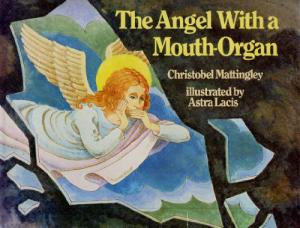
Christmas is coming to Australia read The Angel with a Mouth-Organ


This book begins in the present (many years after WWII) with a mother and her two children decorating their Christmas tree. "You will tell us the angel story again won't you?' Inside the box the little glass angel with the golden wing shone like a star against the cotton wool."

Their mother then tells the story of World War II when she was a small child:

"Out of the clouds the planes came, with noise like thunder and flashes like lightning. They flew across our village. It became a garden of flame. The houses and haystacks were like poppies, bursting out of their buds into glowing gold and orange. The church spire and the chimneys were like spikes of scarlet salvia."  Note Salvia is a tall red flower which you can see here.


The bombing of their village means the family are now homeless and their father is left injured - he has lost his arm. The family pack their possessions, some food and their grandmother into a cart and set off walking. Father puts his mouth organ into his pocket. 


"We walked and walked and walked. And always the sound of the thunder and the glow and the smell of fire flowers were behind us. We walked until the cow lay down and died... We walked until the baby died ... We walked until our neighbour and our last cheese disappeared one night. ... We walked until the sun grew thin and pale, and we grew thin and pale too."

The roads are full of people walking when the planes arrive and spray their bullets. The family survive but the soldiers take away all the men and boys including father. Eventually the two girls and their mother arrive at a camp. The girls teach the young children their father's songs and the family try to settle in but once again they have to move on. 

"We were moved seven times."

Eventually they are forced to shelter in a small hut and finally the war is over but now comes the waiting. Waiting to be reunited with their father. He does return after a very long wait and he brings with him a glass Christmas ornament - it is the angel - and she is playing a mouth organ. 


I am sharing another very old book today. The setting of this book is Europe after World War II so you might wonder why I am including it as an Australian book. This is because the author and illustrator are from Australia. The illustrations in this book by Astra Lacis are very special. I have talked about Christobel Mattingley previously and her book The Magic Saddle has also featured in my twelve books of Christmas this year. The Angel with a Mouth-Organ is based on true events from Astra's family but sadly the link to this part of the story is no longer active.

The Angel with the Mouth Organ is a longer picture book and will suit an older child around 9+. This book was first published in 1984 (my first year of working in a school library). I am unsure if you will find a copy in a library but you might be lucky and find one in a charity shop. In 1985 The Angel with a Mouth Organ was submitted for our CBCA Picture book awards but no winner was selected that year.  Some very fine books were honoured and short listed including Jeannie Baker's Home in the Sky; The Angel with the Mouth Organ by Christobel Mattingley illustrated by Astra Lacis; Arthur by Amanda Graham illustrated by Donna Gynell; There's a sea in my bedroom by Margaret Wild illustrated by Jane Tanner and one of my all time most favourite books - Wilfrid Gordon McDonald Partridge by Margaret Wild illustrated by Julie Vivas. 

There are many part of this story which echo the Nativity story so if you can find this book you might also like to read some other versions of the bible story. 

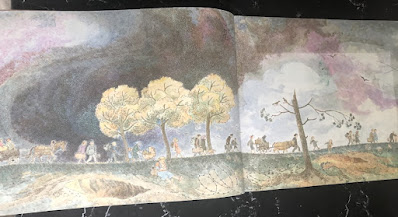
Here are the end papers from The Angel with a Mouth-organ:


The Uprising - The Mapmakers in Cruxcia by Eirlys Hunter


Crikeyomikey this is another good book!


Please begin by reading my post about the first episode where we meet the Mapmakers. Nearly everything I said in that post applies to this second book.


By the end of the first book Sal, Joe, Francie and Humprey have been reunited with their mother. Now the race is on to find their father. He has been taken to a prison in Cruxcia. The new ruler - Governor Mundle - has been arresting everyone in the town - for the most trivial of crimes. On their first day the children and their mother buy drinks from a street stall. Ma and Humphrey sample a different drink and quickly become quite ill.  The children are once again on their own. They find some precious things belonging to Pa and make friends with some children from the town. Pa had been making an important map as a way to show ownership of the land. Now it is up to Vivi, their new friend, to gather all the evidence in time for the arrival of the Land Court Judge. Adding to the tension the children discover the prisoners are about to be moved. Everyone in the community needs to work together to set the adults free but the biggest question of all is what exactly is Govenor Mundle up to? Why is he using his henchmen (called Custodians) to enforce his laws. Why are these men trying to catch Ma? What exactly is the GTC (the Grania Trading Company)? And finally is it possible that all of these children - the Santanders - Sal, Joe, Francie and Humphrey could be related to their new friends - Vivi, Hessa, Tash, and Lysander.

You can read the first chapter of The Uprising here. Here is the trailer.  You can read more plot details here

In this follow-up to the internationally successful The Mapmakers' Race, the Santander children are drawn into a community’s rebellion against a despot and use their mapping skills to avert an environmental scam. Sal, Joe, Francie and Humphrey Santander are mapmakers looking for their father, a famous explorer who disappeared on his last expedition. Their search takes them to Cruxcia, where the people are fighting to protect their land from the all-powerful Grania Trading Company. The Santanders’ mapping skills may be the missing piece in the Cruxcian race to save the ancient valley—and the key to reuniting their family. Part detective story and part adventure. Resonant contemporary themes: revolution, environment, indigenous land ownership. Walker Books 

There are utterly brilliant words in this book such as crikeyomikey; there are steampunk references such as the drigible that the children ride in to travel to Cruxcia and the the hotel lift which is called a cyclic ascender.

"The ascender beside the staircase consisted of a string of small open-sided cabins that moved continuously, going up on the left and down on the right."

Once again you are sure to also enjoy the delicious food in this book and the way Eirlys provides the children with glorious opportunities to take a shower and put on clean clothes. In Cruxia they have worked out how to bring hot water into their homes - this is such a luxury to our Santander children.

"Francie was keen. She liked the feel and smell of clean clothes and their clothes were truly filthy. But Joe hated laundry days: pumping and lugging buckets of water, sweating over a fire and then trying to wring water out of sodden clothes too heavy to lift."

"Hessa clipped the drum shut and hung a weight on a chain that ran up to the ceiling through a series of pulleys, and down again to a spindle. The weight dropped slowly, turning the spindle which turned the drum. Joe knew that wherever he lived in the future, he wanted water from a pipe, and a machine to wash clothes."

"She'd never felt so clean. Her hair and skin smelled of Lysander's mother's soap and they had clean clothes after yesterday's laundering."

The foods all have glorious invented names - pikers (hot cakes) eaten with butter and wild berry jam; cocol (a warm drink); chimlacanda (a delicious hot savoury pie) and Sunderstrum (honey and almond cakes). 

I will mention again that I first discovered Eirlys Hunter via her book The Astonishing Madam Majolica, illustrated by Kelvin Hawley (Scholastic, 1996). I have this on my 'to find' list. Sadly the staff in my previous school library threw this book away.  It might be languishing in a classroom somewhere - I sometimes think about sending the staff the offer of a reward for finding this book and 'selling' it to me.


In 2020 The Mapmakers Race was nominated by New Zealand as their IBBY honour book

Tuesday, December 21, 2021

Christmas is coming to Australia read Sarah's Two Nativities


I discovered this book in 2019 and I was certain it would appear on lots of award lists - but oddly it didn't.  Read my post here. If you are reading this post in 2021 then I am happy to say this book is available, in hardcover, and for a really good price. It won't arrive in time for Christmas but I highly recommend this book as one to add to your own Christmas shelf - it is a book you will want to revisit each year. 

You can see this book at the Storybox Library. 


A perfect story for families everywhere to read at anytime, but especially at Christmas.  Kids' Book Review

Monday, December 20, 2021

Christmas is coming to Australia so sing a song or two

Colin Buchanan (with Greg Champion) has rewritten many favourite Christmas songs and given them a very distinct Australian flavour.  Here are five of them which originally came with an enclosed music CD (and yes they are all out of print). I should mention the illustrators you can see here - Roland Harvey; Kilmeny Niland; Nick Bland and Glen Singleton.


This one has beautiful end papers and mentions many of our gorgeous Australian native flowers such as the bottle brush, waratah, Christmas bush and of course the yellow wattle (which oddly does not flower at Christmas time). You can hear a different version of this song here (not the one included in this book).


This one was published in 2006 and I am guessing might have been the first book by the now famous illustrator Nick Bland. You may know him from books like The Wrong Book; The very noisy Bear (and others in this series); King Pig and A Monster wrote me a Letter. You can hear this song here


This one has illustrations by the wonderful Kilmeny Niland (she died in 2009 read this tribute by Maurice Saxby). Kilmeny illustrated There's a Hippopotamus on our roof eating Cake. This Christmas book contains ten songs by Colin Buchanan (Bucko) such as Australian's all let us Barbeque; C'mon, it's an Aussie Christmas; and He's the Aussie Santa. 


Take a look at this blog post from 2020 where I mention other Australian versions of this song. Starting with one platypus up the gum tree, then two jackaroos, three meat trays, four footy fans, five rusty utes, six snags, seven chooks, eight jumbucks, nine dingoes, ten swaggies, eleven cricket legends and twelve surfing Santas you can see this is a very different version. 


If you don't live in Australia you might need some one to translate the words in this one  - ripper, deadset; crikey; thongs (footwear); and a billabong.

My favourite Australian Christmas song is actually a carol. It is more serious and lyrical than those offered in the books I have mentioned in this post. Click the song title to hear the music.

Carol of the Birds

Out on the plains the brolgas are dancing

Lifting their feet like warhorses prancing

Up to the sun the woodlarks go winging

Faint in the dawn light echoes their singing

Crana! Orana! Orana to Christmas Day.

Down where the tree ferns grow by the river

There where the waters sparkle and quiver

Deep in the gullies bell-birds are chiming

Softly and sweetly their lyric notes rhyming

Orana! Orana! Orana to Christmas Day.

Friar birds sip the nectar of flowers

Currawongs chant in wattle tree bowers

In the blue ranges lorikeets calling

Carols of bush birds rising and falling

Orana! Orana! Orana to Christmas Day.


Sunday, December 19, 2021

Christmas is coming to Australia read The Magic Saddle


Jonni wants a rocking horse but his family are poor and rocking horses cost a lot of money. His family live in a very small house and rocking horses need space. On Saint Nicholas' Day the family visit the Christmas fair. Jonni sees a beautiful rocking horse but of course he cannot have it so instead his mother buys him a little rocking horse Christmas ornament.


On the far side of the fair the family stop in front of a nativity display.

"But no one gave the Christ Child anything. And a little child must have a toy. So, as his father turned away, Jonni leaned down and dropped the red rocking horse (ornament) at the foot of the manger. It was just the right size for the Christ Child."

On Christmas eve Jonni is given gifts - a tiny blue wool mouse, a picture book with animals from around the world, and a gingerbread rocking horse. Jonni almost eats the gingerbread but in a magical moment the rocking horse talks to Jonni and explains about his magic saddle which can take them both on an adventure.


This is a magical story which shows dreams can come true. 

What did you want for Christmas when you were a child? I wanted a dog (and I was given one); I wanted a bicycle (yes I was given one of those too); and I wanted a wooden dolls house (but sadly I didn't quite get the one of my dreams).  As an adult, at one time, I thought I would also like a rocking horse (but as you have guessed I didn't buy one). 

The Magic Saddle is a very old book, published in 1984, and so it is long out of print but as often say here on this blog, you might be lucky and find a copy in a library or at a charity book sale. In 1984 The Magic Saddle was short listed for our CBCA Picture Book of the Year award. This book is not especially Australian - it feels quite European but the author and illustrator are award winning Australian book creators. 

I have talked previously about Christobel Mattingley and her wonderful body of work. In another post I talked about the tissue paper collage illustrations by Patricia Mullins in her books Ice Flowers and The Sea Breeze hotel.

I would pair The Magic Saddle with these two books:


Saturday, December 18, 2021

Seasons greetings from IBBY around the world


From IBBY Head office in Switzerland


Each year a number of our IBBY Sections send out greeting cards. 

Here are a few we have received so far:


IBBY Australia - Card by Tohby Riddle HCAA Nominee


IBBY Argentina illustration by Gusti HCAA Nominee


IBBY India


IBBY Nepal


IBBY Pakistan


IBBY Palestine


IBBY Indonesia


IBBY Ukraine


IBBY Greece


IBBY Russia

Here is a fun activity - try this QUIZ about IBBY - you are sure to make some important discoveries about this amazing and important organisation. 

The Witch of Blackbird Pond by Elizabeth George Speare


"Kit hesitated. She didn't want to admit how disappointing she found this first glimpse of America. The bleak line of shore surrounding the gray harbor was a disheartening contrast to the shimmering green and white that fringed the turquoise bay of Barbados which was her home."

The year is 1687.  Katherine Tyler, known as Kit, has travelled to Connecticut because her grandfather has died. The only family she has now is an aunt who she has never met who lives in Westersfield. Aunt Rachel fell in love with Puritan and ran away to America. Kit is a lively and impetuous girl but these are complex times. It is the time of the witch trials. People in these tiny settlements are suspicious of strangers. Their Puritan ways are severe. Added to this Kit has not told her aunt or uncle that she is coming. 

Publisher blurb: Kit Tyler is marked by suspicion and disapproval from the moment she arrives on the unfamiliar shores of colonial Connecticut in 1687. Alone and desperate, she has been forced to leave her beloved home on the island of Barbados and join a family she has never met. Kit's unconventional background and high-spirited ways immediately clash with the Puritanical lifestyle of her uncle's household, and despite her best efforts to adjust, it seems Kit will never win the favour of those around her. Torn between her quest for belonging and her desire to be true to herself, Kit struggles to survive in a hostile place, and just when it seems she must give up, she finds a kindred spirit. But Kit's friendship with old Hannah Tupper, who is believed by the colonists to be a witch, proves more taboo than she could have imagined, and ultimately Kit is forced to choose between her heart and her duty.

At a recent charity book sale I spied a copy of The Witch of Blackbird Pond.  I have wanted to read this book for a long time partly because I thought I had read it as a child (this turns out to be wrong) and partly because I am trying to find a book I did read in late Primary school about a young girl who goes to live with a mysterious old woman in a swamp and I thought that might be this book (it wasn't).

Did enjoy The Witch of Blackbird pond although I did not understand most of the political and historical references. I did enjoy the love story, the kindness of Kit, her sweet close observations of the people in the town and that all important happy ending. 

The Witch of Blackbird Pond (1958) won the John Newbery Medal in 1959. I have put a selection of covers at the start of this post. You can see more here at the School Library Journal where Elizabeth Bird talks about this book. Listen to the first chapter.

Here are some companion reads:


The Thickety (for mature readers)

And if the topic of strict religious practices is one you want to explore try to find this very old Australian book:


One more thing to add here.  The book I am looking for that I read around age eleven contained a similar story of a girl going to live in a strange environment. The woman she lives with is, I think, shunned by the people of the town. The young girl finds the old woman strange and difficult to talk to and yet each day the woman packs up the most delicious lunch for the girl to eat at school. The lunch is packed into the most perfect little containers. Do you recognise this book?  Please add a title in the comments.