Showing posts with label History. Show all posts

Wednesday, June 24, 2026

The Emperor's Elephant by C Walter Hodges


"Long ago in the city of Bagdad there lived an elephant. His name was Abu-ul-Abbas - or Abu for short. He was the biggest of all the elephants belonging to the Caliph who then ruled Bagdad. ... The Caliph's name was Haroun of Raschid. He was the most famous of all the rulers of the Eastern world. ... At the same time, far away in the West, there was another empire ruled by a mighty Emperor called Charles the Great. (He is often known nowadays as Charlemagne)."

Three ambassadors have arrived in Bagdad with gifts of gold and ivory. They are amazed to see elephants - no one from the West at this time had seen such creatures. The Caliph (in a gesture that feels both diplomatic and egotistical) decides to gift his largest elephant to Charles the Great. The journey is long - travelling through different cities and countries and across the ocean. Abu is accompanied by his young handler Selim. 


Image source (three images in this post) Full Table

In this picture book version Abu arrives to great fanfare and later he travels with the Emperor to war. 

"He became one of the wonders of the Western Empire, as the Caliph had promised, and he lived in fame and comfort with his friend Selim to look after him."


In reality "Abul-Abbas lived for at least eight years after his arrival, according to later accounts. In 810, the elephant accompanied Charlemagne’s army during a campaign against the Danes, when he died suddenly near the Rhine, but the exact cause is not known. Scholars have suggested illness or cold weather as likely factors. Nevertheless, his death ended a remarkable journey that had carried him across Asia, the Middle East, and Europe." History Skills

Charlemagne’s contemporary was a man named Harun al-Rashid, the caliph of Baghdad, who ruled over Baghdad and the Abbasid Caliphate from 786 CE until he died in 809. Well-respected and regarded as a “wise and just ruler,” Harun al-Rashid was a patron of the arts, music, and poetry throughout his life. During his reign, Baghdad flourished in terms of architecture, where Harun al-Rashid built the most beautiful palace of his time in the city, and his reign was one of peace and stability. These rulers had one thing in common: their thirst for knowledge. They both pushed for education. Charlemagne insisted on improving literacy among his subjects as well as their learning of Latin. Meanwhile, Harun al-Rashid’s patronage of the arts and literature followed his desire to establish his House of Wisdom. This House, where books from far and wide were compiled and translated into Arabic, was an institution that could be compared with the Library of Alexandria. Charlemagne and Harun al-Rashid were curious about the world around them hundreds of years before the Renaissance. The Collector


This book is from 1975. I found it in a library because I have been sorting and culling pictures of book covers. You could easily overlook this book because first of all it does look old, and secondly there is no back matter, so unless you are curious, as I was, you may have no idea that Charlemagne was actually gifted a real elephant. This is a book that you should share with your class followed by the two other titles below. A book like The Emperor's Elephant is a fantastic way to bring history to life for young students. I have thoroughly enjoyed my time dipping into this aspect of world history.

Companion book:


This book reminded me of this wonderful title:


C. Walter Hodges first came to prominence as the author/illustrator of Columbus Sails in 1939, which the “Junior Bookshelf” hailed as “The best book never to have been awarded the Carnegie Medal.” Widely acclaimed for the treatment of its subject matter, its powerful narration, and accompanying dramatic line illustrations, Columbus Sails was the first of a number of vivid historical novels written and illustrated by Hodges, including The Namesake (nominated for the 1964 Carnegie Medal), The Marsh King (1967), and The Overland Launch (1969). He is internationally recognised both for his indispensable and learned books about the Elizabethan theatre (for which he gained the Kate Greenaway Medal for illustration in 1964) and his vital illustrations to other authors' texts. 

I now discover he did the cover of one of my favourite childhood books - The Little White Horse by Elizabeth Goudge and other famous covers such as The Silver Sword. 

Tuesday, January 20, 2026

The Library of Ever by Zeno Alexander


“Do you swear to venture forth bravely and find the answer to any question, 
no matter the challenge?”

If you mashed together Alice in Wonderland and The Phantom Tollbooth you might come close to the plot of this book - such a wild ride. You will turn the pages so quickly as you read this book desperate to see if Lenora can survive all the mayhem.  

The only extra things I would have liked were a library map and perhaps a Dewey decimal chart showing all the library departments where Lenora was sent by the Chief Librarian Malachi. Lenora goes to the calendar room, the map room and the unknown room which actually has information about tardigrades, all the while she is being chased by the enemy who brings darkness. Along the way her status rises and she is awarded new badges. Lenora has to be very mindful of the library motto:

Knowledge is Light

Bookseller blurb: With her parents off traveling the globe, Lenora is bored, bored, bored until she discovers a secret doorway into the ultimate library. Maze like and reality-bending, the library contains all the universe's wisdom. Every book ever written, and every fact ever known, can be found within its walls. And Lenora becomes its newly appointed Fourth Assistant Apprentice Librarian. She rockets to the stars, travels to a future filled with robots, and faces down a dark nothingness that wants to destroy all knowledge. To save the library, Lenora will have to test her limits and uncover secrets hidden among its shelves.

In the chaos of this story there is also commentary on censorship, the role of libraries as providers of free information, the importance of curiosity, and of course the value of libraries as organised repositories of books, maps, charts, ephemera and so much more. Materials from everywhere and every time period.

"The Forces of Darkness wish to control people, and it is every knowledge that prevents them from doing so. ... They can only rule where there is ignorance, they can only create fear where the truth has been hidden, they can only gain power when the light has been snuffed out. Librarians are their greatest enemy, and we have fought them throughout time, and always will fight them as long as that light burns anywhere, no matter how weakly."

I may not have kept reading this book actually because it all became a little too silly for me but then I took a detour last night and glanced at the Kirkus review. Such is the power of their work that the star they gave The Library of Ever spurred me on to stick with this story although I am not so sure I need to read the sequel. I did enjoy Lenora's common sense, determination, perseverance, and her amazing general knowledge. She certainly adapted well to the roles of Assistant Apprentice Librarian and later Assistant Librarian. 

There are moments in this story that made me smile:

"The tardigrade snarled. 'As far as we tardigrades are concerned, Pluto is and always will be a planet. end of discussion. ...Lenora saw no reason to argue. She had always thought that Pluto seemed like a perfectly fine planet, whatever the adults might tell her. She took out her notebook. Pluto is, always will be, a planet. This she underlined firmly."

"I would like to know,' she said, 'how to find Wales.' 'You've found them,' said the whale. 'We are in fact, beluga whales.' 'Oh,' said Lenora. 'I mean Wales, the place, not whales, the mammal. 'Hmph' replied the whale ... And I suppose you think that just because I am a whale, a mammal, that I automatically know the location of Wales, the place?"

Not the first tale to be set in a universal library but unusually clever in the details and commendably accurate in its own way. Kirkus Star review

At its heart, The Library of Ever is a love letter to librarians and an ode to the importance of access to knowledge and information for everyone. The Winged Pen

Here is a fun interview with the author and the web page for Zeno Alexander. I picked up my copy of The Library of Ever at a recent charity book sale for $2. This book was published in 2019 but it is still available as is the sequel:


Bookseller blurb: Lenora returns to the magical Library—which holds every book ever known on its shelves. But she discovers the Library is under new management, its incredible rooms and corridors turned sinister and oppressive. Lenora quickly connects with a secret resistance that’s trying to free knowledge from the darkness threatening it. Her new friends introduce her to an ancient lost city, hang-gliding, and mathematical beings larger than the universe itself.

Companion books:


Friday, September 26, 2025

Kamishibai Man by Allen Say


One of the best shelves in many Primary school libraries are set aside for picture books for older readers. I spied this book in the library where I am volunteering. I have previously loved many books by Allen Say (see bottom of this post). You could use this book with a group of younger students who are exploring the topic - Life in the Past. And you will also want to explore the stories told by the old man - The Peach Boy and Little One Inch.

Here is the Kirkus description: Kamishibai means “paper theater” in Japanese, and when Caldecott artist Say was a boy in Japan in the 1940s, a “kamishibai man” on a bicycle used to sell sweets and tell serial tales of heroes and heroines, using picture cards and a wooden stage. This nostalgic story begins when Grandpa, once a kamishibai man, gets a hankering to resurrect his show. Unfortunately, it’s been so long he finds himself in an unrecognizable city with tall buildings and rude drivers. Dismayed, he parks his bike in a vacant lot and begins to recount not the beloved “Peach Boy,” but his own story of how his show was eventually replaced by television (initially referred to as denki, or electric kamishibai!). Soon enough, Grandpa’s surrounded by a crowd of adults who remember him from their childhood, and, ironically, he ends up on the evening news. Say effectively incorporates two illustration styles here—lovely soft watercolors and a more cartoonish style for flashbacks to the heyday of kamishibai. A fascinating window on a bygone art form.


Bookseller blurb: The Kamishibai man used to ride his bicycle into town where he would tell stories to the children and sell them candy, but gradually, fewer and fewer children came running at the sound of his clappers. They were all watching their new televisions instead. Finally, only one boy remained, and he had no money for candy. Years later, the Kamishibai man and his wife made another batch of candy, and he pedaled into town to tell one more story--his own. When he comes out of the reverie of his memories, he looks around to see he is surrounded by familiar faces--the children he used to entertain have returned, all grown up and more eager than ever to listen to his delightful tales. Using two very different yet remarkable styles of art, Allen Say tells a tale within a tale, transporting readers seamlessly to the Japan of his memories.


Sunday, July 6, 2025

The Wonder Horse by Mark Greenwood


Even if you have heard of Phar Lap, the famous race winning horse, you are sure to discover even more when you read this book. Readers who love history and mysteries will thoroughly enjoy this intriguing story and it is also one to share with horse lovers. I especially loved the descriptions when Phar Lap (also known as Bobby) was taken into a field to enjoy sweet grass and clover. I did find the descriptions of adding heavy weights to make racing harder for Phar Lap, who kept winning, very distressing. I guess I should disclose I am not a fan of horse racing but I was fascinated to read about this special horse/hero.

Discover the answers to these and many other questions in this book:

  • Do you know how Phar Lap go this name?
  • Where did Phar Lap run his final race?
  • Did Phar Lap look like a champion when he was a young colt?
  • Did this famous horse win every single race he ever entered?
  • Is Phar Lap from Australia?
  • What is the sweet treat his trainer always gave him?
  • How many races did Phar Lap win?
  • What happened on the day of the Melbourne Cup in 1930 before the race?
  • Why did the owner and trainer need to protect Phar Lap?
  • How do you feel about horse racing after reading this book? 

Here are some other books about Phar Lap that might be in your school library:


Last week I talked about another book from this splendid, thoroughly researched, series. These books are perfect for young curious readers in your library. They are easy to read with short chapters, big print, and page turning stories from history. Huge thanks to Freemantle Press for sending me copies of these two books from the History Hunter series. The Wonder Horse was published early in June 2025. Here are the teachers notes and these are well worth exploring because they contain extra web links and a vocabulary list. Read more details about The Wonder Horse in this blog post from The Bottom Shelf.

Who needs a time machine when you’ve got the History Hunter? He’s your fearless guide, taking you back through time to investigate mysteries that have puzzled the world for generations. From royal treasure rooms to racetracks, you’ll follow the clues, ask the tough questions and maybe even crack the case. These books are a history adventure double-pack that’s cooler than any video game! Better Reading


I previously talked about these horse racing picture books:


Thursday, July 3, 2025

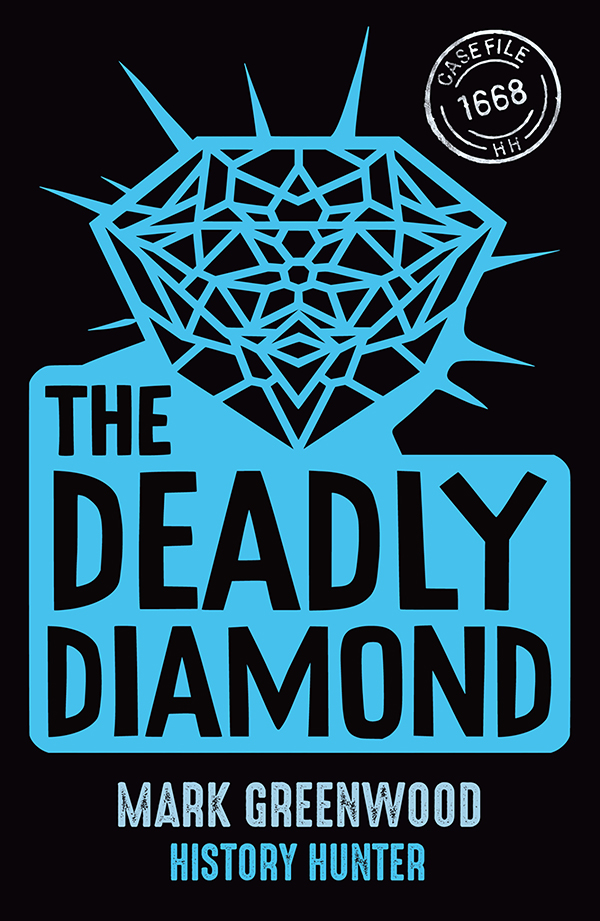
The Deadly Diamond by Mark Greenwood


"To this day the deadly diamond retains a spooky reputation as a stone with an ominous sparkle and the power to bring tragedy to anyone who touches it. But does its ownership bring death, dishonour, disgrace or financial ruin? Can the curse of the most famous jewel in the world be reconciled with reality when many of its owners have lived long and generally prosperous lives?"


Our story of this famous diamond - variously named the Blue Diamond, the French Blue, and the Hope Diamond - begins in India at a diamond mine in 1642. We are not told in detail, but it is very clear that conditions at this mine must have been utterly terrible. Mark Greenwood does mention snakes and overseers and the use of children in the mine. No one is exactly sure, but this diamond was part of a temple idol before it was stolen and then passed through the hands of thieves, con men, nobility, an extremely rich socialite, a famous jeweler and finally presented to the Smithsonian Museum of Natural History which is where you can see it today and from that link you can see many of the aspects and short videos of this story that are mentioned by The Deadly Diamond including the regular postal envelope that was used to send it to the museum - an amazing story. Take a look at these images

This is a slim book but such a page turner and readers are also supplied with a timeline, glossary and extra reading list so curious minds can explore this topic further. If I was sharing this book with a group of students (Grade 5 or 6) I think I would begin by showing the tiny diamond in a ring I wear every day using this as a way to talk about diamonds and their value and origins. You could share this ABC television series "Stuff the British stole" with a High school group. There is an episode about a diamond from South Africa and also one about the Koh I Noor diamond. Both are rated PG. I highly recommend The Deadly Diamond as a perfect addition to your school library or pop this title on your Christmas present list - it would be an especially great gift for a boy aged 10+. This book has big print and white pages and a few actual photographs/portraits of the famous people who were involved or who owned this diamond. 

Further reading:

Many of my reviewing colleagues receive advance copies of new Australian titles but up until this week I only received books from one Australian publisher. Now I can add two more to that list including the publisher of this book - Fremantle Press. I recently talked about their new verse novel Trapped by Julia Lawrinson.

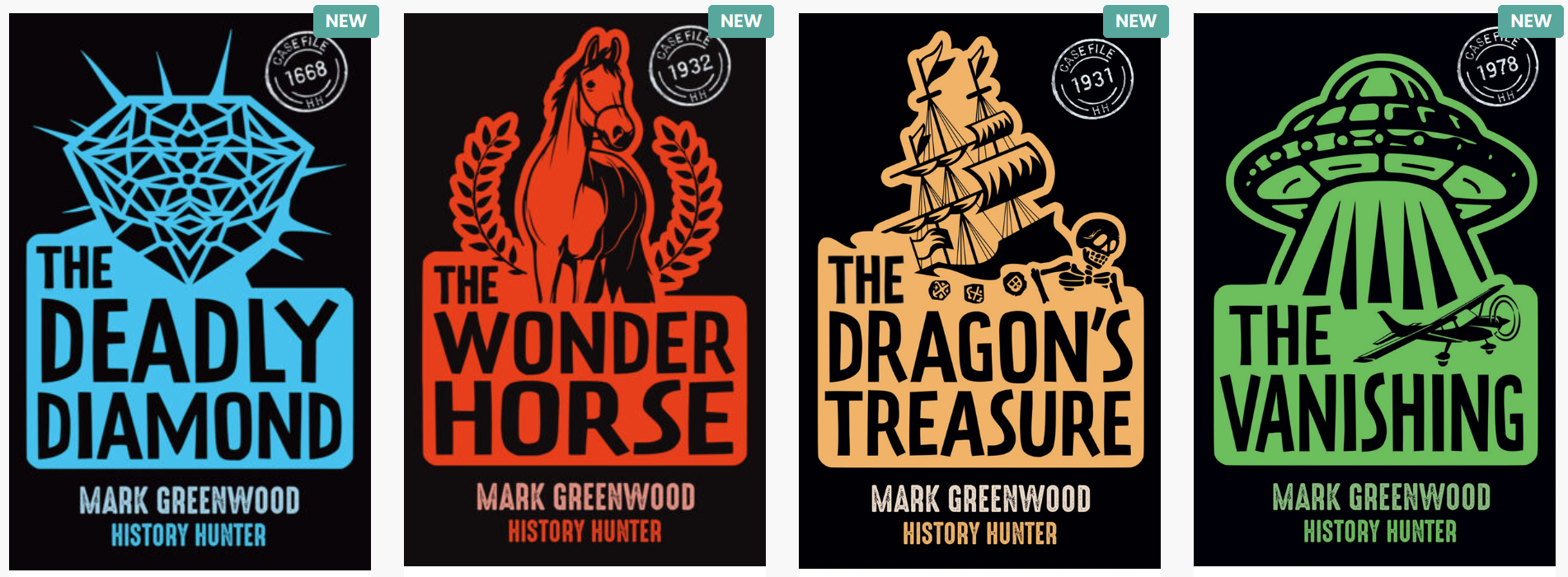
Mark Greenwood has done an enormous amount of research for this book The Deadly Diamond. I simply gobbled up the whole book in one sitting - readers aged 10+ are going to love this book and I am sure the rest of the series are fabulous too. I have another one - The Wooden Horse - ready to read next. Here is the full series called History Hunter:

On the publisher page you can read an extract from The Deadly Diamond and find very detailed and useful teachers notes. There is one word missing from the glossary which your students may need to check - loupe.

I was so interested to read all the ways this stone was cut and changed and reduced in size. I also had no idea about the colours of diamonds - white, yellow, red, dark grey, orange, red, apple green, pink and most desirable of all, the blue.

"The diamonds that came from the fabled mines of Golconda were highly valued. Local rulers jealously guarded the source and kept the largest diamonds for themselves. The radiance of these diamonds was legendary. Many believed they contained a supernatural force. Prized for colour, clarity, size and beauty some were as pure as a drop of dew."

Try to find these two books as companion reads:


This is not about diamonds, but it has the same narrative nonfiction style 
and the same assortment of 'shady' characters.  Highly recommended. 

This form of narrative non fiction is not new but I have not seen any other books in this form for many years. In my previous school library I had other books like this on a range of topics but they are all now long out of print. One series were called True stories published by Allen and Unwin: Stoked! Real Life, Real Surf; Bog Bodies: Mummies and Curious Corpses; Wrecked: Mysteries and Disasters at Sea; Kimberley Warrior: The Story Of Jandamarra; and Soccer: Great Moments, Great Players in World Football. And we also had the It's True series.


Your students who enjoy books that use this form of narrative to tell a true story might find the "I Survived" series in a school or local library. I also had a series called Mega Bites published by Dorling Kindersley in my previous school. 


Sunday, June 1, 2025

The Garden of Inside-Outside by Chiara Mezzalama illustrated by Regis Lejonic translated by Sarah Ardizzone


"Why do people wage wars?' I used to ask her. 
'Sometimes, people grow mad - with anger, with hatred - they lose their grip on words 
and choose weapons instead. 
The truth is I don't know the answer to your question."

In 1979, the Shah of Iran was overthrown by the Islamic Revolution. On 4th November 1979 fifty-two American diplomats and citizens were taken hostage in their embassy. They were held there for 444 days. During this time the father of the author of this book was appointed Italy's ambassador to Iran. This story begins in the summer of 1981.

Inside the children have a place to play filled with flowers and insects and ponds and hiding places. Outside "gunfire, exploding bombs and cries drowned out every sound."

"The city had grown. So had the women and men. People queued for food. Everywhere there were soldiers with heavy boots and big beards, their riffles slung across their shoulders. The city-monster made us feel very frightened."

One day a little boy from outside finds a way to come inside their garden. The children do not share a language, but they do share their imaginations. They play a game of princes and princesses set in times past where people were free to play music and dance and enjoy beautiful things. After their game the little girl tries to give a gift to the boy, but he rejects her t-shirt and flees. He is gone for a long time but when he eventually returns he has a gift for the girl.

"It wasn't a gift. It was a swap."

With exquisitely detailed and evocative images recalling fairy tales and exploring Iran’s artistic heritage – fantasies and ideas about Iran swirling together with glimpsed experiences – this book offers an unusual and breathtaking perspective on conflict: it’s noisy and terrifying even from the safety of their diplomatic compound, so how must it feel out there on the street? This is also a story of childhood defiance and testing barriers. It’s a timely reminder to adults that while we put up barriers to keep our children safe, they still need space to rebel, to find their own freedom and privacy. But above all, it’s a book about the need for friendship, even when there is no common language. Chiara has her brother, but he’s not the same. Her agony is real when she worries she has scared Massoud off or insulted him by offering him a gift of her t-shirt to replace his torn one. She fears she won’t see him again. But he does brave the jump over the wall again, wearing her t-shirt, and he gives her something, a tiny cat carved out of wood. “It wasn’t a gift, it was a swap.” They couldn’t talk, they didn’t know each for long, but they had both entered each other’s lives and made a lasting impression. Book Island Instagram

The Garden of Inside-Outside was first published in French as Le jardin du dedans-dehors, Les Editions des Elephants, France, 2017. Here is some background reading for teachers.

More than a story of childhood fantasy, this book provides a powerful treatise on civil war and its impact on young lives, on both sides of any political conflict. It raises interesting philosophical thoughts for readers of all ages on the futility of war and the power of friendship to overcome political, cultural and physical barriers. IBBY.uk

With war and political division as widespread and relevant today, this is a touching story about breaching walls and bridging cultures. The kindness of childhood friendship contrasts with the brutality of adult conflict. Inside the physically imprisoning garden wall, the children establish trust, overcome misunderstanding and find freedom, while terror grips the city outside. The bright colours and black outlines of the illustrations capture effectively both the bloody, unyielding horrors of war and the vivid dream-world of the children as they explore the garden. Children's Books Ireland

You can see inside this book here


The publisher Book Island have some teachers resources which include:

Here is an interview with the illustrator Regis Lejonic with Library Mice.

I am not entirely sure about the audience for The Garden of Inside-Outside. I am going to suggest this is a picture book for older readers from Grades 5-8. You could most certainly use the illustrator video interview with a High School art group. See full size images from the book. I put graphic novel as a descriptor but this book is not exactly a graphic novel nor is it a conventional picture book. 

Régis Lejonc is a French illustrator, cartoonist, screen writer and author. He has illustrated over 60 books and was the first French illustrator to win the prestigious Prix Sorcières, the French Independent Booksellers’ Award twice in one year. 

Here are some other books about walls for older readers:


With older students you could used these novels as companion reads:


Wednesday, May 21, 2025

Threads Zlata's Ukrainian Shirt by Lina Maslo


 "Red is for love, and black is for sadness ... Life has good times and hard times. Even though the Communists are making life difficult, we still have each other."

"Blue is for healing. Green for renewal. And gold - for the hope that one day, the wheat fields will again touch the sky."

Zlata is given a beautiful shirt for her birthday. Her mother has carefully stitched red flowers and black leaves - "Life has good times and hard times." The year is 1932 and just a few days after her birthday the Russian Communists arrive. They take everything of value from her home and then their neighbors betray them and the solders come back and take their hidden food, tiny amount of money and Zlata's father. Her father is gone, her beautiful new shirt is gone and Zlata and her mother are barely surviving. This is the time in history 1932-1933 called the Holodomor (famine-genocide here is some background reading for teachers).

Zlata has a good friend named Yeva but it was her father who betrayed Zlata and her parents. It is Yeva's fault her Papa has been taken away. Their friendship is over. But then the soldiers take everything from Yeva and her family and her father is also taken away. The way the friendship of these two young girls is able to be healed will warm your heart. In a familiar story trope this healing coincides with the arrival of spring. Sadly though, we do not discover the fate of her father.

You can see pages from this book on the author webpage

Threads: Zlata's Ukrainian Shirt is a very important book for a few reasons:

Children here in Australia will have been hearing about the war in Ukraine for over a year now. This book is a way to introduce older students to (a) the history of other dreadful conflicts in Ukraine and (b) to show the beauty of their culture via, in this case, exquisitely embroidered shirts. This is a picture book I would share with students aged 10+ because it deals with complex topics of betrayal (blood money), persecution, war, famine, injustice, starvation, communism, and fear. 

A poignant yet accessible entry into Ukraine’s ongoing suffering—and survival. Kirkus Star review

Publisher blurb:  The threads on Zlata's beautiful birthday blouse were stitched by her mother. “Red is for love, and black is for sadness,” her papa says. Mama warns her not to show it off. Ever since the Communists came from Russia to Ukraine, they prohibited the teaching of Ukrainian culture. Now, in the Ukrainian Famine-Genocide of the 1930s, they've even taken the grain from Zlata's family's fields. But despite the danger, her parents refuse to give up their art, language, and beliefs. As Zlata works to help her community survive, she finds that the dream of freedom is stitched deeper into the Ukrainian spirit than she could ever imagine. Drawing from her grandparents' experience of the Famine-Genocide, Maslo weaves a thoughtful story that dares us not to forget the pain of the past as it informs the present conflict in Ukraine and inspires hope for the future.

Last week, the 15th May, was the third Thursday in May. Today a new parcel of books arrived and one of them was this one Threads: Zlata's Ukrainian Shirt and that is where I read about the Vyshuvanka which is the special embroidered shirt you can see on the cover of this book. This means I have missed Vyshyvanka Day (by just one week) but I am so happy to have found this book. Next year, 2026, the date will be 21st May. 

Vyshyvanka Day is an international celebration dedicated to the traditional Ukrainian embroidered shirt. Its purpose is to preserve and promote the age-old traditions of folk art and national clothing. While it's not a public holiday, that doesn’t stop people from joyfully supporting the tradition — by wearing a vyshyvanka to work, school, at home, or at public events.

  • In 2015, the holiday gained official international recognition, and vyshyvankas were worn in over 50 countries.
  • In 2017, a massive banner with vyshyvanka patterns was unfurled on the Eiffel Tower in Paris.
  • Between 2020–2022, Ukrainian diplomats wearing vyshyvankas posed for photos in the capitals of countries with Ukrainian embassies.
  • The largest vyshyvanka in the world was created in Rivne, Ukraine, in 2011 — it measured 54 square meters.
  • In 2023, vyshyvankas were even placed on statues in Central Park, New York
  • In 2021, Ukrainian airline SkyUp released a crew capsule collection inspired by vyshyvankas.
  • In 2015, Google featured a special vyshyvanka-themed Doodle on its homepage for Ukrainian users.


Image source: Google Doodle


Over 250 distinct embroidery stitches can be used to form the vyshyvanka’s signature coded symbols. These typically fall into three categories: floral ornamentation, zoomorphic figures, and geometric shapes, all of which can be found in today’s Doodle artwork. No pattern comes without a detailed meaning, and Ukraine’s varied cultures and natural landscapes are reflected in the unique iconography employed within each region. (This video goes into more detail about the embroidery patterns)

The patterns vary across the country as you can see on this map:


Here are two other books by Lina Maslo:


I have previously talked about these books by Ukrainian authors and illustrators. I also love the art of Hans Christian Andersen illustrator Kost Lavro (I do hope he is safe and has perhaps been able to leave Ukraine). And don't forget to look for versions of the folktale The Mitten


Alias Anna (verse novel)