Showing posts with label Learning English. Show all posts

Saturday, January 27, 2024

Singing with Elephants by Margarita Engle


Brilliant, joyful, and deeply moving. Kirkus Star review


Publisher blurb: Cuban-born eleven-year-old Oriol lives in Santa Barbara, California, where she struggles to belong. But most of the time that’s okay, because she enjoys helping her parents care for the many injured animals at their veterinary clinic. Then Gabriela Mistral, the first Latin American winner of a Nobel Prize in Literature moves to town, and aspiring writer Oriol finds herself opening up. And when she discovers that someone is threatening the life of a baby elephant at her parents’ clinic, Oriol is determined to take action. As she begins to create a world of words for herself, Oriol learns it will take courage and strength to do what she thinks is right—even if it means keeping secrets from those she loves.

The baby elephant mentioned in this blurb is a twin. An unscrupulous actor who seeks fame at any cost takes one of the two-week-old baby elephants away from its mother. Oriol is determined to find the baby. She feels the grief of the mother and remaining twin very deeply. Once she finds little Song (his sister is Dance) Oriol then needs to spring into action. She organises a petition and with the help of Gabriela Mistral letters are written to other famous actors and to the Humane society. There must be a way to save this tiny elephant and stop the cruel intentions which would force her to perform in unnatural ways. 

Here are a few text quotes to give you a flavour of this verse novel:

My bird name
musical and sweet,
is one I chose 
for myself, long ago, in Cuba
when I knew who I was
and how 
to speak.

ELEPHANT ANATOMY

Standing in front of Chandra
I'm stunned into silence.
Tree-root feet.
Half-moon toenails.
Map-of-India ears.
Paintbrush tail.
A snake-shaped nose
with forty-thousand
muscles.
Her fifty pound heart pulses with love
for her soon-to-be newborn.
She's been pregnant for twenty-two months,
due any day.
She needs to eat three hundred pounds of hay
every twenty-four houses.
When she moves
she's as graceful
as a swaying
ocean wave.

MY FUTURE IS BLURRY (extract)

Gabriela Mistral is right-
I cannot predict the future,
but I can imagine a time
when wild animals
are no longer held captive
My words and actions
have shown me what
is possible.
Maybe the will change
the whole world
someday.


Add this book to your list of verse novels to share with young readers aged 10+ up to age 13. 


I met Margarita Engle at a USBBY conference a few years ago so when I saw this verse novel in The Little Bookroom (Melbourne bookstore) I grabbed it.

Have you heard of Gabriela Mistral (1889-1957) - the first Latin winner of a Nobel Prize for Literature? I had not heard of her but there are details at the back of Singing with elephants along with one of her poems.

"I wanted to imagine how she might have influenced a child ... so I invented a Cuban immigrant girl who loves animals and nature as much as Mistral."

"She believed children deserved kindness, and her reforms of rural education became a model for all Latin America. At the same time she became a world-famous poet, and served as a diplomat, representing the government of Chile while living in various countries. .... (She) was an influential peace activist (and one) of the founders of the League of Nationals and later UNICEF."

Awards:

  • Rhode Island 2024 Children's Book Award Nominee
  • Bank Street 2023 Best Children's Books
  • New York Times Best Children’s Books of 2022
  • Kirkus Best Middle Grade Books 2022
  • School Library Journal-26 MG Books for Latinx Heritage Month 2022
  • Nerdies Award, 2022
  • Cybils Award Finalist
  • School Library Journal Mock Newbery Suggestions
  • Kirkus Starred Review
  • Junior Library Guild Selection
  • New York Times review
  • NPR Morning Edition interview
  • Publishers Weekly starred review
Margarita Engle is the author of these (Summer Birds is a firm favourite of mine).


Monday, February 14, 2022

Let me whisper you my story by Moya Simons


"I must be quiet. I could hear the thud of boots, Nazi boots, and voices laughing. Why did they laugh? I heard a soldier say 'There's one person missing from this list, a child called Rachel Schwarz. She wasn't with her parents. Her father said she'd gone to visit a friend down the road. Not likely. Search under the beds.'... Someone came into the kitchen. The cupboard door opened with a creak. ... The solider looking sideways at me, stared. 
(Then) suddenly the young man ... walked away. He had left me there."

Publisher blurb: Rachel is German, Jewish and lives in Leipzig just before the outbreak of WWII, with her doctor father, mother and older sister Annie. Life is comfortable, revolving around Sabbath meals shared with uncles, aunts and cousins. When the Nazis arrive, the family is 'relocated' elsewhere in the city, and then taken away to a labour camp. Rachel's father saves her by making her hide in a kitchen cupboard, forbidding her to speak. The damage is done. Rachel remains mute - for years - as a result. Rachel is discovered by a neighbour, Gertrude, who conceals her in her own home until Rachel is taken into care by the Red Cross and sent to an orphanage in England. But where are Rachel's family?

Let me Whisper you my story is a powerful novel written with a gripping immediacy as Rachel navigates the frightening times of World War II witnessing the power of Hitler.  Rachel has no voice that others can hear but we can hear her.  This book was published in 2010 and it is Australian but somehow I missed it. I am amazed to discover it is still in print. You might also find a copy in a school library. I do keep an eye out for books about World War II especially books which offer different perspectives. 

You can read a chapter sample from this book here. 

The publisher list this book for ages 9-13 but I would suggest a older reader aged 10+. Let me Whisper you my Story is the perfect next read for students in Year 6 or junior high school who have read any of the book series by Morris Gleitzman which begins with Once, or they have read or are curious about books like The Story of Anne Frank or perhaps they have read Hitlers Daughter by Jackie French or better yet, if they have read and enjoyed any of these:


Thursday, July 29, 2021

Butterflies Belong Here by Deborah Hopkinson illustrated by Meilo So


"I wondered if I'd ever be brave enough to speak up, take charge, and be noticed."

First off let's take a close look at the full title of this book:

Butterflies Belong Here: A story of one idea, thirty kids, and a world of butterflies

Butterflies belong here implies something has gone wrong. That the butterflies are no longer in this place. We have to ask why?

A story of one idea and thirty kids - it must be time for activism and this will be led by the children beginning with one child and her idea.

A world of butterflies - hooray they have come back but why did they disappear in the first place?

Our young narrator explains:

"Monarch butterflies are soft and gentle, like my baby brother. Some monarchs make a long, long journey, just like we did. They have to be strong to fly so far."


In Summer our narrator begins to look for monarch butterflies with their large black and orange wings. She has read about them in a library book. (I love the Teacher-Librarian in this book).  There are none to be found. Why?

"Monarchs need a special plant called milkweed. ... (but) Milkweed is in trouble, and so monarchs are too. I learned that in 20 years, the number of monarchs has fallen by 90 percent. The problem is big and butterflies are so small."

The young girl keeps reading about this precious creature and she discovers a solution. They need to make a monarch way station - a garden filled with milkweed and nectar flowers. After sharing this idea with her class everyone joins in the project. The children build a way station.  Then the class project expands into the whole school and from there to the local council.

This is one of those truly special books which combines a narrative as described above interspersed with double pages of facts and practical suggestions presented in an easy to read style with colourful scientifically accurate illustrations. This book would make a splendid addition to any school library collection. And as a bonus the illustrations by Meilo So are simply perfect. Meilo So was born in Hong Kong and educated in the United Kingdom. She lives with her family in the Shetland Islands, Scotland.  Take a look inside this book here. Here is a web site for Deborah Hopkinson.  

Deborah Hopkinson’s moving and educational story combines a fictional account of growing up with scientific information on butterflies. The structure is exceptionally effective in showing kids and adults that some children find their voice, discover a talent, or overcome hesitation or shyness when they become involved in a cause or activity they believe in. Celebrate Picture Books

Meilo So’s gorgeous and tender illustrations portray vibrant scenes of flower bedecked balconies, blooming community gardens, and a busy, colorful town. So cleverly depicts the library’s stacks of books in similar floral hues, connecting the nurturing of children and butterflies. Celebrate Picture Books


Images from: Books 4 Your Kids

I was excited to discover Meilo So illustrated the cover of Bronze and Sunflower. Here are some other books illustrated by Meilo So:


Saturday, June 12, 2021

Saving Hanno: The story of a refugee dog by Miriam Halahmy illustrated by Karin Littlewood


Rudi is nine years old. He is living in Frankfurt. The year is 1938. Hitler is on the rise and daily life is changing for Rudi and his Jewish family. Things are becoming very dangerous. His parents make the heartbreaking decision to send Rudi and his sister Lotte on the Kindertransport to England. 

Rudi has no English. Rudi has witnessed terrible violence. And now Rudi is told he cannot take his best friend Hando to England. 

"He's my little dachshund, and he's the best dog in the whole wide world. I've had him since he was a puppy. He's two years and one month old now. He goes everywhere with me ... Hanno's coat is very smooth and a sort of chocolate brown. His ears feel like the velvet on Mutti's best dress. His legs are quite short, but he can walk and run long distances."

Luckily there is a solution. Someone offers to take the little dog to England. It will be a while until the friends are reunited because Hanno will need to stay in quarantine but eventually Rudi will have his special friend by his side. Rudi is sent to live with a very kind older couple. His sister is not so lucky. She is forced to work as a servant but this will only be for a short time Lotte has plans to leave as soon as she turns seventeen but the war intervenes and as this story ends Lotte and Rudi are evacuated again so they can be safe away from the bombs that are about to drop on London.

Publisher blurb: Nine-year-old Rudi and his beloved dog Hanno escape from Nazi Germany, but Rudi soon learns he’ll have to protect Hanno from an entirely new threat in this thrilling reimagining of a little known World War II event. What if you had to leave your dog behind when you fled? Nine-year-old Rudi has a chance to leave the dangers of Nazi Germany on a Kindertransport to England. However, he cannot bring Hanno, his wonderful dachshund. Luckily, his family finds a way to smuggle Hanno to London. But with England on the brink of war, Hanno is still not safe. As a German invasion of England becomes imminent, many British people decide their pets will suffer as well as drain limited resources, and thousands of pets are euthanized. To save Hanno, Rudi joins a group of scrappy London children who hide their pets away in a vacant lot. Just as London’s children are about to be evacuated to the countryside, the group finds a wealthy animal lover willing to care for the menagerie on her country estate. This fast-paced and accessible novel is full of courage and excitement.

Chil­dren who are bond­ed to their pets, as well as oth­er sym­pa­thet­ic ani­mal lovers, will appre­ci­ate Rudi’s love of Han­no and the efforts he makes to save him, and will under­stand that war is a painful and com­pli­cat­ed time. Jewish Book Council

Rudi’s direct, child-centred narrative voice compellingly portrays the feelings of a child refugee facing the loss of everything familiar. It has a modern resonance for the plight of child refugees all over the world. Books for Keeps

Here is a video with the author Miriam Halahmy where she talks about her book. Here are some teachers notes to use with this  book.

Companion reads:


Thursday, April 29, 2021

A Glasshouse of Stars by Shirley Marr

 "This book is bursting with colour and heart" 

Libby Armstrong Beachside Bookshop


I am going to begin with two text quotes to give you a flavour of this writing.  Here are the first sentences from the opening pages;

"You have arrived for a better life at the New House in the New Land. It has been a long journey, the first time you've ever been on an aeroplane. It was nerve-racking when they checked the suitcases at the airport, even though your family has next to no possessions, let alone anything to hide."

Shirley Marr tells us so much from these few sentences but she also leaves so many unanswered questions. Where is the New Land? Who owns the New House? Where have the family travelled from? Why do they have so few possessions? Its been a long journey - is our narrator a refugee? If she is how did she come to travel by aeroplane?

The New House which Meixing calls Big Scary, was owned by First Uncle. He has died and left the house to his sister and her husband. Ma Ma is expecting a baby. Ba Ba will need to get a job and a car and this will be difficult when he has limited skills with the New Language. The neighbours - Mr and Mrs Huynh are kind and offer food and practical help but they speak another language (I assume Vietnamese) and so their food and customs are unfamiliar to the Lim family. Later we learn Meixing and her family have come from China.

Things at school are also confusing for Meixing. In this scene she needs to cross the road but the procedures with the lollipop man are so confusing:

"He thinks you're a silly girl who doesn't know how to cross the road. And he's right. You are a silly girl who doesn't know how to cross the road. Back where you came from there were hardly any cars. Or roads, for that matter. The workers flats you lived in, the deep wounds in the ground from where the machines took out the precious Earth Dust and the handful of shops were the only blights on the island. Beyond that was jungle and dirt tracks, and you went wherever you wanted. You were wild and free ... "

In the backyard of the new house Meixing discovers a greenhouse. When she steps inside she enters a magical place. First Uncle shows her how to plant seeds as a way to understand the past. Later she is able to share this magic with Kevin Huynh from next door and Josh.  "You know that if you call on the glasshouse in your hour of need, the glasshouse - suspended somewhere between reality and imagination - will never let you down."

It is not often that I say I really dislike a character in a book but in A Glasshouse of Stars the teacher Miss Cicely  is despicable. Her treatment of Meixing feels like child abuse. I shudder to think a teacher would actually speak to or treat a student in the way we witness from Miss Cicely and I do hope Shirley Marr was not subjected to this cruelty but since this story is semi autobiographical I worry that this part might be based on her experience.  Thank goodness for the compassion of the ESL teacher Ms Jardine. So you can  see from these comments that this is a book that makes the reader feel things. I loved the honesty of Meixing; the developing friendships; the fragments of each child's back story which we see in the glasshouse; the crazy aunties who arrive at Big scary; and most importantly the way Shirley Marr lets her reader experience just how hard it is when you don't have language skills to communicate your wants, needs and wishes.

When you pick up this book you may find the writing style is a little challenging. Our students are more familiar with either first or third person narratives.  Shirley Marr explains:

This is a migration story I have been trying to write all my life. But I also spent a lot of my life trying to forget and disappearing into myself. I tried to write it from a first person point of view, but it always felt too close and I would always pull back. Third person also felt so distant, like I was writing someone else's story. I happened to pick up a copy of Deadgirls by Nancy Lee from an op-shop while looking for reading matter while on holiday. I was immediately inspired by the first short story, written in the second voice. As soon as I started writing my story in the same voice, I knew it was right. I knew it was a story I had to tell while the reader walked in my shoes and saw some of the things I saw and experienced when I was a child.

The cover of A Glasshouse of Stars is beautiful. The art is by Cornelia Li. My copy of A Glasshouse of Stars came from Penguin Random House. In the UK Usborne have given this book a different cover. I love comparing covers with students. Take a look at this review.


Here is the blurb from Readings in Melbourne: 

Meixing Lim and her family have arrived at the New House in the New Land, inherited from First Uncle who died tragically and unexpectedly while picking oranges in the backyard. Everything is vast and unknown to Meixing and not in a good way, including the house she has dubbed Big Scary. She is embarrassed by the second-hand shoes given to her by the kind neighbours, has trouble understanding the language at school, and with fitting in and making new friends. Her solace is a glasshouse in the garden that inexplicably holds the sun and the moon and all the secrets of her memory and imagination. Her fragile universe is rocked when tragedy strikes and Ma Ma refuses to face the world outside. Meixing finds herself trapped within the shrinking walls of Big Scary. Her parents said this would be a better life for them all, but it feels like the worst and most heart-breaking experience of Meixing’s entire existence. Surviving will take all the resilience and inner belief of this brave girl to turn their world around.

Here is another review from The Bottom Shelf and this book also reached Ms Yingling in Columbus, Ohio, United States. Karen Yingling gives, as usual, a great plot summary. While she enjoyed this book she feels it is too "Australian" for her readers.

Here are some companion reads. Just like Wen in Tiger Daugher, Meixing also carries the huge burden of parental expectations.


Thursday, March 11, 2021

Tiger Daughter by Rebecca Lim


"I'm really sorry,' I say simply, because there's no time to explain the parameters, the dips, and contours, of my life ... Even being in the middle of it makes no sense to me - how the rules keep changing and expanding as I grow, but never in my favour."

"To live is to risk everything."

Wen is the only daughter of Chinese immigrants. Her father is a skilled doctor but his qualifications are not recognised here and so he is forced, much to his shame and anger, to work in a Chinese restaurant. Dad, Mr Zhou, has traditional and authoritarian views about family life and he has very fixed expectations of his wife and child. He quotes from Confucius as a way to justify his extreme control over them but all of the advice is aimed at becoming a good man and Wen is a girl. 

She watches the suffering of her mother. Money is tight but her father expects her mother to produce lavish meals especially each Tuesday night which is his night off from the restaurant. She has to make 8 dishes, not seven, because seven is an unlucky number. Wen watches as her mother repairs her clothes over and over again and she comes to see that clothing, for her mother, is a bit like armour.

Wen cannot talk to her parents. They have high expectations for her and so she takes extra music lessons, has maths tutoring and attends Chinese language classes. In spite of all of this, though, her father does not acknowledge that Wen is a bright student.

Luckily her teacher, the wonderful Miss Spencer, does. She is certain Wen and her best friend Henry Xiao have a very good chance of winning a place in a prestigious school. Life is very hard for Wen's Henry. His family are poor and his mother is suffering from severe depression. Then the unthinkable happens and Fay Xiao takes her own life.

The publisher has listed this book for ages 10+ but I think this is too low. I would say this book is for very mature readers aged 11+. I am also listing it as a Young Adult title. I am going to predict that this book will be a 2022 CBCA Notable title and I am also certain, even though it is early in the year, that this book will be short-listed. 

Tiger Daughter is a thoroughly enjoyable and easy read, peppered with heartfelt and hopeful moments that will leave readers with a renewed faith in humanity. Books and Publishing

Beautifully written with insight and authenticity, this thought-provoking book carries many messages. It reflects the lives of many migrants and their struggles to become part of a better life, and the personal cost for this privilege. A Must Read for this year! Kids' Book Review

This book is breathtaking. It is so honest and raw. I started reading late last night and finished it off in one sitting this morning. There are heavy themes in this book - abuse, control, suicide but there is also a lightness to the writing and the promise that things will change and the family will take steps towards their own healing. I especially loved the open ending and the quiet wisdom of Wen herself. Readers are left to imagine what happens next for Wen and Henry knowing all will be well. 

Don't read this book when you are hungry - Mrs Zhou prepares the most delicious meals - your mouth will be watering. You will also love the generosity when she prepares food for Mr Xiao and Henry:

"In the bottom tier of the carrier is the rich broth mum has made from the qǒu qǐ or goji berries, lotus root, carrots, mushrooms, dried longan, dried scallops and fresh chicken. She even added a handful of dried white fungus for nourishment and for clearing lungs ... In the second tier is the boneless chicken meat she shredded for them, together with other ingredients. And in the top tier are the glistening white noodles, or lā miàn, that Mum boiled for less than two minutes, so they won't be too soft to eat when the hot broth is added to them."

Read more about Rebecca Lim and her desire to see herself in children's books in this recent article from the Sydney Morning Herald.  I previously talked about another book by Rebecca - book one from the Children of the Dragon series.

Companion reads:


Friday, July 24, 2020

Christophe's Story by Nicki Cornwell


Christophe is only eight but in his short life he has experienced distressing and utterly terrible things, things a child his age should never have to see or feel. Living in Rwanda he watched as the streets filled with soldiers and guns, he sees his father taken into custody and later, as the family flee, Christophe himself is shot. The bullet grazes his skin and injures him but, even more distressing, another bullet kills his baby brother. After a long and terrible journey the family finally arrive in England. Christophe has limited English and he has missed two years of school.

Adding to his struggles Christophe has been told about the importance of stories by his grandfather:

"A story should be kept in the head and told from the mouth! That's what Babi says. and he knows about stories. He's a storyteller ... This is how you tell a story like this! You have the story in your head, and when you tell it, you use a big voice or a little voice. And you tell it with your hands, like this! And when you finish, the story flies back into your head. Like a bird going back to its nest!"

When the teacher tries to read stories to Christophe, when she asks Christophe to read stories, and when she tries to get him to write stories, Christophe is filled with fear, grief and confusion. School is torture for Christophe and it is made worse by the class bully. In one scene this boy, called Jeremy, drops a live worm into Christophe's plate of lunch spaghetti. The whole scene made me shudder.

Luckily Christophe has a kind teacher. She gives Christophe time and space to tell his story and gradually she shows him that nothing is lost if a story is indeed written down and in fact this is an important way to share his story with children Christophe himself might never actually meet.

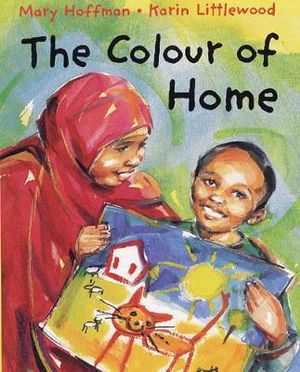
Nicki Cornwell has some teacher notes on her web site. Have you read The Colour of Home. If not find it NOW and read it before you pick up Christophe's story.


Christophe's story was first published in 2006. I have read reviews which question the suitability of this book for children but I think over the last 14 years our exposure to the plight of refugees has greatly increased and in Australia and other countries there are huge numbers of picture books and Primary level novels for young readers which explore all aspects of the refugee experience. Some reviewers list this book for children aged 8-14 but I would suggest it is better suited to older students 10+.

"In writing stories about asylum-seekers and refugees, I hope to find a wide audience for their voices. I try to depict the heroic courage with which they face events over which they have little control. I try to show their moral strength, their courage and their heroism. They are individuals caught up in a web of other people's attitudes and the choices that governments make. We cannot change what has happened to make them flee from their countries, but we can try not to add to their problems by stigmatizing them for seeking asylum." Nicki Cornwell


There is a second book which continues the story of Christophe (I have added it to my to read list but sadly it is out of print.)


For older students I would suggest another book about the power of storytelling:


Books do not need to be long to be "good".  I love the fact that this powerful and emotional story is told in just 72 pages.  Here are some other short books for senior primary readers: