Showing posts with label Technology. Show all posts

Friday, March 13, 2026

The Frindle Files by Andrew Clements illustrated by Brian Selznick


Josh is a student at Clara Vista Middle School. His English teacher (ELA) is Mr N. I love the way he teaches but for Jake it is all too old fashioned. Mr N sets assignments that need to be hand written (neatness counts) and he has no technology in his classroom - instead every student is expected to have, and use, a copy of an old grammar book called The Elements of Style, 4th ed., by William Strunk Jr. and E. B. White (yes that is THE EB White author of Charlotte's Web).

Josh wasn’t sure if Mr. N even owned a computer. There was a rumor that once he’d had a big argument with Mr. Ortega about posting his homework assignments on the school website. Mr. N had told the principal that writing assignments on the board in his classroom was enough—and he didn’t mean one of the SMART Boards that every other teacher used. No, Mr. N had an actual chalkboard that he could move around the room on wheels. The whiteboard was there, but Mr. N kept it hidden behind a huge poster about the parts of speech.

Josh breezes through his other homework but for Mr N he now need paper and a pen. He has almost completed his work when the ink runs out so he picks out a pen from his mother's desk.

Back at the kitchen table, Josh was about to start writing again. Then he noticed something printed on the side of the pen—one word, in bold black letters: It was a word he’d never seen before, which made him curious. And Josh did what any other plugged-in kid would do: He searched the word on his browser—f-r-i-n-d-l-e. And then he hit return. Whoa, 270,000 results?!

What is going on? It's just a pen? Or is it?

“Hey, Mom, where did you get this pen?” She looked, and then smiled. “I’ve had that since sixth grade. Everyone at my school started calling pens frindles, and when those showed up in stores, I bought a couple—so did all my friends. It was kind of a big thing for a while.”

Josh digs deeper and find a photo of the school kid who invented the word 'Frindle' and this kid sure does look like ... Mr N!!


It is now page 9 of a 214 page book. Josh is a very curious boy. He now has a mystery to solve and because he knows Mr N loves words and writing there might be a way to make this interesting. AND Josh is a computer nerd so he can easily do tons of research about this and keep it organised into folders with evidence and photos and online newspaper clippings and so we now have the The Frindle Files. 

Using a fine-tipped Sharpie, he had written the word Frindle in bold black letters along the barrel of a plain white plastic pen. And now that word on that pen was right there on that desk, waiting for Mr. N to discover it. And when he did, Josh would be watching.

Mr N does react but not at all in the way Josh expects and now the battle is on - a battle of wits and words but can there really be a winner? And can this 'joke' go too far?

The Frindle Files publisher blurb: Josh Willet is a techie, a serious gamer. Which is why Josh and his friends can’t stand Mr. N’s ELA class; it’s a strict no-tech zone. Mr. N makes them write everything out by hand, he won’t use a Smartboard, and he’s obsessed with some hundred-year-old grammar book. Then Josh discovers a secret; turns out Mr. N's been keeping a lot more than technology from his students! Together with his best friend Vanessa, and using all the computer skills they’ve got, Josh is determined to solve the mystery of Mr. N’s past. And maybe get some screentime back, too?

You should also feel inspired to read or reread Charlotte's Web after you finish The Frindle Files. 

Frindle (1996) is a book that I read and loved when it was first published.  I mentioned I had read the 'sequel' to Rachel Robson at Gleebooks here in Sydney and she almost swooned - so strong was her own memory of loving Frindle. Sadly, Andrew Clements died late in 2019 so this is his final book which was published posthumously. I did smile when Josh's little sister Sophie asked to see Bluey.

Here's a recap/blurb for Frindle (The Frindle Files can stand alone BUT your reading experience will be so much richer if you have read this famous predecessor). 

Bookseller blurb: Is Nick Allen a troublemaker? He really just likes to liven things up at school -- and he's always had plenty of great ideas. When Nick learns some interesting information about how words are created, suddenly he's got the inspiration for his best plan ever...the frindle. Who says a pen has to be called a pen? Why not call it a frindle? Things begin innocently enough as Nick gets his friends to use the new word. Then other people in town start saying frindle. Soon the school is in an uproar, and Nick has become a local hero. His teacher wants Nick to put an end to all this nonsense, but the funny thing is frindle doesn't belong to Nick anymore. The new word is spreading across the country, and there's nothing Nick can do to stop it.

Or perhaps you could read my 2012 blog post.

The Frindle Files paperback edition has just arrived here in Australia (March 10th 2026) - rush to your favourite independent bookstore today to secure your copy. 

Now that you have your copies of Frindle and The Frindle Files head into your school or local library and borrow some more fantastic books by this master storyteller. My own favourites are:


Friday, May 23, 2025

Our Sister, again by Sophie Cameron


"Welcome to Project Homecoming and exclusive trial by Second Chances Ltd.
You are part of one of the most ambitious and pioneering projects ever carried out in the field of Artificial Intelligence. 
One that, if successful will change how we think about 
and experience life and death forever."

Life is a mystery and so is death but we do know that when someone dies we cannot see them again. In books there is an unwritten rule that death is never reversed or so it seems to me. In this book a young girl is 'brought' back and this has huge implications. This book will most certainly make readers think deeply about grief, death, what it means to be human and also the implications of technology in our lives.

Isla's sister has died. Mum is wrapped up in grief and so when she reads about a way to bring Flora back to 'life' she readily agrees. What does this mean? What are the implications for the family of agreeing to the Second Chances Homecoming Project. What are the implications for the community who have all signed confidentially agreements? And what about the other teenagers who were friends with Flora? They have grieved and attended her funeral and now she is back. But they are older because three years have passed. If this version of Flora is frozen in time and only has the memories. possibly unreliable memories, collected by Second Chances, is she a real person? Mum does not want to see the truth and dad is sure this is totally wrong, so he has left the family and moved away from their island home. Now that Flora is back should she go back to school? Is there any point in sitting exams? And of course, the kids in her class from before have left the school and are at college.

Is Flora person or a robot? "As Flora turns towards the harbour steps her hair falls to the side and shows the back of her pale neck. ... Carved into her skin, only just visible above her jacket, is a small square."

Is this Flora, really Flora? "The returnee has been created using vast amounts of data, in addition to photos, videos and extensive interviews with your loved one's friends and family."

"Our returnees look entirely human ... We are confident that this new arrival will be an extremely close match to the person you remember. However, please be aware that there are some differences. Returnees do not need to sleep, they cannot be fully submerged in water, (they do not need to eat), and they don't fall sick with human illnesses."

The food part about the returnee made my stomach squirm. In the first few days Flora does eat with the family but the food goes into a food compartment in her body and she has to regularly empty it. Eventually she just gives up this charade of eating. 

"Losing Flora so young made me realise that growing old is a gift not everyone gets."

Dad "doesn't think she's human ... He says you can't rebuild a soul and you can't be a human without a soul."

Exploring a number of ethical questions, Our Sister, Again is simultaneously an intriguing mystery and a moving story of grief, family bonds, and what it means to be human.  Book Trust

It's an emotional story, and heartwarming too. The Book Bag (read this full review - it is very thoughtful)

This is an incredibly powerful, compelling and absorbing read that raises issues around personhood, ethics and social media.  ... And, that ending – it brought tears and smiles – and was exquisite! Book Craic

Saturday, November 9, 2024

North and the Only One by Vashti Hardy


This book was among the new titles in the Book Bunker library at Westmead Children's hospital where I work as a volunteer. I previously read a short book by Vashti Hardy - The Griffin Gate.

Rose wakes from a vivid dream that seems to be about her life in the past. A few days ago she had woken up to find herself in a house she does not recognise. She meets Mother but again has no recognition of this person. Life is comfortable and she does have the beautiful companionship of her dog whose name is North but there is always this niggling feeling that someone important is missing. She needs her memories. She needs to remember her past. This dream, as with other dreams, has been so vivid and so she gets of out of bed and quietly goes to Mother's room keen to talk to her about the forest scene and house she has seen in her dream.

If you are book talking this book with your library or class group I would read pages 29-31. This is from page 31. 

"She strode, forward, stopping midway down the bed. Mother looked so peaceful. Her cheeks brushed with white, hands neatly by her sides. Moonlight glinted on something in mid-air to the side of her. At first, Rose thought it must be a moth, but then she realised it was some sort of aerial line or string in  between her and Mother. How curious. She reached towards it to check she wasn't imaging it, and ran her fingers gently along the wire. It was definitely a cable. She looked back to the wall and saw it was plugged into a charging point ... Rose froze. It didn't make sense. She looked at the charging point. She looked at Mother. A shudder ran through her, her heart rate escalating. It was impossible. Mother was plugged in! ... A person didn't need to plug themselves in. Not someone of flesh and bone like Rose. Mother was something else."

I did read this book in almost one sitting but it is a long book (340 pages) so I imagine it will suit a reader who enjoys Science Fiction and a reader with strong reading stamina. The story does take quite a few unexpected twists and turns and, as is often the way with Science Fiction, you do need to suspend disbelief especially in relation to the human need for food. The premise is that Rose is the only or the last human and yet at every turn someone is able to supply her with water and food albeit only small quantities. Clearly Humanoid Robots do not need food so I was somewhat confused about why this was so readily available - but as I say, you just need to let that thought go. I did enjoy the early hint that Mother was not quite 'right' but that scene I quoted above still gave me a huge jolt!

The other part of this story that was a little bit strange - but many young readers won't notice this - is the use of names relating to the invention of the computer - Ada (Lovelace); (Charles) Babbage; and Alan Turing.  There are also layers of Pinocchio and I am sure choice of the two furliths (robot animals) that help Rose - fox and rabbit - have some literary significance. There are also references to Alice in Wonderland, The Nutcracker, Macbeth and Romeo and Juliet.

In some ways this book made me think of an old movie called Logan's Run and even the famous book The Giver by Lois Lowry. 

Bookseller blurb: Twelve-year-old Rose can't remember anything before last week, when she woke up  not knowing her own name, her own house, or even her own mother. The only thing Rose recognized was her puppy, North. But Mother patiently explained everything - well, not everything. Not the real-feeling dreams Rose has about a mysterious forest she half-recognizes. Or why she is not allowed to stray beyond the garden, out into Luminelle, the vast city surrounding them. Mother is kind and helpful, but Rose can't shake the feeling that something's not right. Or maybe it's everything that's not right?
But then, when Rose flees to the outside world with North, it quickly becomes clear to Rose that she is different. And for reasons she doesn't understand, she's dangerous. On an unforgettable journey of discovery, Rose uncovers life-altering truths about the city she's in, the people around her ... and ultimately herself.


Here is the web page for the author Vashti Hardy. She lives in West Sussex.

Friday, November 24, 2023

Ajay and the Jaipur Moon by Varsha Shah


"Space offers us new worlds to conquer, new territories to colonize, and endless resources to take."

These are the words of Mrs Surya. At first they sound glorious to the audience and to the team of kids who have come to meet this famous millionaire but slowly the truth behind this sentence is revealed. You could use this sentence to introduce this book to your readers aged 10+. Think about the words conquer, colonize and take. Colonize is especially poignant when you consider this book is set in India and they were colonized by the British.

Now look at this statement by Mrs Surya:

"As you know, the WECU corporation own factories across the globe. With the willing support of politicians, I will move them into space so that they no longer pollute our world. No longer bogged down with laws and human rights, these factories will be a blueprint for oligarchs everywhere."

The words 'human rights' should chill you. In the first book the workers in the T-Shirt factory were subjected to horrid working conditions. In this second book we meet the slum kids of Jaipur. Their leader, a girl named Laxmi is missing one finger as a result of working in a jewelry making factory. You should review the UN Rights of the Child with your class. 

Now read Chapter 28 - and think about the consequences of Mrs Surya vision of space, her assumed role as leader, and the way she uses words to manipulate the kids and later her press conference audiences. Even her office, with the glass floor and the way the door snaps shut are all about control and power. When you are reading this book notice the references to her eyes - "windows to her corrupt soul."

Ajay and his team of street kids work hard to survive living on the streets of Mumbai. The produce a newspaper which last year led to some fame but as time has passed people are no longer interested in reading the news and printing their paper each week is a huge struggle without a proper printing press. But buying a new press means they need a lot of money. Then Ajay reads about a competition to find a meteorite that has crashed into the earth. Whoever finds it will be given a tour of the new space research base in Jaipur. 

Ajay has a talented team of friends: Vinod is a wonderful cook; Yasmin, safely away from the dangerous T-shirt factory is a very fine artist; Saif is an apprentice engineer who can solve any engineering problem; and Jai is a first-class cricketer.

Working as a team I was sure these kids would find a way to travel from Mumbai to Jaipur, and I knew they would find a way to win this competition. BUT standing in their way there are difficulties, lies, betrayals and corrupt adults. Saif finds the location of the meteorite but as they arrive in Jaipur his tools are stolen. This is just the first disaster. In fact, there are so many twists in this plot I began to think these kids would not survive let alone succeed.

If you read this book in a class you will want to add in some research about Jagadish Chandra Bose (1858-1937) Dr APJ Abdul Kalam (1931-2015), and Asima Chatterjee (1917-2006). Along with the astronaut Kalpana Chawla (1962 -2003).

Sir Jagadish Chandra Bose is one of the most prominent first Indian scientists who proved by experimentation that both animals and plants share much in common. He demonstrated that plants are also sensitive to heat, cold, light, noise and various other external stimuli.

Dr. APJ Abdul Kalam served as the president of India from 2002 to 2007. He began his career designing helicopters for the Indian Army as an aeronautical engineer for the Defence Research and Development Organization (DRDO). In 1969, he was moved to the Indian Space Research Organization (ISRO), where he served as project director on SLV-III, the nation's first satellite launch vehicle, which was successful in putting the satellite Rohini into a near-Earth orbit in 1980.

Asima Chatterjee was an Indian chemist noted for her work in the fields of organic chemistry and phytomedicine. Her most notable work includes research on vinca alkaloids, and the development of anti-epileptic and anti-malarial drugs. She also authored a considerable volume of work on medicinal plants of the Indian subcontinent.

Kalpana Chawla was American astronaut who died in the Space Shuttle ‘Columbia’ disaster. Born in Karnal, India, she was the first woman of Indian origin to go to space. In May 1997, she went on her first space mission, travelling for fifteen days in the Space Shuttle Columbia flight STS-87. In 2003, she travelled once again into the space aboard ill-fated Space Shuttle Columbia flight STS-107.

You can read chapter one on the Chicken House page. 

This is an exciting and beautifully written and illustrated book for children aged eight and upwards. It could be the starting point for discussions about what friendship means to them and how they relate to each other’s varying interests and future plans. School Reading List UK

Alongside action and humour are serious socio-political messages. The power imbalance between rich and poor is a significant theme and there is mention of child labour and exploitation. There are many points in the book that would prompt deep discussions. ‘What defines where someone belongs?’ asks Ajay. He later comments, ‘All that matters about a society is the way it treats its most vulnerable.’  The children’s achievements (in the face of adversity) and their tight friendship makes Ajay and the Jaipur Moon an empowering and heart-warming read. Just Imagine

You could also use this book to discuss the depiction of a character - Mrs Surya. Her clothes are both interesting and obscene when you think about the poverty experienced by the kids in this book. She reminded me of the evil woman in Beetle Boy by MG Leonard.

"Her eyes were the colour of warm caramel ... her smile eclipsing the sun.

"She turned and gave a magnetic smile that he was sure was just for him! She looked magnificent as she went to stand on the podium ... wearing a silver sari encrusted with scales of diamonds that blazed in the light of the chandelier."

"Up close, glittering from head to toe, with silver star earrings, and the border of the sari snaking around her, she looked even more striking."

"Mrs Surya glittered from head to toe in a lace sari that was encrusted with diamonds and looked like the clouds of the milky way. ... she looked like a figure spun from light."

This is the second book about Ajay and his newspaper The Mumbai Sun. I loved the first and this sequel did not disappoint.


Sunday, August 6, 2023

Now We're Together: Adventures in real life by Nicola Edwards illustrated by Jenny Bloomfield


"When we're caught up in the endless scroll and swipe, it takes effort to change our habits. It's worth it, though, because there's an incredible world out there for us to enjoy."

My blog has a few repeated topics or 'messages' one of which relates to the name of the blog - TIME. In the context of this book this means putting away those devices which swallow up your time, turning off those devices to free up your time for other things - reading, noticing, walking, talking, playing, silence, stillness, rest and again reading.

The final pages of this book have some distressing facts which I hope shock you:

"The average grown-up picks up their phone 58 times a day and spends more than three hours each day using it."

"The more we use smartphone, the more likely we are to feel anxious and depressed, especially if we spend a lot of time on social media."

BUT the author also offers advice:

"Try reading a book in bed .... you might find you get a better night's sleep."

"When you wake up in the morning, try not to look at your phone for an hour. Are there other things you could make time for instead?"

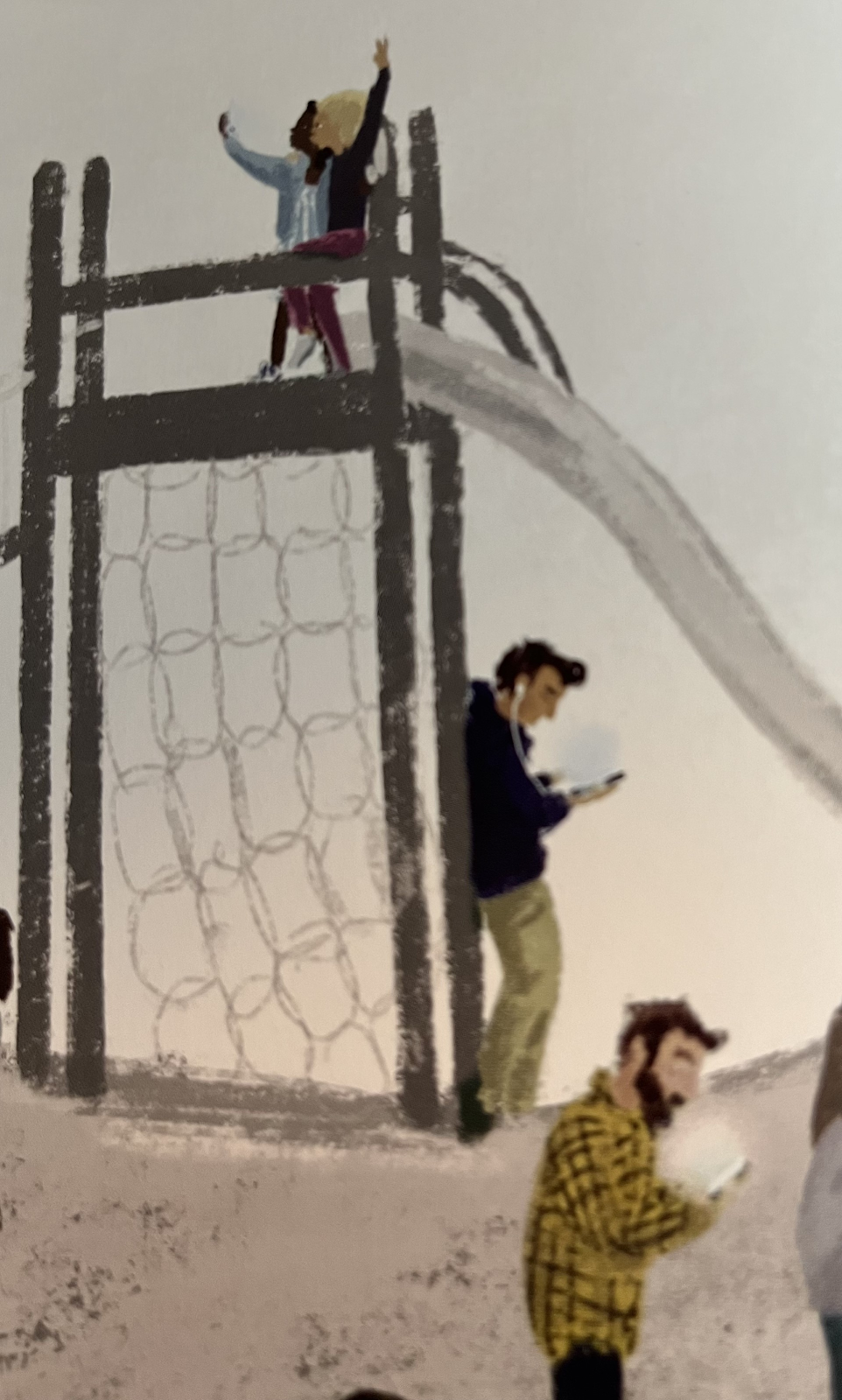
This book is unashamedly didactic right from the opening end papers where we see six windows at night and in each someone is looking at a screen to the back end paper and every scene is joyous and different. A man plays a guitar while his child sings; a lady is watering her indoor garden; two people are talking; an artist works at an easel; and a man is playing with his tiny infant. 

The title page is also quite confronting. Over twenty people are in a park, the children are playing BUT not interacting with all the adults whose faces are illuminated by the screens they are staring at. Oh and some of the children are looking at those screens too!


"We're scrolling, eyes flicking ... but what do we see? Am I seeing you? Are you seeing me?"

But what if that switch is turned off - what will they see? What will they do? What will change?

"The moon is a plant-sized pearl hanging low." "The sky's stuffed with diamonds ... " "Fireflies flutter and flitter ... " "Skies of sherbet and coral and spilt indigo, the sun drips its honey on blue tides below."

The big question about this book, though, is who is the audience? The message is an important one for adults of course but do they read picture books for advice? Older children need this message too but again this picture book might not be shared with older children. Younger children need adult intervention - adults have put those devices into the hands of tiny children and so the message about switching off and seeing other things in the world has to be initiated by the adults in their world. Younger children might enjoy this book but my real hope would be that it might open up conversations and perhaps the adult sharing this book might follow the advice it contains. 

My friend from Kinderbookswitheverything has a Pinterest collection of other books on the topic of devices - unplug or turn off. This book is didactic, as I said, but the message is important and the art by Jenny Bloomfield is sublime. My poor photos do not do it justice. If I had to think of a similar illustrator I would say her style is a little like the wonderful Sydney Smith


Here are other books by Nicola Edwards:


Wednesday, December 21, 2022

e-mail: Jesus@Bethlehem by Hilary Robinson illustrated by Anthony Lewis


If Jesus were born today, how would everyone receive the news? By satellite? Via the World Wide Web? On a mobile phone? By e-mail? This original picture book looks at the changes in technology and communication since the birth of Jesus.

This book was published in 1999 but it really has stood the test of time. The only tiny details adults might notice are the slightly old fashioned television sets and the way the mobile phones have small antennas. And of course we now write email not e-mail. 

This book could be a good conversation starter about technology and the way it is changed over time (social media) and the communications technology that is explored in this book and the way it is used  to share the story of the birth of Jesus. I can even imagine this book being used as the basis of a church sermon perhaps at a Children's Christmas service. 

The library where I borrowed this book still use date due slips. I was quite delighted to see this book has been borrowed many, many times every Christmas since it was first purchased in 2001. There are many used copies of this book still available for very low prices so if the idea of this book appeals to you it should be fairly easy to find a copy (I like to use Better World Books) or it might still be in a school or local library. 


Here is part of the text:

"Let's imagine that Jesus was born today. The shepherds hear the good news on their mobile phones. Then hot off the printing presses ... Later, on television, everyone sees a new flash. ... And via a satellite, in the night time sky, the three kings hear the news. ... The kings travel by private jet. (Camel Airlines), ... And every country sings out to the sound of the Band of Angels with their new big hit."

I really love the final page which shows children with Christmas presents labelled with words such as caring, peace, love, compassion, honesty, sharing, thoughtfulness, kindness, compassion and giving. 

Anthony Lewis is the illustrator of the famous Robert Munsch book  Love you forever

Wednesday, November 16, 2022

Our Table by Peter H Reynolds


One of my favourite things is when, it's a simple thing really, someone enthusiastically passes me a book, especially a picture book. Yesterday my colleague in Westmead Children's Hospital Book Bunker (library) pointed out Our Table which we had on a small display stand. I do wish we had room for more book displays - front facing books are way more enticing to readers that shelves full of spines.

Okay so now I have read a book that I want to share, gift, thrust into the hands of EVERY parent I see reading their phone and ignoring the precious little child in their care.

There are lines in this book that made me cheer and gasp:

"Recently, though, Violet found herself alone at the table. Her family had become busy. Very busy."

"She found her mother on the staircase ... charring silently on her phone."

"Violet found her brother in his room playing games with friends she could not see."

Then Violet sees that the family dining table, where everyone used to gather to talk and laugh, has now disappeared. Luckily Violet is a problem solver, she is a girl of action! She asks her father to join her to watch a carpentry program; she asks her mother to send a message on social media seeking a person who can build a table; she asks her brother to use his computer to draw a plan and then the action begins. 

You should share this book with parents, other adults, young children and older children. If you are looking for a text to explore the use of colours to express emotions this book is perfect. Violet's memories of the past are colourful but the technology distractions of her family make her world turn a monochrome purple. Building the new table, sharing stories around the table and the simple act of everyone coming together once again means life for the whole family is once again filled with vibrant colours.

Take a look at the trailer

In Reynolds’ established tradition, this story is simple and full of heart, celebrating the wonder and possibility of being human and being in relationship. Kirkus Star review

Our Table is a modern fable that is timeless for children and adults. It is a heartfelt, uplifting and important message for all families to balance their time connecting with each other and setting limits on their use of technical devices.  Children's Books Heal

I have talked about the wonderful and important books by Peter H Reynolds in previous posts such as this one

Monday, August 1, 2022

The Boy who Made Things Up by Margaret Mahy illustrated by Lily Emo


Luckily for Michael one day his dad's car breaks down. The pair of them have to walk and after a short while Michael begins to use his imagination and involve his father in a wonderful adventure. By the sixth double spread the father has put away his distracting mobile phone and now he can fully enter into their imaginative journey to the seaside which in reality is far from this place. They play on the beach, dive into the ocean, swim to an island, watch the colourful fish and even enjoy a delicious ice cream delivered by a man on a unicycle.  By the end of the day the father has learned a very important lesson about the importance of family and the intrusion of too much time spent working when he should be enjoying precious time with his son. 

Margaret Mahy sadly died in 2012 but I think it is so important that we all continue to read and share her wonderful and extremely diverse body of work. She wrote picture books, junior novels, short stories, poetry and amazing young adult titles.  In fact Margaret Mahy was awarded the prestigious Hans Christian Andersen medal in 2006 for her body of work.  My favourite picture books are Jam; The Great white Man-eating shark; Beaten by a Balloon; The Pumpkin Man and the Crafty Creeper; The Three-legged Cat; The Boy who was Followed home; and The Man whose Mother was a Pirate.

The Boy who Made Things up was written by Margaret Mahy in 1982 and first appeared in her story collection The Chewing Gum Rescue and Other Stories. I was excited to see one of these older books was illustrated by Jan Ormerod.


The Margaret Mahy Illustration Prize is one of New Zealand’s pre-eminent illustration prizes, offering a unique opportunity for an unpublished New Zealand-based illustrator to illustrate Margaret Mahy’s classic stories. It was launched in 2019 to celebrate and honour the 50th Anniversary of Mahy’s A Lion in the Meadow.

Previous winners

2021 There's a King in the Cupboard illustrated by Minrui Yang


2020 The Boy who Made Things up illustrated by Lily Emo

2019 The Boy With Two Shadows illustrated by Sarah Greig (Originally illustrated by Jenny Williams 1971)


In 2022 the book will be The Witch in the Cherry Tree (1974). Here is the original edition:


I wonder which book will feature for 2023 and beyond. If I could talk to the organisers of this illustration competition I would loudly proclaim it should be The Pumpkin Man and the Very Crafty Creeper originally illustrated by Helen Craig. This story is such a joy to read aloud and it had sadly been out of print for too long!


Saturday, June 18, 2022

Fake by Ele Fountain


"There's a lot of money to be made from keeping people in one place, with only their screens. Think of all the shopping for a start. Why change things if most people are happy? ... 
The ones making all the money are smart. 
They're very generous to the people who made the laws, so they won't rush to change them."

The best authors of dystopian fiction do not reveal everything at the start of their story - they carefully insert tiny fragments of information so as a reader you can 'join the dots' and infer the way of the world in this future time. I adore this style of writing. 

As this book opens, Jess who is fourteen is about to head away to school. She is leaving her beloved younger sister Chloe behind. On the first page we read the word ROOM (I am not going to tell you about this you need to read Fake to understand this). Then on page 15 there is a mention of a portal watch which Jess uses to connect with her friend Finn. It is some sort of video phone.  Chloe and Jess also have a pet kitten. Surely this is not a problem but then Finn comments "Keeping a pet. That's an offence." It is now time to leave but how will Jess get to her new school. We read that the transport has been charged.  

"No transport has space for luggage - big transports waste electricity. ... Families used to have massive cars which could carry everything. Transports only have room for seats, to save energy."

Then we read these chilling words "mum warned me that some students will never have met another child before." and there is a mention of live-learning. The other students take health supplements and have their online shopping delivered by drone. In her trunk Jess has bought some of her fathers precious books. Mae, her room mate has never touched a paper book. 

In this world of the future, children learn on screens at home so they are protected from diseases until they are fourteen when their immune systems have developed.  

"After the antibiotics stopped working I thought they made all kinds of laws to protect us. ... But that was twenty years ago during the Scarlet Fever epidemic."

There is no money, only credits. Chloe needs expensive medicines and her parents, who live on a farm, have very few credits and the price of the medicine keeps rising. Jess has learned about coding and computer hacking. She has a plan to help her family but days in the new school are busy and tiring and working on complex coding at night might not be a good idea because mistakes can easily happen. Mistakes with shocking consequences for her precious family. 

This book is such a terrific commentary on our modern world - on our use of and dependence on technology; on the implications of disease such as the Covid Pandemic; and our concerns with personal privacy when the State collects so much data about our lives. Heavy stuff!  Yes. I nearly gave this book five stars but, to me, the ending was a little rushed and perhaps a little too perfect but this aspect of the story is sure to deeply satisfy young readers aged 10+. 

" ... a compelling thriller with fantastic characters set in a futuristic world where everyone is isolated from each other in their homes."  Books up North

"Well, this is an absolute corker of a story, one that feels slightly surreal as you read and relate to particular events and situations. There is a true link to what we have endured during the initial Covid 19 lockdowns and fear from society."  My Shelves are Full

Companion reads:


Saturday, April 11, 2015

Mousenet by Prudence Breitrose illustrated by Stephanie Yue


I thoroughly enjoy books where the author creates and maintains an alternate reality.  I love discovering all the little inventions and strategies he or she develops so that as a reader I can believe something so entirely I start to wonder if it might in fact even be true,  Mousenet is a perfect example of this.  Think of Mrs Frisby and the Rats of NIMH, The Borrowers, Masterpiece and Tumtum and Nutmeg.

Megan helps her uncle invent a tiny computer which she then names a Thumbtop.  What Megan does not realise is she is being watched - by mice!  The Mouse Nation immediately realise this tiny computer will revolutionize the lives of all mice.  Unknown to humans mice have evolved and they can now use computers and some have even been trained to speak to humans.

Here is a detailed review by Jen Robinson.  My blogger friend Mr K has also written an excellent review.

Here is a picture to show you how mice use human computers and why the Thumbtop will change their lives.

Mousenet is a long book (389 pages) but I read it over two days because it was such fun.  The mice are especially endearing and each has its own quirky personality. This book might make a good family read-a-loud.  I now need to find the sequel Mousemobile.

Here is a little extract to make you smile - three mice will travel with Megan when she is sent to stay with her father and his new wife in Oregon.

"Next, a supply team gathered what was needed for the journey.  They gave each of the mice two small plastic bags, one full of cheese crackers,and the other empty, for poop.  As all mice know, few things in nature disturb humans as much as mouse poop, and a disturbed human can be the most danger mammal on the planet."