Showing posts with label Sibling rivalry. Show all posts

Thursday, January 29, 2026

Koala Lou by Mem Fox illustrated by Pamela Lofts


"There was once a baby koala so soft and round that all her saw her loved her. 
Her name was Koala Lou."

One hundred times a day her mother would say 'Koala Lou, I DO love you!'. But over time more babies arrive and Koala Lou's mother becomes very busy. She no longer stops to say 'I do love you' although of course she did. Koala Lou wants her mother to hug her again so she decides to enter the Bush Olympics. If she can win then her mother will surely say 'I do love you' once again. 

"It was Koala Klaws who went first. Her climb was a record-breaking twenty-two metres in seventy seconds flat. The spectators whistled and cheered and wildly waved their holiday hats."

Now it is time for Koala Lou. 

"But she wasn't fast enough. In spite of all her training and all her hoping, it was Koala Klaws who won the gum-tree climbing. Koala Lou came second. Koala Lou went off and hid. She heard the shouts of the Bush Olympics and cried her heart out."

I think you will be able to guess how this story ends - with those all important words - Koala Lou I DO love you. Yes - that is the illustration on the cover - it comes right at the end of the book.


This book is a perfect ambassador for Australia - on this page you can see our Flannel Flowers and Kangaroo Paws (flowers) and animals in the story include the platypus, emu and in the illustrations you will spy a quoll, bilby, numbat, possum, Tasmania devil, and a galah.

Bookseller blurb: There was once a baby koala, so soft and round that all who saw her loved her. Her name was Koala Lou. Koala Lou is the first born in a large family. She feels sad because her mother seems too busy to pay her any attention. Perhaps if she wins the tree-climbing at the Bush Olympics her mother might notice her again . . . Koala Lou starts her training right away!

Mem Fox talks about writing this book here. She says: A grueling two years and 49 drafts later, the final 585 words of Koala Lou were published ...  You can see a full set of books by Mem Fox here

There are quite a few videos of Koala Lou - if you need to 'read' the book this way try to find one with an Australian voice. The toy of Koala Lou is no longer available.

A few days ago, I listed some books you could share with your child or in your library about Australia perhaps for Australia Day (26th January) and one I mentioned was Koala Lou. This means I discovered I had not talked about this book which is such fun to read aloud.

In 2023 Koala Lou (1988) was 35 years old and a special anniversary edition was released:


And here is the US cover:


Pamela Lofts (1949-2012) is also famous for Wombat Stew, Hunwick's Egg and Sail Away: The Ballad of Skip and Nell.


Blurb: The dingo pair set out to sea - their hearts were beating fast. Their boat was but a redgum log with neither sail nor mast. Follow intrepid adventurers, Skip and Nell, as they travel round Australia 
on their way to that boat race way out west.


Wednesday, May 14, 2025

Bob and Dob by Sean E Avery


There are words (in English) that make me shudder. I think I should make a list of them but the one from today is dobber or dob. Perhaps because I don't have siblings, the act of dobbing did not really feature in my childhood and so that might explain why this word seems so utterly dreadful to me. 

The next thing you need to know is I have a fairly finely tuned "didactic" meter. IF a book even feels slightly agenda driven I usually either switch off or just reject it. Kirkus agree Bob and Dob is not overly didactic saying: A thrilling tale with a gently conveyed moral.

These two things - my dislike of this word and my 'allergy' to didactic stories - could mean I might not enjoy this new book - Bob and Dob and yet somehow Sean E Avery pulls this off. Yes, it is about dobbing (by Dob) and there is a lesson to be learnt but it is done with a light touch, humour and appealing illustrations. Each page has a varied and interesting layout, and I do like the purple and maroon/red colour palette. 

Dobber definitiona person who secretly tells someone in authority that someone else has done something wrong.

The earliest known use of the noun dobber is in the 1830s in the UK and I am not entirely sure the word dobber is used in the US. There is also a complication with defining the word dob because search engines wrongly assume you mean the acronym Date of Birth! 

On the back cover the word dobber has an asterix and at the bottom of the cover there is a word list: blabber-mouth, big-mouth, grass, informer, nark, rumour-monger, sneak, snitch, tattle-tale, whistle-blower. (see also crying wolf). 

Here are some other synonyms for dobber:


Back to the story. Bob and Dob are brothers. 

"Dob was a small bird who enjoyed telling tales. He enjoyed telling small tales, big tales and especially enjoyed telling tales that would get his brother Bob into trouble."  Into trouble with their mother. 

And yes, as the definition suggests, he did this quietly - whispering to his mother when he saw Bob 'breaking the rules' such as flying too high or hunting for worms alone. 

Bob is fed up of course but over time his mother also gets tired of the dobbing by Dob. 

Now the story flips. It might be good at this point for you to think about the story of the boy who cried wolf. Dob sees Bob in real danger from a crocodile but now his mother will not listen. SNAP - Bob is gone. How can Dob save the day? If I was reading this book to a group I might stop at the SNAP page and ask how Dob might save the day.

This book is sure to delight your young reading companion or library group. It is noisy, funny and contains fantastic words such as outrageous, ridiculous, audacity and best of all egad! And of course, this book is sure to be a fabulous discussion starter about this important topic because I know young children often love to dob in their classmates. Congratulations to Walker Books on anther terrific book. I am sure we will see this book listed as a 2026 CBCA Early Childhood Notable. 

Here is a further quote from the Kirkus review - how thrilling to see our Australian book reach this prestigious review journal even though it is clear the word dobber is not used in the US:

Avery presents the events in carefully manipulated vignettes, employing a narrator’s description as well as word bubbles containing characters’ statements placed within the illustrations, which depict Bob as blue, Dob as red, and Mother as an imposing purple. Their every expression is captured by slight changes in their beaks, pupils, or eyebrows, indicating joy, consternation, or anger. Little ones will love reading this story and returning to find new details. Though the word dobber isn’t defined, its meaning is clear in context.

You already know I loved Frank's Red Hat by Sean E Avery.


Look in your library for versions of The Boy who cried wolf:


Saturday, August 3, 2024

One Round Moon and a Star for me by Ingrid Mennen illustrated by Niki Daly

Do you look like your dad? Do you look like your mum? In a family photo is it easy to see you really belong? 

A new baby arrives in the family. 

Papa "kneels down to look at the baby's tiny hands.
'They look like my hands,' he says.
He looks at the baby's tiny round ears.
'Mama's ears.'
He unwraps the blanket, and there are two small feet with ten tiny toes.
'They will walk well.' Papa nods.
'I'm the baby's father,' says Papa with a smile."

The little boy is confused and perhaps a little bit jealous. He asks the all-important question:

"Papa, are you really my papa too?"

His father gently takes hold of the boy's hands and shows him how they match, how his eyes are also like Mama's eyes. 

"You are your papa's child and you are your mama's child."


Take a look at my previous post from earlier this year about the illustrator Niki Daly. One Round Moon and a Star for me was published in 2004 and so it is now out of print. I picked up my copy at a recent charity book sale.

Blurb from the illustrator: A young African boy watches a shooting star falling for his Mama's new baby. The whole village comes together to provide gifts for mother and child. But when he sees his papa smiling at the baby's tiny hands which are just like Papa's own hands, his heart grows dark, like a night with no moon. At last he asks, "Papa, are you really my Papa too?" Set against the backdrop of a rural South African village, Mennen's lyrical text coupled with Daly's evocative illustrations are filled with light and darkness; friendship and community spirit; love and hope, telling the universal story of a young boy's journey to discover his own place in the world.

When the baby comes her brother places two stalks of yellow grass in the roof above the door. No men are allowed in their hut for many days after the birth. Village women bring water for the baby. Others bring a cake of soap for Mama, a small lamp so the baby has light and fresh cow-dung for their floor. Papa leaves a silver bucket filled with milk at the door of the hut. If you want to share different customs for welcoming a new baby you could compare this text with Baby Business.  


Sunday, November 28, 2021

Picture Book Month Day 28


The issue of rhyme in picture books has been on my mind. I can't go into any details here but this will be a topic I return to in 2023! Rhyme can be done well but it can also be done very badly. So it was timely that a friend shared this brilliant blog post with me from Picture Book Den.  Here are a few quotes that resonated with me.

How to write rhyme - it takes heaps of practice:

  • You pick every word with consideration. You edit your own work ruthlessly and tirelessly. If there even might be a better alternative, you chuck out your favourite line and try a new one.
  • You keep all of the following in mind at every stage: plot, character, sense and logic, age appropriateness, commercial appeal, rhythm, timing, accent and pronunciation, syllables, stresses, emotional arcs, story beats, universality, originality, overall word count, word count per page, page turns, potential changes of scene in the illustrations.
  • A skilled writer will not let the rhyme lead them. They will not remain so wedded to a line that they sacrifice sense, rhythm, logic — and the rest.
  • A skilled writer will grab the reins and force the story to work, and work flawlessly, so that the rhymes are so neat, so carefully chosen and constructed that you barely even notice they’re there. 

All of this leads me to my Picture Book for today (Day 28) - Where's the baby? by Pat Hutchins. Take a look at the Pat Hutchins web site - it is delightful.


The rhyme in this book is perfect.  Here are a few examples:

"The mixture for the chocolate cake, that Ma was just about to bake, was tipped on the table and spilled on the floor. There were sticky fingerprints on the door."

"The scarf Ma was knitting for Uncle Fred had been unravelled all over the bed. Wool wiggled and curved across the floor, and they followed the wiggles out of the door."

Other masters, a small sample, of authors who produce perfect rhymes in their picture books include Julia Donaldson; Bill Martin Jr; Dr Seuss (of course); Alan Ahlberg; Lynley Dodd; Kes Gray; and Pamela Allen.

Reasons to include rhyming in picture books - the best ones - into your reading routine with your young child or class.  One serious reason and one important reason (FUN):

Rhyming is important to learning. The ability to recognise rhyme is important to phonemic awareness – that is the ability to identify and to change the sounds within words, in both spoken and written language.

Exposure to rhyme also helps children to develop listening and thinking skills, and vocabulary and comprehension skills, and despite all of that learning potential, rhyming picture books are often just GREAT fun to read – with silly story lines and fun with language. 

Try to find some of these. Just a tiny sample set:


Monday, June 21, 2021

Something I Said by Ben Bailey Smith


"Look at any price, Something I said is a bargain, because for the same price you don't just get funny, you also get a nice double scoop of heart and high drama." Ben Bailey Smith

Carmichael Taylor is not quite a nerd and not quite the cool kid. He has a good group of friends. He comes from a fairly regular family. His days are filled with friends and school. School is okay mostly except for Geography and PE. Carmichael (or Car as he likes to be called) wishes school consisted of only one subject - English. He loves the power of words. He is talked into taking part in the school talent quest performing 'Spoken Word'. This starts out as a project devised by his English teacher and his overbearing mother, then it morphs into a punishment for leaving school without permission. But when Car finally stands on the stage his 'Spoken Word' piece turns into something way bigger than any one anticipated. Some one (his friend Alex) has filmed his standup. The standup routine was basically an attack on his family and teachers and now it is on the internet. Will Car become famous or will this backfire? Is it a good thing that the US producer of a talk show called The Missy Show has seen his performance and now wants him to travel to New York to perform on the show? 

Publisher Blurb: For thirteen-year-old Carmichael Taylor, life is one big joke - in a good way. He just can't understand why no one else seems to find everything as funny as he does. When Car is filmed stumbling into performing a piece of hilarious stand-up at the school talent show - targeting his family, school and friends - the footage ends up creating international infamy. But with the promise of fame and fortune comes trouble, and it's up to Car to decide what or who he's willing to risk to chase his comedy dream. Get ready to laugh at life with this heart-warming, unashamedly honest and hilarious look at family, friendship and what really matters.

When I added this book to my to read pile of Advanced Reader copies (thanks Beachside Bookshop)  I will confess I put Something I Said right at the bottom of my pile. Why?

  • It's a long book 370 pages, and the print is fairly small
  • The author is a celebrity - often books by celebrities lack quality (sorry Ben) See below for more commentary about this topic
  • I recognised the author from his bio photo - he was a very nasty character in a television series (The Split). I find it hard to separate the tv character from the author. I am not familiar with his work as a rapper (Doc Brown) or his work in Children's television on the Four O'Clock Show.
  • This is a book about comedians and comedy standup - not things that I'm keen on
  • The main character, Carmichael is thirteen - is this a Young Adult book?

Having said made all of these points I have amazed myself. I read this whole book in just two days. I didn't laugh at the jokes but I enjoyed the poignancy of self discovery which is a major theme in the story. Perhaps this is because I do not have siblings, but I really do not like unkindness especially unkindness in a family expressed through sarcasm and smart remarks. Yes there are 'put downs' in this book but they were not overdone for 'cheap laughs'. I enjoyed watching Carmichael eventually realise his family should come first. His words are powerful - they can hurt (that's easy) but they can also heal. My only small criticism of this book is the way Ben Bailey Smith portrayed Carmichael's father Stuart. I really wanted him to discover his voice too. 

I think this book will be enjoyed by readers aged 10+. The tone reminded me of The Fourth Stall by Chris Rylander

Celebrities writing books for kids:

The Guardian "Famous first words: how celebrities made their way on to children's bookshelves"

Wild Things: Acts of Mischief in Children's Literature

Sunday, August 23, 2020

Conker and Nudge by Adria Meserve


Sometimes little brothers, who might bother you, can also be heroes!

Nudge loves his older brother Conker. Nudge adores his older brother. Nudge wants to be just like his brother. Nudge hangs around all day trying to copy Conker until finally Conker decides he wants to spend time with his own friends and he leaves Nudge behind. Three friends head off on an adventure and everything goes well until they are attacked by a jaguar. Capybara dives into a hole. Armadillo curls up into a ball but Conker has nowhere to hide. Can you guess who comes to his rescue?

If you are talking about sibling rivalry or you have two kids (boys perhaps) who don't always get along this is a perfect book. It is not didactic - Conker is mostly okay with young Nudge and the way his little brother copies everything Conker does. Yes in the end the two boys (anteaters) do make friends again (mostly).

I said when I started this blog in 2008 I would share new discoveries and old favourites. Conker and Nudge is a new discovery for me but it is not a new book, it was first published in 2008. Yes it is now sadly out of print. You might be lucky like me a find a copy in a well stocked library.

You can see the whole book here

Here is another book by Adria Meserve:


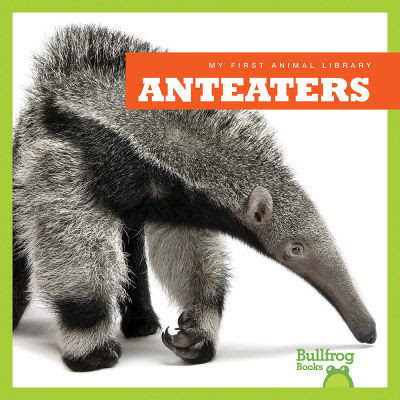
You could follow Conker and Nudge with a few simple non fiction books about the curious anteater and possibly also the capybara and armadillo: