Showing posts with label Swedish children's books. Show all posts

Tuesday, January 13, 2026

Queen of Thieves by John Rundberg translated by Annie Prime


“They’re going to live in a place called the Apple Farm,” whispers Margit. “They call it that because the house is surrounded by apple trees. In May the trees are white with flowers, and by summer, they’re covered with apples as sweet as sugar. They’ll all live together in a big house. The ground floor is Henrietta’s. Rufus, Kristina, and Ossian each have a room upstairs. The sea is so close you can smell it, and it’s light blue and crystal clear, not gray like the water here. And no one will ever go hungry ’cause there are chickens on the farm and wild raspberries growing everywhere.”

First off, I suggest you go back and take a look at my post about the first book from this series - The Moonwind Mysteries. I think this second book (2024) can stand alone but your reading enjoyment will be made all the richer if you can meet the characters and setting in Stockholm in the first book. 


Mika lives in an orphanage. She has been there so long that now she is given responsibility for care of the young children. The kids trust her and usually tell her everything but then she sees two of the young children sneaking away. She follows them into the city and sees them enter a building only to emerge some time later in finer clothes. Ossian is being sent away to work for a foster family but he has run away, Rufus has found an apprenticeship as a chimney sweep, Kristina is acting very strangely - she clearly has a secret, and baby Nora is not well. 

As a reader I was sure the woman who promised a kind of utopia (described above) to the orphans should not be trusted but I had no idea about the diabolical robbery she had planned and of course no reader will ever guess the amazing way Mika working with Constable Hoff will manage to thwart her.

Here are a few text quotes:

“As previously reported, the Vega expedition is on its way home and currently located near Copenhagen. The scientist Nordenskiöld was the first explorer to sail through the so-called Northeast Passage. In addition to many scientific discoveries, it is rumored that the expedition has collected spectacular gifts from the many nations it has visited.

“Sweetheart, all I have to do is look at you; you’re like an open book. I see you sitting at the edge of your seat, as if you have no right to be here. And I know you work night shifts for a pittance with a wicked drunkard. But that’s not why I’m curious about you. I want to know why Constable Hoff sought you out in the first place. And what happened when your little mission ended? Were you hoping it would lead to something more?” The hairs on the back of Mika’s neck stand on end. It feels like Henrietta is looking straight into her. Reading her thoughts, the ones she’s never dared speak aloud. “Such a pity that Constable Hoff wasn’t who you thought he was,” says Henrietta sympathetically. 

“I knew you’d come.” While they are hugging, Mika notices a familiar figure behind Kristina. A tall, thin boy with dark, curly hair is sitting at the table in the living room. It’s Ossian. He briefly raises a hand in greeting and then turns away in shame. Mika wants to tell him she’s not angry with him, but then she hears the clacking sound of high heels, and Henrietta appears. As always, she’s wearing one of her long-sleeved dresses with lace trim. When Henrietta sees Mika, she is suddenly on her guard. Collectedly, she leans forward and whispers something to Kristina, who disappears into the living room and closes the door. With one quick snap of her elbow, Henrietta conjures a knife out of her left dress sleeve and holds the handle in her palm. With her back against the wall, she leans forward and vigilantly scans the stairwell.

Valdemar listens intently all the while. When Mika is done, he sits quietly. “How can she steal the gem in a room full of guests?” he asks finally. “The House of Nobility is always guarded. There will be guards inside and outside the hall.” “I don’t actually know,” admits Mika. “The kids are helping Henrietta with the performance. My job is to pick the lock to the Great Hall and steal the coat of arms.” The kitchen chair wobbles under Valdemar’s weight as he leans back and pensively strokes his beard. “So, in summary: you have no evidence and no idea how the theft is actually going to take place.”

The Vega crew are sitting at the head table; she recognizes Nordenskiöld from the newspapers. The king and queen are sitting at the head of the table closest to Henrietta. Next to the royal couple is a lower table displaying some of the items from the expedition. Mika sees sculptures, parts of a suit of armor, a bow, bowls, and various kinds of tools. In the middle of the table is a velvet pillow, and on top of the pillow sits a magically shimmering gemstone—the Magatama. ... She sees Kristina’s hair standing up straight from the centrifugal force. The blue line of a bulging artery in her throat. The white tablecloth on the head table. A disturbance to distract the audience. In that moment, Mika realizes the extent of Henrietta’s diabolical plan. The distraction isn’t going to come from a spilled wineglass. But from a torrent of blood.

Here is a review with more plot details.

A captivating game of cat and mouse. Kirkus

Listen to an audio sample here. This book was previously published as Tjuvdrottningen.

Bookseller blurb: After a merciless winter, spring has sprung in 1880 Stockholm, and the city awaits the arrival of the SS Vega, the first ship to have sailed the Northeast Passage. Life is busy at the orphanage, but twelve-year-old Mika quickly notices that the older orphans are up to something—and it doesn’t look good. When Constable Hoff approaches her with information about thefts around the city, Mika becomes even more concerned about what the other kids are up to—and what they might be planning for the Vega celebration. The police will have no sympathy for orphans, and she’d hate to see her friends condemned to life in jail. But Mika soon finds herself in a bind she can’t get out of—one that could condemn her own life. Can Mika uncover who is really behind the thefts in the city and keep her friends safe, without getting caught?

Johan Rundberg is an award-winning author of children’s books who lives in Stockholm. He has written picture books, early readers, and middle grade, including Kärlekspizzan, Knockad Romeo, and the series Häxknuten. In 2021, he was awarded Sweden’s most prestigious literary prize, the August Prize, in the children’s and YA category for Nattkorpen, the original edition of The Night Raven, the first book in the Moonwind Mysteries series. Nattkorpen was also the winner of a Swedish Crimetime Award in the children’s and YA category. There are now four books in this series published in Sweden.

Friday, May 2, 2025

The Night Raven by Johan Rundberg translated by Annie Prime


"Everyone in the city has heard of the Night Raven. The murderer was on the loose for four years. The first victim was a girl a couple of years older than Mika, then two men murdered in the same way. The nickname came from the way the criminal seemed to flutter aimlessly through the night, swooping down on innocent unfortunates ... In the end the killer was caught red-handed, a vagrant named John Almgren."

Mika has lived in the orphanage her whole life. It is not unusual for babies to be deposited on the doorstep but the arrival of this baby after midnight seems very strange - almost sinister. Mika can have no idea that the arrival of this baby girl will set off an amazing chain of events that will see her working with a local, rather eccentric police detective, to solve an infamous series of murders in Stockholm. 

The terrified boy who hands Mika the baby stays long enough to say "The Dark Angel knows I am the one who took her." 

Mika has amazing powers of observation. She sees a figure lingering in the shadows. She notices the baby has a braided leather band decorated with tiny red flowers tied around her ankle. Neither of these mysteries, however, are solved in this first installment. And this mystery deepens when the band disappears and Amelia, who is in charge at the orphanage, seems to be holding an even deeper secret.

Mika works in a bar pouring beer for men who can become violent as they become more inebriated. She overhears some men talking about the city murders and the criminal named The Night Raven. He is supposed to now be dead - having been captured and executed - but note my word 'supposed'. Mika is interviewed by a police man and then a detective arrives with more questions before he takes her away in his carriage to a graveyard where he shows her a dead body in a crypt. Is this the man who gave her the newly born baby? No. Then the detective comes again and this time he takes her to visit the gaol.

Here are a few text quotes:

"And sometimes you have to laugh at the thing that scares you most. Life will be what it will be, regardless,"

"I thought you said he was alive when you arrived? ... Barely. We came just in time to hear his last words. He said ... that the Night Raven had come for him."

"I have to pay attention to detail all the time because my life depends on it."

Here is a great description of Detective Valdemar Hoff:

"The first thing she sees is a scarred face half hidden behind a scruffy beard. Bush eyebrows and a nose as bumpy and brown as a seed potato. His body is thickset and reminds Mika of the unfortunate bears she saw once at Norrbro Bazaar. Hands stick out of his coat sleeves are as big as toilet lids. His knuckles are dented with poorly healed cuts and scabs. The ring finger and pinky on his left hand appear to have been severed at the knuckle."

Bookseller blurb: Mika is not your average twelve-year-old-and she's about to prove it. It's 1880, and in the frigid city of Stockholm, death lurks around every corner. Twelve-year-old Mika knows that everyone in her orphanage will struggle to survive this winter. But at least the notorious serial killer the Night Raven is finally off the streets...or is he? Mika is shocked when a newborn baby is left at the orphanage in the middle of the night, by a boy with a cryptic message. Who is he? And who is this "Dark Angel" he speaks of? When a detective shows up, Mika senses something even more sinister is going on. Drawn in by Mika's unique ability to notice small details-a skill Mika has always used to survive-the gruff Detective Hoff unwittingly recruits her to help him with his investigation into a gruesome murder. Mika knows she should stay far, far away, and yet...with such little hope for her future, could this be an opportunity? Maybe, just maybe, this is Mika's chance to be someone who matters.

A thrilling and thoughtful period murder mystery. Kirkus Star review

Over the past decades, dark Scandinavian mysteries, both historical and contemporary, have become popular, and The Night Raven brings the genre to a younger readership. Despite the gruesome deaths, the violence and threats, and the Dickensian urban setting, the descriptions and events are age appropriate, (keeping) most of the violence off the page. Historical Novel Society

The Night Raven is a smart page-turner that’s a bit dark and full of mystery. Rundberg’s pacing is spot-on, and translator A.A. Prime has done a fantastic job making the book accessible to and English-speaking audience. It’s a smooth translation that doesn’t read like one. Cracking the Cover

Johan Rundberg is an award-winning author of children’s books who lives in Stockholm. He has written picture books, early readers, and middle grade, including Kärlekspizzan, Knockad Romeo, and the series Häxknuten. In 2021, he was awarded Sweden’s most prestigious literary prize, the August Prize, in the children’s and YA category for Nattkorpen, the original edition of The Night Raven, which was first written in Swedish. Nattkorpen was also the winner of a Swedish Crimetime Award in the children’s and YA category. There are now four books in this series published in Sweden.

All the books have a stand-alone mystery that is solved in the end. But there is also a storyline that runs throughout the series, so reading the books in order really gives the reader a bigger experience. For example, Mika’s journey to find out about her past is one such storyline, that is revealed bit by bit. Also, both Mika’s character as well as her relationship with Constable Hoff develops during the series, and that is another reason to read the books in order, I think. But it’s all up to the reader. The Night Raven works really well as a stand-alone, but I hope it will make the reader curious to continue.

A. A. Prime (Annie Prime) is an award-winning translator of Swedish literature. She was born in London and traveled the world studying a number of languages before settling in the English coastal town of Hastings. She now works full-time as a translator, specializing in the weird, witty, and wonderful world of children’s and young adult fiction. She holds an MA in translation from University College London and has published more than twenty books in the UK and US. 

I loved this book from the Moonwind Mysteries series so now I plan to read all of them! There are three in the series in English but there are or will be two more in Swedish (Book 4 is published but Book 5 is still underway) - the most recent one was published this year in 2025. In Swedish the series is called Månvind & Hoff. Book one has the title Nattkorpen (2020).

I highly recommend this book for readers aged 11+ and even adults too. When my adult friends discuss the books they have been reading and enjoying I am often left out of the conversation. I dream of the day that an adult asks me to recommend a middle grade or young adult book that they also might like to read - this book The Night Raven is one I would most certainly rave about. I read this book on a Kindle in one sitting on a short flight to a nearby city. 

Here is an interview with Johan Rundberg where he talks about the first book The Night Raven.

I also found this site which expands the map of Stockholm which appears in this book. This could be a great starting point if you visit the city and want to follow Mika's journey across her city.  And here are some discussion questions

Here are the Swedish and Danish covers:


Friday, January 17, 2025

Be More Pippi and Celebrate 80 years of Pippi Longstocking


Our anniversary campaign encourages everyone to be more like Pippi! 
Use your own Pippi power and make the world a little better.

 Follow Pippi on Instagram. Here are some resources for your Pippi party

Pippi Longstocking is turning 80 this year! If you know my name, you know I have a small connection with Astrid Lindgren. Of course, Lindgren was her married name. Her husband was Sture Lindgren. Her full name was Astrid Anna Emilia Lindgren (Ericsson). In 1958, Astrid Lindgren received the second Hans Christian Andersen Medal for Rasmus på luffen (Rasmus and the Vagabond).

Pippi Longstocking (Pippi Långstrump) was published in November 1945 with illustrations by Ingrid Vang Nyman.


Image Source: The Japan Times


Pippi books illustrated by Ingrid Vang Nyman


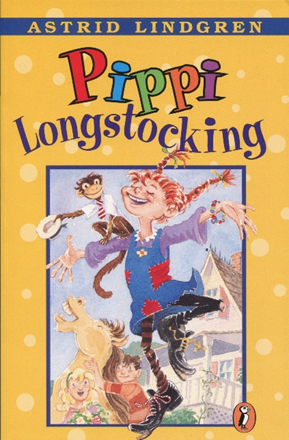
Bookseller blurb: Pippi Longstocking is nine years old. She has just moved into Villa Villekulla where she lives all by herself with a horse, a monkey, and a big suitcase full of gold coins. The grown-ups in the village try to make Pippi behave in ways that they think a little girl should, but Pippi has other ideas. She would much rather spend her days arranging wild, exciting adventures to enjoy with her neighbours, Tommy and Annika, or entertaining everyone she meets with her outrageous stories. Pippi thinks nothing of wrestling a circus strongman, dancing a polka with burglars, or tugging a bull's tail.

Did you know Pippi's full name is: Pippilotta Victoriaria Tea-cosy Appleminta Ephraim’s-daughter Longstocking.

“Her dress was curious indeed. Pippi had made it herself. It was supposed to have been blue, but as there hadn’t been quite enough blue cloth, Pippi had decided to add little red patches here and there. On her long thin legs she wore long stockings, one brown and the other black.”

“Her hair was the same colour as a carrot, and was braided in two stiff pigtails that stood straight out from her head. Her nose was the shape of a very small potato, and was dotted with freckles.”

There are three Pippi books. The series has been translated into more than 70 different languages

  • Pippi Longstocking (1945)
  • Pippi Goes On Board (1946)
  • Pippi In The South Seas (1948)
Astrid Lindgren also created three picture books: Pippi’s After Christmas Party (1950), Pippi on the Run (1971) and Pippi Longstocking in the Park (2001).

In March, 2025 Penguin Random House will release a new audio version of Pippi Longstocking. 

You can read the story of how Astrid Lindgren came to write Pippi Longstocking for her daughter Karin. I have a connection with this famous story. My father's sister (maiden name Lindgren) named her daughter Karin!

In 100 Best Books for Children, Anita Silvey praised the character as "the perfect fantasy heroine — one who lives without supervision but with endless money to execute her schemes." It is not a surprise to learn that other lists of the top 100 children's book also often include Pippi Longstocking. 

Champion of fun, freedom and fantasy and long happy thoughts, Pippi is an inspired creation knit from daydreams. Kirkus Star Review


Quotes from Pippi Longstocking:

“Don't you worry about me. I'll always come out on top.”

“She always slept with her feet on the pillow and her head far down under the covers. ‘That’s the way they sleep in Guatemala,’ she explained. ‘And it’s the only right way to do it. This way, I can wiggle my toes while I’m sleeping, too.‘”

“In the orchard was a cottage, and in this cottage lived Pippi Longstocking. She was nine years old, and she lived all alone. She had neither mother nor father, which was really rather nice, for in this way there was no one to tell her to go to bed just when she was having the most fun, and no one to make her take cod-liver-oil when she felt like eating peppermints.”

“Pippi was a very remarkable child, and the most remarkable thing about her was her strength. She was so strong that in all the world there was no policeman as strong as she. She could have lifted a whole horse if she had wanted to.”

Astrid Lindgren died in 2002 aged 94 but you can find out so much from the comprehensive website and of course if you visit Sweden there are places that link with the book and with other books by this famous author and a museum too. 


Astrid Lindgren is also connected with IBBY:

In 1952 Jella Lepman, a courageous and visionary woman, organized a meeting in Munich, Germany, called International Understanding through Children’s Books. Many important authors, publishers, teachers and philosophers of the time attended the meeting and as a result a committee was appointed to create the International Board on Books for Young People – IBBY. A year later in 1953, IBBY was registered as a non-profit organization in Zurich, Switzerland. The founding members included: Erich Kästner, Lisa Tetzner, Astrid Lindgren, Jo Tenfjord, Fritz Brunner, Bettina Hürlimann and Richard Bamberger.

And a major award for Children's Literature is named after Astrid Lindgren. The Astrid Lindgren Memorial Award (ALMA) is the largest award of its kind. The global award is given annually to a person or organisation for their outstanding contribution to children’s and young adult literature. Our Australian Indigenous Literacy Foundation (2024) were recent winners and in the past we celebrated Australian authors - Shaun Tan (2011) and Sonya Hartnett (2008).

If you enjoy meeting Pippi Longstocking, other books with similar themes or a similarly wonderful heroine are: