Showing posts with label Writing stimulus. Show all posts

Friday, March 28, 2025

Ten-Word Tiny Tales of Love by Joseph Coelho


"Here you will find loving tiny tales plucked from wedding bouquets, found in the fur of much-loved pets and neatly folded in the corner of your favourite hobby. These are stories of love of all kinds."

Check out my post about the first book by Joseph Coelho that explored this idea of ten word tales.


Once again Joseph Coelho has invited illustrators to create images to go with, to extend, to blow your mind with their interpretation of his ten-word tale - this time with the theme of love. There are twenty-one illustrators in this second volume including our own Bob Graham! See his page here.

Joseph Coelho says: "I travelled the globe by hot-air balloon, hovercraft and llama searching for the best illustrators to help bring a glimpse of these tales to life."

Here are a few of the names you might recognise: Sydney Smith; Jon Klassen; Mini Grey; Jarvis; and  Ken Wilson Max.

Here is the page by Sydney Smith - winner of the 2024 Hans Christian Andersen Medal.


Art by Sydney Smith

"As it poured, he taught him to tie his laces."


I do hope you will read this book - Ten-word Tiny Tales of Love and share it with a class. I suggest reading the pages in this book, perhaps one each day, without showing the illustration. Let it sink in. Let the children imagine. Let them draw or write. Then much later in the day you could show the page.

We danced starlight into the rainbows of our broken hearts.

The kisses in her card grew wings and flowery scents.

He wrapped his little sister in a whispered bedtime story.

The love he held for his bike made it amphibious.

Using a ladder he washed the mud from his dog.

Grandma's hot chocolate was a furry hug in a cup.

The rescued cats kept watch as the lost child slept.

As a bonus there are story writing hints at the back of this book and a page of ways to extend the ten-word tale into a longer story. I love that Joseph Coelho explains his story parts can be presented in any order - this is a wonderful counterbalance to the prescribed (paid) writing programs adopted in many of our Australian Primary schools. 

Joseph Coelho shares his book on Instagram. Here is a full list of all the illustrators in Ten-word Tiny Tales of Love:

Katherine Child * Fruzsina Czech * Diane Ewen * Jim Field * Bob Graham * Katie May Green * Mini Grey * Mark Janssen * Jarvis * Baljinder Kaur * Heather Kilgour * Jon Klassen * Fiona Lumbers * Steve McCarthy * Rikin Parekh * Natalia Shaloshvili * Sydney Smith * Beth Suzanna * Victoria Turnbull * Ken Wilson-Max * Myo Yim

OR you could check out their Instagram pages: @blahjinder @bethsuzanna @bobgraham75 @creativedewen @fiona_lumbers @fruzic @heatherkilgourillustration @jarvispicturebooks @_jimfield @jonklassen @katherinelobster @katiemaygreen @wilsonmaxken @markjanssenpicturebooks @mini3grey @myo.yim.drawing @nataly_owl @r1k1n_parekh @mrstevemccarthy @sydneydraws @vic_turnbull


Art by Natalia Shaloshvili

"The kisses in her card grew wings and flowery scents."


Wednesday, May 15, 2024

Rain by Anders Holmer

Bookseller blurb: This haiku collection will enchant both nature lovers and budding poets. The spare, lyrical text describes a series of short vignettes, each of them taking place in a different kind of rain, from thunderstorms to falling flower petals. The poems 'some serious, some gently humorous' depict scenes from all over the globe: a horse struggling to plow a field, a father changing a tire while his children play, and two friends making up after a fight. 

Koja Agency: Rain has just fallen, a baby tooth is loose, a beetle stands up soaked and dazed on the gravel, a mole is lurking underground while a guy on a horse gets a phone call from his grandmother. In other places the snow is melting, and the butterflies soon expected to arrive. Today’s paper is dropped from a suspension bridge and two best friends forget to be angry when a rain of flowers falls. On the overall theme of rain, this book depicts different magnificent and extraordinary places around the world. Each spread represents a new world full of subtle details and ingenious humor. Anders Holmer portrays in his unique way what is going on in that moment in that specific place. Short haiku texts accompany the grandiose spreads.

Yesterday was my third visit to one of our large chain bookstores. They have a number of sale tables filled with children's books acquired by the store before 2019. Every time I visit, I pick up another book or two. There are still heaps of treasures on these tables. My friend from Kinderbookswitheverything picked up nine splendid titles. I will talk about some of these once she puts them into her school library and I can borrow them. We BOTH picked up this book because luckily there were two copies Retail price AUS$28.50 bargain price $14.25 - and two copies have been on the shop shelf since December 2018. Maybe no one picked it up because they read this very negative review from a Swedish newspaper? 

In contrast this book gained a Kirkus Star review: While these poems do not strictly follow all the characteristics of haiku, they do evoke different moods, such as the gathering darkness of a crocodile swamp. They also break stereotypes by juxtaposing technology and rural life—a cellphone rings amid a group of bareback riders galloping across a steppe. Most of all, they invite readers to pore over each colorful, expressive illustration to discover visual clues contained in the spare verse. A unique read-aloud that blends world cultures, poetic form, and natural splendor.

On each rainy spread, life happens in haiku, with all its cultural variety and complexity: A crane observes two children resolving a quarrel, a goatherd wiggles a loose tooth while surveying the flock, a lighthouse keeper discovers an unmoored boat as puffins glide by, rangers monitor a dying forest fire while creatures scurry away, and travelers with llamas climb a steep hillside, stopping for a beetle in their path. Visual details encourage readers to learn more about the countries of origin of the peoples and animals depicted throughout. School Library Journal (quoted by Barnes and Noble)

Okay - begin with the cover and title - Rain. If you look closely you can see rain or snow falling on this young Inuit child and his or her reindeer. But then think about rain and rein. Now flip to the back cover. You will discover this is a book of haiku poems. Each page can almost stand alone. A brilliant resource for teachers looking to inspire their students to write poetry in this beautiful form. This book is a book of poetry or course, but it also fits into my new category of Poetry with Pictures - these are picture books with no narrative.

My favourite page has puffins AND a lighthouse. To be honest this is probably why I bought this book. Here is the text from that page:

Slowly the boat drifts,
drifts away from the lighthouse -
never tied it up.

I also love the image on the page with a group of people (probably in Bolivia) trekking up a mountain with their alpacas only to be stopped by a tiny beetle.

Half-awake and drenched,
a beetle stand guard in the
middle of the path.

Rain is titled Regn in Swedish. It was published in 2018 so is sadly out of print. His debut book was It Happens! (2017). 


Anders Holmer is a Swedish architect, artist and author living in Gothenburg. He has been writing and illustrating children's books since 2017. His haiku album, Rain, was shortlisted for the ALMA Prize, Sweden's most prestigious children's literature award. In 2018, Anders Holmer's work was selected for the art exhibition at the New York Society of Illustrators. 

About Farewell (also translated as Leave): After a sad conversation with her mother, a child sets off on a long journey strewn with pitfalls, an imaginary journey inspired by the elements that populate her daily life. Along the way, she collects different objects, using a butterfly net: cloud, trumpet or diamond. From these, she makes something even more precious. When she returns, she is ready to be herself again.

About Utflykt (Excursion): In Anders Holmer's new picture book, we meet two children who saunter around in enigmatic fantasy landscapes. One is snuffy and sure of what he is doing, and the other is more questioning about what is going on. They try out different identities and take on different guises. You and I and the world are mixed together. We hear the echo of an adult's voice. Existential comedy ensues when they take on a concept they don't fully understand: Excursion. A celebration of children's ability to create hopeful playfulness and make sense of the world. A metaphor of how we in our lives grope for comprehensibility but instead have to accept that not everything can be understood, and that it is also okay. Maybe we won't be any wiser, but we'll have fun along the way.


Monday, May 13, 2024

Ten-Word Tiny Tales by Joseph Coelho


Notice the subtitle: ‘To Inspire and Unsettle.’

Colby Sharp mentioned this book as one he read to his fifth-grade class in April. I was immediately intrigued and then I went down a huge rabbit hole where I discovered more and more about this book which I think would be a wonderful stimulus for class writing. Part of my rabbit hole came from investigating the 21 artists who have illustrated this book. I looked for familiar and unfamiliar names and was not at all surprised to see our own Shaun Tan as one contributor.

Bookseller blurb: Is it possible to spin a tale using just ten words? It most certainly is! In this unique and magnificent compendium designed to spark the imagination, Joseph Coelho brings us stories of underwater worlds, demon hamsters, bears in outer space, and portals to places unknown ... all in just ten words! Each tale has been paired with one of the finest illustrators working today – and, together, the words and pictures will create a space for creativity as young readers imagine how the story might unravel. They might even be inspired to pen a ten-word tiny tale of their own!

Here is a list of the illustrators (my links take your to their webpages): Alex T. Smith, Camilla Sucre, Chuck Groenink, Daishu Ma, Dapo Adeola, Dena Seiferling, Flavia Z. Drago, Freya Hartas, Helen Stephens, Julia Sarda, Katie May Green, Karl James Mountford, Maja Kastelic, Mariachiara Di Giorgio, Nahid Kazemi, Raissa Figueroa, Reggie Brown, Shaun Tan, Thea Lu, Yas Imamura and Yoko Tanaka.

On this blog I have talked about books illustrated by Alex T Smith; Dena Seiferling; Karl James Mountford; Maja Kastelic; Mariachiara Di Giorgio; Nahid Kazemi; Shaun Tan; Yas Imamura; Yoko Tanaka; and Julia Sarda - just pop their name into my search bar. I want to especially mention Yoko Tanaka who illustrated Sparrow Girl - a favourite book of mine and also her wordless book Dandelion's Dream. You could also explore some of these illustrators on the Let's Talk Picture books web page. I would LOVE to see Here and There by Thea Lu - it looks amazing but of course it is way too expensive here in Australia. 

My question (after watching these fifteen minute videos) is how Joseph Coelho assigned the stories. Did the illustrators pick the one they wanted to work with or did Joseph just send each illustrator one random ten-word tale. If that is the case, then somehow Shaun Tan ended up with the perfect text. 


"Every year they honoured their son by decorating his skull"

What comes into your mind with this ten-word tale: "My splintered oars are lost as my boat speeds onwards." Now click here to see the illustration by Alex T Smith. 

Here are some other ten-word tales:

  • We watched the teacher lead the children through the portal.
  • "Invite me in," she says outside my tenth storey window."
  • The fisherman's catch is full of astronaut suits and skeletons.
  • The diver swims into the carnival: radio contact is lost.
  • The second giant’ who ‘cam crashing out of the white cliffs.
  • They say they can’t see me, and now they’re fading

" ... this is a book for older children to pore over and let their imaginations flower. With twenty-one different illustrators representing many styles, media, and settings, each of the spreads stands apart so viewers can concentrate on a single page or read the book through for a disquieting experience." The Horn Book quoted by the publisher.

I don't usually talk about books I have not actually opened, touched, experienced - but this one just seems SO good and I have seen many of the pages and watched several of the videos between Joseph Coelho and his illustrators that I feel I can share this book here. I have popped it onto my own enormous shopping list but I might wait for the price to be reduced a little. 

Invoking multiple dimensions in his notes to readers and the tales themselves, Coelho invites illustrators to consider interplanetary space, undersea caverns, and realms between. The interplay of words and resulting double-page spreads—at turns, inexplicable, sweet, or sinister—evokes the work of Edward Gorey and Chris Van Allsburg. Kirkus

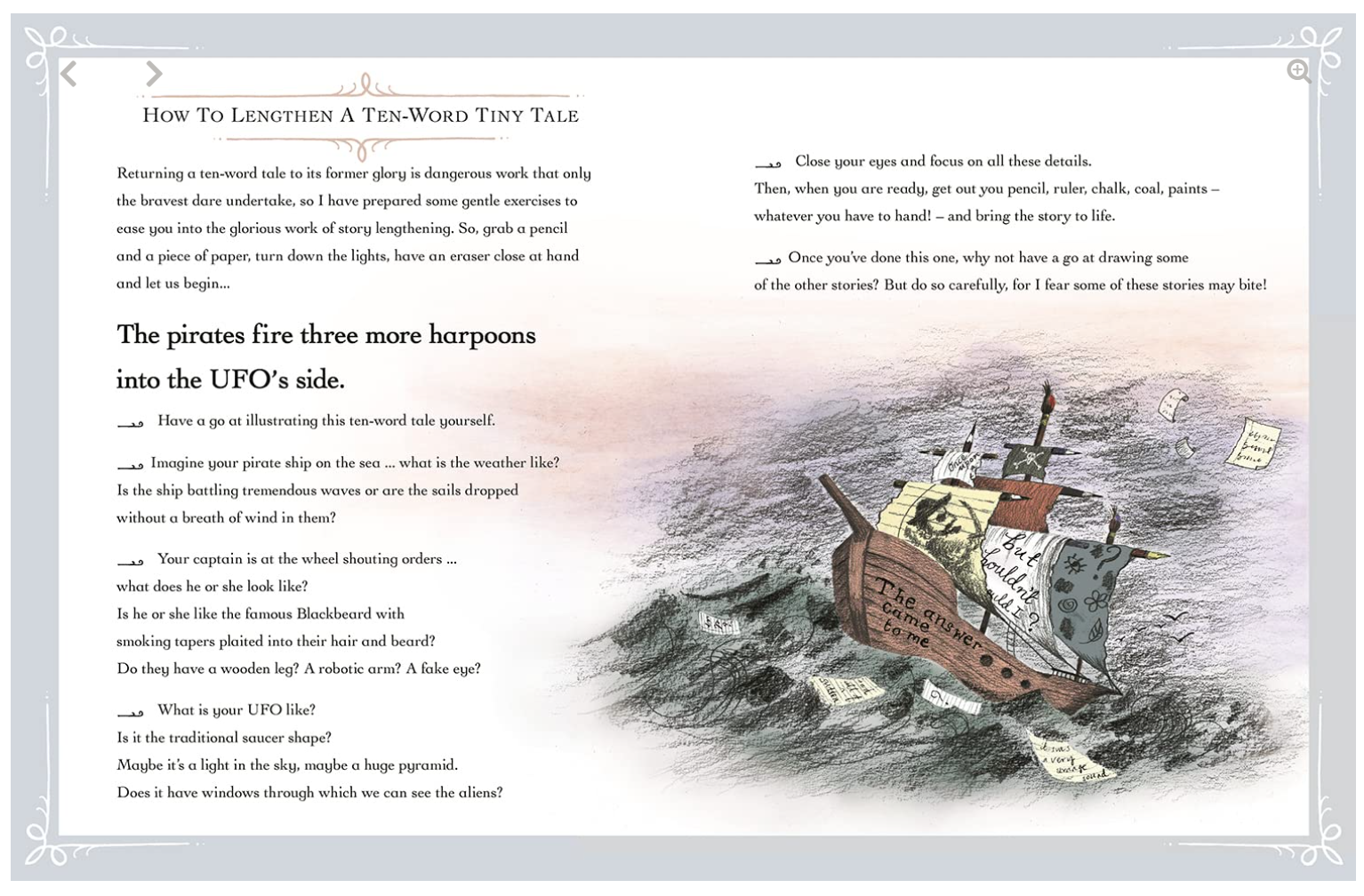
In the classroom, this would be an amazing tool to help pupils unlock their creative writing skills. The blank page is often the enemy of the writer however given a ten word tale and the amazing illustration which accompanies it, a young writer would be able to add their imagination by expanding the story. They would be thinking about the character development, what happened before, after, scene description and so much more. Reading Zone


Writing ideas page from Ten-word Tiny Tales

You will want to pair this with the wonderful predecessor by Chris van Allsburg. I once owned this book in the form of a set of charts - I gave them to a teacher - I hope she has made good use of them:


Sunday, November 5, 2023

Would you come too? by Liz Garton Scanlon illustrated by Diana Sudyka


I guess this book is meant to be a reaction to our dependence on devices - to encourage children and the adults in their lives to switch off and head outside but for me this is also a book that could use used as a wonderful writing stimulus. 

Every page has the words "If we were ... "

If we were walls ...
If we were a pond ...
If we were tadpoles ...
If we were a nest ...
If we were seeds ...

This book will also encourage you to head outside and hopefully be more observant of the natural environment. 

The strength of this book to my eye, though, comes from the illustrations. The style reminds me of Julia Sarda and Felicita Sala. See inside books illustrated by Diana Sudyka here. You might like to follow her on Instagram. Her book Sometimes Rain has a Kirkus Star review. In this interview Diana Sudyka talks to Betsy Bird (they both live in Chicago). 


Here are other books by Liz Garton Scanlon


Sunday, September 24, 2023

If I was a Banana by Alexandra Tylee illustrated by Kieran Rynhart


It would such fun to tell your class - 'tomorrow we will read a book called If I was a Banana'.  I can hear the giggles and gasps.


Here are a few text quotes:

"If I was a ladybug, I don't know how I would feel. To be that small could be a little frightening. And then, who knows, maybe I would be a very brave, bright ladyybug, and fly very high without a care in the world."

"If I was an elephant, I think I would have to be very careful where I put my feet. I guess you would get used to that."

This is another terrific book from Gecko Press (New Zealand).  It was published in 2016 but back then Scholastic Australia were the agents for Gecko and many of their titles were included in their International Titles standing order so I am hoping that this book might be found in your local or school library. It is also on the NSW Premiers Reading Challenge (K-2 code 8426).

I can see from the copy I borrowed from a library that this has been a popular title. Since it arrived in the library (they use date due slips) between 2017 and 2023 it has been borrowed 30 times. That is especially amazing when I tell you this book is shelved with other books about Philosophy at Dewey [100]. This library for students aged 4-7 so I don't imagine they regularly browse the nonfiction shelves - especially not the philosophy section. Another terrific thing about this book is the way the Teacher-Librarian has labelled her books with Sustainable Development Goals.  She has put the sticker for #5 - gender equity on this book. I am in awe of the work ethic of this Teacher-Librarian - she has put a huge amount of effort into labelling books in her library with stickers for each of the 17 goals. 


Drawn in a mostly realistic style with occasional touches of anthropomorphic exaggeration, the illustrations appear to have been created in pencil and oil pastel. Multiple sizes, from vignettes to double-page spreads, and unusual perspectives provide interest and rhythm. Rich textures and muted colors add to the dreamy quality of the text, which has a thoughtful, reflective tone throughout. Kirkus

This lovely exercise in imagination would be a brilliant classroom project for young writers, with lots of room for inventive art activities, too. Beautiful production and thick creamy paper gives the book a nice 'gifty' feel too, so it's perfect for special birthdays or christenings to keep and cherish. At home, it will make an ideal bedtime read, sparking conversation while being calm and dreamy enough to lull little ones to sleep. Book Trust

Alexandra Tylee and Kieran Rynhart are both from New Zealand. You can see the art from this book here. 

Companion books:


Wednesday, May 24, 2023

Twenty Questions by Mac Barnett illustrated by Christian Robinson


Publisher blurb: Not all questions have answers. Some have more than one answer. And others have endless answers, unfolding out to the edges of the world. In this spare yet expansive narrative, acclaimed author Mac Barnett poses twenty questions, both playful and profound. Some make us giggle. Others challenge our assumptions. The result is a quirky, wandering exploration of where the best questions lead—to stories. Intriguing, richly interactive, and brought to vivid life by Caldecott Honor recipient Christian Robinson’s bright and whimsical illustrations, Twenty Questions is a charming invitation to speculate without limits and know no bounds.

This book is puzzling and fun. I saw Colby Sharp talking about it earlier this year and he said this book only really came to life when it was shared with his class. I sure do wish I could do this too.

The questions make more sense when you see the wonderful illustrations by Christian Robinson but here are a few to give you a flavour of this book which I think should be added to all school library collections:

Which of these ladies just robbed a bank?

What is the boy hiding behind his back?

Where did the bandits bury the treasure?

Who gave Mr Beckett a bump on his noggin?

What did the lion get the lamb for her birthday?

I adore the end papers too.


Here is an interview with Mac Barnett and Christian Robinson where they talk about their book. You can either listen or read the transcript. And they talk about it here too. 

Each spread creates its own world, inviting readers to discuss—either orally or in writing—their own answers. A humorous vein runs through the book, but other emotions are also evoked, including poignancy. ... Quirky entertainment to jump-start creativity. Kirkus

There are no wrong answers. Each question is expressed in playful terms with amusing illustrations but the whole concept is thought provoking and, for older children, challenging. Reading Time

Twenty Questions is hilarious and whimsical and delightful. It’s a genius concept and it’s flawlessly executed. It’s basically a list of open-ended questions for children to answer - and I mean really open-ended. One page basically says “how many animals can you not see in this picture.” A big part of the humor is how there’s obviously no correct answer, and kids will undoubtedly love to play along anyhow. It’s very original and a lot of fun. Dad Suggests


Thursday, October 21, 2021

What I like Most by Mary Murphy illustrated by Zhu Cheng-Liang


The little girl in this book is appreciative of so many things in her world - her window, apricot jam, the river, pencils, chips, books, her teddy, and of course her mum!

Apricot jam is what I like most in the world. Except for these shoes ... right now they are what I like most in the world. Except for the river ... The river changes but it is always the river. That is why I like it most in the world.


Image Source Mary Murphy - click to see more images from this precious book

Here is the website for Mary Murphy author of over thirty books. 

Publisher blurb Walker Books: What I like most is this pencil. It is red outside and red inside. Its colour comes out like a red ribbon. It’s what I like most in the world. Except for...  A little girl tells us about all her favourite things, from her light-up shoes, to hot, steamy chips, to her red pencil. But the girl knows that, even as her feet grow, her plate empties, and her pencil shortens, there’s someone she’ll always love … and that is what she likes the very, very most. An intimate ode to the unwavering love a child has for their mother, this tender, lyrical story is brought exquisitely to life by Zhu Cheng-Liang.

Make sure you linger over the end papers when you pick up this book - images of Spring and Autumn - reflecting time and change which are the themes of this book.

Have you seen the book The Important Book by Margaret Wise Brown?  The format for What I like Most feels very similar. I would use all of these books in a writing class.


Zhu Cheng-Liang is from China. He has illustrated over fifty books. His work was chosen for the book All in a Day by Anno.

Saturday, July 28, 2018

Would you rather ... by John Burningham

With a barrage of questions and images, Burningham covers enormous ground, from fairy tales (stirring a caldron with a witch) to horror stories (being locked in a haunted house), from the biblical (being swallowed by a fish) to the universal (being lost in a crowd). He uses the pictures as both sword and shield, jabbing with the provocative yet protecting with lean, almost slapstick images. The main character, a small curly-headed child, seems undaunted by the wild journeys, and ends up safe but exhausted in bed.  New York Times


Yesterday I mentioned Bookworm : A memoir of childhood reading by Lucy Mangan.  Would you Rather by John Burningham is another book which Lucy loved as a young child:

"Burningham opened up the eternal horrors and pleasures of the thought experiment to me, via his Would you Rather ...  But why? And why not? And why does the person reading it to or with you disagree? ... Oh it is a book of fathomless depth and endless wonders, to be debated long into the night..."

I have been a huge John Burningham fan since entering the world of school libraries. I drove for three hours once just to hear him speak and then drove home again arriving home well after midnight. I love to read aloud Cannonball Simp (renamed Simp), Where's Julius, Harvey Slumfenburger's Christmas Present and the classic Avocado Baby, which is a must read for every Kindergarten class.


We do own Would you Rather in our school library (first published 1978) but it is thanks to Lucy Mangan that I have taken the time to really read and look at it properly. Now I find it is such a delightful book which would make a fabulous discussion starter in a family or class and could also be used as a writing model.  You might also use the questions as a springboard to problem solving with a design and make focus where the children plan devices to solve or escape from each scenario.

The first question, which sets up the premise, seems fairly straightforward.  Would you rather your house was surrounded by water, snow or jungle? In a class you might then add - now justify your choice. It is the second question which introduces the fun. Would you rather an elephant drank your bath water, an eagle stole your dinner, a pig tried on your clothes or a hippo slept in your bed?  As you can see the accompanying illustrations are perfect.


My favourite question is Would you rather help a fairy make magic, gnomes dig for treasure, an imp be naughty, a witch make a stew or Santa Claus deliver presents? I can't decide between making magic or digging for treasure.

Here is the star review by Kirkus.  The New York Times offer two other books to explore with a similar question and answer format - Which would you rather be?  by William Steig and Was it a good trade by Beatrice Schenk de Regniers.


And here is exciting news - there is a sequel to Would you Rather with the great title More Would you Rather: