Tuesday, June 18, 2019

What sort of day? by Sally Heinrich

Tuesday Treasure

It simply wasn't a spotty sort of day
It simply wasn't a white sort of day
It simply wasn't a green sort of day


In the past our Kindergarten classes used to begin their year with a colour theme. What sort of Day was a splendid text for this topic. What Sort of Day was published in 1997 and so is sadly out of print. Do you remember the success of Animalia? What Sort of Day follows this same format where you can hunt for objects on every page. The ideas in the illustrations made me smile and there are so many things with a truly Australian flavour.

Here are some highlights or things to look for:

White - flour, rice, white rabbit, Sydney Opera House and great white shark.
Black - ransom note (blackmail), black forest cake, Vegemite and four and twenty blackbirds in a pie.


Yellow - submarine, van Gogh Sunflowers, yellow pages phone book, Goldilocks, sulphur crested cockatoo, hibiscus and lemon meringue pie.
Green - St Patrick's Day, kiwi fruit, greenback (money), ten green bottles and a golf putting green.
Red - dynamite, poinsettia flower, Rudolph the red nosed reindeer, a waratah and Uluru.
Purple - red and blue paint mixed, Purple People Eater record and pulling a plum out of the pie.
Blue - willow pattern plate, blue print plans, little boy blue, blue heeler dog and Bluebeard.
Pink - calamine lotion, pinking shears, iced vovo biscuit, musk sticks, and a pink galah.


You also need to keep your eye out for the chameleon who is hiding in every picture and the teddy bear who adapts his own costume to match with every clothing change.


Along with hunting for things that match each colour and pattern and talking about all the treasures in each illustration there are so many delightful words in this book:

White dress - it made her feel clean and fresh, and very well behaved
Black Jeans and T-shirt - they made her feel powerful and strong, ready for anything.
Green suit - it made her feel peaceful and secure, and full of life.
Red swirly skirt - it made her feel confident and excited, and just a little bit naughty.
Purple velvet pinafore - it made her feel dignified and wise, like a queen.
Long blue dress - it made her feel cool, calm and clever.
Pink overalls - they made her feel pretty and optimistic, and just a little rebellious.

When you read to a child you add to their vocabulary and this is so important. Read the research here. Look at the special words in the examples above - powerful, secure, dignified, wise, optimistic and rebellious.

Here is the yellow page from Sally Heinrich's web site.


If you want to explore more ideas around colours make sure you look for this famous poetry book Hailstones and Halibut bones. Here is the new cover:


Here is a more recent piece of art from Sally Heinrich. I think you can see her fascination with colours and objects has continued.


In 2019 Sally designed the South Australian Premier's Reading Challenge poster:


On her Facebook page Sally posted this memory collage of pages from What sort of day?


Other books by South Australian illustrator Sally Heinrich include Papa Sky (Jane Jolly), One Step at a time (Jane Jolly) and The Most Beautiful Lantern.  Another old book which you might find in a school library with a number focus is her book Cherry Stones.


Tuesday, June 11, 2019

Motor Bill and the Lovely Caroline by Jenny Wagner illustrated by Ron Brooks

Tuesday Treasure


"When they got to the country they found a place where the grass was short and soft, beside a creek where they could cool their feet. They ate currant buns, cinnamon tarts, pies, peanut brittle and oranges and plums, and drank ginger beer."

I love these words and the pastel scene that accompanies them. The marvel of this book, for me, comes from the artistic interpretation by Ron Brooks. I imagine Jenny Wagner sending her words on a simple piece of paper, perhaps in a letter:

Bill had a car.
He was the only person in his street who did.
And because he didn't go to work, and spent all day playing in his garden, and because he couldn't tie a bow, nobody believed his car was real.
That's why they called him Motor Bill.

How does Ron Brooks interpret these words?
In his book Drawn from the Heart Ron explains he loved this text by Jenny Wagner especially these first lines.
Bill is a donkey. Why?
There are more details about this below.
We see a human family walking beside his flowering hedge in a beautiful rural setting.
His car is a box with straps and Bill powers his car with his feet.


Ron says, in his book Drawn from the heart, "When you think about it, isn't it odd that some one (who) has a car, must surely be an adult, yet can't tie a bow?"

How did Ron come to think of a donkey. Jenny Wagner suggested Bill was a boy between sixteen and twenty-four. Ron's publisher thought Bill was a boy aged around six or seven.  These ideas didn't sit comfortably with Ron and nor did the idea that Bill was intellectually challenged. Then Ron saw this book by Emma Chichester Clark which features three young donkeys:


Ron also thought about the young donkey from the bible story and so it was settled Bill would be a donkey but what about Caroline. "Caroline is just a little more knowing, a little more worldly than Bill, and she has pluck, cheek and courage ... " He decided to make Caroline a goat.

"Motor Bill is not just a story about acceptance of 'difference' in another ... It is an extraordinarily tender story about openness and generosity, about love and trust; an exquisitely written text about recognition - about recognising genuine specialness of any kind in another, embracing, celebrating and sharing in it." Drawn from the Heart, page 175  Ron goes on to say this is a book about imagination "the making power, the creative power, of love and imagination."

You may have met the combination of Jenny Wagner and Ron Brooks in three of their previous (and famous) picture books:


Looking at these titles I hope you can see the importance of keeping an older book such as Motor Bill and the Lovely Caroline which was published in 1994. It is interesting to note that just one year later Ron's book Old Pig (Margaret Wild) was short-listed for the CBCA Picture Book of the Year award. When you place these two books, Old Pig and Motor Bill and the Lovely Caroline, side by side there are so many similarities to share with an older group of students who are exploring visual literacy.


Monday, June 10, 2019

The adventures of Harry Stevenson by Ali Pye


Do you remember the scene in Toy Story when Woody is left behind and the family drive off in their car? Woody and the other toys chase the car and find a way to leap aboard?  Something similar happens to Harry Stevenson.  Harry Stevenson is a guinea pig. He lives with Billy Smith and his parents.  Billy loves Harry Stevenson and he always makes sure Harry Stevenson has delicious food, fresh water and a comfortable home. Life is good but things are about to change. Billy and his parents are moving to a new house. Harry Stevenson is coming too but there is an accident and he is left behind. While the car is being packed Harry Stevenson is placed outside! Outside is a new world for Harry Stevenson. He spies a delicious dandelion. His cage is not locked. Harry Stevenson steps out of his cage and no one notices he is missing when the family pack his cage into the car. This is a disaster.

What follows is a wild and amazing adventure involving a bicycle basket, a shaggy dog and a pizza box. I am certain that the happy ending will surprise you!

In the second story Harry Stevenson gets tangled in some helium birthday party balloons. He lands in the middle of a stadium. It is the day of the soccer grand final and his favourite team, Sparky FC, are on the field. Can a little guinea pig assist with this important match? Of course he can.

If you need a laugh and a short book which you could read over a week or two The Adventures of Harry Stevenson is THE book for you! It contains two stories and each have ten chapters. This book will be available on 1st July and I highly recommend it. Huge thanks to Beachside Bookshop for my advance reader copy.

If you enjoy books about guinea pigs there are plenty I can recommend including The World According to Humphrey and sequels,  Tales of Olga da Polga and these books suggested by my friend at Kinderbookswitheverything.

Harry is a lovely and warm character, and we immediately get to like him. He has no superpowers beyond understanding Billy Smith his owner, and being able to read the sports pages that get left to line his cage. But the fun is to be had from the outstandingly unusual scrapes that he ends up in. And I think they're so fun that I've never enjoyed a book this highly unlikely and implausible this much before. The Book Bag

Friday, June 7, 2019

Margaret Power illustrator 1953-2019

Margaret was a wonderful draftsperson who worked with a gentle realism, depicting the humanness of people and the animalness of creatures with amazing accuracy and sensitivity - particularly horses and cats which she knew well and loved passionately. Books Illustrated


I well remember reading Creatures in the Beard (Margaret Wild) in 1987 when it was shortlisted for Picture Book of the Year by the CBCA. Then in 1988 we had another book illustrated by Margaret Power - The Long Red Scarf (Nette Hilton) and one of my wonderful class teachers volunteered to knit us a very very very long red scarf which everyone loved to drape around our school library.

Margaret Power was also the illustrator of several titles in the Aussie Bites/Nibbles series which you can see here. I just talked about Christobel Mattingley who also died this week. Here is an interview with Margaret from 2013 about Oliver's Egg.


Here are some other older titles and book covers illustrated by Margaret Power:


Here is some more recent work by Margaret Power:


I remember titles like Spider in the toilet by Edel Wignell, And Grandad sat on Friday by Val Marshall, Daisy Drew and elephant by Michael Dugan and The Ghost in Abigail Terrace by Robin Klein. Finally here is a PM reader which may look familiar.


Tuesday, June 4, 2019

The story of Chicken Licken by Jan Ormerod

Tuesday Treasure


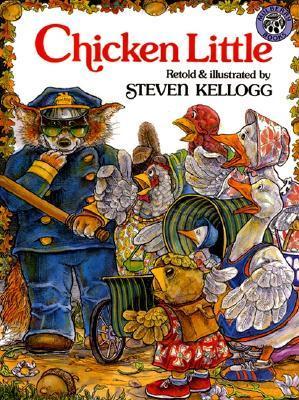
When it was published (1985) this book was quite revolutionary (it was on the CBCA short list in 1986). There are three participants - the kids on stage performing a play of Chicken Licken, the audience of parents some of whom fall asleep and the reader who is observing everything.  It is a story within a story within a story. When you share this book with a child you need to read the book right through several times because there is so much to see. Initially there is the classic folk tale of Chicken Licken, the little hen who thinks the sky is falling. This story is also called Chicken Little or Henny Penny. Perhaps you could compare this version with some others:


Then there is the story of the audience of mums and dads and siblings who are watching the play. One story thread is shown here. You also get a glimpse of the layout - stage in full colour, audience in silhouette. There is a baby in a basket which is behind the seats. The baby is supposedly asleep but watch what happens as we turn each page:


If The Story of Chicken Licken is in your school library please treasure it and share it with a group of young children. Everyone will be richer for this shared experience.

I was surprised and delighted to discover The Terrible Plop by Ursula Dubosarsy is based on the Tibetan version of this folk tale.


Jan Ormerod (1946-2013) is the author of one of my most treasured books - Sunshine.


Here is a quote from Jan Omerod:

"My task as a visual storyteller is to observe, record and edit. Some images go straight from life into a book. Most need to be carefully sifted, reinvented, reorganized. Telling a story with words and pictures is a little like watching a movie, then selecting the evocative moment, like a still taken from a film. I need to capture the moment that has clarity and simplicity, invites empathy, and allows the reader to bring her own knowledge to that moment, to enrich it and develop it according to her own life experiences."

Monday, June 3, 2019

Christobel Mattingley 1931-2019

To be a writer is to be rich, not necessarily in money – few writers are – but to be rich in sharing and reaching out across the world, touching hearts and minds, making friends, knowing that my books are threads in the fabric of other peoples’ lives.


It is with sadness I need to report the passing of Australian author Christobel Mattingley. I recently talked about one of her early books - Black Dog, as part of my series of Tuesday treasures I treasure my copy of The Magic Saddle and wish I had a copy of Rummage (CBCA Junior Book of the Year 1982). Below are some cover images (more here) from a few of her titles. If you visit a school library you may find some of these. It is also interesting to see the names of famous Australian illustrators such as Patricia Mullins, Elizabeth Honey, Craig Smith, Astra Lacis, Anne Spudvilas and Noela Young.


Books - Christobel Wrote 50 books of which 45 were for children. This is a partial list:

  • The Picnic Dog (1970)
  • Windmill at Magpie Creek (1971)
  • The Battle of the Galah trees (1974) - this is a wonderful text when you are exploring local government with a senior primary class.
  • Lizard Log (1975)
  • New Patches for old (1977)
  • The Angel with the Mouth Organ (1974) read this review This book is based on events that did happen to the illustrator Astra Lacis.


  • Tuckers Mob (1992)
  • No Gun for Asmir (1993)
  • Asmir in Vienna (1995)
  • The Race (1995) - this is a very important book to use when you are talking with a class about the special needs of some children. In this book the boy is deaf but he is also a terrific runner.

  • Escape from Sarajevo (1996)
  • Nest egg: A clutch of poems (2006)
  • Chelonia Green - Champion of Turtles (2008)
  • Maralinga the Anangu Story (2009)


The Asmir books are based on a real family from Bosnia and were translated into several languages including Spanish.  My friend at Kinderbookswitheverything has several posts which will give you further insights into Christobel's books.  Christobel Mattingley was our IBBY Australian Hans Christian Andersen Award nominee in 2012. In 2012 Christobel was one of our guest speakers along with Bob Graham at the IBBY Australia International Children's Book Day event held in Sydney. In 2015 Christobel was awarded an Honorary Doctorate from the University of Tasmania.