Showing posts with label Australian History. Show all posts

Wednesday, July 8, 2026

Shakespeare in the Orchard by Danielle Binks


"I suppose we'd like to feel human again' ... A small, mean part of him wanted to make fun and mock - a bunch of Germans wanting feel human in the middle of a war that their lot had started, by play-acting death and destruction, ... but then he heard the others murmuring their agreement with Georg's answer, and he swallowed the acid words he was thinking."

The real strength of this story (apart from learning about Internment camps here in Australia, in particular in Victoria) is the way, very gradually, Jack grows in his understanding of humanity. 

This quote comes near the end of the book:

"All those stories we tell and get told, it's to make them less human ... you know that, because you know them. It's not true, it's just easier to be cruel and look away from what we have in common ... It's harder to kill a man if you know him."

It is 1914 and World War I has just begun. At first Jack is swept up in the war propaganda of Germans as the enemy and of course he is so proud of his brother heading away to train as a soldier. Jack is also learning some army skills himself through his replacement teacher Mr Kempster who is a war fanatic and actually a very dangerous man but not as dangerous as one of the horrible soldiers, Lance Corporal Wright, who has been sent to guard the enemy aliens who are now imprisoned in the rural community of Langwarrin on the Mornington Peninsular. 

Jack has joined the cadets and at first he enjoys the training along with his good friend Walter. But then he witnesses several things in his town which cause him to question the idea of 'the enemy'. Meeting the German prisoners who are sent to help in the apple orchard allows Jack to move beyond that word 'enemy' and understand that these are real people who just happened to be born in a different country and who happened to be here in Australia when we decided people from 'over there' were our enemies.

"if he was honest, there was a lot he hadn't told his mother lately - like the conversations he'd found himself having with the prisoners and his odd curiosity about their lives before the war. Not to mention the Maberly's white feathers and his agreeing to pass Lotti's letters onto Georg (her father) ..."

Jack and his mum anxiously wait for letters from Jack's brother Matt. There is a moment of terrible tension in this story when one of the letters arrives but before Jack can read it to his mother (I am guessing she may had have dyslexia) the letter is lost (Chapter 32). The dreadful Lance Corporal Wright has attacked Lottie (daughter of one of the German prisoners) and he has violently bashed Jack's friend Walter. This horrific incident and my worry over that important letter kept me turning the pages hoping that letter would be found - but it wasn't. 

Blurb from the author page: The whole world is at war. In Langwarrin on the Mornington Peninsula, fourteen-year-old Jack Thorning is the best marksman in military cadet training. His brother, Matt, taught him everything he knew, after their father died. But now Matt has joined the war effort, and it’s up to Jack to hold down the home front and help his mother run the family orchard. When a group of ‘enemy aliens’ are sent to Langwarrin to be held prisoner at the Military base, tensions in the town run high. For Jack and his best friend, Walter, the war feels closer than ever. Like the rest of the town, Jack and Walter want nothing to do with the German prisoners. But as the war progresses, the inmates at the camp are put to work doing manual labour on the farms around Langwarrin, including Jack’s family orchard, and Jack begins to see that the prisoners are people, too. What could Jack possibly have in common with the people responsible for keeping his beloved brother at war? And can Shakespeare bring them all together?

Five years ago I talked about another book based on Internment camps here in Australia (Interned by Pamela Rushby) and in that post I used this article to talk about the features of a good historical novel. I am going to repeat them here because I am so happy to say Danielle Binks does all of these things and she does them brilliantly:

1. Have fun with the research but do your homework. 

This should go without saying, but I’ll say it anyway. Borrow some good reference books. Become comfortable with the time period. Try to understand both the larger scope of the period, while examining aspects of daily life. This will help create an authentic backdrop for your novel.

2. Let the characters engage with the historical details. 

This goes along with that “show don’t tell” truism writers are told all the time. Rather than just dumping a bunch of facts on the poor reader, let your characters interact with these details with all these senses. Let them smell the offal dumped onto the cobblestone streets. Let them squint in the fading light of the tallow candles. Let them feel the tingling sensation as the physician places a leech on their bare skin.

3. Allow your characters to question and explore their place in society. 

This will help reveal the larger political, social, cultural context of the time. What were the expectations for women? For sailors? For criminals? How did people from different parts of society interact with one another?


By coincidence as I finished Shakespeare in the Orchard I picked up our Sydney Morning Herald and saw an article by Danielle Binks under the heading Empathy.

“I am an author who writes sad kid’s books, and I maintain that children are a lot stronger than we give them credit for, and their inner universes so much more complex than we acknowledge. I never try to make my readers upset, I just hope they care enough to feel empathy for the characters I’m giving them.” Danielle Binks Sydney Morning Herald 27 June 2026

She goes on to say:

The book is set during World War I and is inspired by the true events of Australia’s home-front war that unfolded in my hometown of Langwarrin. In 1914, the Australian government suspended habeas corpus for the first (but not the last) time, and imprisoned “enemy aliens” of German and Austro-Hungarian descent. I chose to tell the story from the point of view of a 14-year-old boy named Jack, a military cadet whose brother has joined the war effort and who is being fed a jingoistic form of hyper-nationalism, right when the military reserve across the way from his family’s apple orchard opens its doors to German prisoners. It’s a true but shameful tale of Australia’s war history; a moment when our government arguably did the wrong thing, for the right reasons. The book also tells the true story of how those German prisoners staved off boredom and retained their humanity in the face of such adversity: with theatre. When Jack overhears the prisoners practicing Hamlet, he’s shocked and horrified by their humanity – and his curious response to it.

In this Instagram post you can hear Danielle Banks describing her book. Shakespeare in the Orchard was published yesterday - 7th July. Huge thanks to Gleebooks Kids for loaning me the advance reader copy. 

Daneille Binks suggests her book is for ages 10+ but I am going to say it will better appeal to readers aged 12+ firstly because it is long book (300+ pages) of very small print; secondly because the motivations of several of the Anti-German characters such as the teacher Mr Kempster and Lance Corporal Wright are distressing and complex; thirdly because I think readers will appreciate this book if they have some understanding of or have studied the Shakespeare play Hamlet; and finally because the main character, Jack, is aged 14. I did start this book three times but I kept putting it aside. Then I read a review on social media and the reviewer convinced me to start again and stick with this book - she was right. From about chapter 23 (of the 45 chapters) onwards I was able to read in a more sustained way.

It is a thoroughly heart-warming story demonstrating that prejudices and intolerance are so often created by pure ignorance and willful misunderstandings. A particularly resonant episode is the underlining of the most violent, dangerous and intolerant person in the plot – one of the soldiers reputedly safeguarding the community, not one of the prisoners who remain docile albeit dejected – a thoroughly nasty piece of work. Just so Stories

High School history teachers could make really good use of the letters from Matt that are included in this book especially if the topic is the lead up to the Gallipoli campaign. Here is some background reading about internment camps in Australia. And here are some stories/first-hand accounts. Here are more details in an article from The Conversation


Companion books:


Monday, June 9, 2025

11 Ruby Road 1900 by Charlotte Barkla


Bookseller blurb: It is 1900 and Dorothy and her family have just moved to a new house at 11 Ruby Road. Ruby Road is a busy street, bustling with activity - families and children, noisy carts and animals. The house is close enough to see the city and very different from the rural life Dorothy has known. Best of all it has a secret writing room that only she knows about! Dorothy has big plans for her new neighbourhood - she wants to put on a play and write it herself! But there are other reasons for her family's move to the city and, as Dorothy starts to learn about her new house, she discovers more about the period of time she's growing up in.

I picked up 11 Ruby Road 1900 from a charity book sale for just AUS$2 - this is a little surprising because this is a fairly new book published in 2024. The book that focuses on 1950 will be released in August this year. 

I would have liked a little more detail on historical facts but all in all, a jolly good read for kiddos from around Year 3 upwards. It would certainly be a good read-around-your-topic for history topics focused on this period ...  Just so Stories

Dorothy is bright, driven and rebellious, regularly in trouble at school but only for matters of principle! As the middle child of 6 girls, she looks to her older sisters for social precedents and sees herself as a trailblazer for the little ones. Curious and willing to break tradition, she is a perfect translator for young readers of the morals, values, opportunities and limitations facing young Australians, particularly women, in this era. Storylinks

Here are all three books from the series so far:

Here is the Lamont review of 11 Ruby Road 1900. Read more about Charlotte Barkla here. Walker Books have written some very detailed teachers notes. I am not sure I would use this book as a class novel but if you had a small book club style group (probably of girls) these notes might give you some ideas to discuss. As a character Charlotte annoyed me - she is too selfish and bossy for me. But I did enjoy the way she changed her play to link with the pressing issue of the times - votes for women. You could perhaps read chapter 20 and link this with your study of Australian history. The teachers notes have some useful ideas about this aspect of the story. I also worry about the awful teacher but perhaps her attitude to 'naughty' students is more a reflection of the times. 

The obvious companion text is this famous Australia book My Place.


I also thought of this book where a group of kids are putting on a play:


And this wonderful book by Katrinia Nannestad:


Monday, September 23, 2024

Bird to Bird by Claire Saxby illustrated by Wayne Harris


Begin with the cover - notice the bird flying in the air and the other bird, possibly made from wood, held in a hand above the ocean.


These things come together in this book but you need to read the text to make all the connections. A bird drops a seed, it grows into a tree, the wood from the tree is used to make bunk beds on a ship, this is a ship filled with convicts heading to Australia. The ship falls into disrepair and so the wood from the bunk beds is now used to make a weaving loom because clothes are desperately needed in the new colony. Wool is woven into fabric and then the fabric is made into suits. Eventually the loom is no longer in use and so this wood is now used as part of a kitchen roof. Over time the old home crumbles but a crafter finds the wood and carves a small bird. I just sighed over this perfect ending. 

Here is a set of teachers notes.

There's also a gently delivered message about treating our world with respect and being responsible with its resources. The story's words are used sparingly, which when combined with a series of beautifully painted images, evoke a sense of looking down on places and events as time passes. Bird to Bird is a book that packs a powerful punch. Kids' Book Review

I recently spent a few spare hours in a local library and I took the time to make notes about several picture books which I am now sharing here months later. I had not seen Bird to Bird even though it was published in 2018 but by then I had left my former school library. This book would be SO perfect to share with a Grade Three or Four class as a part of their topic on Australian history especially alongside another book by Claire Saxby My name is Lizzie Flynn. Take a look at the NCACL annotation

Other books by Claire Saxby:


Other books illustrated by Wayne Harris:


Sunday, August 18, 2024

The Riding Gallery by Sally Murphy illustrated by Martina Heiduczek


The horses are four abreast in 14 rows. 
There are also two hand carved wooden elephant carriages. 
One elephant is white the other is grey. 

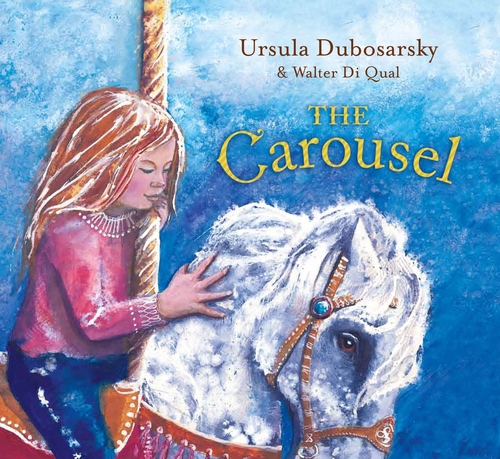
Tell me about this merry-go-round: It was the largest portable steam riding gallery seen in Australia, with a mechanical system allowing it to carry fifty tons without noise or vibration. It carried forty-eight ornately carved horses galloping four abreast; a steam-engine of brass against a highly decorative mirrored background; twisted brass upright bars and an elaborate organ with moving mechanical figures. The carved wooden horses, imported from Germany were impaled on brass bars made in Scotland. They were brightly painted with coloured glass on their harnesses and gargoyles on the rear of their saddles. The horses were all named after popular racehorses of the time. 

The carousel and organ were installed on the Esplanade of the Melbourne bay side suburb of St. Kilda adjacent to Luna Park, the recently built (December 1912) amusement park modelled on a similar American establishment at Coney Island. The carousel travelled the rural “show circuit” during the winter months for a number of years, before being located permanently on the Esplanade at St.Kilda. Anton Weniger, a German immigrant ran the carousel until he relinquished it to William Kelly after about fifty soldiers arrived at the Esplanade in January 1916 during the First World War and attacked Weniger’s Riding Gallery because he was German. (from “St.Kilda - The Show Goes On” by Anne Longmire, 1983). It is likely that the organ facade was damaged at this time since the maker’s name (Gebruder Bruder) was emblazoned on it above the Glockenspiel. The board bearing the maker’s name and the wings, which carried the drums, are missing from those parts of the facade that still exist. Source

You can see the merry-go-round here in Canberra. 

Sally Murphy saw this actual merry-go-round in Canberra (more about how it came to be there below) and this inspired her to do some research and then create a story told as a verse novel. 

I only had enough money
for one ride.
It had to be Mr Weniger's of course.
Rory wasn't so sure.
There are bigger rides
he said.
But he followed me anyway
and I could see he was impressed
that Mr Weniger
knew me.
And let us ride for free!
Afterwards though
he said something funny.
Something that shocked me.
Something I am not even sure is right.
Mr Weniger is all right,
he said.
For a German.

The story is told in three voices - Anton Weniger, Evelyn who has moved to St Kilda from Wodonga where she previously met Anton Weniger and Rory who has three older brothers who have just enlisted. The year is 1915 and Australia is now part of the war that is being waged in Europe. 

Here are some teachers notes from the publisher. Here is a detailed review from The Bottom Shelf. There are useful references included at the back of the book.

More background information: The story begins with Herbert Thomson, born in Melbourne in 1890. By age 19, he had helped his father install machines in coal mines and built a steam engine used in a boat launch on the Yarra River. By 27, he had set up his own business producing steam engines and boilers. In July 1899, he revealed his tour de force – a self-propelled, steam-driven vehicle – or, to put it another way, Australia’s first car. It reached a top speed of 24 km/h, hit during a 56 hour, 36 minute maiden journey from Bathurst to Melbourne. The Thomson Motor Car Company was born, and subsequent models reached 40 km/h and even beat a Benz imported from Germany. The company went out of business in 1912, but not before Herbert had designed a steam-powered carousel for St Kilda beach. It was a properly international effort. The animals, including 50 horses and two elephants, were hand carved in Germany, and sit four abreast in 14 rows, while the twisted brass poles were made in Scotland. Jaunty accompaniment was taken care of by a steam-powered 69-key pipe organ, also from Germany. It drew crowds in Melbourne until September 1973, when Canberra locals collectively raised $40,000 to purchase it from a public auction. Source

Listen to this ABC interview with Sally Murphy.

My friend tells me this book will be welcomed in our New South Wales schools because one of the 'set texts' for the English syllabus is Worse Things by Sally Murphy - sorry I have not been able to find the unit of work but she explained how she creates sets of books for classrooms filled with books to further extend these prescriptive English units containing books by the author being studied or books from a related genre or theme. I hope you can hear me cheering her hard work.

Here are some other books by Sally Murphy I have talked about on this blog:


This book by Pamela Rushby would be the perfect companion book to extend readers understanding of the way German citizens were treated in Australia during World War I.


Other books about Merry-go-rounds:


Saturday, July 6, 2024

Tearaway Coach by Neridah McMullin illustrated by Andrew McLean


Fenton Wood (Fen) and his father need to travel from Ballarat to Geelong. Mama has gone to stay with her own parents awaiting the arrival of a new baby. Fen and his dad have booked tickets on the famous Cobb and Co coach. Papa pays a little more so Fen can sit up with the driver. The coach is filled with passengers, luggage, bags of mail and gold. A new team of six horses are put into the harnesses. The driver is Edward Devine but he is known as Cabbage Tree Ned. He is based a real coach driver Edward (Ned) Devine (1833–1908).

The coach trip is filled with hazards and of course the danger of attack by bushrangers but this is so much more than a book about bushrangers who robbed stagecoaches during the Australian Gold Rush period of the 1850s. Neridah McMullin weaves other dangers into her story such as riding at night over poorly defined tracks, the danger from broken brakes, wildly stampeding horses and the low visibility of a single lantern. The story pace is set by the urgency to arrive on time and the urgency to arrive, perhaps, before the new baby is born. Then there is also the urgency to escape from the bushrangers and their guns. The coach really is a tearaway. 

The story also explores the relationship between Cabbage Tree Ned, the coach driver and Fen, his young passenger, and it also hints at the caring relationships in Fen’s own family when his father pays extra for Fen to ride next to the driver and when we see the family reunited in Geelong.

The illustrations move between full page spreads and small vignettes and the text uses different fonts for emphasis and to highlight two important introductions – meeting Edward Devine or Cabbage Tree Ned and meeting the new baby. 

The cover illustration is taken from the text and perfectly shows an Australian outback scene. The dust blowing behind the coach reinforces the speed of the coach with bounding kangaroos matching the pace of the team of horses. The illustrations were created with pencil, charcoal pencil, watercolour, pastel and Procreate. The sense of time is created by changes to the background colours and the sky which gradually turns blue as the night moves to day. Use of capital letters for the sounds such as the bang of the gun, the clip clop of the horses and the commands to the horses all add to the drama of the story making it a perfect one to read aloud. 

End notes provide extra details about the Cobb and Co coaches that travelled from Ballarat to Geelong and the hazards they faced. As I previously said - Edward Devine was a famous coach driver of the period.

With Andrew McLean’s expressive illustrations, this story takes the reader straight back into that amazing time in our history that formed such an important part of the Australian story, and as much as Fen’s journey is engaging and exciting, it also opens up another aspect of life in the times to explore. The Bottom Shelf

This wonderful evocation of life in early Australia is wonderfully told, and the illustrations are marvellously presented, giving young readers a great deal of detail to look at. Large sweeps of Australian bush land and vistas of blue skies will make them feel part of Fen’s world. The images of the horses are engrossing, drawing the eyes into the detail of their role in pulling the coach, mesmerised by the way they are linked to the driver and the coach itself. Read Plus

The story, shown through Fenton’s eyes and experiences, is high stakes and exciting, taking readers aged four and over on an epic journey in a mode of transport that many readers will never have seen or heard of before, and in doing so, Neridah has brought history to life again. The Book Muse

(Note this blog post is partly based on the annotation I have written for the National Centre for Australian Children's Literature Picture Books for Older reader database).

EVERY Primary school library should add Tearaway Coach to their library collection and I am very sure we will see this book listed as a CBCA 2025 Notable title. It would be great to compare this book with two older books illustrated by Andrew McLean - The Riverboat Crew and The Steam Train Crew. Trove list over 140 books under his name.

Here are some other books illustrated by Andrew McLean. He is one of our most talented Australian children's book illustrators. Andrew McLean grew up in the Victorian country town of Bairnsdale. He trained as a painter and teacher and taught in secondary schools before becoming a lecturer in painting and drawing at Caulfield Institute of Technology. He has been a full-time artist now for more than thirty years. Andrew and his wife Janet have created many picture books together, and Andrew also illustrates books written by other authors. Many of his books have been award winners: he has won the Children’s Book Council of Australia Book of the Year Award three times.


Check out my recent post of Eat my dust by Neridah McMullin.


Wednesday, June 26, 2024

How to Move a Zoo by Kate Simpson illustrated by Owen Swan


Luckily I arrived at the school library where I volunteer in time to 'listen in' to the Teacher-Librarian sharing this new Australian book with a Grade Two class. It was a wonderful lesson where the Teacher-Librarian wove an intriguing story of how Jessie the elephant, in 1916, was moved from the zoo at Moore Park over to our famous Taronga Zoo on the other side of the harbour. The old zoo was too small and often subject to flooding. In total, 228 mammals, 552 birds and 64 reptiles were moved from Moore Park to the new site.

Here are some issues to consider:

  • You are moving an elephant - they are heavy, slow and this one is fairly old (she arrived in Sydney in 1883 aged 8). She died in 1939.
  • For the first part of the journey, Jessie will need to navigate busy city streets. How do you ensure her safety and the safety of the people who live in the city?
  • The Sydney Harbour Bridge was built in 1932 many years after this move so there is no bridge over the harbour
  • How can you transport a 4 ton elephant across a large stretch of water?
  • The alternate route, avoiding the harbour crossing, would be a very long journey over five separate bridges

The end papers in this book show all the other animals traveling in cars and trucks - mostly in cages but they had to make a different plan for Jessie. She would walk to the harbour foreshore and then step onto a steamer boat. 

"Jessie stood as still as a statue across the harbour."

But moving from the boat to the shore meant Jessie had to step onto a pontoon. The library group where I heard this story are familiar with these as our inner harbour ferries stop at pontoons. Because they float on the water this one dipped with Jessie's weight but she bravely stepped across it and onto the shore. Jessie had reached the new zoo.

This is a perfect book to share with a class for so many reasons. It is a true story and young readers always respond well to these. The hero of the story is a huge elephant but it is also a story about problem solving. This book would also fit into any class unit about the history of Sydney and also a mapping topic because there is a splendid old map which is placed across a double spread. You could also share this book as part of a family history topic. I well remember visiting Taronga zoo with my grandparents. The photo I have shows everyone very dressed up for this special outing. The zoo opened in 1916 and my dad was born in 1923. He lived in Neutral Bay not very far from the zoo - I wonder if he ever saw Jessie?

With a group of older students you could also explore issues of animals in captivity and cruelty. In the past zoo visitors paid "a penny a turn (to) ride in a special saddle called a howah on Jessie's back as she walked in a slow circuit with the zoo grounds."

Read this interview with Kate Simpson (teachers note it has a terrific idea for a school excursion). I do expect to see this book listed as a CBCA Eve Pownall (Non Fiction) Notable and hopefully also a shortlisted title for 2025. Now for the library dilemma - where will you shelve this book? Yes it is a picture book but it is a true story. It is about elephants so it could go over to 599.6 but it is about Australian history so it could be 994.4 or perhaps it is about animals in captivity 636.967. Whatever you decide this book should be added to all Australian school library collections. 

... this beautifully illustrated narrative non fiction version is the perfect starting point for not only learning about that remarkable cross-city journey, but also delving more deeply into these fascinating creatures whose future is uncertain.  The Bottom Shelf

Background reading:

I also read this from the Sydney Morning Herald:

  • It took years of logistics to work out how to relocate 228 mammals, 552 birds and 64 reptiles from Sydney’s first zoo at Moore Park to the new bush zoo – promising nothing but air between visitor and animal – at Taronga Park in 1916.
  • Back in 1916, zookeepers were worried about the risks of moving ferocious and strong creatures through city streets. Even six years ago, Taronga Zoo was challenged by the logistics of how to move its giraffes.
  • Sydney’s zookeepers decided to risk it with Jessie. She was a placid creature, “a docile and peaceful pachyderm” said to be loved by the generations of Sydney children who had ridden on her howdah.
  • The trip that had taken years to plan took a little over 90 minutes.
  • "Taronga" is an Aboriginal word that means "beautiful view." 

Other historical books about elephants in zoos:


To find heaps more fabulous resources take a look at all of these splendid posts about elephants from my friend at Kinderbookswitheverything:

8th June International Day of Action for Elephants in Zoos

12th August Elephant Day

12th August World Elephant Day

22nd September Elephant Appreciation Day

Other books illustrated by Owen Swan:


Here is the website for Kate Simpson. I loved her book about Gravity

Sunday, January 14, 2024

Meet the illustrator Mark Wilson


Image source: Kids' Book Review

Begin here with Mark Wilson's web page.

Mark Wilson generously donated a piece of original art for our recent IBBY Australian mini masterpiece art auction.  Moonlight over the Bay. And Mark has generously supported IBBY with other art pieces in the past for our member events. 


From the Booked out Speakers agency:

What are you passionate about?

I am determined to encourage young children to have confidence in telling and illustrating their own stories. I am also passionate about conservation and the environment, and deal with these subjects in my books and workshops.

Anything else you’d like to share with us?

Have confidence in your own writing and drawing. Like anything else, it just takes practice. Also look into your family history and record the stories you find there. You will find that truth can be stranger than fiction.

Today I will meet Mark Wilson in person! He has an exhibition at Dromkeen, Riddells Creek, Victoria. Read more about Dromkeen homestead here. His newest book is Caroline - see inside here


Awards:

2018 Children’s Book Council of Australia (CBCA)Book of the Year Award: Notable Picture Book
Flapper, VC

2018 Young Australian’s Best Book Award (YABBA): Shortlisted Picture Book
Flapper, VC

2016 Whitley Award for Children’s Literature
Migaloo: The White Whale

2015 Children’s Book Council of Australia (CBCA) Eve Pownall Award: Notable Children’s Book
The Afghanistan Pup

2015 OLQP Picture Book of the Year Award
The Afghanistan Pup

2014 Children’s Book Council of Australia (CBCA) Book of the Year Award: Notable Picture Book
Vietnam Diary

2014 West Australian Young Readers’ Award: Shortlisted Picture Book
Ben and Gracies Art Adventure 

2013 Whitley Award for Children’s Literature
Deepsea Whale Rescue 

2013 Children’s Book Council of Australia (CBCA) Book of the Year Award: Notable Picture Book
A Day to Remember – with Jackie French

2013 Aurealis Award 2013 : Shortlisted
Inside The World of Tom Roberts 

2013 White Ravens Award
Trust Me Too  – Illustrated short story collection (Top 250 books from around the world, prepared by the International Youth Library).              
Various Authors & Illustrators, edited by Paul Collins, Ford Street

Services to Children’s Literature

The Dromkeen Medal, initiated in 1982, is bestowed annually to an Australian resident for outstanding achievement in the creation of Australian children's and young adult literature. The Dromkeen Medal was designed by Robert Ingpen and depicts the Dromkeen Homestead, a sickle moon and boughs of wattle. Previous Medal recipients include celebrated children's book illustrators and authors such as Alison Lester, Shaun Tan, Bronwyn Bancroft, Ruth Park, Andy Griffiths, Ercia Wagner, John Marsden and Graeme Base. 

2011 Children’s Book Council of Australia (CBCA) Book of the Year Award: Notable Picture Book
Angel of Kokoda

2011 Wilderness Society – Environment Award for Children’s Literature: Shortlisted Picture Book
Stranded with Jan Ramage

2010 Whitley Award for Children’s Literature
Journey of The Sea Turtle 

2010 Children’s Book Council of Australia (CBCA) Book of the Year Award: Notable Picture Book
My Mother’s Eyes, The Story of a Boy Soldier 

2008 Wilderness Society – Environment Award for Children’s Literature: Shortlisted Picture Book
The Last Tree

2008 Whitley Award for Children’s Literature
The Last Tree

2006 Children’s Book Council of Australia (CBCA) Book of the Year Award: Notable Picture Book
Young Murphy-A Boy’s Adventure with Gary Crew

2005 Western Australian Premier’s Book Awards: Shortlist
Rodeo Darcy with Alison Gregory

2005 Whiteley Award for Children’s Literature
I Said Nothing, The Extinction of the Paradise Parrot with Gary Crew

2004 Whitley Award for Children’s Literature 
I Saw Nothing, The Extinction of the Thylacine, with Gary Crew

2004 Wilderness Society – Environment Award for Children’s Literature
The extinction series – Mark Wilson and Gary Crew
     I Saw Nothing, The Extinction of the Thylacine
     I Said Nothing, The Extinction of the Paradise Parrot
     I Did Nothing, The Extinction of the Gastric Brooding Frog.                     

2004 Children’s Book Council of Australia (CBCA) Book of the Year Award: Notable Picture Book
I Saw Nothing, The Extinction of the Thylacine, with Gary Crew

2003 Wilderness Society – Environment Award for Children’s Literature
Yellow-eye, with David Spillman

2003 Children’s Book Council of Australia (CBCA) Book of the Year Award: Notable Picture Book
Yellow-eye, with David Spillman

1996 Children’s Book Council of Australia (CBCA) Book of the Year Award: Notable Picture Book
The Penguin Shore, with Tim O’Brien

Dromkeen Medal recipients:


2018    John Marsden
2017    Erica Wagner
2016    Alison Lester
2015    Andy Griffiths
2014    Helen Chamberlin
2012    Patricia Mullins
2011    Libby Gleeson AM
2010    Shaun Tan
2009    Bronwyn Bancroft
2008    Ruth Park
2007    Dr Patricia Edgar
2006    Walter McVitty
2005    Roland Harvey
2004    Margaret Hamilton
2003    Ivan Southall
2002    Ann James
2001    Julie Watts
2000    Paul Jennings
1999    Barbara Ker Wilson
1998    Graeme Base
1997    Colin Thiele
1996    Dr Belle Alderman
1995    Jennifer Rowe
1994    Agnes Nieuwenhuizen
1993    Alf Mappin
1992    Julie Vivas
1991    Robin Klein
1990    Mem Fox
1989    Robert Ingpen
1988    Patricia Scott
1987    Joan Phipson
1986    Albert Ullin
1985    Anne Bower Ingram
1984    Patricia Wrightson
1983    Maurice Saxby
1982    Lu Rees