Showing posts with label American Rural life. Show all posts

Wednesday, May 27, 2026

As Brave as You by Jason Reynolds


(nearly five stars)

“Yeah, but you never, like, I’on’t know, just walk around your yard? Not all the way to the edge, but just a little bit? ’Cause if I had a big yard like this back home, I would be in it all the time. Even if I was blind,” Genie said. Grandpop cocked his head. “Is that so?” 
Genie wiped his mouth with the back of his hand. “Yep.” 
“Well, I guess I gotta figure out how to get as brave as you, Little Wood.”

The opening lines of As Brave as You might make you think this will 'just' be a funny book (perhaps filled with toilet humour) but if you think that you will discover you are so 'wrong'.

#460: Poop. Poop is stupid. Stupid poop. Stupid. Poopid. Poopidity. Is poopidity a word?

The boys are cleaning up dog poo. #460 is a way that Genie keeps track of his questions - especially here living with his grandparents who have no internet and so he has no way to use his friend 'Google'. The boys have come from Brooklyn to North Hill, Virginia. Their parents are supposed to be on a holiday. They are supposed to be 'working things out' and hopefully finding a way to stay together so meanwhile Genie and Ernie are trying to adjust to living in a totally new place with new rules. 

Back to Genie's questions. He writes them in a special book:

Genie flipped through pages of his notebook—where he kept his best questions. Some had already been answered, and some were still mysteries. He landed on one that he had totally forgotten about—#389: Do honey badgers eat honey?

Genie was the kind of kid who kept a small jacked-up notebook and pen in his pocket just so that he could jot down interesting things whenever they came. The point was to keep a list—a numbered list—of all the things he needed to Google, because to Genie, the more questions you had, the more answers you could find. And the more answers you found, the more you knew. And the more you knew, the less you made mistakes. Genie wasn’t about mistakes.

Genie is wise beyond his years, and he has a wonderful level of emotional intelligence.  After their long car trip to the country this is what he says about his mum:

The skin on her face looked heavy, and Genie wondered if she had slept at all during the ride. Actually, the skin on her face had been looking heavy for a few months.

There is another layer to this visit - Genie's father and his grandfather have not spoken to each other for years - so something bad must have happened in the past. AND also, Grandpop is totally blind and yet he manages to navigate inside the house. Inside yes, but he needs Genie to help him learn how to walk outside. 

Genie and Grandpop bond over Grandpop's secret inside greenhouse garden and over names - Genie is a girl's name given to a boy and Grandpop's name is Brooke. Ernie and Genie learn about selling peas at the market. It should be an uneventful Summer but of course it is not especially after the boys meet Tess who lives on the next farm. And good news Tess has Wi-Fi so Genie can get onto his backlog of questions. 

Oh and my heart broke when Genie accidentally broke the little red toy truck that had belonged to his Uncle Wood (spoiler alert - his uncle was a soldier who died in action twenty years ago in operation Desert Storm).

#442: Why am I so stupid? Why did he have to leave the truck on the floor? Why? His first day at Grandma and Grandpop’s house, and he had already messed up. The first day. He just couldn’t believe it. He hated making mistakes. All he could think about was how he had to make it right. He had to fix it. But… how?

I do have to give a content warning - this book contains guns, and a shooting.

He turned to open the refrigerator door, and that’s when Genie noticed something was sticking up from the back of his pants like a short tail. Oh… my… G—it was a pistol—the handle of a pistol! Genie had never actually seen a gun in real life, just on the cop shows Ma was always watching, or in movies—action flicks, sci-fi flicks, and even the scary flicks Genie and Ernie weren’t supposed to be watching. ... Questions to remember: What’s a blind man doing with a gun?  Why would Grandpop have a gun, period?

Readers aged 11+ with reading stamina will enjoy this book and the story twists and turns will keep them turning the pages desperate to see if young Genie can atone for his mistakes - breaking that precious truck and accidentally killing one of Grandpop's special birds not to mention the messy issue of Ernie's tooth, the gun shot and his worry about his mum and dad. 

Publisher blurb: Genie’s summer is full of surprises. The first is that he and his big brother, Ernie, are leaving Brooklyn for the very first time to spend the summer with their grandparents all the way in Virginia—in the COUNTRY! The second surprise comes when Genie figures out that their grandfather is blind. Thunderstruck, Genie peppers Grandpop with questions about how he hides it so well (besides wearing way cool Ray-Bans). How does he match his clothes? Know where to walk? Cook with a gas stove? Pour a glass of sweet tea without spilling it? Genie thinks Grandpop must be the bravest guy he’s ever known, but he starts to notice that his grandfather never leaves the house—as in NEVER. And when he finds the secret room that Grandpop is always disappearing into—a room so full of songbirds and plants that it’s almost as if it’s been pulled inside-out—he begins to wonder if his grandfather is really so brave after all. Then Ernie lets him down in the bravery department. It’s his fourteenth birthday, and, Grandpop says to become a man, you have to learn how to shoot a gun. Genie thinks that is AWESOME until he realizes Ernie has no interest in learning how to shoot. None. Nada. Dumbfounded by Ernie’s reluctance, Genie is left to wonder—is bravery and becoming a man only about proving something, or is it just as important to own up to what you won’t do?

This is one of those books where you feel as though you are sitting right beside the family. I especially loved Grandma's cooking and her no-nonsense approach to the boys. 

Awards:

  • ALA Notable Children's Books
  • Bank Street Best Books of the Year
  • William Allen White Children's Book Award Reading List (KS)
  • ALA Coretta Scott King Author Honor Book
  • Chicago Public Library's Best of the Best
  • Rebecca Caudill Young Reader's Book Award (IL)
  • ALA Schneider Family Book Award
  • ALA Notable Children's Recording
  • Wisconsin State Reading Association's Reading List
  • Center for the Study of Multicultural Children's Literature Best Multicultural Books List
  • New York Public Library Best Books for Kids
  • Kirkus Prize Winner
  • USBBY Outstanding Books for Young People with Disabilities Award List

Genie's questions sometimes act as a light relief from some of the heavy themes in this book - here are a few that gave me a smile:

#458: Grits? What exactly are they? And I get that they’re called grits because they’re gritty, but who thought that name was a good idea? That’s like naming peas green slime balls.

#456: How come glaucoma isn’t called eyecoma? Technically, Grandpop’s eyes are ’sleep, right? Eye… coma. Makes more sense.

#447: What does it mean to shoot the breeze? I know one thing, ain’t no breeze nowhere around here for Grandpop to shoot. 

#448: What does a month of Sundays mean? Has there ever actually been a month of Sundays? Maybe the first month of Sundays was the January after Jesus was born. 

#449: Is the sun hotter in the south? If so, then a month of sundaes makes more sense.

#486: How come teeth ain’t called mouthnails? Or maybe fingernails should be called fingerteeth. 

#487: Do old birds ever lose their beaks? Do they ever crack them pecking hard things? If they do, does that change the way they sing? 

#488: Why do they sing anyway? And is the song of a bird different if the bird is in a tree, in the sky, or in a cage?

Monday, May 5, 2025

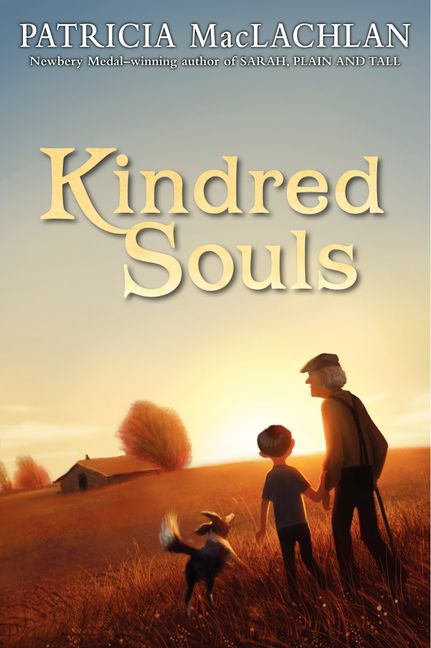
Kindred Souls Patricia MacLachlan


"Billy is eight-eight years old, and I don't worry about him dying. He will live forever. I know that."


This first sentence is near the beginning of Kindred Souls. An astute reader is sure to realise Patricia MacLachlan is giving you a hint about the possible ending to this family story. 

Billy lives with his extended family on a farm near where he was born. His grandchildren are Lida, Jesse and Jake. Jake is named after a plow horse that Billy used to use on his farm and Jake is our narrator.

"I look at Billy's large gnarled hands and his wrinkled face and his bush of white hair. I believe him when he says he talked to the first bird of time. He lives in a sunny room that looks up to the slough that is empty in the summer and filled with water and ducks in the fall. It is a small piece of his old life, like the big prairie that spreads out around is a big piece of his old life."

The word slough is mentioned a few times in this story - it is an important word and one that was new to me. I read Kindred Souls on a Kindle and so I was able to use the online dictionary:

Slough: A swamp, a muddy side channel or inlet.

It is the summer holidays. Jake and Billy take a daily walk around the farm. Billy speaks gently to the cows and he feeds carrots to the horses. 

"And then we go where we always end our walk. We go to the place where Billy was born on this farm. Up the rise and higher up the hill to the edge of the slough ... (and) When Billy pushes the branches of one bush aside, there it is. A small wall of prairie grass and mud three feet high."

This is all that remains of the old sod house. Billy misses it so much.

"I'll tell you everything. ... And then you can build me a sod house ... 
Because we're kindred souls, you and I."

And this, my blog reading friend, is another hint about what is to come. Have you guessed?

After their walk on this day a dog arrives at the house. A small black and white dog. Billy seems to know this dog. He even knows her name is Lucy. It seems Lucy has come to stay, and she is here for Billy.

Back to the sod house. Billy is sure Jake can build this, and the family still have a very old book of instructions. Warning - this book will make you cry. When a new calf is born Billy insists he will also be called Billy - "That means there will be a Billy around here for a long time." Then Billy is unwell and the doctor (who Billy likes to flirt with) says Billy needs to go to hospital. Now Jake just HAS to build that sod house. But will Billy be able to come home and will the house be finished in time and most important of all will Billy like the little sod house.

Here are a few text quotes - they show how beautifully Patricia MacLachlan composes her sentences:

"He tells me the hummingbirds outside speak to him in short, brisk sentences when they fly quickly up and down and around the hanging feeders of sugar water."

"We are quiet. I love the feel of his hand. Outside the hummingbirds flash silently in the sunlight."

"My mama sang lullabies to me in the sod house ... She sat in that old rocking chair in my room and sang lullabies."  [Hello again blog reader - this this sound familiar - an echo of a scene in Sarah, Plain and Tall perhaps].

Publisher blurb: Jake’s grandfather, Billy, hears the talk of birds, is eighty-eight years old, and is going to live forever. Even when Billy gets sick, Jake knows that everything will go on as always. But there’s one thing Billy wants: to rebuild the sod house where he grew up. Can Jake give him this one special thing.

Whenever I finish one of her books, I sit and wonder what it is she does so well... try to define it. It won't take you more than 35 minutes to read through this book but it will stay with you for a long, long time. It's one of those. She reaches to your soul... A Book and a Hug

It's rare to find a children's book that deals so well with death as part of life, offering kids an effective approach to coping with sadness that incorporates humor, love and joy. Kirkus Star review

This small book looks at the role of grandparents in the lives of children in a quiet yet powerful way.  Billy is the center of the book, since he is the center of Jake’s world.  The book, told in the first person by Jake, also explores connections between generations that are strong and true.  The sense of kindred spirits is strong but never overplayed.  This entire book exudes a quiet strength that makes for a compelling read. Waking Brain Cells

If you click on the label I've given this post you can find all of the Patricia MacLachlan books I have talked about here on this blog. 

If you are interested in the idea of the sod house or life on the prairie, try to find this gentle story:


And this verse novel:


Sunday, November 10, 2019

A Year Down Yonder by Richard Peck


It seems odd to say I really love books set in America (remember I live in Australia), set in times past (this is set in 1937) and set in small rural towns (this one is in Illinois). Perhaps it goes back to my childhood reading of the Little House books which I devoured.

A Year Down Yonder won the Newbery Medal in 2001. This means it is famous in America and it also means it has gone through lots of cover designs (see below).  I spied my copy (above) with a sale price in a Sydney children's bookstore. I know how much Horn Book editor, Roger Sutton, adores the writing of Richard Peck and I knew I had already read and enjoyed A long way from Chicago - many years ago so it was easy to make the decision to buy this book. I started reading it this morning and finished it about two hours later - yes it is THAT good!

This book is a sequel but I have no memory of reading of A long Way from Chicago so A Year down Yonder can certainly stand alone. Mary Alice is a wonderful character but it is her Grandmother that I especially love. She has a gruff exterior but underneath she has a heart of gold. She is wise, confident, loud, clever, caring and so very very hard working.

Click these review quotes for more plot details:

And the vignettes, some involving a persnickety Grandma acting nasty while accomplishing a kindness, others in which she deflates an overblown ego or deals with a petty rivalry, are original and wildly funny. The arena may be a small hick town, but the battle for domination over that tiny turf is fierce, and Grandma Dowdel is a canny player for whom losing isn’t an option. Kirkus

Between antic capers, Peck reveals a marshmallow heart inside Grandma's rock-hard exterior and adroitly exposes the mutual, unspoken affection she shares with her granddaughter. Like Mary Alice, audience members will breathe a sigh of regret when the eventful year ""down yonder"" draws to a close. Publishers Weekly

You can read an extract here.  You can also listen to an audio sample from the first page onwards.  I would follow A Year Down Under with Letters to Missy Violet, Turtle in Paradise, and The Girl who bought mischief.  I also recommend other books by Richard Peck such as The Mouse with the question mark Tail and Secrets at Sea.