Showing posts with label Farms. Show all posts

Thursday, September 3, 2026

Landslide by Betty Cully


“Protestors have a right to be there, same as the dump, Nathan. Unless people stop making it, garbage has to go somewhere,” Dad says. “It’s always gonna be in someone’s backyard.”

You know that old saying don't judge a book by its cover? Well in the case of this book I totally misjudged the book by the title. YES there is a landslide but not of the kind involving huge mountains and perhaps catastrophic damage to a small town or village below the disaster. In this case the landslide is a huge or I should say enormous pile of rubbish or garbage that is piled up at the local dump on the edge of town. Perhaps no will notice the pile getting bigger or the pile actually beginning to move but one boy does notice because he lives right across the street!

How did that happen? Where I live the local dump is no not near any houses but Nathan does live there:

Our house on Route 4 in Crawley, Maine, is right across the road from the dump. There wasn’t always a dump there. It used to be the other half of my grandparents’ land, and in the summer we’d look out our front windows and see a big field full of tall grass and wildflowers. In the winter we’d watch deer and foxes. Mom doesn’t blame her sister for selling it. Aunt Del had no idea what would happen. But now it’s the place for everyone’s trash. 

And the complication is Nathan's dad works for the dump company called on Route 4 in Crawley, Maine, is right across the road from the dump. There wasn’t always a dump there. It used to be the other half of my grandparents’ land, and in the summer we’d look out our front windows and see a big field full of tall grass and wildflowers. In the winter we’d watch deer and foxes. Mom doesn’t blame her sister for selling it. Aunt Del had no idea what would happen. But now it’s the place for everyone’s trash. Last week protestors started gathering at the entrance, under the metal sign that says Homefront Municipal Waste Management.  

Nathan begins to read about the way these huge mountains of trash have begun to collapse in other places even leading to a death. Nathan needs a way to gather evidence and also he desperately needs to keep his dad safe. His dad's job is right on top of the pile - he works on huge equipment which tries to flatten the pile as more and more refuse is added each day. And this refuse is not just household waste.

Sometimes trucks from down south start lining up as early as six a.m. with special waste, solid waste, sludge, demolition debris, oily debris, asbestos, fly ash, dirty dirt. ... thing—dirty dirt means contaminated soil.

Luckily Nathan is a very observant boy (he calls this his I-sight) and he also has a terrific tool - a phone that he can use to take photos and timelapse videos. He also has a new friend - a boy names Wilder Bacon who needs a friend as much as Nathan needs someone to help him with this urgent issue. 

He told more glacier facts. Glaciers get so big the pressure of their own tremendous weight causes them to move. Glaciers are solids that flow like a liquid. That’s when I realized the garbage hill doesn’t move like a baseball or a hockey puck or a zip line. What it moves like the most is a glacier. Sometimes it moves fast and other times slow. Check. A glacier is constantly being topped off by fresh snowfall that keeps it flowing downhill, and the landfill always has more garbage being added. Check. If these things make the landfill like a glacier, then the other thing I learned might be true, too—that it is unstoppable.

I have good news and bad news about this book - yes it one I highly recommend and yes it is available here in Australia. It was published this year - 2026 BUT because it is from the US and because so far it is only available in hardcover it is way too expensive for a school library at AUS$35. If you can find this book in a library, I am certain readers aged 10+ will be hooked - Nathan is a kid who has real concerns, he loves his dad, he cares about his community and friendships and his activism as a kid is wonderful to witness. 

Adding to the power of this story the end notes explain the actual real-life situation that led to Betty Cully researching and writing this book. 

Culley grounds the story in solid environmental education, explaining rural landfills’ acceptance of out-of-state waste and the cumulative dangers of exposure to environmental waste and landfill gases. The plot builds steadily, and Nathan’s voice remains absorbing throughout, capturing a kid’s determination to protect his family while grappling with complex community politics. The environmental message is clear but never heavy-handed ... Kirkus

“This book has a lot of information about garbage, landfills, trash removal, and the impact of a landfill on the environment, but it’s also a story of friendship, family, and kindness. The characters are interesting and well developed and are portrayed as loving people who want to do the best for their families as well as the community. . . An excellent choice for libraries needing realistic middle grade fiction, particularly with environmental or social emotional themes.” —School Library Journal, starred review

I found Landslide on a shelf at my public library earlier this week. I’m so glad I did! It’s about a boy named Nathan that lives across the street from the landfill that his dad works at. As you can image, living right next to a landfill comes with some challenges. The characters in this one are easy to root for. Great book! Colby Sharp

Here is a longer review with comments about the writing of this book by the author. Here is the web page for Betty Cully - she lives in Maine.

Sunday, May 3, 2026

I Survived the Dust Bowl, 1935 by Lauren Tarshis


Ray and his best friend Dolly live in Texas in the area called the Panhandle. 


As the cover says the year is 1935 which means America (and other places in the world) are in the grip of the Great Depression. In this small town, businesses are closing and Ray's mum and dad are struggling on their farm with money issues and with a long running drought. In this area and other parts of the US the soil survived over the centuries because there were huge areas of native grasses which kept it locked down but with the arrival of farms and the growing of wheat the grasses are now all gone setting up the perfect conditions for huge and destructive dust storms. 

This story is told by dates and it begins April 14th 1935 then switches back to March 30th. You will feel as though you are living through each dust storm because the descriptions are so intense:

"The wind wacked him down. Ray gasped as dirt and dust rushed into his nose and mouth, clawed his eyes. He flipped over, curling himself into a tight ball. But it did no good. Powerful waves of dirt and dust crashed into him. He couldn't see. He couldn't breathe. He was drowning ... in dust."

"It raged through the morning - brutal winds, whirling dust and dirt, and darkness. As usual Ma and Pa and Ray did their best to seal up the house with sheets and rags. But dust still filled the air and poured down on their heads with every gust of wind."

It was another whole day before the wind died down and the dust stopped swirling. ... A knee-high pile of dust blocked the doorway. ... Their truck was buried up to the windshield. It was going to be a long day of cleaning up."

Plot summary: It is 1935, and Ray and Dolly, best friends, live in a small farming town in the Texas Panhandle. Things had been fine until a drought began. Now, people are losing farms and small businesses to the bank. Many people leave town. Matthew, a nice older boy at school, rides the rails to California to get work. The dust storms are more frequent and severe, and they damage property and people’s health as well. Dolly’s little brother, Skippy, ends up in the hospital with dust pneumonia. The doctors say he can’t stay in Texas any longer, so Dolly’s family is moving away. Ray finds out his parents owe money to the bank, and they might lose the farm. Ray feels like his world is falling apart.

Late last year I read The Higher Power of Lucky by Susan Patron Illustrated by Matt Phelan which is set during the depression and on the Texas Panhandle. That's where I read about these horrible and life-threatening dust storms that ravaged parts of the US in the 1930s. When I saw this book from the I survived series in the library where I volunteer I knew it would be a terrific follow-up. 


The "I survived series" are short historical novels and they are  a perfect way to introduce young readers aged 9+ to major events in history BUT my big advice is don't read the end notes before you read the fictionalised version. I didn't know much about the dust bowl of 1935 so I read the notes first. Sadly this meant as I read this Lauren Tarshis story I found myself ticking off a mental checklist of all the things she had mentioned in her notes. The story really held my attention but I think I would have found it more gripping and perhaps it might have felt less simplified if I did not have the 'facts' rolling around in my head. I will read of the I survived books and next time I won't read the historical information until the end. 

Kirkus explains this in their review of the Titanic book from this series: The plot involves too many convenient coincidences, but the fast pace and intrinsically fascinating disaster story will keep readers turning the pages ...

Having said wait to read the back notes I was very impressed to read the depth of research by Lauren Tarshis and the way, in the case of this book, she took the time to visit a small town in Texas, to talk to the librarian, the historical society and one resident who lived through these times. 

The story of Ray and Dolly is one that young readers will relate to and sympathize with. It is a great way for kids to learn about the history of the Great Depression and the Dust Bowl. Like all the I Survived books, this one is short, well-written, and compelling. Chicago Book Review 5 Stars

The best part of the I Survived books are the historical back matter, which includes period photos and much discussion of a variety of topics. I would have avidly saved my allowance to purchase these titles in elementary school! Ms Yingling (she has a good plot summary too)

I am very very late coming to the series "I survived" and I also now need to read the graphic novels from this series too.  There are over 28 titles published so far all by Lauren Tarshis. The series began in 2010 with I Survived the Shark Attacks of 1916 and I Survived the Sinking of the Titanic, 1912. I Survived the Dust Bowl, 1935 is a new title published in 2025. I plan to find I Survived the Black Death, 1348 to read next. 


About the series:

The I Survived series by Lauren Tarshis presents historical fiction stories focused on children placed in life-threatening events. Each book centers on a different disaster, such as the Titanic sinking, Hurricane Katrina, or the American Revolution. The main conflict involves survival under extreme conditions, often blending factual events with fictional characters. The structure emphasizes action, resilience, and decision-making in crisis situations.

The I Survived series books in order are not required, as each story is fully self-contained with its own beginning, conflict, and resolution. There is no overarching storyline or shared character development across the books. Each installment introduces a new protagonist and historical setting without relying on previous entries. Reading out of order does not affect understanding or enjoyment.

The tone is fast-paced and suspenseful, designed to engage younger readers while presenting serious events. Themes include survival, courage, resilience, and the impact of historical events on ordinary people. Many stories highlight quick thinking and emotional strength in dangerous situations. The writing balances tension with accessibility.

Here are some of the Graphic Novels from this series. I watched The Contoured librarian today and she said the readers in her library rate these very highly. Colby Sharp often mentions these books too. 


Thursday, September 25, 2025

Cobweb by Michael Morpurgo illustrated by Michael Foreman


Bethan lives with her father in Wales. He is not unkind but since the loss of his wife he has become a distant figure. When their farm dog has puppies Bethan is desperate to keep and love the smallest of the litter. At first it seems her father will sell this pup but somehow she convinces him to let little Cobweb join their family. The small corgi proves himself a hard worker with the sheep and he is totally devoted to Bethan. Then just like in all the bad fairytales the wicked step mother arrives and Cobweb is gone. She has sold him and she tells Cobweb the new master will be a cruel one. Luckily this is not true. Becoming a drover's dog is a whole new and rewarding adventure even though the journey to London is long and at times quite dangerous. Meanwhile in Europe Napoleon has been defeated and soldiers are returning from the battlefield. Cobweb will make a new friend (the cover hints at this) and yes, he will find his way back to his beloved Bethan.

This is an engrossing story perfect for readers aged 9+. This book is especially easy to read because (thank you) the publisher has used a bigger font and lots of white space and there are terrific illustrations scattered throughout by Michael Foreman. 

A truly moving portrayal of the powerful bonds that can be formed between animals and humans, and of courage, the ghastliness of war and resulting loss of human life. Red Reading Hub

Publisher blurb: 

"They call me Cobweb. I’ll tell you why later. I may be a dog, but I know and understand a lot more than people think I do.”

Britain. 1815. After years of loss and sacrifice, the end of the war with Napoleon is approaching. Cobweb knows nothing of the war – he loves being a young puppy and playing with his owner, Bethan, exploring the countryside and chasing rabbits. But when he is taken away from Bethan and sold, Cobweb must learn to become a Drover’s Dog – herding sheep and cattle for hundreds of miles on the long, treacherous journey to London. And after the Napoleonic wars finally come to an end with the Battle of Waterloo, Cobweb meets an unexpected stranger with an incredible tale to tell on his journey home …

Michael Morpurgo has written over 150 books and won many prizes, including the Smarties Prize and the Whitbread Award. In 2005 he won the Blue Peter Book Award for his novel Private Peaceful, which was also adapted into an acclaimed stage play. Michael was Children’s Laureate in the UK from 2003 to 2005.  He was knighted in 2018 for services to literature and charity.  His books include the classics War Boy and War Game, winners of the Kate Greenaway Award and Smarties Book Prize respectively.

Companion books:


Wednesday, September 10, 2025

Anne of Green Gables by LM Montgomery


Oh, it seems so wonderful that I'm going to live with you and belong to you. 
I've never belonged to anybody—not really.

That child is hard to understand in some respects. But I believe she'll turn out all right yet. And there's one thing certain, no house will ever be dull that she's in."

I've joined an online US Facebook children's book club. Next month our book is the famous US classic Anne of Green Gables (1908). Until last month I had not read this book. I shared this with one of our esteemed children's literature experts here in Australia and she was utterly shocked and so I felt compelled to now read Anne of Green Gables. I hunted around for a cheaper print copy but eventually I settled on reading an ebook. If you haven't read this classic here are some detailed notes about the themes and plot. You could also consider listening to the audio book - here is a five-minute sample. I also found some free examples. 

Did I love Anne of Green Gables? Not really. There were parts I enjoyed especially early in the story but after a few chapters I found it a bit repetitive and I grew a little tired of anticipating that every 'activity' would end in a disaster for Anne. 

What parts did I enjoy? 

  • The rich vocabulary with words like betokened; wincey; alabaster brow; irreproachable; capricious; coruscations; prosaic; and tenacity
  • The beautifully expressed descriptions of nature: 

" ... the orchard on the slope below the house was in a bridal flush of pinky-white bloom, hummed over by a myriad of bees."

"Very green and neat and precise was that yard, set about on one side with great patriarchal willows and the other with prim Lombardies. Not a stray stick nor stone was to be seen ..."

"Above the bridge the pond ran up into fringing groves of fir and maple and lay all darkly translucent in their wavering shadows. Here and there a wild plum leaned out from the bank like a white-clad girl tip-toeing to her own reflection. From the marsh at the head of the pond came the clear, mournfully-sweet chorus of the frogs."

"On both sides of the house was a big orchard, one of apple-trees and one of cherry-trees, also showered over with blossoms; and their grass was all sprinkled with dandelions. In the garden below were lilac-trees purple with flowers, and their dizzily sweet fragrance drifted up to the window on the morning wind."

"There were rosy bleeding-hearts and great splendid crimson peonies; white, fragrant narcissi and thorny, sweet Scotch roses; pink and blue and white columbines and lilac-tinted Bouncing Bets; clumps of southernwood and ribbon grass and mint; purple Adam-and-Eve, daffodils, and masses of sweet clover white with its delicate, fragrant, feathery sprays ..."

  • I loved some of the characters especially Matthew Cuthbert and Diana. I also appreciated the tiny insights into Marilla and her slowly developing love of Anne. 
  • The touches of humor:
"If Marilla had said that Matthew had gone to Bright River to meet a kangaroo from Australia Mrs. Rachel could not have been more astonished. She was actually stricken dumb for five seconds."

"She thought in exclamation points. A boy! Marilla and Matthew Cuthbert of all people adopting a boy! From an orphan asylum! Well, the world was certainly turning upside down! She would be surprised at nothing after this! Nothing!"

"But if you call me Anne please call me Anne spelled with an E. ... A-n-n looks dreadful, but A-n-n-e looks so much more distinguished."

"I have no hard feelings for you, Mrs. Barry. I assure you once for all that I did not mean to intoxicate Diana and henceforth I shall cover the past with the mantle of oblivion."

"Yes; but cakes have such a terrible habit of turning out bad just when you especially want them to be good,"

"Almost a month having elapsed since the liniment cake episode, it was high time for her to get into fresh trouble of some sort, little mistakes, such as absentmindedly emptying a pan of skim milk into a basket of yarn balls in the pantry instead of into the pigs' bucket ... "

"I've learned a new and valuable lesson today. Ever since I came to Green Gables I've been making mistakes, and each mistake has helped to cure me of some great shortcoming. The affair of the amethyst brooch cured me of meddling with things that didn't belong to me. The Haunted Wood mistake cured me of letting my imagination run away with me. The liniment cake mistake cured me of carelessness in cooking. Dyeing my hair cured me of vanity. I never think about my hair and nose now—at least, very seldom. And today's mistake is going to cure me of being too romantic."

  • Character descriptions:
Anne - "A child of about eleven, garbed in a very short, very tight, very ugly dress of yellowish-gray wincey. She wore a faded brown sailor hat and beneath the hat, extending down her back, were two braids of very thick, decidedly red hair. Her face was small, white and thin, also much freckled; her mouth was large and so were her eyes, which looked green in some lights and moods and gray in others."

Anne - " ... the ordinary observer; an extraordinary observer might have seen that the chin was very pointed and pronounced; that the big eyes were full of spirit and vivacity; that the mouth was sweet-lipped and expressive; that the forehead was broad and full; in short, our discerning extraordinary observer might have concluded that no commonplace soul inhabited the body of this stray woman-child of whom shy Matthew Cuthbert was so ludicrously afraid."

"Diana was sitting on the sofa, reading a book which she dropped when the callers entered. She was a very pretty little girl, with her mother's black eyes and hair, and rosy cheeks, and the merry expression which was her inheritance from her father.
  • And of course Anne's relentless imagination. 

How do you feel about the love story? I was a little frustrated that it took so long to reach this scene but I guess the stage is set for the sequel/s. Will I keep reading this series? Probably not but I might try to find the television series. 

Confession - I have been to Prince Edward Island twice (and yes I do live in Australia) but when I visited I had no interest in this famous book. My visit to island was fabulous though, because I had an introduction to a resident - a lady and her husband who were entitled to called themselves Islanders. I had been teaching in Alberta and a wonderful library volunteer had a connection with a family who lived on PEI. I am so glad I took hold of my courage and phoned them. It was an evening to remember ending with the wife and I sitting in front of their fabulous bookshelves exploring her huge picture book collection! I am sad I no longer remember their names. 

"I've always heard that Prince Edward Island was the prettiest place in the world, and I used to imagine I was living here, but I never really expected I would. It's delightful when your imaginations come true, isn't it?"

Here are our Book Club titles for 2025:


Friday, August 8, 2025

Lizzie Nonsense by Jan Ormerod


"When Lizzie's mama and papa were married, the sun shone on fields of yellow wheat which grew right up to the door of the tiny church. But for as long as Lizzie can remember, she and mama and papa and baby have lived in their little house in the bush, and the church and the neighbours are far away."

Papa needs to take the timber to a faraway town, so mama and Lizzie and baby are left alone for many weeks. As mama completes her chores Lizzie tags along. She sees the world in a different way - using her imagination. The baby in the bath is really floating in the wide blue sea; the flowers from the garden become a bridal bouquet; and for dinner Lizzie declares they will have peaches and cream and sweet little cakes. Of course they are actually having turnips! The church is too far away but on Sunday's they put on their best clothes and walk along the track pretending they are returning from church. Finally papa arrives home:

"And they walk together back to their little house in the bush."


Lizzie Nonsense has a special dedication to "my grandmother Beatrice Evelyn Harvey 1883-1972", so we know this book is based on true events. Jan Ormerod, who died in 2013, also wrote The Water Witcher based on the life of her grandfather.

Here is the full Kirkus Star review: When Papa takes the cut sandalwood into town, Lizzie, Mama and the baby are all alone in their little house in the bush. Lizzie is always playing and pretending; Mama calls it Lizzie nonsense, but her imagination helps lighten the daily chores and hard work. While Mama tends the garden, she picks flowers and becomes a bride; as she helps Mama prepare the usual turnips for dinner, they become peaches and cream; as they mend clothes, Lizzie pretends to make a party dress with buttons and bows. Mama even joins the playfulness when they dress in their best on Sunday and walk along the track and back, pretending they’ve been to church. The beautiful painterly, watercolor illustrations are a departure from Ormerod’s earlier cuddly style. The earth-hued wispy and airy paintings affectionately embellish Lizzy’s nonsense, conveying a warmhearted snippet of time when a family bond overcame the hardships of Australian pioneer life to make a home in an untamed land. Based on anecdotes from the author’s own family history.

Lizzie Nonsense was published in 2004 and shortlisted by the CBCA in 2005. In 2006 IBBY Australia selected Lizzie Nonsense as our Honour Book title for illustration. Here is the catalogue annotation:

Lizzie lives with her mama, papa and baby brother on a remote farm in the Australia bush. Papa leaves the family for weeks on end while he delivers wood to the distant town leaving Lizzie, her Mama and baby alone in the bush. Lizzie is a lively girl with a vivid imagination. Her brother in his bath is floating in the ocean, a fallen log is her brave steed and flowers in the garden become a bridal bouquet. Lizzie is such a happy girl. She finds delight in the smallest of things and her buoyant outlook and positivity help her Mama during these difficult days. Even though she dismisses Lizzie’s ideas as nonsense Mama has her own daydreams too. On Sundays they put on their best clothes and pretend they have walked to church. Finally, after all the long weeks, they hear a sound. Is that harness jangling just in the imagination? No it is papa! Lizzie Nonsense is dedicated to the memory of Jan Ormerod’s grandmother and her life in the 1890s. It is a tale told with warmth, tenderness and humour. The images are built up from pencil drawings. Watercolour and ink are used to evoke the light of the Australian bush and the simple candlelight of their home. Several illustrations are presented as an oval similar to a framed picture placed on a dresser or mantle.

Sadly, it is now out of print. I thought of it again when it was mentioned in a recent podcast when the presenter listed books about weddings. I did a blog post about this a few days ago. Today I discovered the 2013 paperback edition of Lizzie Nonsense and it does look like a wedding story even though in my mind this is still a minor aspect of the story. The cover image comes from the title page of the original book. 


I have talked about many books by Jan Ormerod in the past. Click on the label for this post to find more of her books. 

When I first read Lizzie Nonsense I thought of this wonderful Australian poem which I learned by heart for a play called Yarns and Woolley Tales in 1984:

Before the glare o’ dawn I rise
To milk the sleepy cows, an’ shake
The droving dust from tired eyes,
Look round the rabbit traps, then bake
The children’s bread.
There’s hay to stook, an’ beans to hoe,
An’ ferns to cut in the scrub below,
Women must work, when men must go
Shearing from shed to shed.

I patch an’ darn, now evening comes,
An’ tired I am with labour sore,
Tired o’ the bush, the cows, the gums,
Tired, but we must dree for long months more
What no tongue tells.
The moon is lonely in the sky,
Lonely the bush, an’ lonely I
Stare down the track no horse draws nigh,
An’ start . . . at the cattle bells.

Monday, May 5, 2025

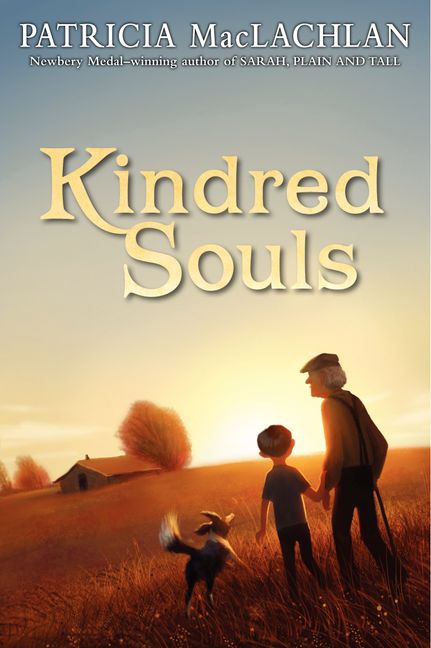
Kindred Souls Patricia MacLachlan


"Billy is eight-eight years old, and I don't worry about him dying. He will live forever. I know that."


This first sentence is near the beginning of Kindred Souls. An astute reader is sure to realise Patricia MacLachlan is giving you a hint about the possible ending to this family story. 

Billy lives with his extended family on a farm near where he was born. His grandchildren are Lida, Jesse and Jake. Jake is named after a plow horse that Billy used to use on his farm and Jake is our narrator.

"I look at Billy's large gnarled hands and his wrinkled face and his bush of white hair. I believe him when he says he talked to the first bird of time. He lives in a sunny room that looks up to the slough that is empty in the summer and filled with water and ducks in the fall. It is a small piece of his old life, like the big prairie that spreads out around is a big piece of his old life."

The word slough is mentioned a few times in this story - it is an important word and one that was new to me. I read Kindred Souls on a Kindle and so I was able to use the online dictionary:

Slough: A swamp, a muddy side channel or inlet.

It is the summer holidays. Jake and Billy take a daily walk around the farm. Billy speaks gently to the cows and he feeds carrots to the horses. 

"And then we go where we always end our walk. We go to the place where Billy was born on this farm. Up the rise and higher up the hill to the edge of the slough ... (and) When Billy pushes the branches of one bush aside, there it is. A small wall of prairie grass and mud three feet high."

This is all that remains of the old sod house. Billy misses it so much.

"I'll tell you everything. ... And then you can build me a sod house ... 
Because we're kindred souls, you and I."

And this, my blog reading friend, is another hint about what is to come. Have you guessed?

After their walk on this day a dog arrives at the house. A small black and white dog. Billy seems to know this dog. He even knows her name is Lucy. It seems Lucy has come to stay, and she is here for Billy.

Back to the sod house. Billy is sure Jake can build this, and the family still have a very old book of instructions. Warning - this book will make you cry. When a new calf is born Billy insists he will also be called Billy - "That means there will be a Billy around here for a long time." Then Billy is unwell and the doctor (who Billy likes to flirt with) says Billy needs to go to hospital. Now Jake just HAS to build that sod house. But will Billy be able to come home and will the house be finished in time and most important of all will Billy like the little sod house.

Here are a few text quotes - they show how beautifully Patricia MacLachlan composes her sentences:

"He tells me the hummingbirds outside speak to him in short, brisk sentences when they fly quickly up and down and around the hanging feeders of sugar water."

"We are quiet. I love the feel of his hand. Outside the hummingbirds flash silently in the sunlight."

"My mama sang lullabies to me in the sod house ... She sat in that old rocking chair in my room and sang lullabies."  [Hello again blog reader - this this sound familiar - an echo of a scene in Sarah, Plain and Tall perhaps].

Publisher blurb: Jake’s grandfather, Billy, hears the talk of birds, is eighty-eight years old, and is going to live forever. Even when Billy gets sick, Jake knows that everything will go on as always. But there’s one thing Billy wants: to rebuild the sod house where he grew up. Can Jake give him this one special thing.

Whenever I finish one of her books, I sit and wonder what it is she does so well... try to define it. It won't take you more than 35 minutes to read through this book but it will stay with you for a long, long time. It's one of those. She reaches to your soul... A Book and a Hug

It's rare to find a children's book that deals so well with death as part of life, offering kids an effective approach to coping with sadness that incorporates humor, love and joy. Kirkus Star review

This small book looks at the role of grandparents in the lives of children in a quiet yet powerful way.  Billy is the center of the book, since he is the center of Jake’s world.  The book, told in the first person by Jake, also explores connections between generations that are strong and true.  The sense of kindred spirits is strong but never overplayed.  This entire book exudes a quiet strength that makes for a compelling read. Waking Brain Cells

If you click on the label I've given this post you can find all of the Patricia MacLachlan books I have talked about here on this blog. 

If you are interested in the idea of the sod house or life on the prairie, try to find this gentle story:


And this verse novel:


Friday, March 15, 2024

The Wheelbarrow Express by Sue Whiting illustrated by Cate James


I am working my way through the CBCA (Children's Book Council of Australia) 2024 notable titles. The Wheelbarrow Express is a title from the Early Childhood list and I really like it. The intended audience for books in this category is ages 0-6 and I can see this book will be perfect to share with your own young reading companion or grandchild or with a younger group in your library or preschool. Why? I will list some features here:

  • The setting is a farm - all young children, even if they have not had the opportunity to visit a farm, love farm animals especially pigs and chickens.
  • The relationships are warm and recognisable - Grandfather and grandson. And there is the arrival of a new baby which is an adjustment for all older siblings.
  • There is a repeated refrain - toot! toot! choo-choo-choo-choo. After all this is an express "train" and there are many stations to visit along the route.
  • The plot is linear as the child and adult travel through the farm, so it is easy for a young child to anticipate a happy ending or in this case reunion with mum and the baby.
  • Adults will love the tiny touches of poignancy - grandad knows he will see Tom again but today is the final day of this visit. Grandad is clearly choked up when they say goodbye to the dam - his voice has gone croaky, and that final hug is so special - I certainly felt the strong squeeze of Pa's arms.
  • The plot races along with the wheelbarrow but before we reach the end the journey there is time just to sit still and enjoy skipping stones into the yabby dam. (A reminder to slow your reading down too and make a plan to one day skip stones too.)
  • This is a universal story of love and shared experiences, but it also feels Australian (I mentioned the yabby dam).
  • And there are also those all-important touches of sweet humour such as when the goat steals Tom's railway cap. 
  • The collection of treasures are the perfect way to recap their journey - the special shared moments of, not just that day, but over the whole visit. 
  • This book will be one you share with your young reading companion more than once and I would anticipate that some of the phrases might become part of your own family vocabulary - "Put away the gloomies"; "With a bump and a bounce and a toot"; and "Till next time."
  • I love that this is not an end-of-life story - it is just a happy day shared across the generations. Too often we categorise grandparents as elderly, but the reality is a child the age of Tom, I'd say he is 3 or 4, would have a grandfather who is only 65-70 years old.

I have previously talked about the art of Cate James. It really shines in this book. I highly recommend this book and suggest after reading you go down to your shed, pull out your old wheelbarrow and go for a ride around your own backyard or park. 

The CBCA Judges said: A heartwarming celebration of the loving bond between a child and grandparent is shared in this timeless narrative. Readers may be familiar with a wheelbarrow ride and will enjoy joining Tom and Pa on their last day on the farm together, journeying on the wheelbarrow express, collecting mementos and revisiting favourite spots and memories. The language is simple and accessible for young readers, with onomatopoeia and some verbs emphasised in a different font. Crucial to the narrative, the farm setting is gloriously reflected in the soft colour palette of blue, greens and browns. Avoiding sentimentality, the narrative alternates between the pair’s genuine banter and playful descriptions of farmyard activities and closes on a reassuring and satisfying note.

This is a charming story celebrating the special bond between grandparent and grandchild that is destined to become a family favourite. The Bottom Shelf

I do hope we see The Wheelbarrow Express as a short-listed title. I previously hoped this would happen with another book by Sue Whiting:


See more books by Sue Whiting here on her webpage. With a group of older students in Grade 1 or 2 you could read another terrific book that features a journey in a wheelbarrow:


Saturday, August 26, 2023

Farmhouse by Sophie Blackall


This book is a lyrical love letter to the past and to an old house that saw children grow and change until the house itself grew too old to stay standing. While this broken old house could not be rescued by Sophie Blackall, I love that she was able to retrieve so many fragments from the history of the house and then painstakingly incorporate them into her delicate collage illustrations. 

Her voice is so authentic recounting the lives of the family with twelve children who lived long ago in this house. There is a beautiful sense of completion when we meet the final and youngest child, now an old lady, who takes her last look around the house before leaving it to nature and tempest. While it is sad, it is also good to see the raw and messy state of the house fifty years after the last family left. From the artist page illustration where we see Sophie Blackall with her materials there is a feeling that even though the house is now gone its spirit will live on. 

The author note at the back of the book is essential reading and heartbreaking with those words “a roaring excavator would come and extend its long neck and open its wide jaws, bite through the beams, push over the walls, crunch up the parlor organ … “. I love the way Sophie scattered seeds on the land after the house was gone. 

The design of Farmhouse is scrumptious – the embossed cover, the wrap around image on the dust jacket, the view of the inside of the house, a little like a dollhouse, found under the dust jacket, the front-end papers with all the patterns and textures and objects from the house, and the photos at the back of those twenty-one dresses looking like ghosts from the house and along with the old organ. I wish I had a button that was once a shell in the sea - that is the perfect refrain. 


This book is sure to delight readers of all ages. The story telling is rich and nostalgic. There is a very strong sense of time and place. The illustrations can be revisited over and over again and each time the discovery of new details will delight children and adults alike. I also love the pace of the illustrations. We move from pages with so much detail and then turn to a quieter page such as the barn milking scene and the apple tree. To my eye those pages and the one where we see the surrounding farmland feel like places where a reader can take a "visual" breath - these are quieter pages.  


The rhythm and meter of the narrative is perfect. It undulates and weaves in and out of the family's little life in a playful and surprising way, drawing the reader in to 'eavesdrop' on the life of the family before sending the reader out to explore details gently dropped into the tale such as the button that was once a shell. It made me reach for my own grandmother's button jar to see if I had a shell button like this. IF I had been able to read this book with a group of children my button (like this one below) would have been my starting point. 


Image Source Etsy

It has taken me a while to talk about this book because I had to wait until after the CBCA (Children's Book Council of Australia) announced their award winners for 2023 - this waiting is part of being a judge. Farmhouse was shortlisted for the picture book award. The judge's comments were partly written by me, so they do overlap with my comments here. 

Here are some review comments:

A lovely, tender reimagining of people in a long-past time and place. Kirkus Star review

Maybe that’s the thing about this book I like so much. Picture books about old houses or old cars or other old structures view natural decomposition as something to be fought and fixed. Farmhouse respectfully disagrees. The tragedy at work here is that the stories that took place in this house might not get told again. They might fade in the memories of the people who knew them. So rather than refurbish and restore the house, Sophie refurbishes and restores the family and their lives in book form. And maybe there will be a child that reads this book and begins to wonder about old photographs in their own homes. Maybe they’ll ask for stories about their own ancestors and, if they’re lucky, maybe they’ll hear some they never heard before. We can’t help but wonder about the people who came before us. Isn’t it nice when someone like Sophie Blackall is able to give them a little gift, in appreciation for coming before? A lovely, moving, thoughtful book, full of children, life and death, and the turning of the years. Fuse 8 Betsy Bird SLJ

I loved watching Sophie Blackall share her process and art creations for this book on Instagram. Here is one moment.  Sophie Blackall talks to the Horn Book magazine. IBBY President Dr Robyn Sheahan-Bright has prepared some outstanding teachers notes. Here is another interview with Sophie by Parnassus Books in Nashville. 

There are hundreds of decisions to be made on every page of a picture book. In this book, in this family, there are twelve children, and they all have chores and I want it to be historically accurate, but I also want to give the characters depth and not lock them into gender roles.

The perfect comparison text is The Little House.


I also suggest looking for these:


Saturday, June 3, 2023

River Murray Mary by Colin Thiele illustrated by Robert Ingpen


This is a vintage Australian book first published in 1979 and reprinted in 1990. It was released again in 2002 but that copy is now also out of print. While I don't think it would be any where near as good, the ebook version is still available. 

It seems easy to dismiss old books as having no appeal to "modern" kids but this is such a gripping story of early Australian pioneers and young Mary is a very memorable character. I think this book would be a fabulous family read aloud. Publishers today would probably not produce a picture book like this with 72 pages and full pages of text but this format is very appealing for this long form picture book especially with the beautiful art by Robert Ingpen. In the past there were some terrific long form picture books in Australia such as Rummage by Christobel Mattingley illustrated by Patricia Mullins; Jandy Malone and the Nine O'Clock tiger by Barbara Bolton illustrated by Alan White; and even the famous Storm Boy by Colin Thiele illustrated by Robert Ingpen.


Mary Agnes Baker lives on a farm on the banks of the Murray River in South Australia. Her father was granted this land when he returned from WWI. Mary was born in 1918 and now that she is aged 10 or 11 Australia is entering the years of The Great Depression. Life on the farm is hard with huge tasks like harvesting grapes. They also have to manage the irrigation.

"Mary was never happier than when she was running up and down the rows at irrigation time, the red mud spattered all over her legs or squelching up between her toes like soft brown butter. As soon as the row of fruit trees or vines had been soaked thoroughly her father went back to the main trench, sealed off the gutter that had been flowing and opened up another one at the next row. And so it went on. All through the night he dozed and worked, dozed and worked ..."

"In the winter months there was pruning and ploughing to do and in summer there was picked and dipping and drying. The dipping was the worse part. It had to be done in a tank full of very hot water mixed with caustic soda. ... It was dreadful work in the heat of summer without shelter or shade but it was the only way the sultanas could be made to dry into soft golden fruit for cakes and pudding and buns all over the world."

Early on in the story Mary encounters a tiger snake and as a reader I just knew this snake would be sure to cause havoc later in the story, but before this happens the family and community have to survive a wild hail storm which destroys their crops and then an enormous flood - water coming down the river over many weeks and covering everything close to the river bank and beyond. These scenes are so dramatic - making this story such a powerful page turner.

If you have this book in your school library there are some wonderful passages you could use with a class as examples of very skilled writing:

"A snake was drinking at the riverbank. He lay like a long rope with his head and neck out over the water and the rest of his curving body in the grass on the bank. His scales shone bronze and black in the morning sun as if he had spent the night polishing himself. ... For an instant a little flicker of blue lightning danced along his lips, quicker than the blink of an eye."

"Mary took another step backwards and waited. The river was so calm that the trees along the edge seemed to be standing on a mirror. The sun was warm and soft, and the air was silent.  ... she could have been the only living creature in the world. She and the snake."

"He bought his head round to the bank and his body followed like black glass, like cold molten glass, easily and silently. Such a fluid flowing of flesh and muscles she had never see before. She glimpsed his rippling underbelly as he moved, streaked with red and bands of smoke ... his body poured itself through the grass in a black shining stream, winding and curving by a kind of magic."

I also love the way Mary talks about her dog:

"She had grown up with old Snap, and although he was a big galumphing dog who was forever doing stupid things and then smiling at what he had done, he was such a happy, warm-hearted fellow that he seemed like a brother to everyone."

Sadly, Snap is bitten by that snake and the doctor (who also works as the local vet) is far away but Mary and her father load Snap into their small row boat and rush him to Doc Williams who luckily does have some anti-venene. It is a tense night as Mary watches over her old dog desperate to see him survive. 


If you have a class studying a topic such as "life in the olden days" read the scene on page 32 when Mary's mother sets up her petrol iron!

"Mary was frightened of the iron and she hated using it herself. First the little tank at the back had to be filled with petrol, then the jet had to be ricked, and finally the iron had to be primed. When everything was ready her mother struck a match and there was a moment or two of anguish when flames were likely to stutter all over the place ... but at last the flames in the hollow between the top of the iron and the heavy sole below sank away and the jet settled down to a steady hiss like a vent of steam that had caught a cold."

Colin Thiele is a famous Australian author of books such as Storm Boy; Sun on the Stubble; Blue Fin; and Pannikin and Pinta. 

Robert Ingpen won the IBBY Hans Christian Andersen award in 1986.