Showing posts with label Chile. Show all posts

Wednesday, May 21, 2025

Pablo Neruda Book of Questions illustrated by Paloma Valdivia translated by Sara Lissa Paulson


Where does the stuff of dreams go? 
Does it pass into the dreams of others?

I am a fan of books with questions (and sometimes even answers). This book has some incredible and possibly unanswerable questions that might spark some philosophical discussions with your students in all grades. Here are a few of the questions selected for this book from 39 of the original poems that I enjoyed thinking about:

Who shouted for joy when the colour blue was born?
Do unshed tears wait in little lakes?
How did the abandoned bicycle find its freedom?
Does smoke strike up a conversation with clouds?
What knowledge is in the bee for it to figure out its itinerary?
Why don't they teach helicopters how to draw honey from the sun?
And what do you call that month between December and January?


The text on this page says:
What do you call a flower that flits from bird to bird? 
Which birds dictate the order of the flock while it flies?

Editor's Note: "We hope that you enjoy these questions, and that, however they arrive for each of you, they come as a reminder of the vastness of our unknowing and a call to passionate engagement in endlessly re-envisioning the world."

Wait until you see the COVER of this book.  My image above does not do it justice. All of the printing is on a clear overlay and then when you lift this off you see the amazing illustration which stretches across the front and back covers.

With a clear acetate jacket with striking green lettering (an homage to Neruda’s affinity for writing in green ink, which he saw as the color of hope), this edition contains six magnificent gatefold spreads that lift to reveal more questions and expanded illustrations, inviting readers into deeper and deeper reflection. Enchanted Lion

Read more about this book and especially about the creation of the illustrations here


Pablo Neruda (1904-1973) was known as a poet and ambassador of the Chilean people. During a time of social upheaval, he traveled the world as a diplomat and an exile, served as a Senator for the Chilean Communist Party, and published more than 35,000 pages of poetry in his native Spanish. Here are a few quick facts:

  • Pablo Neruda was the pen name of Neftali Ricardo Reyes Basoalto
  • He published his first poems when he was 13
  • A Czech poet, Jan Neruda (1834-1891), inspired the young poet and so he took his last name
  • He received numerous prestigious awards, including the International Peace Prize in 1950, the Lenin Peace Prize and the Stalin Peace Prize in 1953, and the Nobel Prize for Literature in 1971
  • Neruda occupied many diplomatic positions in various countries during his lifetime and served a term as a Senator for the Chilean Communist Party
  • When Neruda died in 1973, The Book of Questions was one of eight unpublished poetry manuscripts that lay on his desk

El libro de las preguntas (The Book of Questions) contains:

"320 unanswerable questions, these poems integrate the wonder of a child with the experiences of an adult. By turns Orphic, comic, surreal, and poignant, Neruda’s questions lead the reader beyond reason into realms of intuition and pure imagination. In his introduction, O’Daly writes, “These poems, more so than any of Neruda’s other work, remind us that living in a state of visionary surrender to the elemental questions, free of the quiet desperation of clinging too tightly to answers, may be our greatest act of faith.”

The 320 questions in the original book were presented in a sequence of 74 poems each containing three to six questions for a total of 320 questions. 

"What Neruda shares with us as an old man isn't the arrival of truth, but the astonishing freedom of a curious mind that dares to reimagine the world again and again."

Here is the English edition of his book (for adults):


Awards for Pablo Neruda Book of Questions illustrated by Paloma Valdivia:

  • Kirkus Reviews Best Book of the 21st Century (So Far)
  • NYT Best Children’s Book of 2022
  • Marginalian (aka Brain Pickings) Favorite Book of 2022
  • Bank Street College of Education Best Children’s Book of 2023, Outstanding Merit
  • 2023 Bologna Ragazzi Award Amazing Bookshelf Selection

How did I find Pablo Neruda Book of Questions? I borrowed an odd little book from a library illustrated by Paloma Valdivia. At first I was unfamiliar with this name but digging deeper I found she was a Hans Chrsitian Andersen nominee in 2024 and that she comes from Chile. A few years ago our IBBY Australia group met up with an IBBY delegate from Chile and we were able to show her our NSW State Library children's book exhibition. Investigating the art of Palmoa Valdivia I saw this book cover and a few of the pages and I was intrigued. Then I saw this AUS$35 book was reduced to AUS$28 so I decided to buy it!


I have no expertise about Pablo Neruda but by chance I recently talked about this book which is a biography suitable for readers aged 7+ and which I was shown when we were hosting our visitor from Chile:


Friday, September 9, 2022

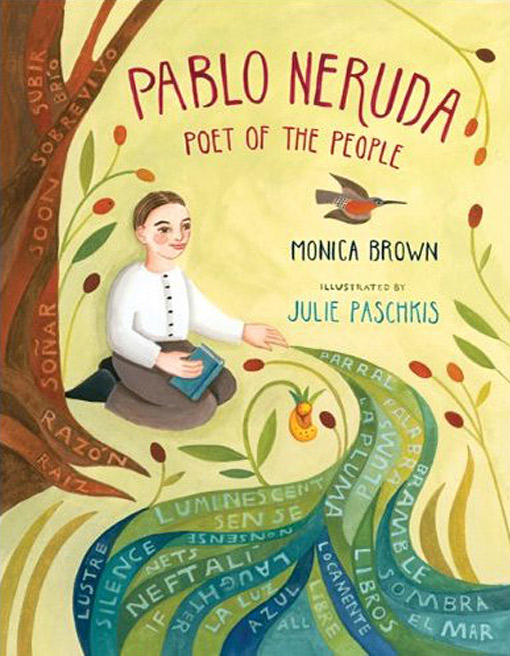
Pablo Neruda Poet of the People by Monica Brown illustrated by Julie Paschkis


Last week IBBY Australia hosted an IBBY delegate from Chile and during a visit to a wonderful school library she mentioned Pablo Neruda. The skilled Teacher-Librarian quickly pulled this book from her shelves. This didn't surprise me because I know she loves the illustrator Julie Paschkis. Our IBBY Chile delegate is also a published poet.

Author site blurb: Once there was a little boy named Neftalí who loved wild things wildly and quiet things quietly. From the moment he could talk, he surrounded himself with words. Neftal' discovered the magic between the pages of books. When he was sixteen, he began publishing his poems as Pablo Neruda. Pablo wrote poems about the things he loved-things made by his friends in the café, things found at the marketplace, and things he saw in nature. He wrote about the people of Chile and their stories of struggle. Because above all things and above all words, Pablo Neruda loved people.

Pablo Neruda won the Nobel Prize for Literature in 1971. He died in 1973. His poetry is written for adults and older teenagers and there is some controversy about his life which is only appropriate for an adult audience. Here is a some information you could use with an Upper Primary group. 

This book for young children is just stunning. The way in which the words (both in Spanish and in English) weave around the page in bright vivid colors (illustrated in a folk-art style by Julie Paschkis), demonstrate how Neruda could make words flow from his pen in magical patterns evoking colors and seasons and animals and most of all, emotions. Rhapsody in Books

The art by Paschkis is extraordinary.  Her paintings combine moments throughout Neruda’s life with words.  The words grow on leaves and trees.  They show in the sun and the moon.  They form the very ground.  It is an expressive way to show the power of words in Neruda’s life as well as how they came from all that surrounds him. Waking Brain Cells


Pablo Neruda Poet of the People was published in 2011 and while it is still available the hardcover edition is very expensive and I am sure well out of reach for most school libraries. There is a bilingual paperback edition , however, which is only around $20. Search for this ISBN 9781250812537. This book would be useful for High School libraries who may be studying the poetry of Pablo Neruda. 

Here are some other books illustrated by Julie Paschkis:


Here are some other biographies by Monica Brown: