Showing posts with label Voice. Show all posts

Wednesday, April 16, 2025

Roar for Reading by Beth Ferry illustrated by Andrew Joyner


"Libraries are like the best free buffets, offering endless choices 
so everyone can pick and choose what they like. 
If there comes a day when you hear that some books have been pulled from your library, it might be time to ROAR."

Libraries were once guarded by lions. They became known as librarians! They had the joyous job of story times, reading and recommending books to children, and adding wonderful books to their libraries. Then came the day Ms Millicent receives a letter. Ms Millicent headed straight to the office of the Mayor. He used words like controversial, inappropriate, and conservative. Ms Millicent replied with words like banning, censorship and accessibility. Ms Millicent did not win this battle of words and so on the next page we see the head librarian, Ms Millicent, pulling bundles and bundles of books off her library shelves. 

Lions from earlier times knew how to roar if things were amiss in the library. Young Julius has been watching his mum pulling out his own favourite books. 

"Julius got a funny feeling. He ran to the shelf where he kept his favourite books. He felt a rush of relief when he saw them, these stories that he loved so much. The one he had read thirty-three times. The one he was saving for the first day of summer. The special one he read with his grandmother."

What would happen if he couldn't read these books? Julius feels a rumble and the rumble turns into a ROAR! His mum feels the roar too and the roar spreads to book lovers everywhere.

At the end of this book the protesters win, and Julius and the other library patrons can read any book they like BUT as you probably know very sadly this is not actually the case in the US. The final pages of Roar for Reading have a set of four stepts - R Recognise book bans and censorship; O Organise and talk to other who see this as wrong A Act write letters, attend meetings and R respect everyone's right to read what interest them. 


This timely book effectively simplifies the current book-banning movement into easily digestible terms. Kirkus

This book caught my eye because I saw the Australian illustrator Andrew Joyner. You may remember his books - The Swap, Flocked, The Terrible Plop or Too Many elephants in this House. I read all of these to hundreds of children in my former school library.

Beth Ferry is a famous author in the US - I wonder how Andrew Joyner came to illustrate her book. Andrew lives in South Australia.  Beth Ferry is the author of Scarecrow illustrated by The Fan Brothers has been on my to buy/read list for many years - sadly though it is very expensive here in Australia. See her books here

These are a very small sample of the picture books and middle grade books that have been banned in the US. These are all books I loved and continue to recommend:


Sunday, December 31, 2023

Catching a Story Fish by Janice N Harrington


'You'd talk the whiskers off a catfish,'
Grandpa says, 'and the shine 
off a new penny.'

I like to talk.
I like to spin stories,
this-is-what-I-did stories,
this-is-what-I-saw stories,
stories to make my brother giggle-bouncy
and wiggly as a worm,
stories to make my Daddy lean in
and hold me octopus-tight,
stories to make Mama's eyes
shine birthday-candle bright.

My name is Katharen but my friends and family call me Keet - Keet Keet Parakeet.

"I used to be Keet-Keet Parakeet.
I used to talk to anyone.
I used to talk anywhere.
But now at school,
words are peanut-butter sticky
and tight was lids on pickle jars."

This seems like a perfect book to end my reading year. It is a verse novel and I adore this genre. It is a book that I knew nothing about, so it is a surprise discovery. This is a book that celebrates the power of storytelling and the importance of courage to use your voice. I love the new friendship between Keet and Allegra. And the paperback edition (2023) of this book has just been published so we can afford to buy it here in Australia. There is even a poem you could use from this book when you talk about our CBCA (Children's Book Council of Australia) 2024 slogan - Reading is Magic. 

Ms Lindle is the school Teacher-Librarian:

"Ms Lindle won't mind.
She says getting lost in a book
is a magic trick
which means that I'm a wizard."

I love Ms Lindle.  When Keet enters a story competition I can hear her warm voice when she says:

"It's a good story, Katharen.'
'Really?' I ask,
'Absolutely-truly-ruly-
no-mistake-for-certain,' Ms Lindle says."

Moving house is hard for Keet and at school the other kids tease her southern accent:

"Grandpa, the kids say I talk funny.
They laugh at my words.
They're mean. Grandpa. And I don't like,
I don't like, I don't like school at all."

Blurb from the author webpageKeet knows the only good thing about moving away from her Alabama home is that she'll live near her beloved grandfather. When Keet starts school, it's even worse than she expected, as the kids tease her about her southern accent. Now Keet, who can "talk the whiskers off a catfish," doesn't want to open her mouth. Slowly, though, while fishing with her grandfather, she learns the art of listening. Gradually, she makes her first new friend. But just as she's beginning to settle in, her grandfather has a stroke, and even though he's still nearby, he suddenly feels ever-so-far-away. Keet is determined to reel him back to her by telling him stories; in the process she finds her voice and her grandfather again. This lyrical and deeply emotional novel-in-verse celebrates the power of story and of finding one's individual voice.

Keet's is a simple and familiar-feeling story, but one that is understated, fully realized, deftly written, and utterly absorbing ... School Library Journal

Awards

  • Winner of the Paterson Prize for Books for Young People
  • Arnold Adoff Poetry Honor Award
Janice N Harrington includes ten different poetry forms in her story and these are listed at the back. 

"This lyrical novel in verse effortlessly weaves together multiple poetry forms to introduce readers to Katharen, called Keet, a young girl who loves to talk and spin stories.... The poems effectively convey conflicting emotions; different styles (haiku, concrete, blues, etc.,) express moods and nuances without being distracting."  Booklist

New Girl Blues

I got the New-Girl blues.
I got those back-to-school and don’t-want-to,
do-I-have-to-Mama? do-I-have-to? blues.

Blues in my thinking, blues
in my walk. Blue and lonely lonely
because of my New-Girl talk.

I got the New-Girl,
don’t-want-to-go,
don’t-make-me-go blues.

You could use this book with a class as a way to explore poetry forms plus there is a wonderful public speaking topic idea - The Dream Report.

I would pair this book with:


Tuesday, November 14, 2023

The Balloon Blow Up! by Andy Geppert


"A balloon as big as the moon will quickly pop. I think we need to make it smaller."

The little girl asks her friend the elephant to blow up her balloon. To make it big, bigger, biggest - as big as the moon!

After Elephant explains this might lead to a disaster she watches as he shrinks the balloon smaller and smaller until it goes pfft!

Then a new voice takes over the balloon himself speaks up. (In a way this shouldn't be a surprise if you notice the image on the title page). The balloon sets up his conditions for use and care in the form of an owner's contract. This reminded me of this book:


I am certain this new Australian Picture book will be a CBCA Notable (Early Childhood). Andy Geppert won Children’s Book Council of Australia Crichton Award ‘Best New Illustrator’ (2010).  The Balloon Blow up! is such a fun book. It is one you will want to share with many groups of readers in your school library. The limited colours of grey, yellow and mauve all done in a soft focus are perfect. Grab a balloon and your toy elephant and settle down for a terrific reading experience. The cover alone, with those 'O' balloons will surely make you want to open this book. 

My friend from Kinderbookswitheverything has a Pinterest collection of books about balloons. Here is a set of teachers notes written by Dr Robyn Sheahan-Bright. The notes also include a list of other picture books about balloons. Here is my favourite:


Here are two other books by Andy Geppert:


Sunday, May 21, 2023

The Summer We Found the Baby by Amy Hest


Julie Sweet and her little sister Martha find a baby on the steps of the library. The sisters have come to the library because today is the day the new children's library will be opened and they are hoping a very special guest will arrive to cut the ribbon. Julie, aged eleven, has even made a cake for the celebration but all of this goes out of her mind when she sees the baby on the library steps in a carry basket. 

Julie picks up the basket and heads off to the beach with her little sister tagging behind. Where did this baby come from? Bruno sees Julie pick up the basket. He sees there is a note inside. He and Julie used to be friends but something has gone seriously wrong and she won't speak to him even though he lives next door.  Little Martha adores Bruno's mum Mrs Ben Eli. Mr and Mrs Ben Eli run the local store in this seaside place and Summer is their busiest time. Bruno is sure Julie is kidnapping the baby so he feels he has to follow her. He did have a more urgent plan for that day having just received a letter from his brother who is serving in the army. The letter told Bruno to catch the train to New York to find his brother Ben's girl friend, Tess. 

This story is told in three voices - Julie, Martha and Bruno - and as we read we slowly piece together the events of the Summer, why Julie is not speaking to Bruno, the importance of letters from young soldiers and a little about Julie and Martha's mum who died many years ago. 

I selected this book because I have read and enjoyed other books by Amy Hest and as you can see I have given this five stars. I highly highly recommend this book for readers aged 9+. It is a short book with lots of white space and empty pages between scenes. I read the whole thing in less than an hour. Read more plot details by Ms Yingling.

Warm family stories laced with some sorrow and great joy. Kirkus star review

Throughout the tale, Hest juxtaposes childish bickering with the heavy weight of grief and ultimately hope in the form Eleanor Roosevelt. Historical novel society

This brief story unfolds in short vignettes which prove surprisingly engaging and will draw the reader in quickly. Kids Book a Day


Friday, September 9, 2022

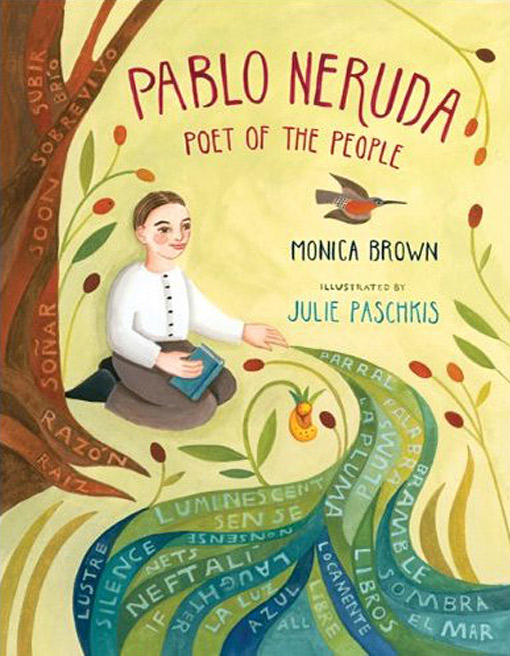
Pablo Neruda Poet of the People by Monica Brown illustrated by Julie Paschkis


Last week IBBY Australia hosted an IBBY delegate from Chile and during a visit to a wonderful school library she mentioned Pablo Neruda. The skilled Teacher-Librarian quickly pulled this book from her shelves. This didn't surprise me because I know she loves the illustrator Julie Paschkis. Our IBBY Chile delegate is also a published poet.

Author site blurb: Once there was a little boy named Neftalí who loved wild things wildly and quiet things quietly. From the moment he could talk, he surrounded himself with words. Neftal' discovered the magic between the pages of books. When he was sixteen, he began publishing his poems as Pablo Neruda. Pablo wrote poems about the things he loved-things made by his friends in the café, things found at the marketplace, and things he saw in nature. He wrote about the people of Chile and their stories of struggle. Because above all things and above all words, Pablo Neruda loved people.

Pablo Neruda won the Nobel Prize for Literature in 1971. He died in 1973. His poetry is written for adults and older teenagers and there is some controversy about his life which is only appropriate for an adult audience. Here is a some information you could use with an Upper Primary group. 

This book for young children is just stunning. The way in which the words (both in Spanish and in English) weave around the page in bright vivid colors (illustrated in a folk-art style by Julie Paschkis), demonstrate how Neruda could make words flow from his pen in magical patterns evoking colors and seasons and animals and most of all, emotions. Rhapsody in Books

The art by Paschkis is extraordinary.  Her paintings combine moments throughout Neruda’s life with words.  The words grow on leaves and trees.  They show in the sun and the moon.  They form the very ground.  It is an expressive way to show the power of words in Neruda’s life as well as how they came from all that surrounds him. Waking Brain Cells


Pablo Neruda Poet of the People was published in 2011 and while it is still available the hardcover edition is very expensive and I am sure well out of reach for most school libraries. There is a bilingual paperback edition , however, which is only around $20. Search for this ISBN 9781250812537. This book would be useful for High School libraries who may be studying the poetry of Pablo Neruda. 

Here are some other books illustrated by Julie Paschkis:


Here are some other biographies by Monica Brown:


Wednesday, August 17, 2022

No Words by Maryam Master


Aria is the new boy at school. Hero (named after the Shakespearean character) and her friend Jaz are curious about Aria. He does not speak. No he is not just a quiet kid - he is mute. At first their friendship is more about curiosity, this no speaking seems like a mystery to solve, but very quickly all three become good friends which means they can unite against the school bully Rufus. Well Hero would like to challenge and even defeat Rufus but every time she witnesses dreadful things happening to Aria she just freezes - she seems unable to be a hero even though that is her name. Then the girls make another discovery about Aria and so perhaps Hero can be a hero after all.

At home things can be tough for Hero because her father suffers enormous mood swings - he can be UP and happy and engaged or way down and unable to leave the house or get out of bed. 

Jaz is the third character and she is just a crazy girl. She is loud and has strong opinions and she is fearless even though she does obsess about her health.

Now that you have met Aria, Hero and Jaz you need to read this book to discover why Aria cannot talk, how Jaz and Hero help him, and hopefully find out how the issue of Rufus is resolved. 

There are a lot of issues in this book which has just over 200 pages - bullies, mental health, refugees, courage, and the importance of friendship. 

The strongest part of this writing comes from the way Maryam Master gives the reader fragments of Aria's story and his terrifying experience of fleeing Iran. These chapters are 'decorated' with fragments of the Arabic and English alphabet. This is a subtle but well designed way to show the change of voice. The short chapters ensure this book is a quick read and a true page turner. 

Maryam Master talked to Joy Lawn at Paperbark Words:

It is my hope that anyone reading No Words will be uplifted. I hope they too will see that no matter what curveballs life throws at us (even a revolution!), hope and humour will see us through. Oh, and words.

My only small criticism of this book (and probably these parts will appeal to the target audience of 10+) are the references to poo, farts and snot. I am not the target audience but these felt like cheap, and perhaps unnecessary, jokes although I appreciate that Maryam wanted to add a touch of humour to her story. I also was unsure why the class teacher was depicted as such a crazy lady allocating hundreds of detention hours for tiny misdemeanours. On the other hand this book has a huge amount of heart and Aria's experiences are heart-wrenching and beautifully described. I also really enjoy books with multiple voices. 

Parts of this book reminded me of a more sophisticated story Soraya the Storyteller by Rosanne Hawke.


Companion reads:


This one is perfect for a younger audience


If you want to explore another book about selective mutism try to find this one (note it has several different covers):


And these:


Sunday, August 22, 2021

Madam Squeaker by Pip Jones illustrated by Paula Bowles


Here is the blurb: Crumbs on the counter, morsels on the floor – there should be plenty of food for Minetta the mouse to eat in Hollyhock House …  But the Ruling Rats are running rampage every night, taking the best of everything for themselves. Minetta has decided that enough is enough – it’s time the rats learn to share. The trouble is, Minetta is so small and her voice just a squeak. How will she ever make them listen …?

Now that you have read the blurb take a closer look at the front cover. This might be a way to introduce the word megaphone to your young reading companion. Possibly, also, young readers may not have ever seen a cotton reel - there is a whole wonderful discussion to be had about this too. You might also like to talk about the title and the pun of squeaker versus speaker. 

Next make sure you look at the end papers with their brightly pink polka dot pattern and the little quizzes found inside the front and back dust jackets - these are a delightful addition in all of the Little Gem titles. 

After reading the story you could think about why the owl is named Sage and the idea of sage advice. Then there are the themes of negotiation, conflict resolution, bravery, finding a voice, confidence and team work. All of this in a tiny illustrated 84 page book!

Minetta does confront the rats with the wonderful support of her community - the other animals in the house and garden but the part of this story that I enjoyed the most was the ending. It is rare to find a book for a young audience with an open ending that invites more thought or perhaps even inspires some writing. Here are the final lines of the book:

"The first thing we need to talk about,' she said to all the animals and birds around her, 'is sharing food.' One by one, the mice and doves, the voles and hedgehogs, and even the rats sat down and they listened."

If you haven't discovered the Little Gems series published by Barrington Stoke can I suggest you try to find some soon. These books are perfect easy chapter books for newly independent readers. This story has just 12 very short chapters.  You could plan to read one or two each night as a family read aloud.  The chapters have fun titles: Half a peanut and a speak of cheese; Some Sage advice; and No room for a Mouse. 

My friend at Kinderbookswitheverything has an extensive Pinterest collection of books featuring mice. Here are some other books about heroic mice for young readers. I especially recommend hunting out the Squeak Street chapter books by Emily Rodda:


Squeak Street - easy chapter series and picture book


You can see other books illustrated by Paula Bowles here.  Pip Jones is the author of the Squishy McFluff books. There are seven titles in this series.