Showing posts with label Nature storybook series. Show all posts

Thursday, April 23, 2026

Say Hi to Hedgehogs by Jane McGuiness


Follow this lovely little creature through the year and learn what hedgehogs like to eat, how they hunt for their food, where they build their nests, the time it takes for them grow from tiny hoglets into healthy adults and, as the seasons turn, 
how they prepare for hibernation.

You are right - we do not have hedgehogs here in Australia but that does not stop my fascination. Several years ago I visited a family in Sussex and they were delighted to show me a baby hedgehog and they also explained how people in their rural village or hamlet were anxious to create safe spaces for these tiny creatures. In the USA this book has a different cover and title - Prickly Hedgehogs. Say hi to Hedgehogs is a title from the Nature Story Book (or formerly called Read and Wonder) book series published by Walker Books (Candlewick in the US).  Click the label at the bottom of this post to find more books from this fabulous series. 

You can see just how sweet they look in this glorious illustration by Brian Wildsmith from his book Wild Animals:

Here are a couple of my favourite hedgehog books:


Find more book ideas here - 2nd February 2019 Hedgehog Day (Kinderbookswitheverything); and 2nd February 2023 Hedgehog Day (Kinderbookswitheverything). 

Jane McGuinness is also the illustrator of this terrific book that you MUST add to your library:


Monday, April 6, 2026

My Pet Goldfish by Catherine Rayner


"When I was four, I got my first ever pet: a fish no bigger than my hand, with red and orange scales. My very own goldfish! He didn't have a name yet so I got to choose one - and I called him 'Richard'".

Richard is not alone - he lives in a fish tank with her sister's fish. The young girl loves spending time with Richard - telling him about her day. Sandy, the boy next door also has some goldfish but this live in pond in his garden. When you turn to the page filled with the fish in Sandy's pond you will gasp at all the colours.


There are facts on each page of this book: did you know there are over two hundred different kinds of goldfish with names like comets, bubble eyes and pompoms. And did you know that a group of goldfish is called a “troubling” or that the oldest ever goldfish was 43 years old?

Eventually Richard grows too big for the fish tank and so the girl takes him over to Sandy's to live in his pond. 

Because this book is a combination of narrative and nonfiction it contains an index, further reading list, and a page of author notes. 

My Pet Goldfish was published in 2021 - I am not sure how I missed it. AND it is illustrated (and written) by Catherine Rayner which is another reason I should have been aware of this book. Here is a video of Catherine reading her book. 

In the library where I spend a joyous day as a volunteer the Teacher-Librarian has gathered together all of her books from the Nature Storybook (or previously Read and Wonder) series from Walker books. I think she might have nearly every one of these splendid nonfiction titles. Recently she set up a display of books about goldfish and it proved very popular with the children and now this topic links perfectly with one of the CBCA 2026 Early Childhood shortlisted titles - Derek.


Wednesday, November 12, 2025

Super Swifts by Justin Anderson illustrated by Clover Robin


Subtitle: The small bird with amazing powers


Super Swifts is set in Africa, Europe and the UK BUT we do have swifts here in Australia - ork-tailed Swift (Apus pacificus); House Swift (Apus affinis); White-throated Needletail (Hirundapus caudacutus) and the Uniform Swiftlet (Aerodramus vanikorensis). One of our Australian netball teams is named The Swifts!

I find the topic of bird migration endlessly fascinating. Click the label on this post to find more books on this topic - try to find Circle by Australian illustrator Jeannie Baker. 

Swifts are a family of highly aerial birds known as Apodidae, which reside within the Apodiformes order alongside hummingbirds. ... Swifts have small, weak legs, which led to them sometimes being depicted without feet historically. ...  There are about 100 species of swifts, which are known for their high speeds, with the white-throated needletail reaching up to 169 km/h. They have elongated wingtip bones and the ability to rotate their wings from the base, which aids in their maneuverability and efficiency in flight. Swiftlets have evolved a form of echolocation to navigate dark caves. These birds are found worldwide except in the extremes of the polar, desert, and some oceanic islands, and migratory swifts travel from temperate regions to the tropics in winter. Their nests, often attached to vertical surfaces with saliva or located in wall cavities, are unique—some are used in the traditional bird's nest soup. Swifts are insectivores, hunting mid-flight, and their breeding and development patterns are more similar to seabirds than passerines. While no swift species has been recorded as extinct since 1600, some are considered endangered or vulnerable ... (Source)

All about swifts:
  • Coloured dark, sooty brown but can look black against the sky 
  • Pale patch on the throat, but this is often difficult to see in flight 
  • Long, pointed wings held in a ‘boomerang’ shape 
  • Wings are narrower than those of a Swallow or martin 
  • Short, forked tail which can be folded to a point 
  • Bullet-shaped head 
  • You’ll often hear them before you see them – they make an unmistakable, high-pitched ‘scream’ 
  • Swifts can travel up to 500 miles in one day
  • They 'sleep' while flying - this is called unihemispheric slow-wave sleep, where one half of their brain remains alert while the other half enters a sleep state.
  • Swift fly slowly through rain as a way to keep clean
  • Swift mate for life
  • They can catch as many as 50,000 insects in a day
  • They can live up to 21 years
Here is a map showing the journey of one swift in 2010 and you could show this video to your students:


Image source: Turning the Stones

The first thing I noticed in the two books I read today about swifts (see below for the second title) is their large eyes. So, I went hunting for a photo of a swift.


Images source: Audubon Society

I also thought about collective nouns which is a topic I find quite fascinating. What do you call a group of swifts? I found four possibilities Flight, Scream, Flock or Kettle!

Then I found this one - a sweep of swifts:

Swifts are highly agile and acrobatic birds known for their remarkable speed and graceful movements in the sky. When witnessed together, their collective presence forms a breathtaking spectacle as they swoop, loop, and glide through the air, displaying remarkable synchronization and coordination. The term sweep embodies the seamless and synchronized movements performed by these swifts, as if they are brushing through the atmosphere with remarkable elegance. The sight of a Sweep of Swifts evokes a sense of awe and wonder, as these social birds create a hypnotizing performance while efficiently navigating their surroundings.


Publisher blurbA swift may not look like anything special—it’s just a plain brown bird, small enough to nestle in the palm of your hand—but these superheroes of the avian world can fly incredible distances amazingly quickly, reaching speeds of up to seventy miles per hour and spending ten months of every year in the air. Follow one female swift from the steamy forests of tropical central Africa to northern Europe as she navigates arid desert and restless ocean, dodging predators along the way. Eating, drinking, and sleeping on the wind, she won’t rest until she’s reached her nesting site. Woven through with fascinating facts amplified in an author’s note and index, Super Swifts fuses gorgeous collage illustrations and a lilting text to evoke the grandeur of a voyage like no other—and introduce a singular bird with amazing powers.

Text in a larger font provides a smooth narrative, ideal for a read-aloud, while text in a smaller font offers intriguing facts. A series of text boxes describe the swifts’ symbiotic relationship with the louse flies that ride north in their feathers, lay eggs in swift nests, and send a new generation of swift lice south in the fall. Robin’s mixed-media illustrations show the changing scenery in double-page spreads; smaller vignettes depict nesting details and a thrilling scene in which our protagonist must evade an attacking falcon. Kirkus

Super Swifts is published by Walker Books. I need to explain this series (and my confusion). When Walker Books started this series, where a narrative is paired with facts presented on the same page in a smaller font,  they were called Read and Wonder. To me this was the perfect series name. Then many years later the name changed to Nature Storybooks. Same format, same fabulous topics and most importantly same highly skilled illustrators. Fast forward to today - Walker Books are still producing these wonderful books which need to be added to EVERY school and public library BUT now there is no series name.  I can only ask why?

Companion book (you need this one in your library too):


I am a huge fan of collage art by Clover Robin - here is her instagram page. Here are some two books I have talked about here she has illustrated:


Other Read and Wonder or Nature Storybook titles:


Sunday, February 25, 2024

The Beehive by Megan Daley illustrated by Max Hamilton (Walker Nature Storybook series)


It is always thrilling to me when I see bees buzzing around flowering trees and small flowers. Megan Daley, the author of this new book, has loved bees nearly all her life beginning with times shared with her grandfather on his farm. Here is part of the dedication from her book:

"To Grandad for sparking and nurturing my love of bees, gardening and agriculture when I was very young."

The Beehive publisher blurb Walker Books: It's finally hive day! Willow has been waiting all year for groundskeeper Tom to split the school's native stingless beehive in two so she can take home her very own hive. Everything needs to be just right to help so that the bees forage and thrive in their new home. The dual text results in a charming story alongside an abundance of fascinating facts about Australia's native bees.

The Walker Books Nature Story series (formerly called Read and Wonder) are fabulous books to share with a young reader or in a library session. 


At the Sydney event to celebrate publication of The Beehive and on also this podcast (Words and Nerds) Megan explains that she loves to share nonfiction with her students and so about seven years ago she used the format of the Nature Story Book series to pen an innovation on this text style, writing her own book about our Native Australian bees. 

Native Australian bees are smaller than European bees and nearly all of them do not sting but they can nip you with their mandibles. The most special of our Australian Native bees are the Blue-Banded variety. I have listed further resources below. Read this review from the Australian Native Bee Association.

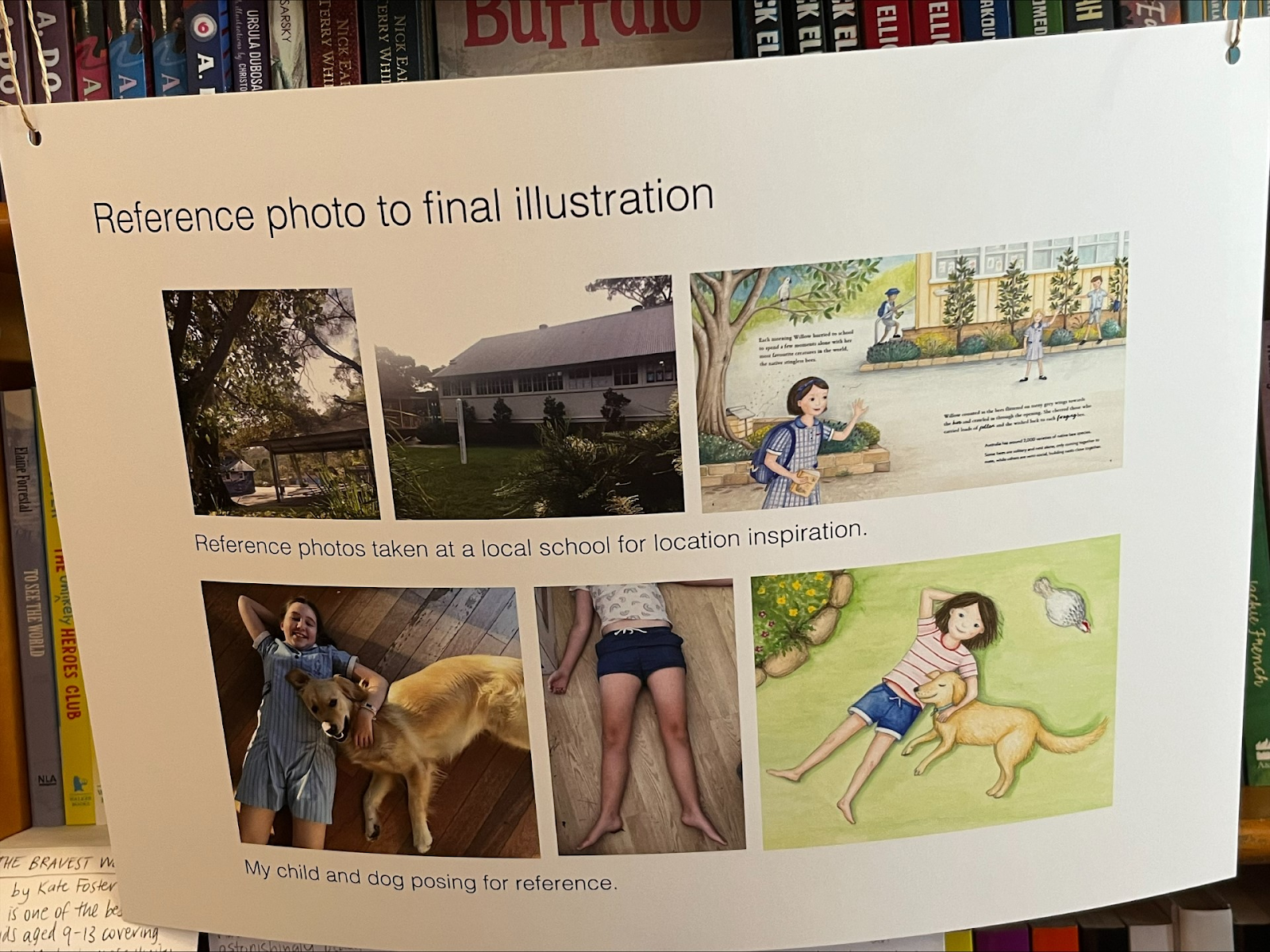
Prior to attending this event at our Sydney Bookshop - Gleebooks - I had read quite a bit about The Beehive via Megan Daley's own posts on Facebook and also via her group Your Kid's Next Read although I didn't know her story character Willow's name came from her younger daughter. Nor did I know she wrote 27 drafts of this text and that her beekeeper partner did not want the story beekeeper to look like an old man with grey hair. Here are the ideas Max Hamilton tried out before settling in the character of Tom who is based on a real person:


The really interesting part of the event today though, was hearing from the illustrator Max Hamilton. By happy coincidence this Sydney event was the first time Max Hamilton and Megan Daley had met in person. 


One lovely moment came when Megan talked about how she loved the AA Milne Winnie the Pooh books as a child - especially all the references to honey and bees. Then Max Hamilton showed that she had incorporated this classic story into her illustration without knowing this connection with the author Megan Daley!


We also saw her thumbnails for the book layout, her changing ideas for the cover, and the photos she used as models for her illustrations.


Everything in this story is beautiful, with a unique voice that shines on the page, dancing its way around each word and image as the story and facts come together to create a book that readers of all ages will enjoy and find engaging. It is also bright and colourful, exactly as a book about bees should be as it celebrates nature and the natural world, and what it can give us. I loved that it spoke about how important bees are whilst also being entertaining and accessible, ensuring that the layers of understanding are there for a wide range of readers. The Book Muse

Further reading:

Aussie Bee

Wheenbee Foundation

Which Native Bees live in your area? (I would love to see a Teddy Bear bee)

ABC Education Bee Heroes

World Bee Day - 20th May

100 Hives in 100 Schools

Kinderbookswitheverything blog - World Bee Day book ideas

This book also has a link to IBBY Australia. Max Hamilton kindly donated a beautiful piece of original art for our mini masterpiece auction - it was the little girl from this book! And we found out why she is holding Gnomes by Wil Huygen.


You could also look for these in your school library:


I should also mention there were a number of famous children's literature supporters and creators at this event including members of the CBCA (Children's Book Council of Australia) committee; and authors and illustrators such as Nat A'MooreCheryl Orsini; Debra Tidball; Allison Tait; Jacqueline Harvey; Pip Harry; and Kristin Darell.  Thanks also to bookseller Rachel Robson. Her costume and enthusiasm made this event very special (and memorable). Best wishes for her move to the new shop just down the road - packing up all those books will be a mammoth task but I can't wait to see the newly renovated space (which will have a coffee shop).

Tuesday, August 16, 2022

Kookaburra by Claire Saxby illustrated by Tannya Harricks


Publisher blurb: Kook-kook-kook. Kak-kak-kak. What is that sunrise chorus that sounds like laughter? It is a kookaburra and her family, calling over the river. Follow these iconic Australian birds as they search for food and team up to defend their territory in preparation for the nesting season. With rich paintings and poetic text, threaded through with intriguing facts, Kookaburra offers insight into the lives of these fascinating birds. Curious readers will find more information about kookaburras at the end, as well as an index leading them back through the book to explore these distinctive creatures more closely.

I adore Kookaburras and I am lucky because there is a colony of them living in the bush land near me so I often see them and hear their raucous and very distinct laughter


I picked up Kookaburra at the Book Bunker library at Westmead Children's Hospital mainly because I wanted to share the fabulous illustrations. This book would also be perfect to send as a gift to a child or friend living overseas.


Image Source: Booktopia

Here is an interview with Tannya by Kids' Book Review. 

I often think it would be wonderful to present a paper at an international conference about our Australian animals and birds in picture books especially the less well known ones or less well known overseas anyway.  You might remember I already talked about wombats (there are so many picture books about wombats perhaps because Diary of a Wombat by Jackie French is so popular). You might like to explore other books about kookaburras.


Kookaburra is from the Nature Story Book (Read and Wonder) series from Walker Books. If you have not discovered Tannya Harricks try to find her spectacular book Mallee Sky.


Sunday, July 3, 2022

Wombat by Christopher Cheng illustrated by Liz Duthie


Yesterday I talked about wombats in picture books. Today I will look a little more closely at a fairly new non fiction book about wombats. This book is from the splendid series by Walker Books called Nature Storybooks. Yes they are stories or narratives as the series name implies, but each also contains a wealth of facts about each animal. These books are so well researched and designed, yet, at no time do these books overload the reader with facts.  Each page follows a format of a large illustration, lines of the narrative (in one font) and facts (in a different font) usually below the main narrative. At the back of each book there is an index and a page of further information. On the Walker Books site you can access teachers notes for each Australian title. 

These books (the full set) should be added to every Primary school library and public library too. They are perfect for class use and for sharing with children aged 4-8. 

Wombat begins with the lines:

"Far underground, where dirt and tree roots mesh, tunnels lead to a burrow, and Wombat's day begins. She ventures outside, alert and hungry as a fading sun farewells the day."

Now read the non fiction text which perfectly describes the cover image:

"Wombats have poor eyesight. Their ears are short, slightly rounded and small. Their button-like noses with nostrils at the tip are hairless and covered in grainy skin. They have course, thick fur, a bit like a doormat."

I also need to comment on the rich vocabulary Christopher Cheng uses in his book - mesh, ventures, ambles, determined, excavating, intense, raucous, antics, intruder, sanctuary, flinch, chamber, and wary.

This is the second Nature Storybook by Christopher Cheng - his previous title was Python illustrated by Mark Jackson. 

Publisher blurb for Wombat: Learn all about the Australian “bulldozer of the bush” in a fascinating introduction to the wombat. Wombats may look soft and cuddly, but they are determined and tough, with sharp teeth that never stop growing, limbs that they use to shovel dirt like bulldozers, and bony bottoms they use to defend their burrows. They can live for years without drinking water, getting all of their moisture from the plants they eat—and they deposit their cube-shaped poop on rocks or stumps as a warning to other wombats. Follow one of these powerful marsupials through a suspenseful day in Christopher Cheng’s engaging narration, paired with endearing illustrations by Liz Duthie and interspersed with intriguing facts. An endnote provides additional information about wombats for readers curious to learn more.

I was so pleased to see Wombat listed as a 2022 Eve Pownall Notable book for 2022


Here are the teachers notes. You could compare Wombat (Christopher Cheng and Liz Duthie) with other wombat non fiction titles - there are sure to be a few in your library at [599.24]. 


Here are more of the Nature Storybooks which are also called Read and Wonder. I love the way many of these feature work by the best illustrators such as Satoshi Kitamura; Liz Anelli; Tannya Harricks; Anita Jeram; Charlotte Voake; Julie Vivas; Salvatore Rubbino; Michael Foreman; Catherine Rayner; and Tim Hopgood. They also showcase some fabulous authors too. In the US they are published by Candlewick


I have added these three to my own (very long) to read list: