Sunday, July 17, 2016

Somewhere in Australia by Marcello Pennacchio illustrated by Danny Snell


Do you know this little song?

Over in the meadow in a pond in the sun,
Lived an old mother duck and her little duck one,
Quack said the mother,
Quack said the one,
And they quacked and were happy in their pond in the sun.


Somewhere in Australia is an innovation on this classic text adding a decidedly Australian flavour.


I am making a collection of picture books to read to our youngest classes as we explore the CBCA slogan of 2016

Australia: Story Country

Here is the text for the first verse of this version :

Somewhere in Australia, in a land of scorching sun,
Lived a mother kangaroo and her little joey one.
'Hop,' said the mother. 'I hop,' said the one,
as they hopped over land scorched by the hot sun.

Next we meet two kookaburra chicks, three platypus babies (platy-pups), four Tassie devils, five dingo pups and so on all the way to ten red-back spiders.

Teachers could make excellent use of the verbs in this book :
hop, laugh, swim, growl, howl, slither, bask, run, jump and hunt.

You could also make a list of other Australian animals and write more verses for the song perhaps.

For international readers baby platypus are not called platy-pups - they are called puggles but in this story Marcello Pennacchio needed to maintain his rhyming scheme and I do like the idea of platy-pups.

Danny Snell adds fabulous illustrations to this book.  Take a look at my previous review of his book Seagull.  Jeremy (about a rescued kookaburra) was a popular book during Book Week in 2014.

The final lines of this book match perfectly with our 2016 slogan :

All across Australia, in the dreams of sleepy little ones,
Are sand and sea, bush and desert, the land of the scorching sun.




Saturday, July 16, 2016

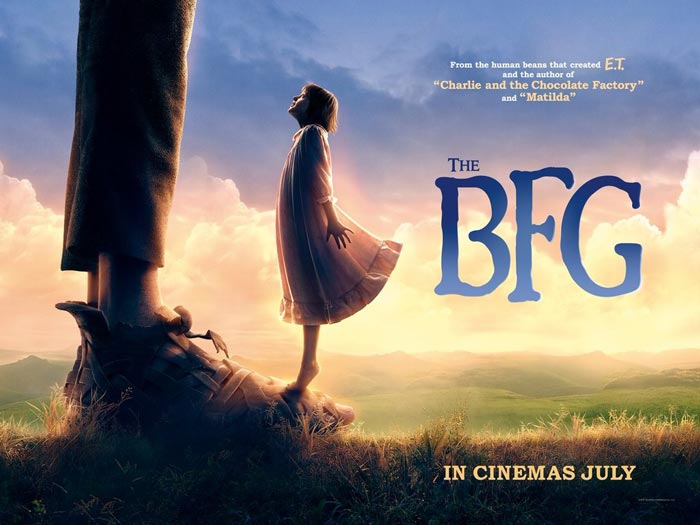
The BFG by Roald Dahl


The BFG is, of course, such a famous book.  I won't go into all the plot details, inventive and amazing words or the very special relationship between this brave little girl and her gentle giant friend. Read here for some ideas to use with a class.  Next item on my school shopping list is the audio book read by David Walliams.

Instead I just thought I might quote a couple of my favourite passages :

"The butler, an imposing personage named Mr Tibbs, was in supreme command of all the palace servants and he did the best he could in the short time available.  A man does not rise to become the Queen's butler unless he is gifted with extraordinary cunning, sophistication, sagacity, discretion and a host of other talents that neither you nor I possess."

"Sophie, still wearing only her nightie, was reclining comfortably in a crevice of the BFG's right ear. She was actually in the outer rim of the ear, near the top, where the edge of the ear folds over, and this fold-over bit made a sort of roof for her and gave her wonderful protection against the rushing wind. What is more, she was lying on skin that was soft and warm and almost velvety. Nobody, she told herself, had ever travelled in greater comfort."

"Then out he came!
Twenty-four feet tall, wearing his back cloak with the grace of a nobleman, still carrying his long trumpet in one hand, he strode magnificently across the Palace lawn toward the window .. he stopped and made a graceful bow ... 'Your Majester ... I is your humbug servant."

I re-read The BFG today in preparation for seeing the new movie. I do hope it has the same magic (and marvelous words) that make the book so special for every generation.


Home Now by Lesley Beake illustrated by Karin Littlewood

I have been looking for books to link with the CBCA short listed titles.  I do like to extend our reading of these books with an exploration of the author or illustrator or perhaps the topic.

Home now links quite nicely with One step at a time.   Listen to an interview with Jane Jolley and Sally Heinrich.  They talk about the horror of land mines and their impact on the people and animals in Thailand.


In Home now we meet Sieta, has recently become an orphan in South Africa, and read how a special baby elephant is able to help her as she adjusts to her new life.


"Sieta remembered a green garden in a dry land. ... Sieta remembered when she and Ma and Pa went to church on Sundays."

Sieta goes on a school excursion to an elephant park.  She meets orphan elephants and forms an immediate bond with Satara - the baby. "Sieta smelled his elephant smell and it smelled like wild places far, far away."  The next day, straight after school,  Sieta goes back to visit Satara.  Back in her village she looks on the scene with new eyes.  This is a new and strange place but perhaps it can become her new home - a place for new memories and new pictures in her mind.

After reading Home Now you might compare this with The colour of home which has the same illustrator - Karin Littlewood.  For class reading you could also use Tua and the elephant and Elephant Mountain from the Aussie Bites series.

Monday, July 11, 2016

Hello from nowhere by Raewyn Caisley and Karen Blair


Our Book Week slogan for 2016 is 
Australia : Story Country

My friends and I have been talking about Australian themed books we can use to explore this slogan. Hello from nowhere was mentioned in our discussion so I bought it home to read.

This is a very special book and a great way to give city children a little insight into life in a remote corner of Australia.  Read more about the inspiration for this book.

Eve lives at a roadhouse. The map on the final end paper shows the exact remote location somewhere in south western South Australia in the Nullabor desert.


Eve is a very self sufficient child but she desperately misses her grandmother and hopes one day she might come out to Nowhere for a visit.  Eve has her animal friends, her cat called Livestock, and the regular visitors to the roadhouse - tourists, truck drivers and grey nomads. Eve writes to her Nan and the day she arrives (after such a long wait) is utterly joyous. Eve shares all the good things of her environment.  Nan does have to leave at the end but she gives the promise of returning again very soon.


Take a look here for some teaching ideas to use with this book.  You might like to look at my review of With Nan also illustrated by Karen Blair.

Other books we will explore this term include Are we there yet? by Alison Lester, Possum Magic by Mem Fox and Tom the outback mailman by Kristin Wiedenbach.

Sunday, July 10, 2016

The cow tripped over the moon by Tony Wilson illustrated by Laura Wood


The cow tripped over the moon is short listed for the 2016 CBCA Early Childhood Picture book of the year.  I personally don't see it as the major prize winner but it will be fun to explore this book and others which follow a similar theme with our youngest students this term.

In this version the poor cow makes eight attempts at jumping over the moon.  The fiddle, dish, spoon and little dog all have a part to play not the least as a cheer squad.  You can see some of the pages on the illustrator web site.

"The whole group together
Said 'Cow, now or never!
We know that you'll make it this time.
And as of this night
We'll remember your flight
In a hay diddle-diddly rhyme."

Before reading The cow tripped over the moon you might revisit the actual rhyme :

Hey diddle diddle, the cat and the fiddle,
The cow jumped over the moon.
The little dog laughed to see such fun
And the dish ran away with the spoon!


Here is a simple video version.  Older children will laugh over this version by Michael Rosen from this wonderful book Hairy Tales and Nursery Crimes.

Following this you might compare this version by Tony Wilson with Over the Moon by Libby Hathorn, The Great Nursery Rhyme Disaster by David Conway, Hey Diddle Diddle by Kate Toms, The adventures of the dish and spoon by Mini Grey and a book with the same title The Cow jumped over the moon by Jeanne Willis.


Class teachers could also look at some Nursery Rhyme anthologies and the wonderful series of books called Urgency Emergency.


Thursday, July 7, 2016

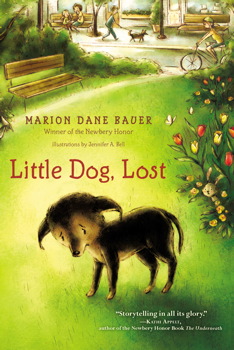
Little dog, lost by Marion Dane Bauer illustrated by Jennifer A Bell


By the end of this little verse novel every one has huge smiles on their faces - the kids, the adults and the reader!  The words gem, joy, delight, charming, sweet, honest and exquisite are all words I would use to describe Little Dog, Lost.

I was browsing a list of verse novels when I saw the cover of this little book.  I adore verse novels but I had not seen Little Dog, Lost on any previous lists.  It is not a new book first published in 2012.

I read the Kirkus review and knew I would adore this book.


Mark longs for a dog.  A boy in another town has a dog he adores. This boy is moving to an apartment and his dog is given away to a lady (who has no understanding of dogs) who lives in the same town as Mark.  The little dog is called Buddy.  She is confused and desperate to find her boy again.  Meanwhile, Mark decides he needs a campaign to lobby his mum - who is the mayor - for a dog park. Mum won't let Mark have a dog but perhaps a park will give him space to connect with the special dogs owned by all of his friends. Living in this town, called Erthly, is an old man grieving for the loss of his mistress - he is now the reclusive owner of a mansion in the middle of town. How can these three lives be bought together?

In the night dark
he could make out a small dog
with airplane ears
that drooped
just at the tips.
Such sweet ears!

...

Charles Larue watched the boy,
watched the dog.
Both boy and dog
were coiled springs,
waiting to be released.

Buddy stretched toward the reaching hand.
She touched it,
just lightly
with her cool, damp nose.
A boy hand.
A good boy hand.
She breathed it in.

Here is a discussion guide.  You can hear the author read a small section of this book on her web site.  I would link the reading of this book with Rose Meets Mr Wintergarten by Bob Graham, One dog and his boy by Eva Ibbotson and Everything for a dog by Ann M Martin.  This book also reminded me of Happy Mouseday.

I am delighted to see another book by Marion Dane Bauer this time featuring a cat.


Wednesday, July 6, 2016

Theophilus Grey and the Demon Thief by Catherine Jinks


Some books are a sprint while others are a marathon.  Theophilus Grey and the Demon Thief is certainly a marathon read but the rewards are truly great.

Catherine Jinks is a modern day Charles Dickens.  Her turn of phrase, colourful character names, vivid descriptions of life in eighteenth century London and her ability to recreate the sights, disgusting smells and night terrors of the city are breathtaking.

"Philo hurried along Turnstile Alley, heading for the George Inn.  It was past midnight. Recent showers had turned the street into a swamp, so Philo took care to avoid the drain that ran down its centre.  Instead he stayed close to the mean little shops on his left which were full of second-hand furniture and household goods. .. Then a shuttered door slammed open, and someone dumped the contents of a chamber-pot out of a second-storey window."

Theophilus is better known as Philo.  He is an orphan in the tradition of the Artful Dodger of Oliver Twist fame.  Philo works for a cunning man called Garnet Hooke.  Philo and his gang of linkboys report each day to Garnet who gathers information like Fagan.  Garnet uses information about thefts in London to bribe officials and claim rewards.

A linkboy is a boy who carries a light at night to show the way to people in the city at night.  This story is set before the advent of street lighting and this activity alone greatly adds to the tension of the story.  The city is such a dangerous place and lately it has become even more dangerous as several notorious criminals are struck with a mystery malady causing them to fall into unconsciousness. Rumors are rife that a monster, a demon, called a spriggan is the cause.

This is a complex book to read but Catherine Jinks offers help in the form of a map, insightful chapter headings and a glossary.  Readers will encounter so many new and unfamiliar words in this book but the context helps you glean the meaning and because the story is so engrossing.  I mentioned previously Catherine Jinks skill with words.

"will you peach on 'em or no?"
"Val was rolling up his palliasse"
"In the past, Garnet had always been shielded from rebuke"
"It was quite busy thanks to a hurdy-gurdy player stationed near the livery stables."
"his leather breeches had to be cinched in at the waist with a piece of rope."

The descriptions in this book are excellent and could be used as a writing model with a senior primary class.  Here is a description of Susannah.  Philo will need all his courage and problem solving skills to save her from a dreadful imprisonment later in the story.

"She was nine years old and as frail as a cobweb, with bleached skin, hands like a chicken' s claws, and pale, silky hair.  It seemed to Philo that she must have been born in her draggled blue skirt and oversized stays, for he had never seen her in anything else.  During summer she sold fresh rosemary for a penny a bunch; in winter, the rosemary was dried."

Theophilus Grey and the Demon Thief is the first in a series of two books.  I am now keen to begin book two.


Here is a review in Reading Time.  Teacher notes are available from the publisher web site.

After reading Thophilus Grey and the Demon Thief I recommend The City of Orphans series which begins with A Very Unusual Pursuit (also by Catherine Jinks), Ruby in the Smoke by Philip Pullman and Barnaby Grimes by Paul Stewart.