Showing posts with label Africa. Show all posts

Saturday, July 26, 2025

Children of the Quicksands by Efua Traore


Publisher blurb: City girl Simi is sent to stay with her long-lost grandmother in a remote Nigerian village. There’s no TV, internet or phone. Not a single human-made sound can be heard at night, just the noise of birds and animals rustling in the dark forest outside. Her witchlike grandmother dispenses advice and herbal medicine to the village, but she’s tight lipped about their family history. Something must have happened, but what? Determined to find out, Simi disobeys her grandmother and goes exploring. Caught in the sinking red quicksand of a forbidden lake, her fantastical journey begins …

There are only a few main characters in this book but I did keep getting lost and so I wish a list of human and non-human (gods) had been included. The ending is a little abrupt and for me, confusing. I didn't understand why the children were suffering on the other side of the lake and also I still don't really know why hundreds of them were taken there over the years. I also should have made more use of the help glossary which is included at the beginning of the book.

Readers aged 10+ with plenty of reading stamina who enjoy stories set in different cultures and stories with elements of magical realism and danger may enjoy this story. 

Curious readers might dig deeper into Nigerian folklore:

The taking of the children from the village might also make you think of the famous poem about the Pied Piper. 

Children of the quicksand was a debut novel for Efua Traore - she won the Times/Chicken House competition which then led to the publication of her book. You can see her other books here. I do enjoy books published by Chicken House. On their page you can read an extract from this book. Here is a review from the journal Africa Access

Here is an alternate cover:


Bookseller blurb: A richly imagined magical adventure set in West Africa by a prize-winning new voice in children's writing, Children of the Quicksands introduces readers to Yoruba myths and legends while showcasing the wealth of culture, traditions, adventure, joy, pride, and love found in Nigeria. Both modern and fantastical, extraordinary debut talent Efua Traore takes us to the village of a modern day Ajao and the strange parallel world that lies beneath. In a remote Nigerian village, thirteen-year-old Simi is desperate to uncover a family secret. Ajao is nothing like Lagos--no cells phones, no running water or electricity. Not a single human-made sound can be heard at night, just the noise of birds and animals rustling in the dark forest outside. Her witchlike grandmother dispenses advice and herbal medicine to the village, but she's tight lipped about their family history. Something must have happened, but what? Determined to find out, Simi disobeys her grandmother and goes exploring only to find herself sinking in the red quicksand of a forbidden lake and into the strange parallel world that lies beneath. It must have been a dream...right? Wrong. Something isn't right. Children are disappearing and it's up to Simi to discover the truth.

Monday, May 26, 2025

Flying Through Water by Mamle Wolo


We all grabbed bailing vessels. Thunder cracked, and lightning streaked across the sky like a celestial tree revealing its branches for a split second. I felt as though I were caught in a different dimension where death was as present as life, and everything was elemental and terrifying.

I thought about this world and the things we humans struggled for, and all the ways in which we imprisoned ourselves, and each other. It seemed to me that greed was just as much of a prison as poverty, only worse. Here I was alone on this island in the middle of nowhere, stripped of whatever meager possessions I had ever owned. And yet in nature’s heart I felt liberated and endowed with a splendor beyond anything humans could ever purchase. 
What greater wealth was there in this world than freedom?

This story is told in three parts. Sena describes his life in Ghana and his special relationship with is grandfather who tells him stories of his village life before the artificial creation of Volta Lake and the Akosombo Dam. Sena lives with his mother, sister and baby brother. They are very poor but he has been able to go to school. His education is not perfect and the teachers are often absent and they do beat the students but if he can sit the final exam there is the promise of further education and hopefully a better life for his family. But there is a young man who visits their village with promises to the young boys of work and money and perhaps even adventures. Sena is suspicious of this flashy man who they call 'Jack of Diamonds' and he has heard stories of boys sent to work with cattle - boys who are given little or no food and forced to work in dreadful conditions. Sena is determined not to follow this path but then his grandfather dies, his mother is gravely ill with malaria and his best friend declares he is heading away to work because he is sure the promises from 'Jack of Diamonds' are true. 

Sena loves his family and he really wants to help them so after his final exam he leaves a letter under his sister's pillow and he heads off - what he does not know is that this will be a journey into hell. So begins part two. Sena is taken to work as a slave for a cruel master catching fish and diving deep into treatrous waters to untangle the fishing nets. He is given virtually no food, he is beaten and the group of about ten boys are forbidden to talk to each other except about their tasks. Yes this is illegal human trafficking. Can Sena escape? Where will he go? What will happen if he is caught? He does befriend one of the boys and then that boy is killed - possibly murdered by their master - so now Sena must leave. He arrived at this place terrified of water and unable to swim. After several months of this cruel work he can now swim but he is still terrified of the dark water and the waves and he has not learned how to float. Part 3 is all about survival because he does find his way to a small deserted island with only monkeys for company but of course he must also find a way to get back to his family. He also carries huge guilt about the boys he left behind and he has made a new wonderful discovery of a special and rare underwater animal - the lake Manatee. The book ends with a sense of hope for the future for Sena himself but also for other trafficked boys and hopefully also for this very special wild creature who is also trapped in the waters of this lake.

Here are a few text quotes from this book:

Treatment by teachers: The humiliation hurt almost more than the lashes, but I hardened myself to it even though it upset me that the teachers beat us when they knew how hard our lives were. They knew we weren’t late out of laziness or what they called I-don’t-care-ism. But I got used to that too—the callousness of powerful people and the way they didn’t care what was fair.

Kekeli - a description: She had a round face, and when she smiled it was as if the distance between her lips and chin had been measured with a protractor and traced with a compass, their curves were so perfectly parallel. Her laughter was like that of a baby discovering funniness for the first time and too little to contain it. She could spark off the whole class.

Grandfather the storyteller: He said stories took us where our legs couldn’t go and showed us what our eyes couldn’t see, and that the best thing about books was that they were still there when storytellers were gone. I could see what he meant when I thought that one day, he wouldn’t be here to tell us stories anymore—a prospect I quickly banished. I loved his stories more than any I’d read in books.

Jack of Diamonds: Everyone was excited and following his every move, but something in me held back. I wondered if I was the only one to whom his mannerisms seemed somehow familiar, as if he’d studied them on someone else, like Shatta Wale or Burna Boy. Perhaps I was just being silly, but it made me uneasy that we couldn’t see his eyes, because he never took off his sunglasses. And it was amazing how he kept that black jacket on in this heat.

Publisher blurb: Sena treasures his life in rural Ghana-playing soccer, working the family farm, striving to do his best at school-but he is increasingly aware of his family's precarious security in the face of poverty. When an alluring gentleman comes to town to befriend local teenagers, offering promises of a better future, it only takes one more unsettling turn of events to send Sena into the clutches of human traffickers. Sena's ordeal, escape, and remarkable survival makes for a page-turning adventure of self-discovery and empowerment.

Searing and eye-opening, readers will devour Sena’s story in a day. School Library Journal

Wolo skillfully sheds light on the horrific practice of the trafficking of children, and the grim situations many are forced to live and work in—but she also tells a story of hope and perseverance. The vividly described settings include imagery that paints the scenes for readers as the story unfolds. A powerful look at human suffering and the will to survive. Kirkus Star review

Jack of Diamonds turns out to be a pied piper for a human trafficking network and thus, Sena finds that he has been sold into indentured labour to a fisherman who employs a motley crew of children, some as young as three, in a bid to compete with foreign trawlers working the Volta Lake. Cold and brutish, Sena’s master is a formidable antagonist, the like of which populates Dickensian novels, but the real villain here is the systemic poverty that has left intergenerational scars and threatens the possibility of a future for its under aged victims, who are malnourished, overworked, and constantly exposed to the risk of drowning. The Lagos Review

Fans of Hatchet and A Long Walk to Water will find Flying Through water an engrossing book. Sadly I have no idea how I discovered this book - I must have seen it recommended somewhere.

Listen to an audio sample here. This book only in hardcover so far is too expensive here in Australia (AUS$32.50) but I read a copy on a Kindle.

I recommend this moving and atmospheric story for readers aged 12+ especially those with an interest in social justice. Your senior students could also investigate the work of our Australian organisation that assists victims of modern slavery - The Freedom Hub.

I recently read this book which also explores the topic of human trafficking:


Saturday, August 3, 2024

One Round Moon and a Star for me by Ingrid Mennen illustrated by Niki Daly

Do you look like your dad? Do you look like your mum? In a family photo is it easy to see you really belong? 

A new baby arrives in the family. 

Papa "kneels down to look at the baby's tiny hands.
'They look like my hands,' he says.
He looks at the baby's tiny round ears.
'Mama's ears.'
He unwraps the blanket, and there are two small feet with ten tiny toes.
'They will walk well.' Papa nods.
'I'm the baby's father,' says Papa with a smile."

The little boy is confused and perhaps a little bit jealous. He asks the all-important question:

"Papa, are you really my papa too?"

His father gently takes hold of the boy's hands and shows him how they match, how his eyes are also like Mama's eyes. 

"You are your papa's child and you are your mama's child."


Take a look at my previous post from earlier this year about the illustrator Niki Daly. One Round Moon and a Star for me was published in 2004 and so it is now out of print. I picked up my copy at a recent charity book sale.

Blurb from the illustrator: A young African boy watches a shooting star falling for his Mama's new baby. The whole village comes together to provide gifts for mother and child. But when he sees his papa smiling at the baby's tiny hands which are just like Papa's own hands, his heart grows dark, like a night with no moon. At last he asks, "Papa, are you really my Papa too?" Set against the backdrop of a rural South African village, Mennen's lyrical text coupled with Daly's evocative illustrations are filled with light and darkness; friendship and community spirit; love and hope, telling the universal story of a young boy's journey to discover his own place in the world.

When the baby comes her brother places two stalks of yellow grass in the roof above the door. No men are allowed in their hut for many days after the birth. Village women bring water for the baby. Others bring a cake of soap for Mama, a small lamp so the baby has light and fresh cow-dung for their floor. Papa leaves a silver bucket filled with milk at the door of the hut. If you want to share different customs for welcoming a new baby you could compare this text with Baby Business.  


Wednesday, April 24, 2024

B is for Baby by Atinuke illustrated by Angela Brooksbank


A big brother is taking a basket of bananas to his Baba (grandfather), but he does not realise the baby has stowed away and is now riding on the back of his bike - no wonder the banana basket is so heavy. The baby peeks out from under the basket lid and sees a butterfly and a beautiful bird. A mischievous baboon takes her basket lid and as they ride past a heavily laden bus the baby passes a banana to one of the passengers. Meanwhile the boy, wearing headphones, has no idea that all of this is happening behind his back. 


When he arrives, Baba reaches into the basket for a banana, and he finds the happy baby with her big smile. Everyone sits down to enjoy a fresh biscuit and a cool drink. The baby has certainly had a terrific adventure. I do enjoy stories which feature tricksters like this sweet baby. Oh, and it is fun to see all the ways this simple story incorporates so many words beginning with the letter B and so much action happens in the illustrations. Your young reading companion is sure to enjoy this visual storytelling. 

This is a clever and unusual book, with beautiful illustrations and a fun story that little children will delight in following. Atinuke’s books are always a feast for senses, showcasing the beauty of the author’s home. Book Trust

Companion book:


Atinuke was born in Nigeria and spent her childhood in both Africa and the UK. As a traditional oral storyteller, drawing upon her recent Yoruba ancestry, she visits schools and theatres all over the world. Atinuke is the author of the bestselling Anna Hibiscus fiction series, as well as the No. 1 Car Spotter series, and the picture books Baby Goes to Market also illustrated by Angela Brooksbank and Hugo illustrated by Birgitta Sif.

Angela Brooksbank worked as a designer and art director in the children's book industry before undertaking an MA at the Cambridge School of Art and turning her hand to her own illustration. Angela says, "I am constantly inspired by children’s energy and unique response to life and hope that my work conveys some of their playful spirit." Baby Goes to Market, written by Atinuke, was her debut picture book.

You might also like to look for:


This week I visited a charity book sale and I found 57 fantastic books for less than AUS$110. Among them was this one - in mint condition - ready to gift to a new baby (she is coming next month). This book was published in 2019 and I found a copy on an online bookseller site for over AUS$40 for the hardcover edition. I think the paperback edition might be available [9781406390872]. 

Sunday, August 27, 2023

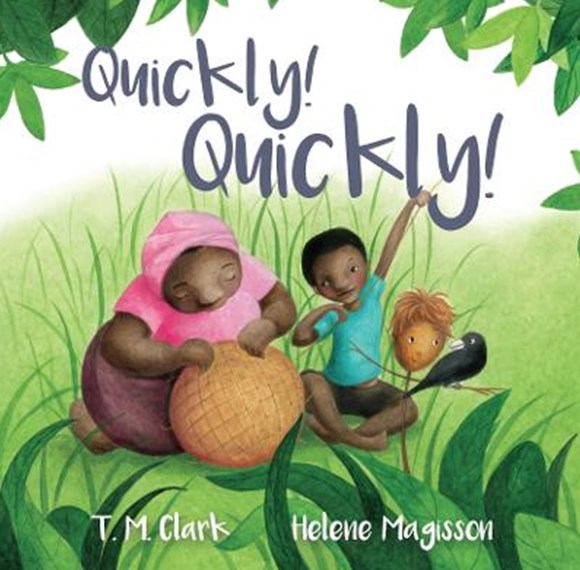
Quickly! Quickly! by TM Clark illustrated by Helene Magisson

Crafty crows camped on the corners of the field.

Monkeys mined for mealworms and munched mangoes.

Bongani beat his drum and shouted, 'Get away from my crops.'


Bongani is not old enough to go to school, but he is old enough to help with planting the crops. He sees crafty crows ready to eat the maize and monkeys munching on his mangoes. Somewhere along the way Bongani has heard the word scarecrow. He thinks if he can catch a crow then he can make a 'scared crow'. His grandmother and mother have been out in the field with Bongani and his grandmother explains a little about scarecrows. But Bongai is sure if a crow sits on the shoulder of a scarecrow the other crows will stay away. 

His grandmother weaves a large round basket and they put some corn inside. She explains: When a crow steps under the basket you have to be fast - quickly quickly - pull the string. But the crow flies away. Then the tables are turned and it is the crow, sitting on the tiny homemade scarecrow (you can see it on the cover), who shouts - get away from my crops. Oh no and now the elephants have arrived. 

This story has a folk tale feel and the alliterative repeated refrain means this text will work really well as a read aloud to young children. Helene Magisson gives her characters warm personalities. I love the rich colours of their clothes. The setting feels like an authentic African village. The twist at the end will make readers smile.  

I love the relationship between Bongani and his grandmother and her gentle patience and encouragement. There are so many details to notice in the illustrations such as the oxen working their land, the bare feet of the grandmother and Bongani, the babies held by their mothers while they work in the fields, the grandmother weaving the basket which they use for the trap and the iconic baobab tree. This book explores themes of family, community and culture.

The author says:

Bongani has grown a little, but has accepted that he is still too small to attend school just yet. But when he has to help protect the crops from animals, he decides he needs a better plan. He needs to catch a crow! With the help of his grandma, he learns how to be quick and cunning enough to catch a crow. Working together, the pair try and catch a crow. Like before in Slowly! Slowly!, Bongani is learning new things. Having grown since the first picture book, Bongani continues to teach children different and important values as well as show them a beautiful glimpse of African culture and stories. With good teamwork and the willingness to listen and learn from those around him, Bongani pursues his goal.

This is (another) successful blend of art and story that is a pure joy to experience. Embracing the importance and power of patience, tenacity, family and working with nature rather than against, Clarke and Magisson have suffused the essence of African village life into a humorous engaging tale. And with the elephants afoot in Bongani’s village, I wonder how long it will be until he attempts his next important job. Kids' Book Review

Quickly Quickly is the sequel to Slowly Slowly:

Bongani wants to go to school but he is too young. To prove to his family that he is big and strong just like his cousins, he tries to catch a monkey. Slowly, slowly, he must go. Luckily his family is there is to school him in the lessons of patience and compassion.


Here is the web page for the illustrator Helen Magisson. 

Saturday, August 7, 2021

The Heaven Shop by Deborah Ellis


Binti is a character you will never forget and this compelling, compassionate story will change your perspective on the world. Allen and Unwin

Binti lives in Malawi. Daily life is a struggle and her mother has died many years ago. Somehow, though they are a happy family group who are able to make ends meet because her father Bambo has enough work in his coffin shop meaning Binti along with her older siblings is able to attend school. As a bonus, Binti works on a radio show where she is paid to take part in stories intended to help the people in her community understand health issues such as AIDS and HIV. 

Then everything changes. Bambo dies and it could be AIDS. The relatives arrive like vultures and take away nearly everything and they squabble about which relative will take Binti, Junie and her brother Kwasi. It is decided Kwasi will be sent to work for a fisherman and Binti and Junie will work in the home of an uncle. 

Uncle Wysom and Aunt Agnes treat the children as slaves. Their meagre possessions are taken away and the girls have to sleep on the floor of a storeroom. Their days are filled with cleaning and cooking preparation. Junie, who was always so smart, seems to have shut down but actually she has a plan. The men in the bar give her money. It is not stated but it is implied that this is for sexual favours. The girls hide the money carefully in their little space but one day a younger child discovers it. The girls are now accused by the aunt and uncle of theft. Junie tells Binti to run away to their grandmother Gogo. Junie herself leaves hoping to find work and to make a home for the three siblings.

When Binti reaches Gogo she really discovers the realities of poverty and also the horrible results of the AIDS epidemic. Luckily, though, her grandmother is kind, Junie is found and, while it very sad, Binti does know how to make coffins. Her father taught her and so as the story ends there is some hope that these orphan children can now find a way to survive.

The Heaven Shop was first published in 2004 which made me think it would be out of print, but as far as I can see it may still be available. I found my copy in a bookshop on sale. It had been on their shelves since 2016 and I bought it early in 2019. Back in 2005 I read The Heaven shop and yesterday I read it again.  I really enjoyed the honesty of this story even though the extreme poverty is distressing. From an historical perspective it was interesting to read about the awful prejudice sounding AIDS and the misunderstandings about the transmission of this disease. Read more of the plot here

Binti, like Parvana (the heroine of Ellis’s Breadwinner trilogy) before her, is a plucky, high-spirited heroine whom young readers will take to their hearts. Quill and Quire

The Heaven shop is a Young Adult title. For younger readers in Senior Primary I would look for The Paper House as a companion read:


And also Girl of the Southern Sea

Monday, June 14, 2021

In a Cloud of Dust by Alma Fullerton illustrated by Brian Deines


This book made me cry. Yes it is a simple story but the beautiful act of kindness you will find here is so very moving and a moment to share and treasure with your reading companion or class.

Anna goes to school in Tanzania. It is a long walk each day and she always arrives home after dark. One day, while she is working through her lunch break, a truck pulls up outside her school. It has come from 'The Bicycle Library'.  Every child is given a bike. Every child except Anna. Stop reading. Now is a good moment to talk with your students.  How should Anna react? Is this fair? What would you do if you were Anna? Can you understand why having access to a bicycle might be so important to Anna - perhaps even life changing?

Now turn the page:

"Anna is disappointed but she's excited to help her friends."

We now watch Anna helping her friend Leyla learn to balance, encouraging Samwel as he navigates obstacles, and taking the hand of Prisca when she falls. On the way home Anna runs beside Farida, Samwel, Leyla and Irene. Then Mohammad gives her a ride on the back of his bike. When they reach his house Anna climbs off ready to walk the last part of her journey home alone BUT ...

"When they get off the bike, Mohammed hands it to Anna. 'You have further to go."


Publisher blurb (Pajama Press): In a Tanzanian village school, Anna struggles to keep up. Her walk home takes so long that when she arrives, it is too dark to do her homework. Working through the lunch hour instead, she doesn’t see the truck from the bicycle library pull into the schoolyard. By the time she gets out there, the bikes are all gone. Anna hides her disappointment, happy to help her friends learn to balance and steer. She doesn’t know a compassionate friend will offer her a clever solution—and the chance to raise her own cloud of dust.

Brian Deines is a Canadian illustrator from Alberta.  I was pleased to discover he lives in Red Deer which is a town near Sundre where I once worked. Alma Fullerton lives in Ontario.

Here are some websites to explore:

I would read In a cloud of Dust along side these titles:


Friday, May 7, 2021

Where are you going Manyoni? by Catherine Stock


Little Manyoni wakes up early, gets dressed, eats breakfast with her parents and then she sets off alone across the wilds of Zimbabwe to reach a very special place (spoiler alert) her school.

"This story is set on the Limpopo River in Zimbabwe. Children who live in this dry, sparsely settled area, as in many other parts of rural Africa, often walk as many as two hours to school every day."

The animals Manyoni sees are listed in the back of the book - a civet cat; babons; an African spookbill; elephants; a jackal; and zebras.  There are also animals you may not know such as kudus; elands; a gemsbok, an eland; and a dassie. This book would have been perfect to use with the 2020 CBCA Book Week slogan Curious Creatures, Wild Minds. 

This book also contains delicious words which are explained in the glossary: 

Manyoni crosses the fever tree pan (a temporary shallow lake)

(She) enters the shady kloof (a ravine) where the shy impala feed

Manyoni skips past the red sandstone koppies (small hills)

(She) scrambles over the krantz (a rocky cliff) above the Tobwani Dam.

This book was first published in 1993 but I am happy to report it is still available. The copy I read was purchased by the school library in 2017. 

The exceptional illustrations treat the vast African landscape with awe and love. Catherine Stock Time Magazine


Catherine Stock is the illustrator of other books set in Africa which I highly recommend as worth considering for your school library:


Wednesday, April 28, 2021

Too Small Tola and the Three Fine Girls by Atinuke illustrated by Onyinye Iwu


Tola lives with her older sister Moji and her younger brother Dapo and their hardworking Grandmummy in Lagos, Nigeria. Daily life is a struggle for this small family but there is love and laughter in their simple home. One of the daily tasks, which the children are expected to complete while Grandmummy is away selling groundnuts by the side of the road, is sorting the rice and removing stones.  This will seem an incredible task to a young reader in affluent Australia. I had no idea cheap rice was sold with stones.

"The family can only buy cheap sacks of rice. Cheap sacks of rice have many small stones in them, stones that must be picked out."

Tola settles into this task but her brother and sister are distracted. Dapo wants to practice with his ball and Moji wants to study on her computer. Tola is unhappy but she is also determined to help her Grandmummy and she knows it is essential to sort the rice. Then there is a disaster. A pair of precious earrings are knocked on the floor.  One is found but it seems as though the other is lost. How can Tola wisely save the day?

In the second story Grandmummy becomes very seriously ill. She has put some money aside for emergencies. The money must now all be spent on medicine and it is up to the three children to work out how to earn money for food because it seems Grandmummy will be ill for some weeks. Moji cannot miss her school work so she cannot help. Dapo should help but he seems more interested in the mechanics who are working near the roadway so it is once again up to Tola to sell the groundnuts. Dapo is annoying but by the end of this chapter you will cheer that he has found a much better way to help his family.

In the third and final story, Tola would love to go to the masquerade parade but Grandmummy explains she cannot go alone. Tola also sees some girls who look very fine. They have more money than Tolo's family. She sees three girls and you can read about them here:

"A girl walking towards her. A girl wearing a pink skirt and a T-shirt embroidered with a silver heart."

"A girl, Tola's age comes out of the shop. She is wearing a pair of jeans ... (that fit) her all the way up and way down and they have no stains at all. ... Her jeans are cool. Her denim jacket is cool. Her hair that falls down her back like a black waterfall looks freshly washed and cool, cool cool!"

"She is staring at (another) girl wearing a traditional buba and blouse in matching bright-red cloth with white aeroplanes printed on it."

Tola longs for new clothes, better hair, and most of all to attend the Masquerade. Grandmummy is so wise. She knows Tola is a very special girl and so she finds a way to make this dream come true.

This is the second collection of stories built round Tola and her family in Lagos; it is a delight. Atinuke is a storyteller herself and these are stories that demand to be read aloud. They are just the right length, full of atmosphere, built round situations that arise out of Tola’s everyday. Books for Keeps

Once again, Atinuke has provided both a window and a mirror for children to immerse themselves in when adventuring with Tola in a different culture, and for children from urban Nigeria to see their homes and communities reflected in a book. Miss Clevelands Reading

As you read this is the second book in the Too Small Tola series. I highly recommended the first book and I am going to say the same thing about the second which is equally good. This is a book series which should be added to all Primary school collections. You can see the art from this book on Onyinye Iwu's web page.

Friday, February 19, 2021

Too Small Tola by Atinuke


Atinuke has crafted another gem. A small story about a small girl set in a city and country possibly very unfamiliar to most readers. A small story with a HUGE heart. 

"Tola lives in a run-down block of flats in the megacity of Lagos, in the country of Nigeria. She lives with her sister Moji, who is very clever; her brother Dapo, who is very fast and Grandmummy who is very-very bossy."

"Sometimes the electricity words. And sometimes it does not. Sometimes the water runs. And sometimes it does not. Once the lift worked. And now it definitely does not."

There are three short stories in Too Small Tola. All of them would make a terrific class read aloud for a Grade One or Grade Two class but I especially love the final story where little Tola takes on a big responsibility.  Easter is coming and it is nearly the end of Ramadan. People are preparing for the festival of Eid which this year coincides with Easter. Tola and her neighbours do not have much money but they always have new clothes made to wear for Easter Sunday. Tola may be small but she loves maths and she loves numbers and she is skilled with measuring. Mr Abdul, the local tailor, has a bad bicycle accident. Tola, with help from her brother Dapo, take over riding around the city collecting orders and taking those all important measurements. Mr Abdul is a wonderful man. He knows just how to make every one feel terrific even Dapo who is at first very reluctant to help. 

Too Small Tola is the first book in a planned series.  


The setting for Too Small Tola is Nigeria. Kids Book A Day blogger Janet Dawson talked about this book today and she made the comment:

 I was really hoping for a bit of backmatter on Lagos and Nigeria–at least a map.

So I found some maps:


Too Small Tola is a wonderfully warm read. Warm, heartfelt and super lovely. What a brilliant start to a brand new series! My Book Corner

this is a smashing chapter book for newly confident readers. Red Reading Hub

Through the young girl’s experiences, children will learn about life in Lagos, from the bumper-to-bumper traffic on hot, dusty roads to the stark contrast between rich and poor. Readers will also identify with Tola’s universal concerns, such as sibling tensions and facing up to bullies. Book Trust

Can I suggest you visit your school library today to look for other books by Atinuke. These are books that should be part of every primary school library and they should be shared widely.


Saturday, December 5, 2020

A Stork in a Baobab Tree by Catherine House illustrated by Polly Alakija

 The Twelve Days of Christmas


In my last post I talked about an Australia version of this famous poem. In this next post I am excited to have found a African version. If you can find this book first published in 2011 begin with the scrumptious end papers which show beautiful woven baskets in red, white and green from Ethiopia.

My true love gave to me:

  • A stork in a baobab tree -  Botswana
  • Two thatched huts - Zimbabwe
  • Three woven baskets - Ethiopia
  • Four market traders - Tanzania
  • Five bright khangas - Uganda
  • Six women pounding - Mali
  • Seven children playing - Niger
  • Eight wooden carvings - Nigeria
  • Nine grazing goats - Kenya
  • Ten drummers drumming - Ghana
  • Eleven dancers dancing - Morocco
  • Twelve storytellers - South Africa

In addition to the lines from the poem this book also gives readers a brief paragraph on each page as an explanation for example the grazing goats:

"Flocks of goats are often seen in African villages. Goats are used for meat, milk and for their skins. Traditionally it was the job of a child to look after the family goats. At the end of the day, the herder makes sure every animal returns to the safety of the homestead."

"The Khanga is a traditional cloth worn by many women, which can be used in different ways: a skirt, a shawl, headdress or even a baby sling."

You can see some illustrations from this book here

If you want to see more books featuring the twelve days of Christmas there are over forty in this Pinterest collection.

About the author: Catherine House lives in Oxford, UK and specialises in writing for African and Caribbean schools. She has lived and worked in Kenya, Sudan, Eritrea and Zimbabwe.

About the illustrator: Polly Alakija was born in the UK but now lives in Nigeria. Her most recent book is Counting Chickens.

Friday, August 23, 2019

Thank you, Omu! Oge Mora


This week I was lucky to celebrate Book Week in a small rural Steiner school. I took along around 60 picture books and spent the day sharing stories with four different classes. I did intend to read Thank you, Omu! with the Preschool and Kinder group but at the last minute I changed my plan. Sadly the book I did read - The secret life of a Tiger by Przemystaw Wechterowicz, was not as successful as I would have liked.  I did read 1 is for One and this was a huge hit with these little listeners.

I wish I read read Thank you Omu! because is allows for participation which I think works well with a group of very young children. Omu (pronounced AH-moo) is cooking a pot of thick red stew for her evening meal. She hears a knock on the door - KNOCK! When she opens the door she finds a little boy who has smelled "the most delicious smell."  There is plenty of stew so Omu spoons some into a bowl for the boy. He says thank you and goes on his way.


Omu goes back to reading her book when she hears KNOCK KNOCK on her door. It is the local police offer. He also smelled "the most delicious smell."  Omu still has plenty to share so she shares some with the police officer to take home for his evening meal.

Omu once again goes back to her book when KNOCK KNOCK KNOCK the hot dog vendor arrives. He has smelled "the most delicious smell." Omu shares some stew with the vendor.  And so her evening continues.

She feeds a shop owner, a cab driver, a doctor, an actor, a lawyer, a dancer, a baker, an artist, a singer, an athlete, a bus driver, a construction worker and the town mayor.  The night grows dark and it is time for Omu to enjoy her evening meal but when she picks up her pot of thick red stew it is EMPTY.

Once again there is a knock on the door.

WE ARE HERE TO GIVE

A lovely story of giving and community founded in Nigerian culture. Delectable. Kirkus Star review

Mora times her story perfectly, with each beat in the right place and repetition that will encourage participation from a group. This will be an ideal volume to use any time sharing is the theme. Horn Book

Omu is the Nigerian word for queen but for the author it meant Grandma. Read more about Oge Mora on her web site. Here is a video reading of the whole book. Thank you Omu won the Coretta Scott King new talent/new illustrator award in 2019. On the Little Brown web site the author talks about her book. This book also won the Ezra Jack Keats illustration award for 2019.


Saturday, March 3, 2018

Figgy takes the city by Tamsin Janu

Figgy takes the City is the third book in the series that began with Figgy in the world and continued with Figgy for President.  I said the second book didn't disappoint and I will say this again about the third installment and now we have the exciting news that this book and another by Tasmin Janu have been selected for our CBCA Notables list.

Figgy and her friend Nana sit for a scholarship exam and both of them are selected to attend Hope College in the city of Accra. Figgy knows her friend Nana is clever and that he has studied hard to earn this honour but she is not so certain about why she has been selected.

"Principal Alfoso smiled. And he said, 'You deserve it for a number of reasons.' My breath caught in my throat when he tapped my cheek. Just below the spot where my second eye should be. I was not getting a scholarship because I was good at reading, sport or maths. Not even because I was in a movie I was getting a scholarship because I was missing an eye."

When the children finally arrive in the city after an eventful journey and a confusing first week they go to stay with Uncle Philmond.  Figgy is struck by the poverty she sees. "It was the biggest slum I had ever visited. It seemed to go on forever."  We know Figgy feels concern for the slum dwellers but it is Nana who takes practical steps to help them. Nana can see Uncle Philmond is rich and yet he often fails to send much needed money to Grandma Ama. Nana wants to make money to pay Grandma back for his care. He joins the slum kids each weekend scavenging in the dump instead of staying with Uncle Philmond. Figgy is both curious and furious. Nana seems so different and mysterious - is he still her friend? He won't answer her questions so one evening she follows him.

Tamsin really lets her readers inside a scene and this one is especially graphic.  Here Figgy is following Nana :

"The alleyway was not as busy as the street. I had to be careful Nana wouldn't see me ... The ground was muddy, slippery, and littered with bits of glass and plastic. I almost cried out when I tripped over a cow's head, which was surrounded by a cloud of flies. The cow's mouth was wide open, as if it had been yelling as it died. Most of it's skin had peeled away and what remained was being eaten by maggots."

Here is a review in Reading Time.  I especially like the way the three covers all link together and I thank Tasmin Janu for allowing me to spend a little time in Ghana with Figgy - watching her growing up and taking on new challenges.