Showing posts with label Hiking. Show all posts

Saturday, June 3, 2023

The Perfect Picnic by Ciara Flood


Unlikely best friends Squirrel and Mole decide today is the day for a perfect picnic. They prepare sandwiches (with no butter); apples; crackers and a delicious strawberry layer sponge cake. Squirrel has the map and Mole has his back pack but unfortunately, very early on, Mole's pack catches on a blackberry bush and the thorns rip a long slit in the bottom of his pack. Mole and Squirrel continue their hunt for the perfect picnic spot oblivious to the loss of all their food. Luckily, though, other forest animals have been following this disaster and somehow the day is saved with a wonderful generous gathering at the end even if it is not quite perfect. Oh, and for the next picnic, Mole suggests they might add some butter to the sandwiches.

I adore picnics even though I don't go on them very often. When I was a child we often went on picnics - my mum, dad and I - and we also had an American cookery book that fascinated me because it was filled with photos of glamorous people enjoying picnics in all sorts of locations.


Ciara Flood is a UK illustrator so I am puzzled as to how her book came to be published here in Australia by Five Mile Press. I have already mentioned another book by Ciara Flood - Those Pesky Rabbits. 

I love her illustration of Squirrel and Mole's homes. It reminds me of Upstairs Mouse and Downstairs Mole; Happy Hoppy Home and Need a House call Ms Mouse. 

Take a look at this post about picnics from my friend at Kinderbookswitheverything. I would pair The Perfect Picnic (sorry it is out of print) with:



Another famous book where the main character does not realise everything is being lost on their journey is this one but I am sure there are others:


Saturday, January 16, 2021

Hike by Pete Oswald


Like the woods, this book is an immersive experience 

that invites repeated visits. Kirkus Star review

It’s a book to read slowly — and read repeatedly. 

Seven Impossible things Before Breakfast

Let's go on a hike.  We've been on a hike before so we know what we need to pack - binoculars; camera; snacks; drinks; rope; hard hats; and walking sticks. BUT why are we hiking?

  • To see beautiful places
  • To marvel at scenery
  • For exercise
  • To spend time with each other (father and child)
  • To enjoy the great outdoors
  • For an adventure

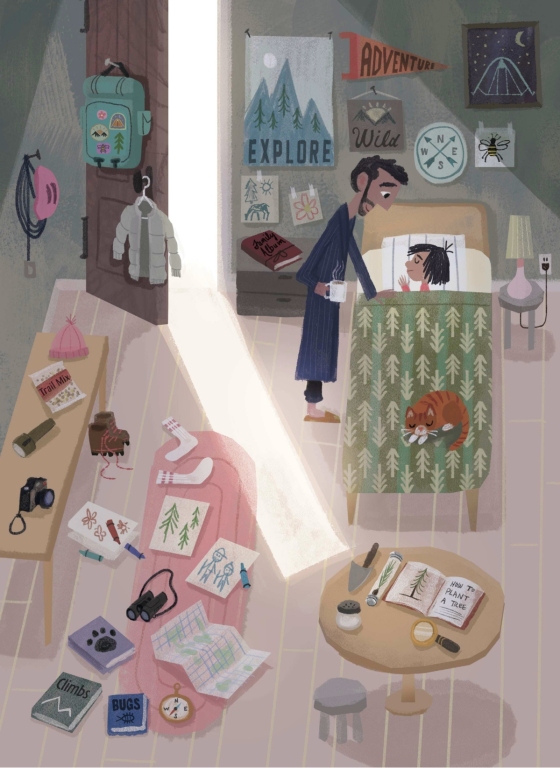
All of these are legitimate reasons but in Hike this pair, father and child, have an extra purpose. If you take a look at the quilt cover on the child's bed you get a small hint. It is covered in a forest of trees. In his bedroom the child has been reading a book - How to Plant a Tree. Do make sure you look at the very last page to see how tree planting has become a family tradition.


Hike is not quite a "silent"  or wordless book although it does appear on most book lists under this heading. 

Here are some of the words used in this book:  miaow; zip; click (coat fastening); munch; knock knock knock (woodpecker); click (camera); cheers; purr.

Plus there are books, labels, posters, signs and words in books such as Black Bear; milk; family album; How to plant a tree; Climbs; Bugs; Expore; Wild; Adventure; Vincent shoes; Anderson Fizz; and Will sports.

I am listing all of these to show that in the context of the IBBY Silent book collection this book probably would not be selected because the intention of this project is:

a collection of silent books (wordless picture books) that could be understood and enjoyed by children regardless of language.

Here is part of a report by IBBY New Zealand who hosted the silent book exhibition in 2020

One thing we noticed as we engaged with the books and spent time with them and visitors to the exhibition, was that not having words allowed us to slow down and spend time noticing details in the illustrations. We also learned how much language is generated when collaborating to make a story from the pictures; quite an irony for a supposedly ‘silent’ picture book. From our experiences we now understand even more clearly how powerful these books will be for generating stories and language from children and adults arriving in Lampedusa with multiple languages.

Even though Hike might not be selected by IBBY it is a truly splendid wordless book to share and re-read many times.  Here is an interview with Pete Oswald where he talks about wordless books and his ideas for Hike. So I tried to make the child more gender neutral. Since this is a wordless book I didn’t have to say ‘he’ or ’she.’ I felt like this idea could work. So the child has cropped hair, a green backpack and wears a pink beanie with knee high socks.


Here is a video of the whole book.

Here are some other books illustrated by Pete Oswald:


Pete Oswald mentioned the illustrator Miroslav SaĊĦek (1916-1980) as someone he admires:


Finally you might like to watch this video made with a gentle sound track and a very personal story commentary.

Saturday, June 20, 2020

A Field Guide to Getting Lost by Joy McCullough


Sutton is worried. Her dad has a new 'girl friend'. Does this mean he plans to marry Elizabeth? Does this mean two people will move into their small apartment? Or will Sutton and her dad have to move to the suburbs of Seattle? Elizabeth has a son called Luis. Luis is so very different from Sutton. How can they ever be friends? And then there is the issue of Sutton's mother who is working in Antarctica. Sutton is sad that her parents are divorced but at least mum does live in the same building except these days she is never home because she is studying emperor penguins and with climate change her study time is unpredictable. Mum's return will be delayed and she won't arrive home in time for Sutton's tenth birthday.  Life seems way too hard for Sutton right now and her bot programming is not working out either.

Sutton loves science. She is working on a program for her bot (small robot). Dad is keen for Sutton to like Elizabeth and to make friends with Luis but the outings he organises seem doomed to fail. They go to the Museum of Popular Culture. Luis loves Star Wars and Harry Potter but these references are a mystery to Sutton. In a way these two kids are polar opposites - science brain versus imagination. The next outing is a hike at Discovery Park which has 12 miles of trails. The biggest complication here is Luis and his allergies. He is allergic to bees, peanuts and dairy. His mum is naturally very protective but on the hike Sutton and Luis are separated from the adults and things do go terribly wrong. These kids, though, are resilient and together they can survive.

A field guide to getting lost is an easy novel to read, I did care about the characters, and I enjoy books with alternating voices. The sense of community in the final scene made me smile. It reminded me of the final scene in The View from the 32nd Floor and the community of Hazel Green (Odo Hirsch). There are a lot of "issues" in this middle grade story but they are handled with a light touch. If you know a middle grade reader who has allergies to various foods and bees this book could be somewhat reassuring showing there are ways to cope when things get tough especially when you have the support of a good friend (and a mum who truly cares about you).


You can read the first chapter on the Simon and Schuster web pages. Here is an interview with Joy McCullough. Thanks to Beachside Bookshop for my advance reader copy of A field guide to getting lost which was published in April.

I would follow A field guide to getting lost with: