Showing posts with label Imaginary lands. Show all posts

Wednesday, September 27, 2023

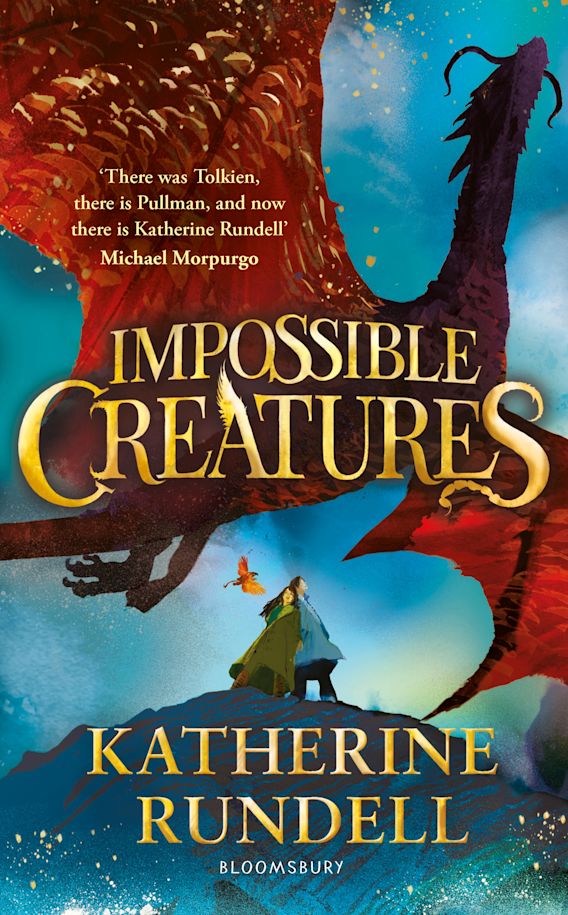
Impossible Creatures by Katherine Rundell


In this book you will meet - beautiful Al-mirajes; Dragons of every size; a Kanko; a vicious Karkadann; some little Lavellans; a huge Longma; a very special Ratatoska; a herd of Unicorns and many others.

Publisher blurb: Impossible Creatures tells the story of a boy called Christopher who is visiting his reclusive grandfather when he witnesses an avalanche of mythic creatures come tearing down the hill. This is how Christopher learns that his grandfather is the guardian of one of the ways between the non-magical world and a place called the Archipelago: a cluster of magical islands, where all the creatures we tell of in myth live and breed and thrive alongside humans. They have been protected for thousands of years from being discovered; now, terrifyingly, the protection has worn thin, and creatures are breaking through.  Then a girl, Mal, appears in Christopher’s world. She is in possession of a flying coat, is being pursued by a killer, and is herself in pursuit of a baby griffin. Mal, Christopher and the griffin embark on an urgent quest across the wild splendor of the Archipelago, where sphinxes hold secrets and centaurs do murder, to find the truth – with unimaginable consequences for both their worlds. Together the two must face the problem of power, and of knowledge, and of what love demands of us.

As I read this book I added about 40 post-it notes marking my favourite scenes and sentences.  Here are some of them:

"This world has always had magic in it, Christopher. Aren't you holding a griffin in your arms? The magic grew with the Earth's first tree, from the tree it flowed into the soil, into the air and the water. In the Archipelago, they call it the glimourie."

"Some sentences have the power to change everything. There are the usual suspects: I love you, .... But the words with the greatest power to create both havoc and marvels are these - I need your help."

"He knew that sometimes, if you are among the very lucky, a spark of understanding cuts like lightning across the space between two people. It's a defibrillator for the heart. And it toughens you. It nourishes you."

Thank you, Katherine Rundell for mentioning delicious and essential food - this is something I always look for in longer complex books like this one.

"She spent hours running through trees with Gelifen (a griffin), looking for unicorns and gorging on waterberries."

"There was a wall of blue glass jars, containing sweets from across the Archipelago. There were balls of soft gum, harvested from the sea by sylphs, which gave you brief bursts of great physical strength, but if you chewed too long gave you a rash of scales across your hands. There were ruinously expensive candies called voulay-drops, made my centaurs in the mountains of Edem. They tasted of that which craved most, but also, if you ate more than one, made you vomit something black for days afterwards."

"The table was laden with food. There was a beautiful moist nut cake, and fresh cinnamon twists, and a plate of biscuits still hot from the own.  Leonor was grey-haired, untalkative, unsmiling - but she showed her care in her cooking. She was the finest baker in the whole of Icthus: it was there that she put her patience, and her love."

"His grandfather had said that unicorns had a taste for mint. Quickly he tore open the pack and held them out in one hand. The unicorn dipped its mouth and sucked them from his palm, leaving it wet with unicorn spit. Then it touched its muzzle to his face, and breathed. Christopher felt the warmth on his skin and it smelt of mint and animal and something magnificently wild ..."

"There was a dark flat bread, which they ate dipped in olive oil. There was a slab of cream-coloured dried fish, delicious and so salty it was like eating the sea itself."

"He had been given a woven bag of apples, of plums and pears and apricot: dryad fruit, like nothing else on earth. They tasted still-living fruits with opinions and jokes and laughter in them."

Overtones of folklore; mythology; fairytales; and CS Lewis (the final scenes are sure to make you think of Aslan and Narnia):

"It had been years now since Mal had first learned to fly. a travelling seer had given her the flying coat soon after she was born. He had named her and laid the coat at her small feet." I thought of Sleeping Beauty.

Vocab: phalanx of swans; rhinocerosed; gainsay; scrofulous. And there are lots of invented words too. 

Names are important in this book too (think of A Wizard of Earthsea). Mal is short for Malum - and malum has a deep meaning - one that Mal herself has yet to discover. 

There is also a tiny thread of a love story in Impossible Creatures. I am not going to spoil this with any details, but adult readers might think of scenes from a favourite movie where the two main characters briefly glance at one another and then look away or brush hands and it's electric - these tiny moments were thrilling for a romantic reader like me. 

The Guardian's Bestiary at the start of this book has art by Tomislav Tomić. He is from Croatia. The cover is by Daniel Egnéus. (I have talked here about two of his books - Fox and Raven Child. In the UK the hardcover edition has phoenix sprayed on the page edges - it looks so magical.


Image source: Instagram

One of my favourite parts of writing Impossible Creatures was creating a bestiary to go in the front of the book: a collection of twenty-one of the creatures you might meet in the Archipelago. It’s illustrated by Tomislav Tomic, whose artwork is magnificent - 
kluddes and kankos and karkadanns, longmas and lavellans. 


I am not a big fan of endorsements, but this book has a huge list of celebrity praises - Michael Morpurgo; Catherine Doyle; Philip Pullman; Neil Gaiman; Jacqueline Wilson; and Kiran Millwood Hargrave. 

Everyone on social media is so excited about this new Katherine Rundell book - and justly so. I have seen bookshop window displays here in Australia (Three Sparrows) and in UK (my bookish friend has shared them) and the Australian children's book podcast Your Kids' Next Read included an interview with Katherine Rundell [begin at 16.45]- this is quite amazing because this group (Facebook and Podcasts) are usually, almost exclusively, focused on Australian books. I was also amazed that that interviewer had not previously read any of Katherine's books - how did she miss them and why didn't she prepare for the interview?  Anyway, if you listen you can hear Katherine Rundell's absolutely beautiful, lyrical speaking voice. 

I completely agree with these review comments by Just So Stories: I cannot tell you how much I love this (book), and that will be demonstrated by the fact that I will be keeping my copy and will re-read it, more than once I suspect. Though I read it immediately it was received, in swift binge fashion (and cried), it has taken me two weeks to compose this review – which I fear still does not do it justice.

I also agree this book is best for mature readers aged 11 or 12+. 

Here is Katherine Rundell on Instagram. Here is a one hour video where Katherine talks with Michael Morpurgo about her book. I do need to warn you, I just read on the UK publisher site (Bloomsbury) that Impossible Creatures is the first book in a trilogy. The good news is that at the end of the first book we are not left hanging. Yes, another book will be very welcome but enough is resolved at the end of the first installment thank goodness. Listen to this short introduction by Katherine Rundell. 

Writing fantasy has been a huge joy. Impossible Creatures has been a long time in the making – I pitched the idea more than five years ago, and I’ve found it a magnificent challenge. I loved fantasy as a child, and I love it now as a writer – for the freedom it gives to wholly unleash your imagination. Fantasy seems to me one of the most exciting ways to wield metaphor: so that, in writing about griffins and dragons and horned hares and immortality and flying coats, you might offer children (who have such allegiance with the fantastic, in every sense) a way to fathom their own world. Katherine Rundell

I have read and LOVED so many books by Katherine Rundell and the delicious thing about her writing is that it defies categorization. She covers so many genres and themes but the one thing that links these books is that they are all page turners and for me, they are all FIVE star titles.


I also loved these:


All through this book I kept thinking about this book illustrated by our Australian Hans Christian Andersen winner - Robert Ingpen and I have discovered he has a new book about mythical creatures too.


Companion reads:


Thursday, December 27, 2018

Endling Book One - The Last by Katherine Applegate

An endling is the last known individual of a species or subspecies. Once the endling dies, the species becomes extinct. 
Source Wikipedia


If you want to say something about life to other people 
you should tell them a story - Manning Clark

Literature offers us images to think with - Aidan Chambers


There is a quote on the first page of this book:

In nature nothing exists alone.  Rachel Carson, Silent Spring, 1962

The idea of existing alone is at the heart of Endling, The Last. Byx is a Dairne. She is the youngest member of her family. The smallest one, the runt. She sets out exploring one day but when she returns she sees a horrible scene. Her whole pack has been massacred. Does this mean Byx is now an endling- the last member of her species?

"Dairnes were often mistaken for dogs. We share many physical similarities. Dogs, however, lack opposable thumbs They can't walk upright. They aren't able to glide from tree to tree. They can't speak to humans."

Byx is convinced she is not the last. There must be other dairnes somewhere. But how will Byx find the others? Who will help her? And can she trust her companions?

One very special and important trait of the dairnes is their ability to detect lies. Dairnes are one of the six governing species along with humans, raptidons, felivets, terramants and natites. Every species is important. And so are the mezzitti - the lesser species such as wobbyks, starlons and gorellis. Below the mezzitti are  Inferritti - chimps, whales, crickets and so on.

"The six governing species may not prey on one another."

That is the decree but it seems this has been overturned. The dairne's ability to tell truth from falsehood is deemed a threat by the humans. They are determined to exterminate every member of this species.

Along with the beautifully created world of this book there are some brave and feisty characters who you will adore. Tobble - the wobbyk, Khara a human girl who is a poacher and Gambler - a felivet. Felivets are a type of giant cat "huge and sleek, his coat pure black except for a series of delicate white stripes on his face. His long, muscular tail reminded me far too much of a serpent."

I also love all the amazing animals in this book. There is a scene where our group witness a mass migration of land animals. We learn about garilans (deep crimson, six legs, spiral horns and golden tails), tirralopes and xia deer.

This book has been on my to read list all this year but I felt the hardcover copy was beyond my budget. I was so thrilled when I saw a paperback copy in a city book store last week. I read this book over two days very late into the night but then when I finished I had very serious withdrawal symptoms. I kept picking it up longing to go back into the world of Byx, Tobble, Gamble and Khara.

Here is a set of thoughtful discussion questions and a set of questions with Katherine. Before you read this book take a look at the trailer. It is perfect. I have already talked about several books by Katherine Applegate including Wishtree (my book of the year for 2018), The One and Only Ivan and Crenshaw.

"It's humans who hate your kind. ... 
They hate that you make it impossible for them to lie."

"These humans do not understand the balance in life. 
They do not understand that their will to dominate and control, 
to use and abuse, is destructive to all"

Read some reviews:


I am a little confused as School library journal said  "Illustrations and maps will help young readers imagine the rich setting filled with fantastical creatures that vie for power in Nedarra."
There was no map in my copy but perhaps this is a feature of the hardcover edition.

The second book of this trilogy -  Endling, The First is, as I write this page, over 130 days away! I can hardly wait.


It's been a wonderful year for fantasy books. Here are some I have adored:


Great news this is now available in paperback. I want to rush out and buy a copy for everyone this Christmas!


Friday, November 24, 2017

The Wonderling by Mira Bartok

He looked down at the small disk in his red furry hand.  The number was nearly worn off. Who would he have become, he wondered, had he remained Number Thirteen and not escaped? 'I have a real name,' he said under his breath. 'My name is Arthur."


Number Thirteen or Arthur, as he is now named, is a Groundling - part animal part human.  He has been sent to the Home for Wayward and Misbegotten Creatures.  Take a minute to re-read these words wayward - the implication is that they are bad or in need of instruction and misbegotten - conceived by mistake.  Miss Carbunkle rules this school with an iron fist and the oppressed youngsters are forced to endure long hours 'education' followed by even longer hours of tedious factory work and desperate living conditions.  From the moment we meet Arthur, though, it seems he has a special destiny.

"He looked like a young fox but he stood upright like child and had no tail to speak of. His eyes were a lovely chestnut brown and flecked with gold. But there was something about them that gave one the sense that, although he had not been in this world very long, he carried within him some inexplicable sorrow."

"He'd reach beneath his pillow and pull out something soft and blue: a fragment of his baby blanket. ... Wrapped inside the scrap of blanket was a tiny gold key. ... the only things remaining from his very first home."

Arthur has some great skills one of which is acute hearing and he also longs to sing.  Perhaps this is part of his destiny.

"Silence was what was expected of him anyway, for it was the first and most important of Miss Carbunkle's Golden Rules. Noise, including conversation, was barely tolerated. ... Singing, humming, or making music of any kind whatsoever was also prohibited."

He is also very kind so when a tiny creature is being used as a plaything by three bullies who live in the Home he rescues her - a tiny bird called Trinket. She tells him wonderful stories of life outside and convinces Arthur they can escape and forge new lives.  Everything is new to Arthur.  Perhaps one day he will taste a pie.  When you read page 176 you will just gasp knowing how much he longs to taste this delicious treat.

"Pies are the best of all ... They are buttery, sweet, and filled with every kind of delicious thing imaginable.  But it's not the sort of thing one can actually describe. You just have to taste it."

"Except for the top of the birch tree and the sky, he had never seen the Outside, or rather he couldn't recall what it looked like, for he had been at Miss Carbunkle's Home for all of his remembered life."

"There was so much he wished to know.  And so much he realized he wish for.  ... he wanted to know if he still had a family somewhere. And he wanted to know why he had no name, and why he had one ear. And who had sung that beautiful song when he was but a wee pup, and why he could hear things others couldn't and why and why and why."

I made a list of some of the utterly delicious and special words used by Mira Bartok.  Here is a video where she talks about her book.  Here is a detailed question and answer session.


  • formidable
  • panoptic
  • capricious
  • peevish
  • cruciferous
  • demeanor
  • miscreants
  • pugent
  • bindle
  • malodourous
  • daguerreotypes
  • conundrum


I enjoy books filled with senses and because Arthur is a fox his sense of smell is strong and so many smells are graphically described in this book. As mentioned his sense of hearing is also amazing even though he only has one ear.  Both of these attributes are more than just useful as Arthur finds himself in confronting and extremely dangerous situations. I love these words "the air was his library, and it was rich with sound."

Food is scarce in the orphanage and on the streets of Lumentown which means I love this breakfast scene near the end of the book - being provided with food like this is so reassuring that Arthur is now heading for happiness.

"The table was set for breakfast: scrambled eggs, fried mushrooms, toast with butter and gooseberry jam, goat cheese tarts, sliced apples - and a little bowl of seeds for Trinket."

All the characters in this book have perfect names.  Arthur, Miss Carbunkle, Sneezweed, Mardox, Mr Bonegrubber, Wire, Trinket, Peevil, Quintus, Baby Tizer and Linette.

The Wonderling is a long book but you will be richly rewarded when you take the time to read it.  The first part just flew past for me as did the final chapters where good does triumph over evil as expected but perhaps with a twist or two that you will not anticipate.

Take time to read this review by 12 year old Jazzy.  I would follow The Wonderling with A Very Unusual Pursuit, The wolves of Willoughby Chase, The girl who drank the moon and Gregor the Overlander.

Captivating and with great potential as a read-aloud. Kirkus Star review

In stunning prose, set in three parts, we accompany the two friends on their journey out of the Home, and meet the most surprising characters.  Kids Book Review

Mira Bartók's world of The Wonderling is strikingly complex: sounds, tastes, colors are all described so vividly that the world practically sparkles  Shelf Awareness


Saturday, February 11, 2017

Furthermore by Tahereh Mafi

"Alice plucked a tulip from her pocket and bit off the top. She felt the petals pressing against her tongue; she could taste the velvet, the magenta of it all. She closed her eyes and licked her lips before biting in the stem. Not quite green but brighter, more vibrant; there was a song in that colour and she could feel it singing inside of her."


As the cover suggests this is a fantasy book and I think it is one fans of this genre will enjoy but you do need reading stamina.  If you loved the imaginative journey in The Phantom Tollbooth then this is also the book for you. On the down side this is a very long book (400 pages) and I did take more than a week to read it.  There are moments of delightful storytelling but I did want the action to move along a little more quickly.  When Oliver declares "We are currently at the entry of Slumber, which is just one of the sixty-eight villages we must travel through, and each village has its own very specific rules. We cannot break a single one if we are to find your father." My heart sank.  Sixty-eight villages.  I was not sure I had the fortitude to withstand the vagaries of so many different places and their different and hazardous rules.

The sentences I quoted at the beginning of this review come from very early in this story.  I missed the first page accidentally but when I read about Alice eating flowers I knew this was going to be a very different book. I went back and read that Alice herself has no colour.

"But then one day they realised that their baby, the one they'd named Alice, had no pigment at all. Her hair and skin were white as milk; her heart and soul were soft as silk. ... Ferenwood had been built on colour. Bursts of it, swaths of it, depths and breadths of it."

Alice thinks her father has left the family because of her disgrace.  Her mother has become unkind and so when Oliver Newbanks tells her he knows the location of her father and that she needs to come to his rescue her adventures truly begin.  Alice does not go to all sixty-eight villages but the ones she does visit are extremely odd such as Paper where her arm is bitten off by an origami fox.

I did enjoy watching Alice grow and gain self-acceptance as this book progressed but I wanted to know a little more about Oliver - his back story and motivation. Of course the ending is a happy one as you might predict and it was perhaps a little rushed but after all the turmoil of their journey across Furthermore it was good to reach the comfort of home.

After reading Furthermore you might like to read Wolf Wilder, Firegirl and for mature readers The Thickety.

You can listen to a five minute audio sample here.


Told in rich, luscious, clever prose by an omniscient narrator whose chatty asides warn and inform, Alice’s remarkable adventure transports her across bizarre landscapes where she eventually realizes how wonderful it is to be herself and to have a friend she can trust.