Showing posts with label Heroism. Show all posts

Saturday, May 17, 2025

Stars of the Night by Caren Stelson illustrated by Selina Alko


Save one life, save the world

This book begins in Czechoslovakia 1938. The children are enjoying life in their city of Prague - skating and drinking hot cocoa with whipped cream. 

"All through the year, we played with our friends, went to school with them, laughed and told our secrets to them. We were Jewish. They were often not. It didn't matter to us."

But in November of 1938 life changed. In Germany dreadful things were happening to Jewish citizens and so many refugees arrived in Prague. The children in Prague, kids who had lived there their whole lives were subjected to name calling and bullying. The parents had to make the heart wrenching decision to send their children away to England. 

"There will be times when you'll feel lonely and homesick. Let the stars of the night and the sun of the day be the messenger of our thoughts and love."

These children were rescued by Nicholas Winton. He saved 669 children but he never talked about this until decades after the war his wife found a suitcase filled with documents about these children. In 1988 Nicholas Winton was invited to appear on a television show. If you watch this you will see all adults in the audience - these are the children he saved. 

Stars of the Night has extensive back notes, a timeline, source list, bibliography, author and illustrator notes and a list of books for further reading.

Walker Books blurb: The incredible true story of the rescue of 669 children from Czechoslovakia on the eve of World War II.

"When we were seven or eight or nine or ten, our home was the old city of Prague."

So begins this powerful story of the children who were rescued from Czechoslovakia on the eve of World War II as Hitler's campaign of hatred toward Jews and political dissidents took hold. Told from the collective perspective of the children, the narrative starts in 1938 and follows them as they journey to foster families in England for the duration of the war, return to Prague afterward in an unsuccessful search for their parents, and eventually connect with Nicholas Winton, a British former stockbroker who was instrumental in bringing them to safety.


A not-to-be-missed, inspirational book about courage, heart, and the necessity of caring for others. Kirkus Star review

This searing account is all the more heart-rending because it is collectively narrated by the young people saved by Winton, delivered in the innocent, matter-of-fact voice of a child. Kirkus Star review

A necessary and inspirational book about a little-known light amid a dark period of history, this book should find a home in all libraries. School Library Journal

For younger readers ... I hope they realize, besides their parents, there are good people in the world who, even as strangers, will take care of children as if they were their own — particularly under difficult circumstances. There are people in the world like Nicholas Winton who see the necessity to act to help children, even in the face of danger. The Dalai Lama said of Nicholas Winton, “We must carry [Nicholas Winton’s] spirit from generation to generation … Then humanity’s future will be brighter.” Bookology Magazine

Here are some very detailed teachers notes with excellent background reading ideas. 

This video will give you a look at the illustrations in this book. 

Awards for Stars of the Night:

  • ALA Notable Children’s Book
  • Bank Street College Best Children’s Books of the Year, Outstanding Merit
  • ILA Honor Award for Social Justice
  • National Jewish Book Award Finalist
  • New York Public Library Best Books for Kids
  • Notable Books for a Global Society List Selection
  • Orbis Pictus Recommended Book
  • School Library Journal Best Book
  • Texas Bluebonnet Master list


Photo of Nicholas Winton who died in 2015


Kindertransport Memorial at Liverpool Street Station, London

Here is a fascinating interview of the author and illustrator with Roger Sutton at The Horn Book. And another with The Lerner Blog. And on the author webpage

Check out my two previous books which explore the topic of the Kindertransport:


Companion book:


And just today I picked up this book - the cover looked interesting then I read the blurb - and saw the word Kindertransport. 


Saturday, July 20, 2024

Azizi and the Little Blue Bird by Laila Koubaa illustrated by Mattias De Leeuw translated by David Colmer


"Not that long ago, in a country that still exists today, Azizi was relaxing in an orange tree."

Azizi hears his father hanging portraits in their lounge room. They are huge and portray very ugly people. His father explains he has to hang them - these are the two rulers Tih and Reni. The family have to appear to be loyal and at all times they have to be careful about what they say incase 'the walls have ears'.  Readers will begin to feel the oppression and fear of their lives, and this is only page two!


"Tih and Reni ruled the Land of the Crescent Moon with an iron hand. And they stuffed their stomachs full from early in the morning until late at night. ... (their) courtyard was filled by an enormous white cage that had all of the country's blue bird locked up inside it."

I would stop reading at this point (sorry to interrupt the story), but can you anticipate an act of heroism? Also why are they locking up all the birds? Why would these cruel rulers be afraid of little blue birds? What power might the birds have? (twitter, twitter!)

As Tih and Reni grow in power (and size) the people seem to shrink and almost disappear. Then one day a blue bird lands on the window ledge of Azizi's house. Azizi and his mother have made garlands of jasmine which they attached to twigs tied together with red threads. The little blue bird tells Azizi to gather the jasmine and join all the threads together. It is time to fly to the castle. Azizi is now so small that their sewing needle is almost like a sword. Remember how big Tih and Reni have become - their bodies are like huge balloons. 

"swift as an arrow, Azizi and the little blue bird drilled a hole right through Tih and Reni. Everything the greedy rulers had stolen exploded into the sky like giant fireworks, and the key to the big white cage shone among the vases, carpets, and dishes."

The little blue bird and Azizi set all the birds free.  I love the final sentence:

"And as Azizi and the little blue bird did somersaults in the star-filled sky, the sweet smell of jasmine rained down over the Land of the Crescent Moon."

The blue birds are representative of Twitter, and the widespread censorship of the internet by various governments during the revolutions – when I worked this out, suddenly the story made a whole lot more sense, and became more than just a poetic tale.  Bookseller NZ

I picked this book up at a recent charity book sale. I wonder who previously purchased it here in Australia. This book was originally published in 2013 in Flemish with the title Azizi en de kleine blauwe vogel by Book Island. There are teachers notes on the publisher page. You could use this book with students aged 10+ as a good discussion starter. The book size is extra large and the illustrations are colourful, appealing and very detailed. 

Bookseller blurb: Azizi lives with Umma and Baba in a country ruled with an iron fist, whose leaders capture all the blue birds and lock them up in a white cage in the courtyard of their palace. While the rulers swell and bulge like hot air balloons, stuffing their stomachs from morning till night, the people shrink and suffer until they are almost invisible. One day, when Azizi is no bigger than a pine nut in a glass of mint tea, a little blue bird escapes from the cage. Determined to live in fear no longer, Azizi and the little blue bird set out on a journey to free the people of their cruel and greedy rulers and bring peace to the land once more. This contemporary fairy tale of freedom against oppression is inspired by the Jasmine Revolution in Tunisia.

This gorgeous story is reminiscent of traditional fairy tales, with a brave hero, evil villains and a plucky sidekick. The descriptive writing is superb, conjuring images of a warm land bathed in sweetly scented air that is slowly turning into a place of hardship and oppression. Book Trust

From The Book Trail: In 2010 the Jasmin revolution in Tunisia inspired Laila Koubaa to write the story of Azizi and the little blue bird. Inspired by the Arab Spring and the blue birds of Twitter… Crescent Moon – The setting of the novel is a despotic place where every household must display their pictures; free speech is stifled, and the people live in abject fear. The rulers decree that all the blue birds in the land must be captured and locked in a big cage in the courtyard of the palace. But one day, a tiny blue bird escapes and flies to Azizi’s house…. Despite his young age Mattias De Leeuw (1989) is one of the most prolific illustrators of his generation. He is a talented artist who can create a character in a few quick lines. Some reviewers call him the Flemish Quentin Blake.

Here is a list of some similes found in this book:

• as small as a pine nut in a glass of mint tea
• poppies glittering like red diamonds
• like a knight on horseback
• swift as an arrow
• like giant fireworks
• danced like palm trees
• curled like calligraphy

I wonder if this might be a book you could compare with this title from our CBCA 2024 short list which also explores the power of social media.


Monday, December 11, 2023

The Thief who Sang Storms by Sophie Anderson


"My family are alkonosts, which means we're descended from the ancient bird-people of our island. Most alkonosts look similar to humans, although we're smaller and lighter, and have feathers, while humans have hair. ... The biggest difference between alkonosts and humans (have the) ability to sing magic."

Until three years ago alkonosts and humans lived in harmony but on the day of the Unity celebration one of their ships - Joy - sinks in a wild storm and the leaders of Morovia are drowned. The new leader blames the singing magic and all alkonosts are banished to the swamp lands. A new army of bogatyrs take control but they need protection from the singing magic and this comes from iron. Bogatyrs and their leader Captain Ilya clad themselves in iron from head to toe. The iron is mined from the waste land behind the castle and so alkonosts are captured and forced to undertake back-breaking labour. 

Linnet, an alkonost, watches as her father is captured. She is a resourceful girl and so she gathers her friends - alkonost and human and they make a plan to rescue Nightingale and all of the others. As she works on her plan unlikely ally arrives. Her name is Hero. Linnet and Hero were best friends before the sinking of Joy but something changed and straight after the sinking Hero utterly rejected Linnet blaming her and all alkonosts for the tragedy. Hero arrives in the swamp lands just as Linnet and her friends are about to be arrested but can she be trusted?

This book contains the most amazing, invented world. The days of the week for example have creative names: Songsday, Nestday, Liftday, Flightday, Glidesday, Soarsday and Swoopday. And the alkonost character names are all based around birds - Linnet, Nightingale, Jay, Kestrel, Robin and Lark. You are sure to also warm to Linnet's special friends - you can see them on the cover - Lumpy a toad and Whiskers a swamp rat. 

Reading this book does take some stamina - it has just over 400 pages and every few chapters there is a flashback where Linnet tells the story of past events which are linked to their banishment. I expected to read this book over a day or two but it took me over a week. I am not sure why but someone the action didn't seem to hold my attention. The title also continues to puzzle me, but I will leave you to ponder this yourself. Here are some very detailed teachers notes from the author webpage

Publisher blurb: The Island of Morovia is shaped like a broken heart. The humans live on one side of the island, and the alkonosts - the bird-people - live on the other. But it wasn't always this way...Linnet wishes she could sing magic. But magic is forbidden and she has been banished with her father to the Mournful Swamp. She misses her old life, and dreams of reuniting with her friends. When her father is captured for taking a precious jewel, Linnet must set out on a treacherous journey. Travelling through alligator pools and sinking sands with new friends, she learns how to be brave, and discovers something even more powerful than singing magic. Something that could save her father, and heal the broken heart of her island once more... 

Anderson delivers convincing, inviting worldbuilding, wide in scope, lovely in its evocation of landscapes, and entrancing in descriptions of foods, crafts, clothing, and feathers. ... Impressively different and captivating. Kirkus

This beautifully written tale of a divided nation is loosely based on characters from a Russian folksong. It explores bereavement and persecution, but ultimately celebrates the power of friendship, trust and hope to reunify enemies and establish peace. BookTrust

With a cast of wonderful characters – including a toad named Lumpy and a smelly but ever-faithful swamp rat named Whiskers – and an action-filled plot, The Thief Who Sang Storms is as entertaining as it is moving, and would be a fantastic addition to the bookshelf for kids aged 9+. Readings

Sophie Anderson has won the Independent Bookshop Book of the Year Award and the Wales Book of the Year Award, and been shortlisted for the CILIP Carnegie Medal twice, the Waterstones Children’s Book Prize, the Blue Peter Book Award, the British Book Awards’ Children’s Fiction Book of the Year, the Andersen Prize, and the Branford Boase Award. Here are three other books by Sophie Anderson.

Here is the US cover - which do you prefer?


Companion book: 


Tuesday, October 31, 2023

Eat my Dust by Neridah McMullin illustrated by Lucia Masciullo


In 1928, Jean Robertson and Kathleen Howell broke the land speed record when they traveled from Perth to Adelaide 2824km in two days, nine hours and 57 minutes. They broke the record by five hours driving their Italian Lancia Lambda car.

"Intrepid, dynamic, pioneering, Jean and Kathleen broke down gender stereotypes by excelling at driving, discovering Australia by car, and conquering what was considered a male-dominated frontier." (endnotes)

Eat my Dust recreates the journey by these pioneer women. It also explores the bias/sexism of the times - against women.

"I bet you're back by dinnertime,' sniggers the official."

You could build a writing lesson around the power of the word choice here - sniggers.

Later we read this:

"You two are dreamin'. You'll get lost out there in five minutes and I won't be coming to find ya."

On the other hand - you are sure to be cheering when the two women blow a tyre and without a second thought they jump out of the car and quickly execute a repair. And when their car seems to fly through the air.  I love the colloquial Aussie slang too:

"The saltbush is a silver blur as they go like the clappers."


This book is certain to be a CBCA (Children's Book Council of Australia) Eve Pownall (non-fiction) notable title and I am sure it will also be shortlisted. Add this book to your library shopping list today and plan to read it to groups of students as soon as it arrives. 

Congratulations to Neridah McMullin for finding, researching and sharing this story. Congratulations to Lucia Masciullo for her fabulous illustrations - you can almost feel the heat and smell the dust. And finally congratulations to Walker Books Australia for publishing this book so children can read this story about the history of our continent. Read some review comments on their webpage. Also congratulations to Walker on teaming Lucia and Neridah together - just a perfect pairing of illustrator and author. Here are some teachers notes and an interview with Lucia Masciullo about this book. 

This is a story of perseverance and resilience, and an important yet relatively unknown part of Australian history. Read Eat My Dust! with your kids, it's a story that deserves to be celebrated.  Kids' Book Review

A great addition to any library ... Reading Time

With the 2023 CBCA Book Week theme of Read. Grow. Inspire still fresh in our minds, this is another story that allows young readers to meet the pioneers who followed their dreams, inspired others and  made something “abnormal” normal for today’s generations.  The Bottom Shelf

Lucia Mascuillo has a piece of art in our IBBY Australia Mini Masterpiece art auction (18th November 2023). 


I have talked about other books by Neridah McMullin:


And I have talked about these books illustrated by Lucia Masciullo:


Sunday, October 8, 2023

Loteria by Karla Arenas Valenti illustrated by Dana Sanmar


"The issue of free will was one the two friends often debated. At the heart of the debate was the question of choice: whether a person's destiny was determined by past events or if people had the ability to shape their own future. Life believed that people created their own destiny. ... 
Catrina (Lady Death), on the other hand, argued that choice was an illusion."

Long ago I read the Greek myth based on the three women, the fates, who cut the strings of life. The Moirai, or Fates as they are known in English, wove the threads of fate on a great loom. Clotho, “The Spinner,” spun the thread of life from her distaff onto her spindle. At the moment of birth, she created the thread of a person’s lifetime. Lachesis, “The Drawer of Lots,” measured each thread. Finally Atropos, “The Unturning,” cut each thread at the appointed length, setting the person’s death. I don't know why but the image of this has lingered with me for over 40 years. 

In this book there are two players - Life and Lady Death. Once each year they play a game, in this instance to set the fate of a young girl named Clara. 


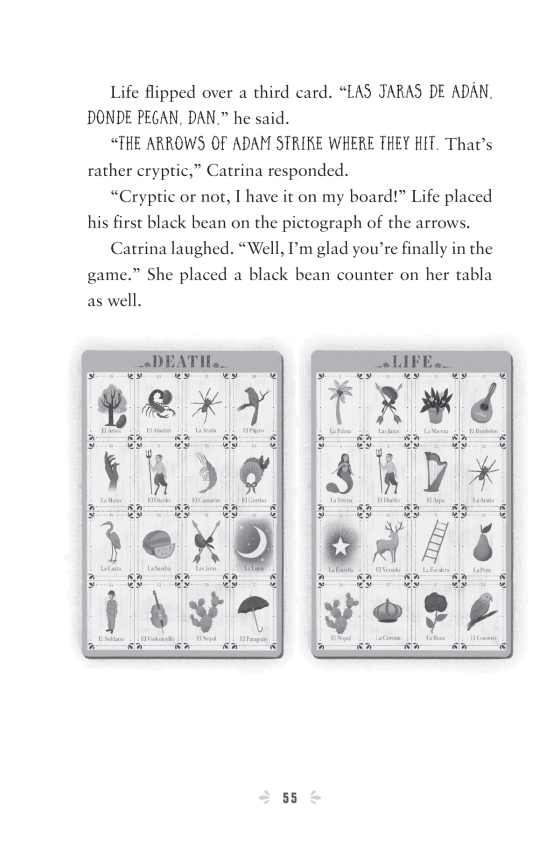
"La Loteria was a simple game of chance. The first to get four cards in a straight line - horizontal, vertical or diagonal - would win. A win by Catrina (Lady Death) would deliver Clara into her hand. A win by Life would spare the child, granting Clara a long life. ... The players had three days to complete the game and deliver their prize, after which they would part ways for another year, meeting only to play another round. "

Each player has set before them a placard with a different image printed one each of the sixteen squares. (Here are some you could print for a class) Beside this the players have a set of fifty-three cards (here are a set to use with the game) each with a different image and the players also have a handful of frijoles - small beans as black as night. Lady Death and Life take turns to flip the cards and find matching images on their own placards - a bit like bingo (but this game might not have a happy outcome). 

The cards contain sayings that need to be interpreted such as EL QUE A BUEN ARBOL SE ARRIMA BUENA SOMBRA LE COBIJA - He who approaches a good tree is blanketed by good shade. Lady Death places a bean on the image of a tree on her tabla. 


Catrina and Life begin their game. A scorpion hides in Clara's sketchbook emerging as she shares her dragon drawing at a family picnic; nearby a young boy is trying out his new bow and arrow; Estaban's mother, a healer, rushes home for some herbs to help with the scorpion sting; at that moment the boy unleashes his arrow. These are the awful events that create enormous grief. Estaban has already lost his father and now his mother. When a stranger arrives, rather like the Pied Piper, Estaban believes he will be taken to see his mother. He can hear her singing. He follows the man in the red coat into another world.

Clara has promised to keep her young cousin Estaban safe and so she follows them into this dangerous and unpredictable place. Clearly the man has evil intentions but why does he want this young boy? As you might suspect this is all about power but you might be surprised to learn it is also about the elixir of youth. Yes, this sounds complex and it is, but it is also utterly riveting. 

One thing Clara has to do to survive and to find her cousin, is work out the bargaining system. At one point she meets a fawn hiding from some hunters. He will tell her how to climb through some impenetrable vines in exchange for colour - the colour of her hair! Pages 140-143 in my paperback copy could be a fabulous section to read aloud as a book talk to a group of students. 

The descriptions in this book are fabulous - they would be wonderful to use with a writing group:

"He looked quite dapper in his black suit and matching vest, with a crisp white shirt and the tiniest hint of red peeking out of his jacket pocket: a crimson handkerchief, monogrammed."

"Two fig trees heavy with fruit flanked the entrance to the path. Ceramic pots of various shapes and sizes lined the way. Some held tall and spiky cacti, while others boasted flowering plants with buds of yellow and orange; a pair of succulents grew in a rooster shaped pot."

"As she spoke, she plucked a petal off her crown and released it into the air. The petal folded into a rose-scented butterfly."

"The baby deer has left its hiding place and now stood behind her. It was completely white, a bright beacon against the greens and reds and yellow surrounding them. Its large black eyes gazed at her openly."

"A waterfall roared down the side of the cliff into a pool of clear water that branched off into dozens of canals. The canals snaked along the jungle floor toward fountains carved in the shape of mermaids or fish or outstretched hands with fingers reaching upward."

This book is filled with Spanish food and words but you will have no problem working things out. There is no glossary but this book does have a useful set of notes at the back. I did look up one important word: El diablo - the devil (the man in the red coat).

Loteria is a totally engrossing story. I know the bravery of Clara and the horrible scene where we discover why the boy king has taken these children will linger with me for years to come. This is another one of those books where I marvel at the imagination of the author.

You can read the first nine chapters here. The publisher - Random House Kids suggests ages 8-12 for this book but I would say it is for 11+. I have labelled it as Young Adult because a loved character does die very early in the story and the fate of Clara and her young cousin Esteban is a very complex one - not something a young reader would understand. Also, this book is written using a sophisticated vocabulary, and it is, as I said, filled with Spanish expressions and food. The scene with the enormous spiders when Clara is tossed into the underground prison are truly frightening. (Chapter 28).

Publisher blurb: In the hottest hour of the hottest day of the year, a fateful wind blows into Oaxaca City. It whistles down cobbled streets and rustles the jacaranda trees before slipping into the window of an eleven-year-old girl named Clara. Unbeknownst to her, Clara has been marked for la Lotería. Life and Death deal the Lotería cards but once a year, and the stakes could not be higher. Every card reveals a new twist in Clara’s fate—a scorpion, an arrow, a blood-red rose. If Life wins, Clara will live to a ripe old age. If Death prevails, she’ll flicker out like a candle.  But Clara knows none of this. All she knows is that her young cousin Esteban has vanished, and she’ll do whatever it takes to save him, traveling to the mythical Kingdom of Las Pozas, where every action has a price, and every choice has consequences. And though it seems her fate is sealed, Clara just might have what it takes to shatter the game and choose a new path.

Read some review comments on Karla Arenas Valenti's web page. Here's the Horn Book review. And here is a radio interview with the author. Here is a set of excellent discussion questions. See the cover being made here. And here is an interview with Betsy Bird - she loved this book too. And finally here is another interview from the blog - From the Mixed-up files

Wednesday, September 27, 2023

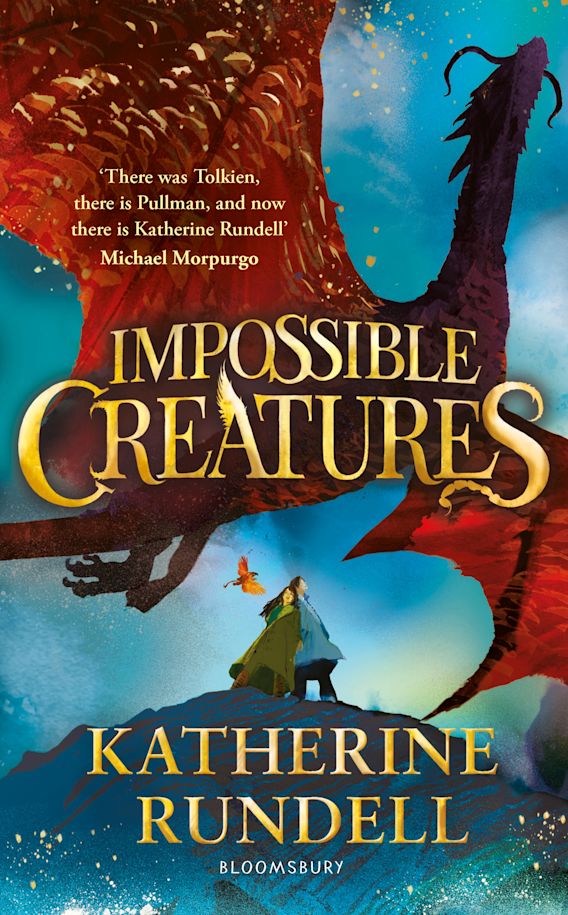
Impossible Creatures by Katherine Rundell


In this book you will meet - beautiful Al-mirajes; Dragons of every size; a Kanko; a vicious Karkadann; some little Lavellans; a huge Longma; a very special Ratatoska; a herd of Unicorns and many others.

Publisher blurb: Impossible Creatures tells the story of a boy called Christopher who is visiting his reclusive grandfather when he witnesses an avalanche of mythic creatures come tearing down the hill. This is how Christopher learns that his grandfather is the guardian of one of the ways between the non-magical world and a place called the Archipelago: a cluster of magical islands, where all the creatures we tell of in myth live and breed and thrive alongside humans. They have been protected for thousands of years from being discovered; now, terrifyingly, the protection has worn thin, and creatures are breaking through.  Then a girl, Mal, appears in Christopher’s world. She is in possession of a flying coat, is being pursued by a killer, and is herself in pursuit of a baby griffin. Mal, Christopher and the griffin embark on an urgent quest across the wild splendor of the Archipelago, where sphinxes hold secrets and centaurs do murder, to find the truth – with unimaginable consequences for both their worlds. Together the two must face the problem of power, and of knowledge, and of what love demands of us.

As I read this book I added about 40 post-it notes marking my favourite scenes and sentences.  Here are some of them:

"This world has always had magic in it, Christopher. Aren't you holding a griffin in your arms? The magic grew with the Earth's first tree, from the tree it flowed into the soil, into the air and the water. In the Archipelago, they call it the glimourie."

"Some sentences have the power to change everything. There are the usual suspects: I love you, .... But the words with the greatest power to create both havoc and marvels are these - I need your help."

"He knew that sometimes, if you are among the very lucky, a spark of understanding cuts like lightning across the space between two people. It's a defibrillator for the heart. And it toughens you. It nourishes you."

Thank you, Katherine Rundell for mentioning delicious and essential food - this is something I always look for in longer complex books like this one.

"She spent hours running through trees with Gelifen (a griffin), looking for unicorns and gorging on waterberries."

"There was a wall of blue glass jars, containing sweets from across the Archipelago. There were balls of soft gum, harvested from the sea by sylphs, which gave you brief bursts of great physical strength, but if you chewed too long gave you a rash of scales across your hands. There were ruinously expensive candies called voulay-drops, made my centaurs in the mountains of Edem. They tasted of that which craved most, but also, if you ate more than one, made you vomit something black for days afterwards."

"The table was laden with food. There was a beautiful moist nut cake, and fresh cinnamon twists, and a plate of biscuits still hot from the own.  Leonor was grey-haired, untalkative, unsmiling - but she showed her care in her cooking. She was the finest baker in the whole of Icthus: it was there that she put her patience, and her love."

"His grandfather had said that unicorns had a taste for mint. Quickly he tore open the pack and held them out in one hand. The unicorn dipped its mouth and sucked them from his palm, leaving it wet with unicorn spit. Then it touched its muzzle to his face, and breathed. Christopher felt the warmth on his skin and it smelt of mint and animal and something magnificently wild ..."

"There was a dark flat bread, which they ate dipped in olive oil. There was a slab of cream-coloured dried fish, delicious and so salty it was like eating the sea itself."

"He had been given a woven bag of apples, of plums and pears and apricot: dryad fruit, like nothing else on earth. They tasted still-living fruits with opinions and jokes and laughter in them."

Overtones of folklore; mythology; fairytales; and CS Lewis (the final scenes are sure to make you think of Aslan and Narnia):

"It had been years now since Mal had first learned to fly. a travelling seer had given her the flying coat soon after she was born. He had named her and laid the coat at her small feet." I thought of Sleeping Beauty.

Vocab: phalanx of swans; rhinocerosed; gainsay; scrofulous. And there are lots of invented words too. 

Names are important in this book too (think of A Wizard of Earthsea). Mal is short for Malum - and malum has a deep meaning - one that Mal herself has yet to discover. 

There is also a tiny thread of a love story in Impossible Creatures. I am not going to spoil this with any details, but adult readers might think of scenes from a favourite movie where the two main characters briefly glance at one another and then look away or brush hands and it's electric - these tiny moments were thrilling for a romantic reader like me. 

The Guardian's Bestiary at the start of this book has art by Tomislav Tomić. He is from Croatia. The cover is by Daniel Egnéus. (I have talked here about two of his books - Fox and Raven Child. In the UK the hardcover edition has phoenix sprayed on the page edges - it looks so magical.


Image source: Instagram

One of my favourite parts of writing Impossible Creatures was creating a bestiary to go in the front of the book: a collection of twenty-one of the creatures you might meet in the Archipelago. It’s illustrated by Tomislav Tomic, whose artwork is magnificent - 
kluddes and kankos and karkadanns, longmas and lavellans. 


I am not a big fan of endorsements, but this book has a huge list of celebrity praises - Michael Morpurgo; Catherine Doyle; Philip Pullman; Neil Gaiman; Jacqueline Wilson; and Kiran Millwood Hargrave. 

Everyone on social media is so excited about this new Katherine Rundell book - and justly so. I have seen bookshop window displays here in Australia (Three Sparrows) and in UK (my bookish friend has shared them) and the Australian children's book podcast Your Kids' Next Read included an interview with Katherine Rundell [begin at 16.45]- this is quite amazing because this group (Facebook and Podcasts) are usually, almost exclusively, focused on Australian books. I was also amazed that that interviewer had not previously read any of Katherine's books - how did she miss them and why didn't she prepare for the interview?  Anyway, if you listen you can hear Katherine Rundell's absolutely beautiful, lyrical speaking voice. 

I completely agree with these review comments by Just So Stories: I cannot tell you how much I love this (book), and that will be demonstrated by the fact that I will be keeping my copy and will re-read it, more than once I suspect. Though I read it immediately it was received, in swift binge fashion (and cried), it has taken me two weeks to compose this review – which I fear still does not do it justice.

I also agree this book is best for mature readers aged 11 or 12+. 

Here is Katherine Rundell on Instagram. Here is a one hour video where Katherine talks with Michael Morpurgo about her book. I do need to warn you, I just read on the UK publisher site (Bloomsbury) that Impossible Creatures is the first book in a trilogy. The good news is that at the end of the first book we are not left hanging. Yes, another book will be very welcome but enough is resolved at the end of the first installment thank goodness. Listen to this short introduction by Katherine Rundell. 

Writing fantasy has been a huge joy. Impossible Creatures has been a long time in the making – I pitched the idea more than five years ago, and I’ve found it a magnificent challenge. I loved fantasy as a child, and I love it now as a writer – for the freedom it gives to wholly unleash your imagination. Fantasy seems to me one of the most exciting ways to wield metaphor: so that, in writing about griffins and dragons and horned hares and immortality and flying coats, you might offer children (who have such allegiance with the fantastic, in every sense) a way to fathom their own world. Katherine Rundell

I have read and LOVED so many books by Katherine Rundell and the delicious thing about her writing is that it defies categorization. She covers so many genres and themes but the one thing that links these books is that they are all page turners and for me, they are all FIVE star titles.


I also loved these:


All through this book I kept thinking about this book illustrated by our Australian Hans Christian Andersen winner - Robert Ingpen and I have discovered he has a new book about mythical creatures too.


Companion reads:


Friday, September 22, 2023

Little Robot by Ben Hatke


The opening scenes of this graphic novel or toon are wordless. We see a highway, trucks and then move in closer to see one truck in particular. A carton falls off the truck when it goes over a bump in the road. The box falls off a bridge and into the river below. The wordless scenes continue into Chapter One. A young girl climbs out of the window of a trailer house. She plays at the park and then heads down to the river where she has stashed her toolkit. She finds a carton and when she opens it, she discovers something very surprising - a robot! He's been slightly damaged from the fall out of the truck so the girl, remember she has set of tools, sets about some repairs and before too long the little robot, who looks a little like R2D2 is up on his feet and able to walk. 


Meanwhile back at the factory the computer sensors ring out alarms because one of the units - UNIT 00012 - is missing. The orders are to locate and recover.

I hope this plot is making you think of The Wild Robot by Peter Brown.

Of course, things are heading for a showdown. The sinister robot charged with finding UNIT00012 is coming. The little girl has truly made a special friend so what will happen when the retrieval robot arrives? Problem solving, ingenuity and true heroism are at the heart of this story. Oh, and there is a lot of 'boom', 'zom', 'clink', 'clang', 'chonk', 'pling', 'ploop', and 'jonk' to enjoy along the way as well as lots more robots!

This delightful, nearly wordless graphic novel portrays a kid with gumption enough to take on big business and smarts enough to advise the factory’s fix-it robot on repairs even though she just might be too young for kindergarten. Despite having little material means and few human connections, this kid creates life in the inanimate and fosters community where none could exist before. Girl power at its best. A sure winner!  Kirkus Star review

This is not only a sweet and wonderful book about friendship, though – it’s a great maker space selection! This is a little girl who’s comfortable with a tool belt and she tinkers with a robot! What' cha Reading?

Blurb: When a little girl finds an adorable robot in the woods, she presses a button and accidentally activates him for the first time. Now, she finally has a friend. But the big, bad robots are coming to collect the little guy for nefarious purposes, and it's all up to a five-year-old armed only with a wrench and a fierce loyalty to her mechanical friend to save the day!

This is not a book an Australian school library could ever add to their collection which is such a dreadful shame. Here in Australia this book, with only 135 pages, costs over AUS$45. Why oh why?

In 2016 Little Robot won Will Eisner award (Considered the “Oscars” of the comic book industry, are handed out each year in a gala ceremony at Comic-Con International: San Diego. Named for renowned cartoonist Will Eisner (creator of “The Spirit” and pioneer of the graphic novels), the Awards are given out in more than two-dozen categories covering the best publications and creators of the previous year):

2016 Best Publication for Early Readers (up to age 8): Little Robot, by Ben Hatke 

2023 Best Publication for Early Readers (up to age 8) Chibi Usagi: Attack of the Heebie Chibis, by Julie and Stan Sakai


Other 2023 entries for ages up to 8 years:

Beneath The Trees: A Fine Summer, by Dav (Magnetic Press)

Fox + Chick: Up and Down: and Other Stories, by Sergio Ruzzier (Chronicle Books)

Grumpy Monkey Who Threw That? by Suzanne Lang and Max Lang (Random House Studio)

Hey, Bruce!: An Interactive Book, by Ryan Higgins (Disney/Hyperion)

Here is the full list of past winners:

2012 Dragon Puncher Island, by James Kochalka (Top Shelf)

2013 Babymouse for President, by Jennifer L. Holm and Matthew Holm (Random House)

2014 Itty Bitty Hellboy, by Art Baltazar and Franco Aureliani (Dark Horse)

2015 The Zoo Box, by Ariel Cohn and Aron Nels Steinke (First Second)

2016 Little Robot, by Ben Hatke (First Second)

2017 Narwhal: Unicorn of the Sea, by Ben Clanton (Tundra)

2018 Good Night, Planet, by Liniers (Toon Books)

2019 Johnny Boo and the Ice Cream Computer, by James Kochalka (Top Shelf/IDW)

2020 Comics: Easy as ABC, by Ivan Brunetti (TOON)

2022 Chibi Usagi: Attack of the Heebie Chibis, by Julie and Stan Sakai (IDW)

2023 The Pigeon Will Ride the Roller Coaster! by Mo Willems (Union Square Kids)

Here are some other books (graphic novels) by Ben Hatke: