Showing posts with label Mexico. Show all posts

Sunday, September 27, 2026

Land of the Cranes by Aida Salazar


I know how to write and draw the picture poems Ms. Martinez taught us to paint our feelings. I know to never forget to scribble my name and date on the bottom.


Publisher blurb: Nine-year-old Betita knows she is a crane. Papi has told her the story, even before her family fled to Los Angeles to seek refuge from cartel wars in Mexico. The Aztecs came from a place called Aztlan, what is now the Southwest US, called the land of the cranes. They left Aztlan to establish their great city in the center of the universe-Tenochtitlan, modern-day Mexico City. It was prophesized that their people would one day return to live among the cranes in their promised land. Papi tells Betita that they are cranes that have come home. Then one day, Betita's beloved father is arrested by Immigration Customs Enforcement (ICE) and deported to Mexico. Betita and her pregnant mother are left behind on their own, but soon they too are detained and must learn to survive in a family detention camp outside of Los Angeles. Even in cruel and inhumane conditions, Betita finds heart in her own poetry and in the community she and her mother find in the camp. The voices of her fellow asylum seekers fly above the hatred keeping them caged, but each day threatens to tear them down lower than they ever thought they could be. Will Betita and her family ever be whole again?

This book is a harrowing one to read but it is also such an important story that needs to be shared. I expect this book has probably been banned in some states of the US because it takes a very unapologetic and raw honest view of ICE and the dreadful conditions in detention centres.

Here are some text quotes (note this is a verse novel but I have not set the quotes out in that format):

Six raids in the last two days, Papi chews. Where? In the factories just over the tracks. People say there will be more. This administration is out to get us. But this is a sanctuary state. A what, Mami? Papi clears his throat and almost whispers, A “sanctuary” is a place where cranes can’t get caught. Caught for doing what?

On Monday Papi must be late. It’s six p.m. and aftercare closes at six fifteen. The ticks on the clock are honey-slow tocks I try not to count. I wonder if Papi’s broken a wing on the skyscrapers he helps build with hammers and steel?

From a string of weeping words I learn someone named ICE put Papi and other hammer workers. From a string of weeping words I learn someone named ICE put Papi and other hammer workers.

We line up to be served a cardboard tray holding a burrito moldy and half-frozen. Exactly how it feels to be inside this prison.

The guard’s fist smashes into her nose which sends her back like a rag doll. Then the other guard rushes her while she is down and kicks and kicks and kicks her in the stomach and in the face until she is        still crying and breathing a heavy and steady pain.

Kirus say ages 8-12 but I totally disagree. This book is one I would place in a High School library for readers aged 12+. It touches on sexual assault and has some very violent and distressing scenes.

Betita expresses her feelings through short poems and pictures:


To make a picture poem first, close your eyes. I tell them. Then let your imagination lead to where your heart is and ask, How are you feeling? Now sit with the answer and if it is sad or scary or happy or grumpy then ask yourself, What does your feeling look like? What shapes appear? What words appear? What story are you telling?

Salazar’s verse novel presents contemporary issues such as “zero tolerance” policies, internalized racism, and mass deportations through Betita’s innocent and hopeful eyes, making the complex topics easy to understand through passionate, lyrical verses. Kirkus

I read an ebook version of this book for a book discussion group. It is not available to buy here in Australia but you might find a copy in a library.

From the author: I wrote Land of the Cranes with an understanding of the long and devastating history of raids, separations, deportations, incarcerations, and deaths my community has suffered. But also, I wrote from an intimate place. I, like Betita, was an undocumented child. I was born in Mexico and brought to the United States as a baby. My childhood fear of “La Migra” (immigration enforcement) and how they could easily rip our family apart hung over me until we received our green cards, though this was not necessarily a guarantee of safety. ... I wrote Land of the Cranes with an understanding of the long and devastating history of raids, separations, deportations, incarcerations, and deaths my community has suffered. But also, I wrote from an intimate place. I, like Betita, was an undocumented child. I was born in Mexico and brought to the United States as a baby. My childhood fear of “La Migra” (immigration enforcement) and how they could easily rip our family apart hung over me until we received our green cards, though this was not necessarily a guarantee of safety.

Here are three other books by Aida Salazar:


Sunday, June 16, 2024

To the Other Side by Erika Meza


También de este lado hay sueños
"There are dreams on this side too."

A big sister tells her younger sibling they are playing a game. The pair, and all their 'friends' don masks and they set off careful to avoid the monsters and knowing it is vital that they are not caught.

"She promised the masks would hide us. Make us fast. Make us brave. It's like tag. If the monsters catch you, you're out. 'We win the game when we cross the line.' Everyone was racing to see who could get there faster."

So where are these kids going? And why? And who are the monsters?

"We thought hard of what we might win. 'A home!' 'A really big school!' 'A spotty dog!' "A pair of shiny red shoes."

Take a look at this list - a home? This might be your first hint something bigger and way more serious is going on here. And in the illustrations, we see the children and others are running and then they are on a bus, a raft and train. But they are not riding in the train they are on the roof. This is another hint about the real reason for this 'game'. 

"This isn't a game ... is it?' I asked."

Finally you reach the last page - which contains the back matter for this story:

"There are currently 13 million child refugees in the world. Every year tens of thousands of children leave their homes, sometimes with their families, and sometimes alone, in search of a safter place to live."

Now go back and notice tiny details in the illustrations: the boy's mask eyes can close but his sister's eyes are always wide open. There are bars everywhere (anticipating immigration detention) even the game of hopscotch ends in a chalk set of bars that looks suspiciously like the US flag. The village they leave (flee) is on fire. There are black, evil looking figures watching them the whole way. The children only have their small backpacks. As they jump off the train, it turns into a monster. 

I was chilled to see crosses drawn on the wall and you can see the words written on the wall at the top of this post. This journey is truly one of life and death. And on the final pages, even though they have reached safety and have a new life, the sister still holds onto her mask. And there is a whole discussion that needs to be had about the colour choices and use colour in this book. 


This is one of the most interesting picture books I have read in a long time. As an adult reader it is clear this book is dealing with a devasting journey and deep themes of the plight of refugees and border crossings especially from Mexico into the US.  Betsy Bird said: I don’t know how this book got made. I mean, I know the rudimentary basics behind it. I know how an author would write out a proposal and, if they were also an artist, draw some sketches. What I don’t know is how a person can look at a topic as impossible to encapsulate as child migrants moving across the U.S.-Mexico border and then know how to write a picture book on the subject.... when I read To the Other Side by Erika Meza, I was floored. With care and invention, she’s actually managed to tell a migrant story that is both literal and figurative, realistic and metaphorical, and does so with honesty and more than a bit of cleverness.

A gorgeously rendered, heartbreaking look at one family’s immigration experience. Kirkus Kirkus Star review

To The Other Side, written and illustrated by Erika Meza, is an allegorical picture book that gently addresses child and family migration with compassion and empathy. Meza skillfully balances the challenging aspects of the immigrant experience, presenting it as an adventure or game, while acknowledging the emotional complexity behind colorful masks worn by the kids on this journey. Common Sense Media

Yes, this particular story is of crossing from Mexico to the U.S. but with more and more asylum-seeking children from various parts of the world being welcomed into homes and schools in the UK, this book is highly relevant here and wherever else there are immigrants. Strongly recommended for sharing in primary schools to open up discussion. Books for Keeps

Awards:

  • Shortlisted for the Yoto Carnegie Medal for Illustration 2024
  • Shortlisted for the Jhalak Children's & Young Adult Prize 2024
  • Empathy Collection title
  • 2024 Inclusive Books for Children
I would share To the Other Side with older primary students aged 10+ and it would be a perfect text for a High School class. There is sure to be a lot of discussion with the group about the story and themes of this book. This is not a book to read and discard. It is a book that needs careful reading and deep thought. The copy I borrowed from a school library is not shelved with their picture books - it is in the non-fiction [325] which is the Dewey number for International Migration. Decisions like this are important and must be based around your library users (staff and students). In my former school, for example, I had a shelving bay with Picture Books for Older readers (Grade 5 and 6) which is where I would place this book.

About the author: Erika Meza was born in Mexico and developed a taste for eclairs in Paris before moving to the UK to teach drawing. She won a scholarship to study in L'Ecole Nationale Superieure des Arts Decoratifs, where she learned to combine bold colour and mark-making with poetry.

Companion books:


Read more about each of these books about crossing the border from Mexico to the US
Above all else, these stories showcase the humanity of the people who risk everything to seek refuge in the United States. More than providing insight into someone else’s reality, in these stories immigrant children can also see their own stories reflected back at them—
stories of fortitude, resilience, joy, and sorrow.

Please take a minute to watch this video of Erika Meza talking about her book. In this radio interview Erika talks about her use of masks in this book. 

Here are other books by Erika Meza:


By chance today I was talking to a friend and she mentioned a former student from my previous school. Take a look at this article written by lawyer and journalist Claire McMullen about the plight of families trying to cross the border from Guatemala into the US. I was thrilled to see her success as a lawyer and journalist and impressed a school kid from suburban Australia is tackling big topics just like the one covered in this book. 

Sunday, October 8, 2023

Loteria by Karla Arenas Valenti illustrated by Dana Sanmar


"The issue of free will was one the two friends often debated. At the heart of the debate was the question of choice: whether a person's destiny was determined by past events or if people had the ability to shape their own future. Life believed that people created their own destiny. ... 
Catrina (Lady Death), on the other hand, argued that choice was an illusion."

Long ago I read the Greek myth based on the three women, the fates, who cut the strings of life. The Moirai, or Fates as they are known in English, wove the threads of fate on a great loom. Clotho, “The Spinner,” spun the thread of life from her distaff onto her spindle. At the moment of birth, she created the thread of a person’s lifetime. Lachesis, “The Drawer of Lots,” measured each thread. Finally Atropos, “The Unturning,” cut each thread at the appointed length, setting the person’s death. I don't know why but the image of this has lingered with me for over 40 years. 

In this book there are two players - Life and Lady Death. Once each year they play a game, in this instance to set the fate of a young girl named Clara. 


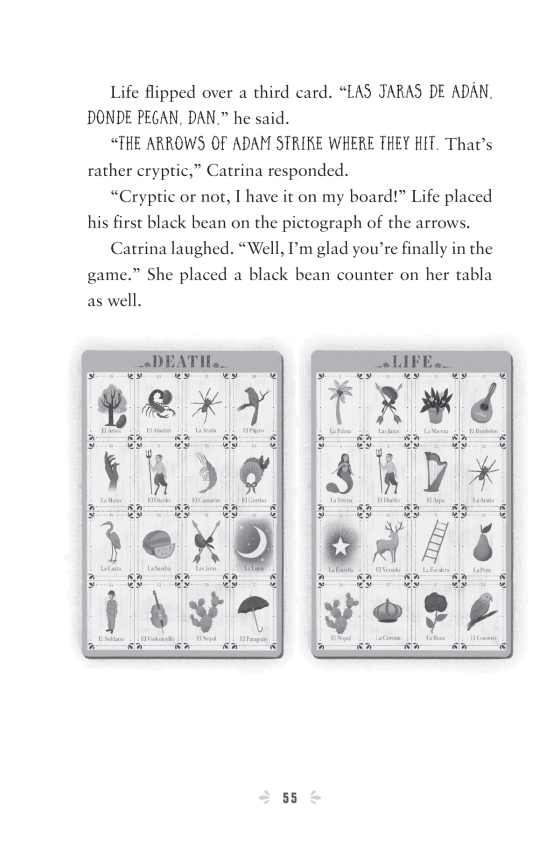
"La Loteria was a simple game of chance. The first to get four cards in a straight line - horizontal, vertical or diagonal - would win. A win by Catrina (Lady Death) would deliver Clara into her hand. A win by Life would spare the child, granting Clara a long life. ... The players had three days to complete the game and deliver their prize, after which they would part ways for another year, meeting only to play another round. "

Each player has set before them a placard with a different image printed one each of the sixteen squares. (Here are some you could print for a class) Beside this the players have a set of fifty-three cards (here are a set to use with the game) each with a different image and the players also have a handful of frijoles - small beans as black as night. Lady Death and Life take turns to flip the cards and find matching images on their own placards - a bit like bingo (but this game might not have a happy outcome). 

The cards contain sayings that need to be interpreted such as EL QUE A BUEN ARBOL SE ARRIMA BUENA SOMBRA LE COBIJA - He who approaches a good tree is blanketed by good shade. Lady Death places a bean on the image of a tree on her tabla. 


Catrina and Life begin their game. A scorpion hides in Clara's sketchbook emerging as she shares her dragon drawing at a family picnic; nearby a young boy is trying out his new bow and arrow; Estaban's mother, a healer, rushes home for some herbs to help with the scorpion sting; at that moment the boy unleashes his arrow. These are the awful events that create enormous grief. Estaban has already lost his father and now his mother. When a stranger arrives, rather like the Pied Piper, Estaban believes he will be taken to see his mother. He can hear her singing. He follows the man in the red coat into another world.

Clara has promised to keep her young cousin Estaban safe and so she follows them into this dangerous and unpredictable place. Clearly the man has evil intentions but why does he want this young boy? As you might suspect this is all about power but you might be surprised to learn it is also about the elixir of youth. Yes, this sounds complex and it is, but it is also utterly riveting. 

One thing Clara has to do to survive and to find her cousin, is work out the bargaining system. At one point she meets a fawn hiding from some hunters. He will tell her how to climb through some impenetrable vines in exchange for colour - the colour of her hair! Pages 140-143 in my paperback copy could be a fabulous section to read aloud as a book talk to a group of students. 

The descriptions in this book are fabulous - they would be wonderful to use with a writing group:

"He looked quite dapper in his black suit and matching vest, with a crisp white shirt and the tiniest hint of red peeking out of his jacket pocket: a crimson handkerchief, monogrammed."

"Two fig trees heavy with fruit flanked the entrance to the path. Ceramic pots of various shapes and sizes lined the way. Some held tall and spiky cacti, while others boasted flowering plants with buds of yellow and orange; a pair of succulents grew in a rooster shaped pot."

"As she spoke, she plucked a petal off her crown and released it into the air. The petal folded into a rose-scented butterfly."

"The baby deer has left its hiding place and now stood behind her. It was completely white, a bright beacon against the greens and reds and yellow surrounding them. Its large black eyes gazed at her openly."

"A waterfall roared down the side of the cliff into a pool of clear water that branched off into dozens of canals. The canals snaked along the jungle floor toward fountains carved in the shape of mermaids or fish or outstretched hands with fingers reaching upward."

This book is filled with Spanish food and words but you will have no problem working things out. There is no glossary but this book does have a useful set of notes at the back. I did look up one important word: El diablo - the devil (the man in the red coat).

Loteria is a totally engrossing story. I know the bravery of Clara and the horrible scene where we discover why the boy king has taken these children will linger with me for years to come. This is another one of those books where I marvel at the imagination of the author.

You can read the first nine chapters here. The publisher - Random House Kids suggests ages 8-12 for this book but I would say it is for 11+. I have labelled it as Young Adult because a loved character does die very early in the story and the fate of Clara and her young cousin Esteban is a very complex one - not something a young reader would understand. Also, this book is written using a sophisticated vocabulary, and it is, as I said, filled with Spanish expressions and food. The scene with the enormous spiders when Clara is tossed into the underground prison are truly frightening. (Chapter 28).

Publisher blurb: In the hottest hour of the hottest day of the year, a fateful wind blows into Oaxaca City. It whistles down cobbled streets and rustles the jacaranda trees before slipping into the window of an eleven-year-old girl named Clara. Unbeknownst to her, Clara has been marked for la Lotería. Life and Death deal the Lotería cards but once a year, and the stakes could not be higher. Every card reveals a new twist in Clara’s fate—a scorpion, an arrow, a blood-red rose. If Life wins, Clara will live to a ripe old age. If Death prevails, she’ll flicker out like a candle.  But Clara knows none of this. All she knows is that her young cousin Esteban has vanished, and she’ll do whatever it takes to save him, traveling to the mythical Kingdom of Las Pozas, where every action has a price, and every choice has consequences. And though it seems her fate is sealed, Clara just might have what it takes to shatter the game and choose a new path.

Read some review comments on Karla Arenas Valenti's web page. Here's the Horn Book review. And here is a radio interview with the author. Here is a set of excellent discussion questions. See the cover being made here. And here is an interview with Betsy Bird - she loved this book too. And finally here is another interview from the blog - From the Mixed-up files.