Poetry can bring delight and insights to children from a very young age.
But some adults lack confidence in introducing poems at home or in the classroom.
Today we’ll show you some picture books based on one complete poem.
We hope they’ll inspire you to seek out more. Dr Robin Morrow
Over the last few months Dr Robin Morrow and I have been preparing a presentation on the topic One Poem in a Picture book. This post is a sneak peek of our newest IBBY presentation. Members will be sent the video link over the coming weeks. Our video has a wealth of book titles for you to explore. The book above - Stopping by Woods on a Snowy Evening by Robert Frost with spectacular illustrations by PJ Lynch - was one of the titles that inspired this talk. Many years ago, I also started a Pinterest on this topic (80+ titles) after a question was posed in a Facebook group. If you join IBBY Australia (only AUS$45) you will be able to access our full video over the coming weeks.
In our presentation we talk about Australian bush ballads, famous poems from people such as Emily Dickinson and Christina Rossetti, lyrical poems, funny and nonsense poems and we share books by many famous illustrators such as Charles Keeping, Andrew McLean, Freya Blackwood, Tom Hopgood, Helen Oxenbury, Jan Brett, Charlotte Voake, Susan Jeffers and Julie Morstad.
Senior Primary (Elementary school) and High School teachers and Teacher-Librarians could use these resources as for lessons in visual literacy and also in an art class to talk about the way illustrations have interpreted these famous poems. You are sure to be able to find examples of one poem in a picture book in your school or local library.
Here are a few of the books we feature in our presentation and script excerpts by Dr Robin Morrow:
Hist! is an Australian poem that is not a bush ballad, but it is a narrative poem, written by the popular poet C J Dennis. It is a simple tale of a group of children making their way home in darkness, with a build-up of tension. Peter Gouldthorpe’s skillful design and technique result in an elegant book.
There is a rich array of nonsense poems from the major Anglophone countries. The master of nonsense, Edward Lear, was an artist and added witty drawings to his poems. The Quangle Wangle’s Hat cries out to be read aloud and also offers scope for a variety of visual interpretations. It is interesting to note that Helen Oxenbury’s earliest picture books included this nonsense rhyme. The original cover shows the small Olympian bear. Of course, she never reveals the face of the Quangle Wangle himself, a special challenge of this poem, because the verse states his face you could not see because of his huge hat.
Another great favourite Edward Lear poem is The Owl and the Pussycat. A number of illustrators have worked on this rollicking but poignant verse. The US illustrator Jan Brett sets her many picture books in exotic locations. I think Edward Lear would be surprised to find his fantasy couple in the seascape and landscape of the island of Martinique, with its radiant colours.
Another English writer, Walter de la Mare, created many poems that have become beloved by children. ... perhaps the best-known, Silver, in which on a spring evening, two sleepy children join a parade to a wonderful, dream-like fairy party in the woods.
Slowly, silently, now the moon
Walks the night in her silver shoon;
This way, and that, she peers, and sees
Silver fruit upon silver trees;
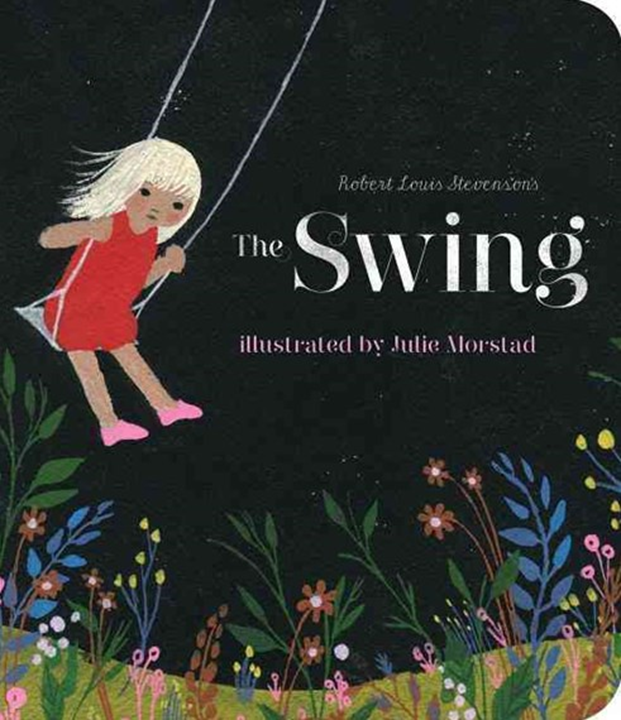
Canadian illustrator Julie Morstad uses bright colours, strong brush strokes, and simple but skillful composition in this book. And the appeal of swinging is such a universal joy of childhood that it is good to see this, another favourite Robert Louis Stevenson poem, presented for a very young readership.
Langston Hughes, a most influential African-American poet, wrote An Earth Song, a simple, exuberant poem about welcoming spring. The illustrator Tequitia Andrews has made clear, strong illustrations of children enjoying the seasonal change, reminiscent of the work of Ezra Jack Keats.
An Earth Song is from a series called Petite Poems (Abrams Appleseed).




.jpg)


