Showing posts with label Bush Ballads. Show all posts

Monday, February 2, 2026

Mulga Bill's Bicycle by PB Paterson illustrated by Kilmeny and Deborah Niland


Last week I shared some Australian books that teachers or Teacher-Librarian could display or read to groups for Australia Day. Our schools here in Australia are always on their summer holidays when this public holiday is celebrated but you could still share the books I mentioned during the first few weeks of the term especially when new classes have not yet been formed. My previous school waited through the first week before forming their classes and this was always a difficult period for the students, keen to meet their new teacher, and the staff who would much prefer to meet their new class having already said goodbye to their previous students at the end of last year.

I realised when I posted about some terrific picture books with an Australian flavour that I had not talked about Mulga Bill's Bicycle here on this blog. I have read this version to many students in Grade 4 - it is good to share poetry by one of our very famous bush poets but as a bonus the story of this poem is so funny. The first steps though need to be an unpackaging of some of the words and phrases. I have added bold to the text of the poem below.

Here are some teaching ideas. I would share the poem, then the book and then you could perhaps use this video (it is not perfect but it is the best one I found).

Banjo Paterson wrote the poem in 1896, a time when cycling was a relatively new and popular activity. It tells the story of Mulga Bill who thinks he will have no problem riding his velocipede, you know, one of those bicycles that has a huge wheel in the front and a teensy weensy one at the back. After a hair-raising ride he crash lands in Dead Man’s Creek and decides that the bicycle “ it’s safe at rest in Dead Man’s Creek – we’ll leave it lying still; A horse’s back is good enough henceforth for Mulga Bill’. Storylinks


Publisher blurb: Mulga Bill's Bicycle was written by Banjo Paterson in 1896. It was written at a time when cycling was a relatively new and popular social activity. Cycles were ridden everywhere, including in the outback by shearers and other workers who needed to travel cheaply. Mulga Bill's Bicycle tells the hilarious story of Mulga Bill, who thinks he's much better at cycling than he turns out to be. A resounding crash sends him back to his original mode of transport - his trusty horse. Kilmeny and Deborah Niland's delightful illustrations catch the mood and humour of Paterson's verse with great spirit, and this book has become an enduring classic.

'Twas Mulga Bill, from Eaglehawk, that caught the cycling craze;
He turned away the good old horse that served him many days;
He dressed himself in cycling clothes, resplendent to be seen;
He hurried off to town and bought a shining new machine;
And as he wheeled it through the door, with air of lordly pride,
The grinning shop assistant said, "Excuse me, can you ride?"
"See here, young man," said Mulga Bill, "from Walgett to the sea,
From Conroy's Gap to Castlereagh, there's none can ride like me.
I'm good all round at everything, as everybody knows,
Although I'm not the one to talk; I hate a man that blows.
But riding is my special gift, my chiefest, sole delight;
Just ask a wild duck can it swim, a wildcat can it fight.
There's nothing clothed in hair or hide, or built of flesh or steel,
There's nothing walks or jumps, or runs, on axle, hoof, or wheel,
But what I'll sit, while hide will hold and girths and straps are tight:
I'll ride this here two-wheeled concern right straight away at sight."

'Twas Mulga Bill, from Eaglehawk, that sought his own abode,
That perched above the Dead Man's Creek, beside the mountain road.
He turned the cycle down the hill and mounted for the fray,
But ere he'd gone a dozen yards it bolted clean away.
It left the track, and through the trees, just like a silver streak,
It whistled down the awful slope towards the Dead Man's Creek.

It shaved a stump by half an inch, it dodged a big white-box:
The very wallaroos in fright went scrambling up the rocks,
The wombats hiding in their caves dug deeper underground,
As Mulga Bill, as white as chalk, sat tight to every bound.
It struck a stone and gave a spring that cleared a fallen tree,
It raced beside a precipice as close as close could be;
And then as Mulga Bill let out one last despairing shriek
It made a leap of twenty feet into the Dead Man's Creek.

'Twas Mulga Bill from Eaglehawk, that slowly swam ashore:
He said, "I've had some narrer shaves and lively rides before;
I've rode a wild bull round a yard to win a five-pound bet,
But this was the most awful ride that I've encountered yet.
I'll give that two-wheeled outlaw best; It's shaken all my nerve
To feel it whistle through the air and plunge and buck and swerve.
It's safe at rest in Dead Man's Creek, we'll leave it lying still;
A horse's back is good enough henceforth for Mulga Bill."


Image source Bike Ability UK


Saturday, December 14, 2024

One Poem in a Picture Book IBBY Video sneak peek


Poetry can bring delight and insights to children from a very young age. 
But some adults lack confidence in introducing poems at home or in the classroom. 
Today we’ll show you some picture books based on one complete poem. 
We hope they’ll inspire you to seek out more.  Dr Robin Morrow

Over the last few months Dr Robin Morrow and I have been preparing a presentation on the topic One Poem in a Picture book. This post is a sneak peek of our newest IBBY presentation. Members will be sent the video link over the coming weeks. Our video has a wealth of book titles for you to explore. The book above - Stopping by Woods on a Snowy Evening by Robert Frost with spectacular illustrations by PJ Lynch - was one of the titles that inspired this talk. Many years ago, I also started a Pinterest on this topic (80+ titles) after a question was posed in a Facebook group. If you join IBBY Australia (only AUS$45) you will be able to access our full video over the coming weeks. 

In our presentation we talk about Australian bush ballads, famous poems from people such as Emily Dickinson and Christina Rossetti, lyrical poems, funny and nonsense poems and we share books by many famous illustrators such as Charles Keeping, Andrew McLean, Freya Blackwood, Tom Hopgood, Helen Oxenbury, Jan Brett, Charlotte Voake, Susan Jeffers and Julie Morstad.

Senior Primary (Elementary school) and High School teachers and Teacher-Librarians could use these resources as for lessons in visual literacy and also in an art class to talk about the way illustrations have interpreted these famous poems. You are sure to be able to find examples of one poem in a picture book in your school or local library. 

Here are a few of the books we feature in our presentation and script excerpts by Dr Robin Morrow:


Hist! is an Australian poem that is not a bush ballad, but it is a narrative poem, written by the popular poet C J Dennis. It is a simple tale of a group of children making their way home in darkness, with a build-up of tension. Peter Gouldthorpe’s skillful design and technique result in an elegant book. 


There is a rich array of nonsense poems from the major Anglophone countries. The master of nonsense, Edward Lear, was an artist and added witty drawings to his poems. The Quangle Wangle’s Hat cries out to be read aloud and also offers scope for a variety of visual interpretations. It is interesting to note that Helen Oxenbury’s earliest picture books included this nonsense rhyme. The original cover shows the small Olympian bear. Of course, she never reveals the face of the Quangle Wangle himself, a special challenge of this poem, because the verse states his face you could not see because of his huge hat.


Another great favourite Edward Lear poem is The Owl and the Pussycat. A number of illustrators have worked on this rollicking but poignant verse. The US illustrator Jan Brett sets her many picture books in exotic locations. I think Edward Lear would be surprised to find his fantasy couple in the seascape and landscape of the island of Martinique, with its radiant colours.


Another English writer, Walter de la Mare, created many poems that have become beloved by children. ... perhaps the best-known, Silver, in which on a spring evening, two sleepy children join a parade to a wonderful, dream-like fairy party in the woods.

Slowly, silently, now the moon
Walks the night in her silver shoon;
This way, and that, she peers, and sees
Silver fruit upon silver trees;


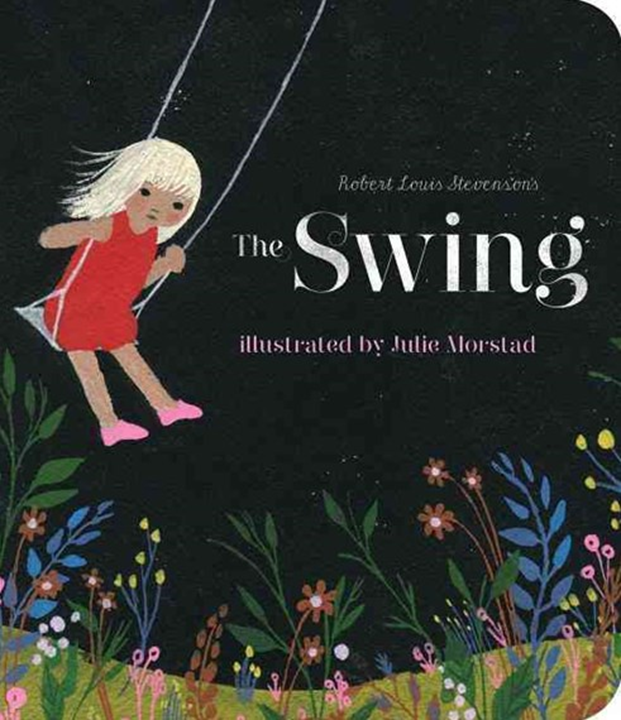
Canadian illustrator Julie Morstad uses bright colours, strong brush strokes, and simple but skillful composition in this book. And the appeal of swinging is such a universal joy of childhood that it is good to see this, another favourite Robert Louis Stevenson poem, presented for a very young readership.


Langston Hughes, a most influential African-American poet, wrote An Earth Song, a simple, exuberant poem about welcoming spring. The illustrator Tequitia Andrews has made clear, strong illustrations of children enjoying the seasonal change, reminiscent of the work of Ezra Jack Keats. 

An Earth Song is from a series called Petite Poems (Abrams Appleseed).