"Once, in the time of your grandmother's grandmother, there was a kingdom. In the middle of the kingdom was a large lagoon dotted with islands, and here a city had been built; a city of sky-blue water and golden bridges. It was a small city, but it was a beautiful ... and the king and queen were very proud of it. They were also proud of their daughter Lucia ..."
And so the scene is set. Lucia needs a husband. The parents write a letter to the wise man and he replies they must find a young man "who can show you the most wonderful thing in the world."
Lucia is brought roses, a snow-white horse, performing dogs, magical beasts, a piece of frozen sky and many more strange and amazing gifts but none of these things see quite wonderful enough. You may have guessed the ending - although I hope not. Find this book and I hope you gasp with delight as I did at the outcome. (Spoiler alert don't click the Kirkus review below until you have read this book)
Here we have the perfect author and illustrator team who have produced a sumptuous, romantic picture book with a completely satisfying story.
Here is the author web site and you might also like to dip into my review of the series Tales of the Five Kingdoms also by Vivian French. We also have several books illustrated by Angela Barrett in our library including one of my favourites The Hidden House by Martin Waddell.
Following this book I suggest reading The Greatest Treasure of Charlemagne the King, The Quilt Makers Gift and The Dragon and the Minstrel pup.
Monday, October 12, 2015
Sunday, October 11, 2015
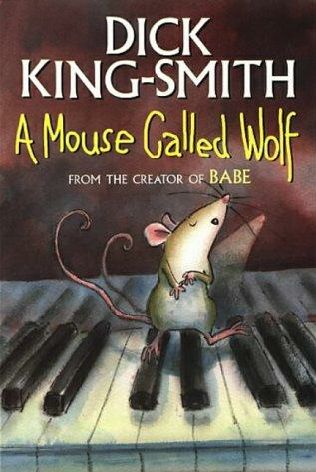
A mouse called Wolf by Dick King-Smith
Last week as I was heading home I quickly browsed my library shelves looking for some weekend reading. I picked up a few books including A mouse called Wolf. Why did I pick up this book which was first published in 1997? I always enjoy books by Dick King-Smith, author of The Sheep pig later turned into the movie called Babe. I really liked the cover of our copy but now I have discovered new editions have even better covers. This looked like a short book for a quick read and it was a book I had not read.
I sat down for a little while this morning and read the whole book right through in one short sitting. What a delight. Here we have a charming story about music, mice, chocolate and one very special older lady who with patience and care befriends a little mouse called Wolf. Actually his real name is Wolfgang Amadeus Mouse but this has been shortened to Wolf. He is a mouse with a special musical talent as befits his prestigious name. He is also a mouse with courage and perseverance.
I think the publisher is missing a terrific marketing opportunity here. I am planning to recommend this to my Grade Three teachers as a read-a-loud title. This book should come with a CD containing all the music that Wolf and Mrs Honeybee (I love that name) enjoy together.
Here is a partial list of some of their favourites:
The best scene comes at the end of the book when Wolf sings his own composition entitled Swallow Sonata to Mrs Honeybee :
"I never taught him this, she thought, I've never heard this piece of music before. Never in all my concert playing days did I hear this, and yet it must be by one of the great classical composers. How light it is, how airy, how wonderfully joyful!"
If you enjoy this book follow it up with Walter which is also about a very special rodent.
Here is the web site for the author.
I sat down for a little while this morning and read the whole book right through in one short sitting. What a delight. Here we have a charming story about music, mice, chocolate and one very special older lady who with patience and care befriends a little mouse called Wolf. Actually his real name is Wolfgang Amadeus Mouse but this has been shortened to Wolf. He is a mouse with a special musical talent as befits his prestigious name. He is also a mouse with courage and perseverance.
I think the publisher is missing a terrific marketing opportunity here. I am planning to recommend this to my Grade Three teachers as a read-a-loud title. This book should come with a CD containing all the music that Wolf and Mrs Honeybee (I love that name) enjoy together.Here is a partial list of some of their favourites:
- Mendelssohn Song without words
- Just a song at Twilight
- Food glorious food from Oliver
- Climb every mountain
- Help by the Beatles
The best scene comes at the end of the book when Wolf sings his own composition entitled Swallow Sonata to Mrs Honeybee :
"I never taught him this, she thought, I've never heard this piece of music before. Never in all my concert playing days did I hear this, and yet it must be by one of the great classical composers. How light it is, how airy, how wonderfully joyful!"
If you enjoy this book follow it up with Walter which is also about a very special rodent.
Here is the web site for the author.
Labels:
Easy chapter book,
Junior Fiction,
Mice,
music,
Rescue,
Singing
Friday, October 9, 2015
Australian kids through the years by Tania McCartney illustrated by Andrew Joyner
If you have been reading this blog you will know I very rarely discuss non fiction. Today, though, I simply have to talk about Australian Kids though the Years.
As a part of my job in a school library I read many, many books but if you were to look at percentages I read around 90% fiction. With non fiction there are obvious features which make one text better than another. We look for the usual library devices such as index, contents, captions, large photographs, accuracy, and information presented in a variety of ways especially visual. We have thousands of non fiction books in our school library but only a handful really stand out in my opinion.
Australian Kids through the Years is a standout book! It does not have an index or contents but this is not important. This is a book which can be used right across a Primary school. The youngest children can look at their parents and grandparents clothes, toys and hair. Middle primary students could make timelines showing each theme and the oldest students could use the final illustrations list at the back of the book as part of a discussion about copyright. Older students could also compare the way information is presented in this book with more conventional timeline series such as Australia in the Twentieth century. I would also pair this book up with My Place by Nadia Wheatley which is one of the very best books ever written about Australian history from the point of view of a child.The design of Australian Kids through the years is chronological. Beginning with First Children and then moving through time - 1800-1840s, 1850s, 1900-1909, 1910-1940s, 1950s, 1960s and so on up to 2000-today.
I love the way Tania McCartney resisted the need to present the dates in a pattern. Instead these dates match major events in Australian history such as the Gold Rush of 1850.
For each time period in this book we meet two children - a boy and a girl. On the next page we see all the "things in their world" such as clothes, food, hairstyles and my favourite part - the books they read. This book has obviously been very carefully researched but all these facts are presented in such an appealing way.
The books are such a 'blast from the past' for me. Here are a few (I have my own old copies of these books) :
1910-1940 Blinky Bill and Winnie the Pooh
1950s Charlotte's web and The cat in the hat
197s0 The Lion, the Witch and the Wardrobe
1980s Possum Magic
Here are the web sites for the author and illustrator. I am once again going to predict that this book will be short listed for our CBCA awards 2016. You might like to read this review.
I am including one page from the book and the photo page which appears at the end. This is a book which should be part of every school library collection and every home library too.
Saturday, October 3, 2015
Sister Heart by Sally Morgan
Just by chance here is another verse novel. I read this last week before reading The Crazy Man. Sister Heart and The Crazy man do not have a lot in common on one level - one is set in Canada in 1965 and the other in Australia between 1905 and 1970. On an emotional level, though, both are such important stories.
Sally Morgan herself says complex topics such as the Stolen Generation can be more deeply explained through a personal narrative. In this book we meet a little girl who has been named Annie. We never discover her true name or learn where she is from. As the book opens Annie has been taken away from her mother and family. She travels over many days by ship and is placed in institutional care. It is here that Annie makes an important friend. A girl of the same age called Janey who befriends Annie and helps her to cope with her loss, bewilderment and the brutality of the care in this place which is now her home.
One of the best parts of this book is when Annie and Janey are able to wander away from the care home to a nearby creek.
The bush nearby smells damp
fresh
alive.
Birds swoop
call out
make nests
sing.
Annie's brother Tim gives her a laughing stone.
If ya feel sad
squeeze the stone
and laugh
Only don't laugh in school!
Here is a set of very detailed teaching notes. This book should be considered as essential reading for a senior primary grade. It could be used along side the book and movie of The Rabbit Proof Fence and The Burnt Stick.
You can read an interview with Sally Morgan here. You should also listen to this Radio National interview. It goes for about 14 minutes but is worth spending the time to listen right to the end.
I will make another of my bold predictions and say this book will surely be short listed for the CBCA prize in 2016. Once it is available in paperback I plan to add a class set of this book to our library.
Here is a selection of other books on this topic which you might explore
The crazy man by Pamela Porter
In 2012 I visited one of my favourite book shops - Woozles in Halifax, Nova Scotia, Canada. While I was there (this was my second visit) the manager recommended The Crazy Man because it is an award winning Canadian book and because we had been talking about verse novels.
The Crazy Man is a wonderful verse novel - and if you have been reading my blog you will know I adore this format - they are always such powerful narratives.
The Crazy Man was first published in 2005 but my edition is from 2011. This book is not in our school library but you might be lucky and find it in a high school or public library collection here in Australia - I hope so.
The book opens with a terrible farm accident. Emmie is very badly hurt. Her dad blames himself but takes his anger out on their dog Prince. "... my daddy tied Prince up to the tractor shed and shot him with his hunting rifle."
The only visitor to the hospital is her grade six teacher Miss Tollofsen.
"She got out of her car with a fist full
of lilac flowers, and I found out
we had something in common.
Mum put them in a glass of water
and I got to smell them. Dark purple ones
and light purple ones, Some still
tight little buds.
Even some white ones, and they all
smelled a little different.
She bought the whole spring day inside
when she did that."
With her Daddy gone, Emmie and her mum need help on their farm. It is planting time. Nearby there is a hospital - a mental institution. The year is 1965 and the air is thick with prejudice and gossip. This is a book about healing and acceptance. Amos, who comes to help on the farm, is healed and so is Emmie. The people in this small town also learn a little about acceptance of difference.
Listen to Pamela talking about her book and reading an extract. Here is a detailed review.
If you enjoy The Crazy Man you should also read Out of the Dust by Karen Hesse and Love that dog by Sharon Creech. You might also look for A corner of the Universe by Ann Martin.
I will finish off with another quote so you can get a sense of the power of this writing. In this scene Emmie has gone to Souris pool.
"Once I was in, I moved like a fish,
kicking and squirming,
no heavy shoe to lug around. I turned
somersaults
in the water. I floated on my back
and raced underwater,
like nothing had happened
to change me forever."
Labels:
Farms,
Fathers,
Hardship,
Healing,
love,
Mental illness,
Prejudice,
Senior fiction,
Verse Novel
Thursday, September 24, 2015
Solo by Paul Geraghty
I recently reviewed Seagull by Danny Snell . Solo would make a good partner for this text. Here we follow a pair of emperor penguins and the arrival of their chick, Solo. It begins as a gentle story of survival in an extreme environment.
The tone of this story takes a severe downturn when the father penguin Fin, fails to return. He is bringing food for his partner Floe and baby Solo. Floe herself has made this journey over the previous months as Fin kept their egg warm.
Survival instincts kick in and Floe is forced to leave little Solo behind. "Solo tried to follow, but she couldn't keep up. She waited quietly for a while, but then she cried out from the cold." This scene and the following pages may break your heart. The ending is bitter sweet. Yes Solo finds her mother and is reunited with her father but the final image of the little family shows their will be ongoing struggles - human made struggles - for this intrepid family.
You can see a full list of wonderful books by Paul Geraghty here. You can see some terrific art inspired by this book. This book should be added to your study of the environment with a young class.
Labels:
Family relationships,
Life cycles,
Penguins,
Picture Book
Monday, September 21, 2015
The case of the weird blue chicken by Doreen Cronin illustrated by Kevin Cornell
This is the second madcap adventure by the Chicken Squad and I must confess I missed the first (yes it is in our school library) but it did not seem to matter I quickly fell into the workings of the squad and their riotous exploits.
The squad consists of four odd ball chicks named :
Dirt
Sugar
Poppy
Sweetie
You lost it.
We'll find it.
You broke it?
We'll fix it.
In trouble?
We'll get you out.
Looking for trouble?
We'll bring it to you.
A tiny blue bird shows up at the chicken coop with a problem. Someone has kidnapped her house. This is the perfect case for our squad. You can read more about this adventure when you click the Kirkus link below :
Please take a minute to listen to this little audio sample - it is perfect! This book might work well as readers theatre or adapted as a play with your class. If you have not read any other books by Doreen Cronin look in our library. I love reading Vote for Duck each year to our grade six students when they are talking about government. This same book is called Duck for President in the US.
Subscribe to:
Posts (Atom)