Showing posts with label African American children. Show all posts

Monday, June 22, 2026

One Big Open Sky by Lesa Cline-Ransome


Daddy says Momma (Sylvia), Lettie, Silas and Elijah are going to move. It is time to have their own land and not have to work for some else. There is no more slavery. It is time to be truly free. The journey will be long, but they have shelter in their covered wagon, and they will not be alone - this family group will travel with others all determined to reach Nebraska. Ten families heading West out of Mississippi to take advantage of the land promised by the Homestead Act of 1862. But food will be short, along the way small towns will charge enormous prices for basic supplies and there are dangerous rivers to cross. Luckily along the way they do pick up a young woman who is hard-working and wise. And when a dreadful catastrophe befalls the family, young Philomena is able to step in and help with their two faithful mules Charly and Titus. 

All the land you want 
Free 
he said to me 
All we got to do is go on and get it 
Take what’s ours 
I looked down at the paper 
that didn’t say none of what he was 
Any colored who want it 
Come with some money too right? 
I looked at his eyes 
shining in the lamplight 
bright 
Who was I to dim their light? 
To take from him what white men 
masters 
loss 
and years of fieldwork left of him 
He asked pointing down at the paper 
And they even give you a wagon?

Here is what they pack: 200 pounds of flour 10 pounds of rice 5 pounds of coffee 25 pounds of sugar 1 bushel of beans 20 pounds of salt 1 bushel of cornmeal 1 keg of vinegar 100 pounds of bacon 25 pounds of dried fruit Daddy’s good rifle and gunpowder two pistols lard, candles, lye powder matches and soap frying pans and a coffeepot our old stew kettle and Momma’s sharpest knife nails one washtub A tent and blankets blankets for Charly and Titus plus their feed too even the cradle Momma wanted was packed in tight.

The journey could take four or five or even six months. This story is about the journey not the destination but readers are left with enormous hope that the family will prosper in their new home. 

From where we sat we could see the lantern lighting up the cabin and imagine the warmth inside our new home in the West in Nebraska with a fire in the hearth and beds stacked with quilts Silas, Elijah, Momma and Miss Pratt inside But me and Sutter liked it best curled in close together warming each other best as we could in the tent Momma let me pitch outdoors.

There are three voices in this verse novel so you do have to pay attention at the start of each section or chapter. It is very significant that these are three women - Lettie is a young girl born after the end of slavery but also born into a time when women are expected to marry, have children, and of course have no rights and no vote. Her mother Sylvia is brave and loyal to her husband but she has to sacrifice so much to make this enormous journey to find a place her husband believes will be 'a promised land'. Philomena is a young, newly trained teacher who values her independence. She has been promised a teaching job in Nebraska and for Philomena this means she can support herself without the need for a husband. 

When I was in Primary School (Elementary) here in Australia I read and loved, like so many kids of my generation, books about American pioneers such as Little House on the Prairie and all the sequels but even more I loved Children of the Oregon Trail. That goes part of the way to explaining why I simply devoured One Big Open Sky. As usual I have no idea how I came across this book and then why I added it to my 'to read' list as a title I could pop on my Kindle. I started this book on a two-hour bus and train journey and then completed it on the way home. I am happy to see the paperback edition of this book is available [9780823460625].

Publisher blurb: Three women narrate a perilous wagon journey westward that could set them free—or cost them everything they have—in this intergenerational verse novel that explores the history of the Black homesteader movement. 1879, Mississippi. Young dreamer Lettie may have her head in the stars, but her body is on a covered wagon heading westward. Her father, Thomas, promises that Nebraska will be everything the family needs: an opportunity to claim the independence they’ve strived for over generations on their very own plot of land. But Thomas’ hopes—and mouth—are bigger than his ability to follow through. With few supplies and even less money, the only thing that feels certain is danger.

This map shows their journey:


Awards:
A Coretta Scott King Author Honor Book
Winner of the Virginia Library Association Cardinal Cup Award
A Bank Street Best Children's Book of the Year
A Junior Library Guild Gold Standard Selection
One of Evanston Public Library's 101 Great Books for Kids
A CSMCL Best Multicultural Children’s Book of the Year
An ALSC Notable Children's Book
A CLA Notable Children's Book in the Language Arts

Companion book:


Wednesday, April 29, 2026

Radiant by Vunda Micheaux Nelson


Sometimes 
I want to be white. 
White— 
like new snow 
or angel wings. 
White— 
like fresh milk 
or cumulous clouds. 
White— 
like just-washed sheets 
dancing on the clothesline. 
White— 
a full moon on a clear night.


Cooper is named after her Grandfather. I do like to think about names. Her name could be a source of teasing or worse but no, the bullying all relates to the colour of her skin mainly from one boy in her class. She is having a hard time in school - firstly with a dreadful bully named Wade Carter and also with her teacher Mrs Keating. But Cooper has a goal to shine:

I look up “shine” in the dictionary. It means a lot of good stuff. The kind Mama means: “To radiate. To give off light. To be made bright by polishing. To sparkle and shimmer with luster." It means brilliance and splendor. —That’s what I want. I want to shine. To be brilliant. To be radiant. “Radiant” is one of the words.

To shine at school means scoring good grades and 'winning' over Mrs Keating. At times this seems to be an almost impossible goal.

Then there is Wade who takes every opportunity to be so nasty to Cooper. Spoiler alert - in stories (and maybe in real life too) there is often a deeper reason for the bullying - and in this book it is true that Wade is going through some very tough stuff at home but I have to say I found it very hard to be sympathetic (even when his mum died). 

I wish Wade hadn’t heard me say I want to shine. I wish I hadn’t said it out loud. I do want to shine. I want to shine so bright, so bright that I blind Wade. Color blind him.

I wonder, is Wade scared? Scared of me? Or is he just mean?

Cooper, quite rightly, would like different colours for Crayola crayons - different colours to use for skin tones. This could be a good discussion point with a reading group. 

And why does my skin matter so much? Nobody cares if I wear a red blouse or a blue one. Why should they care if I wear black skin or white skin or purple skin?

Then for Christmas Cooper is gifted a small transistor radio and she also discovers the famous pop group - the Beatles. 

Kate and I read about John Lennon Paul McCartney George Harrison and Ringo Starr (with two r’s). We learn some new British words, like “gear” and “cuppa” “lift” and “kip.”

It is also an important turning point for Cooper when another 'black' student arrives in her class. I loved this boy - he is confident, he is kind, He is so proud of his heritage and most of all he is so friendly to everyone. 

There are references to other books in Radiant - The Wizard of Oz; Charlotte's Web; and Langston Hughes poetry. 

Australian readers will be unfamiliar with many of the historical references in this book - the assassination of JFK, Martin Luther King Jr, and the Klu Klux Klan along with all the references to racial discrimination but many kids will identify with Cooper's need to find herself, her voice, her own place in the world and her desire for representation - where are the kids like her in stories and films. They will also cheer as she conquers school and gains good results on her end of year report card. I would share this verse novel with mature readers aged 10+.

Publisher blurb: As school begins in 1963, Cooper Dale wrestles with what it means to “shine” for a black girl in a predominantly white community near Pittsburgh. Set against the historic backdrop of the Birmingham church bombing, the Kennedy assassination, and Beatlemania, Radiant is a finely crafted novel in verse about race, class, faith, and finding your place in a loving family and a complicated world.   Cooper’s primary concern is navigating fifth grade, where she faces both an extra-strict teacher and the bullying of Wade Carter, the only child of a well-to-do white family, whose home Cooper’s mother cleans for extra income. How can she shine when her mother works for the meanest boy in school? To make matters worse, Cooper quietly wishes she could be someone else. It’s not all bad, though. Cooper and her beloved older sister have fallen for the Beatles, and Cooper is thrilled to have something special they can share. And what she learns about her British idols adds new complexity to Cooper’s feelings about race.

This verse novel examines complex themes of identity, forgiveness, self-love, and self-actualization through writing that’s accessible to young readers. Nelson intentionally and deftly uses details to situate the novel with history, and she’s crafted an endearing, three-dimensional protagonist in Cooper, whose voice and authentic struggle to make sense of her experiences will resonate in a work that presents fertile ground for discussion. Kirkus

Companion books:


Ten years ago I read another book by Vunca Micheaux Nelson - Possibles.


Saturday, February 21, 2026

The Mighty Miss Malone by Christopher Paul Curtis


In summation and conclusion, the Malone family has four members who are very bright, very good-looking and uniquely talented, just not all in one person at the same time. We are the only family in the world, in my ken, that has a motto of our own! That motto is “We are a family on a journey to a place called Wonderful.” I can’t wait until we get there!

Hoping is such hard work. It tires you out and you never seem to get any kind of reward. Hoping feels like you’re a balloon that has a pinhole that slowly leaks air.

Meet Deza - "I am neither very intelligent nor very tall. I also have not been blessed with a beautiful singing voice. I have a pleasingly even disposition unless it’s one of those times that I become very angry or scared and have embarrassing wishes to hurt someone real bad." "My most annoying trait is that some of the time I might talk a little too much, I can be very verbose. I also exaggerate but that is because I come from a family of great storytellers which is not the same as great liars."

And her mother - "My mother, Mrs. Margaret “Peggy” Sutphen Malone, was born here in Gary, Indiana. She is willowy and radiant and spell-blindingly beautiful. She is also very intelligent. She has a great job cleaning for the Carsdale family. Yes, that Carsdale family! The family whose patriarch is the president of the Gary Citizens’ Bank. Her most endearing trait is that she is the glue holding this family together."

My father who uses alliteration every chance he has - "He always calls me his Darling Daughter Deza, and I’m supposed to answer that he is my Dearest Delightful Daddy. He calls Jimmie the Genuine, Gentle Jumpin’ Giant, and Jimmie’s supposed to call him his Fine Friendly Father Figure. Father also calls Mother the Marvelous Mammalian Matriarch ... "

And Deza's brother is Jimmy - "The oldest child in our family, Mr. James Edward Malone, is fifteen years old and has been blessed with the singing voice of a angel. Jimmie’s most annoying trait is that he has what Mother says is a napoleon complex. That means Jimmie is not as tall or robust as most boys his age and tries to make up for it by being as loud and full of braggadocio as he can. He also gets in lots of fights. Jimmie’s most endearing trait is that he loves me more than any big brother has loved a little sister since time immoral."

The year is 1936 - the years of The Great Depression. The Malone family are poor. The have to rely on community food handouts. Deza desperately needs to see a dentist and her brother is bullied and taunted for being small and 'slow'. 

“And I know you, Peg. I know you’re going through the same thing, we both know that that little brown-skinned angel is something beyond special. You know if there’s any chance in the future, it’s riding on her narrow shoulders. So you tell me, you tell me how can I come home empty-handed knowing that that sassy, smart, beautiful, charming little girl…my Mighty Miss Malone…is slowly rotting away on the inside and we can’t afford to have her teeth looked after, we can’t even get them pulled?"

Her father is badly hurt on a fishing trip. Her mother loses her cleaning job. Then Deza's Daddy heads away to find work in Flint. Mother, Deza and Jimmy try to follow him but one night Jimmy heads off. He has a dream to be a singer but is he just being conned? These are dangerous times for the mother and daughter who find themselves living in a camp or shanty town with other displaced people. Their dream, though, is to try to find a place called Wonderful with a house of their own and everyone reunited. 

Deza is a top student and her teacher recognises her abilities and also her poverty. In a beautiful scene near the beginning of the book Mrs Needham gifts Deza some shoes and clothes. 

Inside the bag there was a beautiful pair of new patent leather shoes and some folded-up clothes. Mother says it’s rude to set shoes on anything but the floor so that’s where I put them. “Do you wear a size five?” “I’m not sure.” “Try them on.” I picked up the first shoe. There were some socks rolled up in it. “Should I put on the socks too?” “Yes.” I was glad I was behind her desk and she couldn’t see my shoes and socks. My shoes are quite tired and my socks have been darned a million times. Jimmie says our socks and clothes are very religious because they are so holey. My hands were shaking, but I pulled the new socks on and slipped my feet into the shoes. I knew just how Cinderella felt! They were a little big, but maybe that was because mine were so tight. I sat on my socks so Mrs. Needham wouldn’t see them. She said, “My niece from Cleveland spent the summer with me a while ago and left a few things. I thought they might fit you.” Did Mrs. Needham really mean these shoes were for me?

I've included this long quote above because I was utterly devastated later in the story when Deza accidentally leaves her precious clothes behind. 

To get to Flint they jump a train. They are given some really important advice about ways to stay safe in the camp - these were called Hooverville during the Depression.

"You gonna have to be extra careful when you get to camp, that’s unsafe too, if you don’t know what you’re doing.” “What do you mean?” “It’s just like anything else, there’s just enough bad folks in camp to make it so you got to keep your guard up at all times. It’s especially hard on women, and even worst for little girls.” She looked at me and a shiver went through my heart. “You just gotta keep your wits about you and don’t let no one in on your business. Keep it to yourself why you’re on the road alone.” ... “Always let folks think your husband or your brother is with you, always tell ’em that he’s gonna be back later tonight. There’s strength in numbers so let folks think there’s a lot of y’all. You’re a good-looking woman, you gonna have to be careful not to draw a lot of attention you don’t want.” Mother’s jaws tightened. “And don’t let no one get too familiar either, man or woman. Don’t let ’em know where y’all are really from. They’ll start prying and before you know it they’re looking to help you out in some way that ain’t no kind of help at all. Just keep your head low. Don’t look weak or scared.”

Spoiler alert - there were moments I cheered in this story: When Deza and her mother move into a room in a real house; when Deza has an address so she can get a library card; when Deza finally gets good dental help; and when the series of letters arrive with money and news about her father. AND there were moments of despair: When Deza lost her clothing gift; when she couldn't go to the special extra lessons with Mrs Needham; and in her new school when 'black' students are always given low grades no matter how well they perform. 

Bookseller blurb: Deza is the smartest girl in her class, singled out by teachers for a special path in life. But the Great Depression hit Gary, Indiana hard, and there are no jobs for Black men. When her beloved father leaves to find work, Deza, Mother, and her older brother Jimmie go in search of him, and end up in a Hooverville outside Flint, Michigan. While Jimmie's beautiful voice inspires him to leave the camp to be a performer, Deza and Mother continue on, clinging to the hope that they will find Father. The twists and turns of the Malone's journey reveal not only the devastation of the Depression but also the enduring strength of family bonds and the mighty heart of young Deza Malone.

Listen to an audio sample here. The Might Miss Malone was published in 2012 but because it won the Coretta Scott King Award it is still in print and available in paperback. 

Each of these reviews has more plot details:

Vivid picture of what it was like to live through the Great Depression, as well as what it was like to live with every day prejudice. Deza is a strong character, and her family tries their best to survive and prosper during a difficult time. Ms Yingling

The Mighty Miss Malone is a Superlative Stupendous Story and a Totally Awesome Book. The Book Smugglers

The fluidity of the writing, the strong sense of place and time combined with well-drawn characters will captivate and delight. Kirkus Star review

We talk now about the importance of representation in books for children. Here is a wonderful quote from The Mighty Miss Malone which epitomises this:

"When I was in Gary and would read novels I used to put myself right in the middle of the story. I knew it was a great book when it felt like the author was writing about me. Some of the time I’d get snapped out of the book when I read things that I couldn’t pretend were about me, even if I had the imagination of Mr. William Shakespeare. Words like “her pale, luminescent skin” or “her flowing mane of golden hair” or “her lovely, cornflower-blue eyes” or “the maiden fair.” I would stop and think, No, Deza, none of these books are about you."

Deza is a character from a previous book by Christopher Paul Curtis:


Sunday, December 28, 2025

Patina by Jason Reynolds


"I probably should introduce myself. My name is Patina Jones. And I ain't no junk. I also ain't no hair flipper. And most of the girls at Chester Academy are hair flippers who be looking at me like my mum some kind of junk maker. But ain't none of them got the guts to come out of their mouths with no craziness. They just turn and flip their dingy ponytails toward me like I care. Tuh. I guess it's no secret that it's never easy being the new girl."


Publisher blurb: Patina, or Patty, runs like a flash. She runs for many reasons—to escape the taunts from the kids at the fancy-schmancy new school she’s been sent to ever since she and her little sister had to stop living with their mom. She runs from the reason WHY she’s not able to live with her “real” mom anymore: her mom has The Sugar, and Patty is terrified that the disease that took her mom’s legs will one day take her away forever. And so Patty’s also running for her mom, who can’t. But can you ever really run away from any of this? As the stress builds, it’s building up a pretty bad attitude as well. Coach won’t tolerate bad attitude. No day, no way. And now he wants Patty to run relay…where you have to depend on other people? How’s she going to do THAT?

Here are some text quotes:

"And just so you don't get the wrong idea, it' not like my mum just wanted her legs cut off. She got the sugar. Well, it's really a disease called diabetes, but she calls it the sugar, so I call it the sugar, plus I like that better than diabetes because diabetes got the word 'die' in it, and I hate that word."

"Here at Chester, as long as your face is selfie-ready 100 percent of the time, you got a chance. A chance at what? Well, I don't really know. All I know it, I ain't got one."

"My uncle's voice, when he's speaking like a regular human being, is deep, but not in a scary way. He has one of those voices that you wish you could touch, wrap yourself up like a blanket. A voice like a dad. And I guess ... like an uncle. A favourite uncle."

'It's like the less numbers in your bank account, the more numbers in your address."

It is the characters from these stories that will linger with you. I love Patty's relationship with her little sister Maddy. I love the quiet restrained wisdom of Coach. Patty is so lucky to live with her aunt and uncle. And Patty herself has a wonderful level of maturity especially when it comes to dealing with her school relationships and the girls in her project group. Studying Freda Kahlo seemed like the perfect topic for Patty and I have no idea how he does it, but Jason Reynolds completely convinced me that he truly understands girls, African American girls and girls on the cusp of the teenage years. At times I felt as though I was also running with the track team and completing in the relay races passing those slippery batons. 

Writing in Patty’s voice, Reynolds creates a fully dimensional, conflicted character whose hard-earned pragmatism helps her bring her relay team together, negotiate the social dynamics of the all-girls, mostly white private school she attends, and make the best of her unusual family lot. When this last is threatened, readers will ache right alongside her. Kirkus Star review

Patina is the second book in the Track series. I previously talked about Ghost

If you only add one series to your school library this term make it these. The new title is Coach. I love the covers - how terrific these will look on your shelves:


Ghost. Lu. Patina. Sunny. Four kids from wildly different backgrounds with personalities that are explosive when they clash. But they are also four kids chosen for an elite middle school track team—
a team that could qualify them for the Junior Olympics if they can get their acts together. 
They all have a lot to lose, but they also have a lot to prove, not only to each other, 
but to themselves. Simon and Schuster


The publisher page has a story extract and discussion questions. 

There were parts of this book which reminded me of this one:


Wednesday, September 17, 2025

Roll of Thunder Hear my Cry by Mildred D Taylor


“I didn’t say that Lillian Jean is better than you. I said Mr. Simms only thinks she is. In fact, he thinks she’s better than Stacey or Little Man or Christopher-John—” 
“Just ’cause she’s his daughter?” I asked, beginning to think Mr. Simms was a bit touched in the head. “No, baby, because she’s white.” Mama’s hold tightened on mine, but I exclaimed, “Ah, shoot! White ain’t nothin’!” Mama’s grip did not lessen. 
“It is something, Cassie. White is something just like black is something. Everybody born on this earth is something and nobody, no matter what color, is better than anybody else.” “Then how come Mr. Simms don’t know that?” “Because he’s one of those people who has to believe that white people are better than black people to make himself feel big.”

“Baby, we have no choice of what color we’re born or who our parents are or whether we’re rich or poor. What we do have is some choice over what we make of our lives once we’re here.” Mama cupped my face in her hands. 
“And I pray to God you’ll make the best of yours.”

Cassie lives with her three brothers, mother, father and grandfather in the Southern US in the 1930s. Her father has work albeit far away working building railway lines and her mother has a job as a teacher. The family also have a farm where they grow cotton and Cassie's grandmother is able to take produce to a local market so unlike other local families the Logan's are not living in dire poverty. They do, however, have to be careful with their money because there is a farm mortgage/tax payment due every month and a local, white, landowner who wants to reclaim their land. Cassie is only vaguely aware of the differences in her community and the ways white adults and children treat her and her family differently. One of the earliest incidents that introduce this to the reader comes when we read that Cassie and her brothers have to walk to school along dusty and sometimes very muddy roads. The white children travel by bus to a different school and every day the horrid bus driver deliberately sprays the Logan kids and their friends with dirt or mud by driving his bus close to the side of the road.

Finally, when the bus was less than fifty feet behind us, it veered dangerously close to the right edge of the road where we were running, forcing us to attempt the jump to the bank; but all of us fell short and landed in the slime of the gully.

Cassie is a feisty girl and she is not prepared to suffer this injustice. She hatches a plan to trap the bus in a huge hole in the road which is disguised by all the mud. Her plan works but then Cassie realises this could put her family in danger. Big Ma her grandmother takes Cassie into the town of Strawberry and on this day Cassie sees even more ways her family suffer discrimination. 

There is a local boy named TJ who is 'sort of' a friend to the Logan kids especially Stacey. TJ keeps failing at school but he is filled with bravado. I knew from the start he was a dangerous boy to have as a friend. He 'swindles' Stacey out of his wonderful new coat and then he fails school again and takes his anger out on Mrs Logan. Finally, he joins up with some local white boys but he is so naive he has no idea they are using him and as the book ends it is TJ who is headed for execution. 

Two of the strongest scenes in this book (for me) were when Cassie's mother pastes brown paper over the ownership grid at the front of the text books that have been 'donated' to the school. 


Then there is a way more harrowing scene where Cassie and her siblings are taken to visit the man who was the victim of the recent lynching:

She took a sheet from a nearby table. “Gots to cover him,” she explained. “He can’t hardly stand to have nothin’ touch him.” When she was visible again, she picked up a candle stump and felt around a table for matches. “He can’t speak no more. The fire burned him too bad. But he understands all right.” Finding the matches, she lit the candle and turned once more to the corner. A still form lay there staring at us with glittering eyes. The face had no nose, and the head no hair; the skin was scarred, burned, and the lips were wizened black, like charcoal. As the wheezing sound echoed from the opening that was a mouth, Mama said, “Say good morning to Mrs. Berry’s husband, children.”

Read the opening scene which gives you a good sense of Cassie's voice:

“Little Man, would you come on? You keep it up and you’re gonna make us late.” My youngest brother paid no attention to me. Grasping more firmly his newspaper-wrapped notebook and his tin-can lunch of cornbread and oil sausages, he continued to concentrate on the dusty road. 

He lagged several feet behind my other brothers, Stacey and Christopher-John, and me, attempting to keep the rusty Mississippi dust from swelling with each step and drifting back upon his shiny black shoes and the cuffs of his corduroy pants by lifting each foot high before setting it gently down again. Always meticulously neat, six-year-old Little Man never allowed dirt or tears or stains to mar anything he owned. Today was no exception. 

“You keep it up and make us late for school, Mama’s gonna wear you out,” I threatened, pulling with exasperation at the high collar of the Sunday dress Mama had made me wear for the first day of school—as if that event were something special. It seemed to me that showing up at school at all on a bright August-like October morning made for running the cool forest trails and wading barefoot in the forest pond was concession enough; Sunday clothing was asking too much. Christopher-John and Stacey were not too pleased about the clothing or school either. 

Only Little Man, just beginning his school career, found the prospects of both intriguing.

There are some delicious descriptions of food in this book and I loved the small phrases used by Mildred D Taylor:

There was little I could do in a dress, and as for shoes, they imprisoned freedom-loving feet accustomed to the feel of the warm earth.

I would wear threadbare clothing washed to dishwater color ...

“Shoot,” I mumbled, taking one of the buckets from Stacey, “by the time a body walk way back here, they’ll have bunions on their soles and corns on their toes.”

Here is a list of the characters in this story.

Description of Mr Morrison (I hope we learn more about him in the subsequent books): The man was a human tree in height, towering high above Papa’s six feet two inches. The long trunk of his massive body bulged with muscles, and his skin, of the deepest ebony, was partially scarred upon his face and neck, as if by fire. Deep lifelines were cut into his face and his hair was splotched with gray, but his eyes were clear and penetrating. I glanced at the boys and it was obvious to me that they were wondering the same thing as I: Where had such a being come from?

This US classic was published in 1977 but I am not sure if many readers of my generation would have encountered this book in Australia. 

Awards for Roll of Thunder Hear my Cry:

  • Newbery Medal 1977
  • National Book Award finalist 
  • Coretta Scott King Award Honour

Publisher blurb: Set in Mississippi at the height of the Depression, this is the story of one family's struggle to maintain their integrity, pride, and independence in the face of racism and social injustice. And it is also Cassie's story—Cassie Logan, an independent girl who discovers over the course of an important year why having land of their own is so crucial to the Logan family, even as she learns to draw strength from her own sense of dignity and self-respect.

I started reading this book (ebook version) on a train journey to my volunteer library job and I read more than one third of the text but then I decided to leave this book for a week because I needed to be quiet and calm and have the time and emotional strength to cope with the scenes I predicted were coming in this story for example when the family cross the bridge and don't let the white driver go first and Mama says “But one day we’ll have to pay for it. Believe me,” she said, “one day we’ll pay”

I picked this book up again a week later and then in the early hours of the morning, around 2am, I finished my reading and discovered I now need to read the sequels. I have read The Gold Cadillac and Mississippi Bridge without realising they were part of this series or connected to Roll of Thunder Hear my Cry and I have discovered Roll of Thunder Hear my Cry is actually book four in this series. 

  • Song of the Trees
  • Roll of Thunder, Hear My Cry
  • Let the Circle Be Unbroken
  • The Friendship
  • The Gold Cadillac
  • Mississippi Bridge
  • The Road to Memphis
  • The Well
  • The Land
  • All the Days Past, All the Days to Come


Wednesday, July 23, 2025

Lizzie Bright and the Buckminster Boy by Gary D. Schmidt


My father is with God, just as the minister here says. But God didn’t call him there because God had work for him to do. My father died because he was doing God’s work here. 
He wanted the people of Malaga Island to live in a place that was their own.”

I started reading this book four days ago, but I kept having to put it down because there are so many utterly terrible scenes. On the one hand I wanted to keep reading but I also felt the need to protect myself from the vicious scenes. 

This book is utterly harrowing and upsetting but I really do appreciate the journey Gary D Schmidt has taken me on. About halfway through this story I began to worry there might not be a happy ending so I decided to skim through a few reviews. Some said the ending was tragic, but I also read that the ending was hopeful. This means that when the most dreadful and devastating things happened to Turner, I simply did not believe them. 

I should have read the Kirkus Star review more carefully:

There can be no happy ending to this story, but the telling is both beautiful and emotionally honest, both funny and piercingly sad.

Bookseller blurb: Set in 1912 and centered on a historical event, the moving and compelling coming-of-age story of Turner, a white minister's son who discovers joy through his friendship with a black girl, Lizzie, and finds his own strength and voice after painful losses transform his life. In this powerful and moving novel, Turner Buckminster, a preacher's son newly arrived in in Phippsburg, Maine, meets Lizzie Bright Griffin, a strong, spirited black girl from Malaga Island, a nearby island community founded by former slaves. All of Phippsburg, especially Turner's repressive father, disapproves of their friendship, but Turner ignores them; Lizzie is the wisest, most knowledgeable person he ever met. On top of knowing everything, she can row a boat and pitch a baseball like a champ. The town's move to turn the island into a tourist attraction destroys the powerless community, a historical event that occurred in 1912. It is the catalyst for a wave of personal losses that shakes Turner's world but leaves him whole.

Lizzie Bright and the Buckminster Boy is a Young Adult title and I would say this book is best for ages 14+. The treatment of and prejudice towards African American citizens as explained in this story set in 1912 in Maine is certain to shock teenage readers here in modern Australia.  It is also important to read the back notes which explain the actual historical events that inspired this novel.

If you are book talking Lizzie Bright and the Buckminster Boy I would use the four covers I have shared above as a way to interest your library or class group. In the light of my earlier comments it is interesting to think about the age intention of these cover designs. I wouldn't use this with a high school group but I do wish I could find a soundtrack of all the hymns Turner plays to Mrs Cobb. 

Take a look at this review. Here are some text quotes from this book:

Opening sentence: Turner Buckminster had lived in Phippsburg, Maine, for fifteen minutes shy of six hours. He had dipped his hand in its waves and licked the salt from his fingers. He had smelled the sharp resin of the pines. He had heard the low rhythm of the bells on the buoys that balanced on the ridges of the sea. He had seen the fine clapboard parsonage beside the church where he was to live, ...

He didn’t know how much longer he could stand it. Maybe somewhere out West there really were Territories that he could light out to, where being a minister’s son wouldn’t matter worth a . . . well, worth a darn. He hoped so, because here, being a minister’s son mattered a whole lot, and pretending that it didn’t matter to him was starting to peck at his soul.

Readers let's meet Lizzie Bright: She looked out at the thrusting tide, clenched her toes into the loose sand, and smelled the salty, piney air. At thirteen, she was, as her grandfather liked to remind her, one year older than the century, and so a good deal wiser. Too wise to stay on Malaga Island, he said, but she planned to stay there forever. Where else, after all, did the tide set a pale crab on your toe?

“More to the point,” said the tallest of the group—the one with the most expensive frock coat, the most expensive top hat, and the most expensive shiny shoes—“one less colored on Malaga Island.” Laughter from the group, louder than the gulls. “Though the issue is much larger than one colored.” His eye searched the pine shadows across the water for the girl, as if he sensed her watching him. His hands moved to the lapels of his coat. “The issue is how to relieve Malaga Island of the girl, her family, her neighbors, what she would call her house, what they would call their town.”

“Reverend Buckminster, behold the cross we bear in Phippsburg: a ragtag collection of hovels and shacks, filled with thieves and lazy sots, eking out a life by eating clams from the ocean mud, heedless of offers of help from either state or church, a blight on the town’s aspirations, a hopeless barrier to its future.”

The afternoon had become as hot as meanness, and since the shirt he was wearing had enough starch in it to mummify two, maybe three, pharaohs, he began to feel he could hardly breathe. The only thing that saved him from absolute suffocation was the sea breeze somersaulting and fooling, first ahead, then behind, running and panting like a dog ready to play.

In the clearing, sixty graves lay quiet and still, restful. Wood crosses with printed names too faded to read stood at their heads. Some had piles of pink-grained stones gathered from around the island placed carefully at the foot of each cross. Some had sprigs of violets, some fresh evergreen boughs.

She took a deep breath, and she wasn’t just breathing in the air. She breathed in the waves, the sea grass, the pines, the pale lichens on the granite, the sweet shimmering of the pebbles dragged back and forth in the surf, the fish hawk diving to the waves, the dolphin jumping out of them. She would not ebb.

And suddenly, Turner had a thought that had never occurred to him before: he wondered if his father really believed a single thing he was saying. And suddenly, Turner had a second thought that had never occurred to him before: he wondered if he believed a single thing his father was saying.

Turner felt the cold of the place come into him. He could not move. It was as though the bricks surrounded him and him alone. He felt that he would never escape them, never see anyone he loved again, never see the ocean waves again. That he would always be cold, and the cold would be in him more than around him.

Companion book:

You may have read my previous post about the Newbery Award where I set myself a challenge to read more of the honor book titles. Lizzie Bright and the Buckminster Boy (2004) was one title on my list - partly because the title sounded intriguing and partly because I recognised the author's name.

I previously read these books by Gary D Schmidt:


Thursday, April 24, 2025

Just like Jackie by Lindsey Stoddard


Her name is Robinson - that's her first name. Do not call her Robin! Robinson is a champion at playground snow baseball and an expert with car repairs. She is a feisty girl who should not be crossed but she also has a longing in her heart. Robinson knows nothing about her mother. She knows her mother died just after she was born but her grandfather refuses to talk about her. Then the worst possible thing happens at school. The teacher sets an assignment to draw and present a talk about their family tree. Robinson only has one person in her family. This assignment is NOT going to happen. She also has to contend with a bully at school and now she has been dragged into group counselling sessions with a special teacher oh and that bully kid is there too!

Meanwhile her grandfather's memory is failing. Charlie is still okay with working on cars in his mechanics business and Robinson is always thrilled when she can work there too but at other times he keeps forgetting his words and misplacing every day items such as his favourite flannel shirt. There is also a crisis on the day they are pouring the maple syrup and his hand is badly burnt. It seems certain someone will report her grandfather and they will be separated. Robinson knows she has to fight against this no matter what.

Luckily there are kind people in her life. Her friend Derek, Harold who works with Charlie at the garage, Harold's partner Paul (they are about to adopt a baby), Ms Gloria the school counsellor, and Candace another kid in the counselling group.

Here are a few text quotes to give you a flavour of this story:

"Plus the ground is thawing and the sap is running and Grandpa could use my help collecting it from the maple trees we tapped, then boiling it into syrup. School just gets in the way of the stuff worth doing."

"he didn't do anything wrong except get given a bad kid."

"It makes me wonder if she can see into Grandpa's tired memory and if she knows that sometime he leaves his keys in the refrigerator and the milk by the door."

"There are only three places in the whole world that make me feel like this, I'm not sparky at all. Third base where Jackie Robinson played; our sugar maple trees in the backyard; and in Grandpa's garage fixing something that's broken."

"I'll never be able to find any memories. And I'm scared he's forgetting his. Then I'll never know."

"Her eyes are blue. Not baby-blanket wussy blue ... they're windshield washer-fluid blue. Like they could scrub-the-streaks-and-smudges-and-bird-crap-right-out-of-you-blue."

"I can only remember my mom and feel that feeling in my gut that I get when I remember she's dead because I'm alive but I don't even know why because Grandpa is closed up so tight."

"I'm so sad at Grandpa's brain because I don't know how to diagnose his malfunction, and I don't even know if he knows that his check engine light's on."

I started this book on a long train journey and finished it the next day but here is a warning - it might not have been a good idea to read this book in public because I sobbed (twice) near the end - I am sure the person sitting next to me on the bus wondered what on earth was going on!

This book could feel too American for an Australian child but really I was fascinated to learn about the making of maple syrup and also I don't think it matters at all that I had never heard of the famous baseball player Jackie Robinson. I also had to research shoes called Air Griffeys. 

Publisher blurb: For as long as Robinson Hart can remember, it’s just been her and Grandpa. He taught her about cars, baseball, and everything else worth knowing. But Grandpa’s memory has been getting bad–so bad that he sometimes can’t even remember Robbie’s name. She’s sure that she’s making things worse by getting in trouble at school, but she can’t resist using her fists when bullies like Alex Carter make fun of her for not having a mom. Now she’s stuck in group guidance–and to make things even worse, Alex Carter is there too. There’s no way Robbie’s going to open up about her life to some therapy group, especially not with Alex in the room. Besides, if she told anyone how forgetful Grandpa’s been getting lately, they’d take her away from him. He’s the only family she has–and it’s up to her to keep them together, no matter what.

Validating, heart-rending, and a deft blend of suffering and inspiration. Kirkus Star review

Listen to a five minute audio sample. Warning there are some mildly strong language used in this book for example the words 'crap' 'effing' and 'bull crap'. 

I previously read and loved two other books by Lindsey Stoddard.  Just Like Jackie was published in 2018 it may still be available - I read a Kindle version.


I have also added this book to my 'to read' list as it also tackles the topic of a family tree school assignment told by a girl with no family.


Thursday, May 23, 2024

Lulu or Lola series by Anna McQuinn illustrated by Rosalind Beardshaw


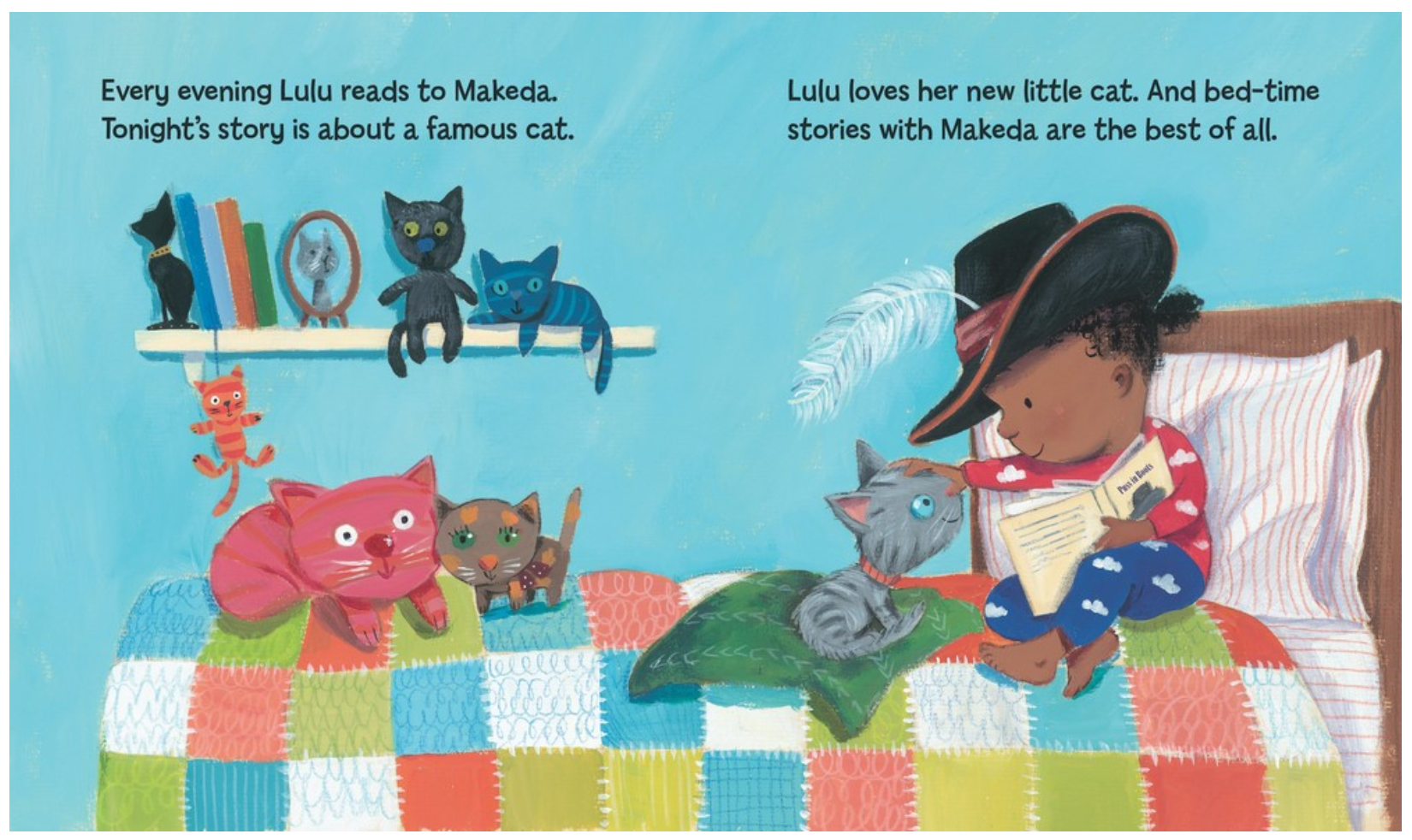
I borrowed one book from this series (Lola gets a Cat) only to discover there are so many more titles and that the main character has two different names (more on that confusion in moment). I collect images of books like this one for my Pinterest collection entitled "She looks like me" for two little girls with a mum from UK and dad from Sri Lanka. The books in this series would be perfect gifts for these girls and they should also be added to your preschool shelves. Here is a page from Lulu or Lola gets a Cat.


The books in this series are available in paperback and hardcover. In the UK, Australia and New Zealand the little girl is called Lulu and in USA and Canada she is Lola. I wonder why they made this change - it sure has confused me!


"This is a great picture book where story and illustration come together seamlessly. Yet this is also a must-have picture book because it bucks the trend of a real lack of diversity in children's books."
2021 comment from Children's Books Ireland.

Anna McQuinn has worked in children’s books for more than twenty-five years as an editor, publisher, and writer. She is the author of more than twenty books for children, including Lola at the Library, Lola Loves Stories, Lola Reads to Leo and The Sleep Sheep. On her web page she shares something deeply shocking - in some US states Lola at the Library is a banned book (this is madness). Here is her Facebook page. And Instagram

Kirkus said (Lola at the Library): Beardshaw’s vividly colored acrylic paintings of a mother and child’s morning outing in their racially mixed neighborhood complements the classic library scenes charged with a child’s vibrant enthusiasm. The simple, significant message will ring true with every librarian, teacher, caregiver and parent as the day concludes with Lola’s nightly bedtime story. Everyone should begin and end the day with a good book.

Here is the Spanish edition. 


Rosalind Beardshaw loved drawing from early childhood and from a young age decided she wanted to become an illustrator. She studied at Manchester Polytechnic where she earned a degree in illustration. Since graduating in 1992, she has illustrated many children’s books. Check out her books My Pet Star and Just Right for Two. Here is her Instagram page.


And to confuse you further Anna McQuinn and Rosalind Beardshaw have a series about a little boy called Zeki (UK, New Zealand and Australia) and Leo (USA and Canada).