Showing posts with label Prejudice. Show all posts

Wednesday, July 8, 2026

Shakespeare in the Orchard by Danielle Binks


"I suppose we'd like to feel human again' ... A small, mean part of him wanted to make fun and mock - a bunch of Germans wanting feel human in the middle of a war that their lot had started, by play-acting death and destruction, ... but then he heard the others murmuring their agreement with Georg's answer, and he swallowed the acid words he was thinking."

The real strength of this story (apart from learning about Internment camps here in Australia, in particular in Victoria) is the way, very gradually, Jack grows in his understanding of humanity. 

This quote comes near the end of the book:

"All those stories we tell and get told, it's to make them less human ... you know that, because you know them. It's not true, it's just easier to be cruel and look away from what we have in common ... It's harder to kill a man if you know him."

It is 1914 and World War I has just begun. At first Jack is swept up in the war propaganda of Germans as the enemy and of course he is so proud of his brother heading away to train as a soldier. Jack is also learning some army skills himself through his replacement teacher Mr Kempster who is a war fanatic and actually a very dangerous man but not as dangerous as one of the horrible soldiers, Lance Corporal Wright, who has been sent to guard the enemy aliens who are now imprisoned in the rural community of Langwarrin on the Mornington Peninsular. 

Jack has joined the cadets and at first he enjoys the training along with his good friend Walter. But then he witnesses several things in his town which cause him to question the idea of 'the enemy'. Meeting the German prisoners who are sent to help in the apple orchard allows Jack to move beyond that word 'enemy' and understand that these are real people who just happened to be born in a different country and who happened to be here in Australia when we decided people from 'over there' were our enemies.

"if he was honest, there was a lot he hadn't told his mother lately - like the conversations he'd found himself having with the prisoners and his odd curiosity about their lives before the war. Not to mention the Maberly's white feathers and his agreeing to pass Lotti's letters onto Georg (her father) ..."

Jack and his mum anxiously wait for letters from Jack's brother Matt. There is a moment of terrible tension in this story when one of the letters arrives but before Jack can read it to his mother (I am guessing she may had have dyslexia) the letter is lost (Chapter 32). The dreadful Lance Corporal Wright has attacked Lottie (daughter of one of the German prisoners) and he has violently bashed Jack's friend Walter. This horrific incident and my worry over that important letter kept me turning the pages hoping that letter would be found - but it wasn't. 

Blurb from the author page: The whole world is at war. In Langwarrin on the Mornington Peninsula, fourteen-year-old Jack Thorning is the best marksman in military cadet training. His brother, Matt, taught him everything he knew, after their father died. But now Matt has joined the war effort, and it’s up to Jack to hold down the home front and help his mother run the family orchard. When a group of ‘enemy aliens’ are sent to Langwarrin to be held prisoner at the Military base, tensions in the town run high. For Jack and his best friend, Walter, the war feels closer than ever. Like the rest of the town, Jack and Walter want nothing to do with the German prisoners. But as the war progresses, the inmates at the camp are put to work doing manual labour on the farms around Langwarrin, including Jack’s family orchard, and Jack begins to see that the prisoners are people, too. What could Jack possibly have in common with the people responsible for keeping his beloved brother at war? And can Shakespeare bring them all together?

Five years ago I talked about another book based on Internment camps here in Australia (Interned by Pamela Rushby) and in that post I used this article to talk about the features of a good historical novel. I am going to repeat them here because I am so happy to say Danielle Binks does all of these things and she does them brilliantly:

1. Have fun with the research but do your homework. 

This should go without saying, but I’ll say it anyway. Borrow some good reference books. Become comfortable with the time period. Try to understand both the larger scope of the period, while examining aspects of daily life. This will help create an authentic backdrop for your novel.

2. Let the characters engage with the historical details. 

This goes along with that “show don’t tell” truism writers are told all the time. Rather than just dumping a bunch of facts on the poor reader, let your characters interact with these details with all these senses. Let them smell the offal dumped onto the cobblestone streets. Let them squint in the fading light of the tallow candles. Let them feel the tingling sensation as the physician places a leech on their bare skin.

3. Allow your characters to question and explore their place in society. 

This will help reveal the larger political, social, cultural context of the time. What were the expectations for women? For sailors? For criminals? How did people from different parts of society interact with one another?


By coincidence as I finished Shakespeare in the Orchard I picked up our Sydney Morning Herald and saw an article by Danielle Binks under the heading Empathy.

“I am an author who writes sad kid’s books, and I maintain that children are a lot stronger than we give them credit for, and their inner universes so much more complex than we acknowledge. I never try to make my readers upset, I just hope they care enough to feel empathy for the characters I’m giving them.” Danielle Binks Sydney Morning Herald 27 June 2026

She goes on to say:

The book is set during World War I and is inspired by the true events of Australia’s home-front war that unfolded in my hometown of Langwarrin. In 1914, the Australian government suspended habeas corpus for the first (but not the last) time, and imprisoned “enemy aliens” of German and Austro-Hungarian descent. I chose to tell the story from the point of view of a 14-year-old boy named Jack, a military cadet whose brother has joined the war effort and who is being fed a jingoistic form of hyper-nationalism, right when the military reserve across the way from his family’s apple orchard opens its doors to German prisoners. It’s a true but shameful tale of Australia’s war history; a moment when our government arguably did the wrong thing, for the right reasons. The book also tells the true story of how those German prisoners staved off boredom and retained their humanity in the face of such adversity: with theatre. When Jack overhears the prisoners practicing Hamlet, he’s shocked and horrified by their humanity – and his curious response to it.

In this Instagram post you can hear Danielle Banks describing her book. Shakespeare in the Orchard was published yesterday - 7th July. Huge thanks to Gleebooks Kids for loaning me the advance reader copy. 

Daneille Binks suggests her book is for ages 10+ but I am going to say it will better appeal to readers aged 12+ firstly because it is long book (300+ pages) of very small print; secondly because the motivations of several of the Anti-German characters such as the teacher Mr Kempster and Lance Corporal Wright are distressing and complex; thirdly because I think readers will appreciate this book if they have some understanding of or have studied the Shakespeare play Hamlet; and finally because the main character, Jack, is aged 14. I did start this book three times but I kept putting it aside. Then I read a review on social media and the reviewer convinced me to start again and stick with this book - she was right. From about chapter 23 (of the 45 chapters) onwards I was able to read in a more sustained way.

It is a thoroughly heart-warming story demonstrating that prejudices and intolerance are so often created by pure ignorance and willful misunderstandings. A particularly resonant episode is the underlining of the most violent, dangerous and intolerant person in the plot – one of the soldiers reputedly safeguarding the community, not one of the prisoners who remain docile albeit dejected – a thoroughly nasty piece of work. Just so Stories

High School history teachers could make really good use of the letters from Matt that are included in this book especially if the topic is the lead up to the Gallipoli campaign. Here is some background reading about internment camps in Australia. And here are some stories/first-hand accounts. Here are more details in an article from The Conversation


Companion books:


Wednesday, July 23, 2025

Lizzie Bright and the Buckminster Boy by Gary D. Schmidt


My father is with God, just as the minister here says. But God didn’t call him there because God had work for him to do. My father died because he was doing God’s work here. 
He wanted the people of Malaga Island to live in a place that was their own.”

I started reading this book four days ago, but I kept having to put it down because there are so many utterly terrible scenes. On the one hand I wanted to keep reading but I also felt the need to protect myself from the vicious scenes. 

This book is utterly harrowing and upsetting but I really do appreciate the journey Gary D Schmidt has taken me on. About halfway through this story I began to worry there might not be a happy ending so I decided to skim through a few reviews. Some said the ending was tragic, but I also read that the ending was hopeful. This means that when the most dreadful and devastating things happened to Turner, I simply did not believe them. 

I should have read the Kirkus Star review more carefully:

There can be no happy ending to this story, but the telling is both beautiful and emotionally honest, both funny and piercingly sad.

Bookseller blurb: Set in 1912 and centered on a historical event, the moving and compelling coming-of-age story of Turner, a white minister's son who discovers joy through his friendship with a black girl, Lizzie, and finds his own strength and voice after painful losses transform his life. In this powerful and moving novel, Turner Buckminster, a preacher's son newly arrived in in Phippsburg, Maine, meets Lizzie Bright Griffin, a strong, spirited black girl from Malaga Island, a nearby island community founded by former slaves. All of Phippsburg, especially Turner's repressive father, disapproves of their friendship, but Turner ignores them; Lizzie is the wisest, most knowledgeable person he ever met. On top of knowing everything, she can row a boat and pitch a baseball like a champ. The town's move to turn the island into a tourist attraction destroys the powerless community, a historical event that occurred in 1912. It is the catalyst for a wave of personal losses that shakes Turner's world but leaves him whole.

Lizzie Bright and the Buckminster Boy is a Young Adult title and I would say this book is best for ages 14+. The treatment of and prejudice towards African American citizens as explained in this story set in 1912 in Maine is certain to shock teenage readers here in modern Australia.  It is also important to read the back notes which explain the actual historical events that inspired this novel.

If you are book talking Lizzie Bright and the Buckminster Boy I would use the four covers I have shared above as a way to interest your library or class group. In the light of my earlier comments it is interesting to think about the age intention of these cover designs. I wouldn't use this with a high school group but I do wish I could find a soundtrack of all the hymns Turner plays to Mrs Cobb. 

Take a look at this review. Here are some text quotes from this book:

Opening sentence: Turner Buckminster had lived in Phippsburg, Maine, for fifteen minutes shy of six hours. He had dipped his hand in its waves and licked the salt from his fingers. He had smelled the sharp resin of the pines. He had heard the low rhythm of the bells on the buoys that balanced on the ridges of the sea. He had seen the fine clapboard parsonage beside the church where he was to live, ...

He didn’t know how much longer he could stand it. Maybe somewhere out West there really were Territories that he could light out to, where being a minister’s son wouldn’t matter worth a . . . well, worth a darn. He hoped so, because here, being a minister’s son mattered a whole lot, and pretending that it didn’t matter to him was starting to peck at his soul.

Readers let's meet Lizzie Bright: She looked out at the thrusting tide, clenched her toes into the loose sand, and smelled the salty, piney air. At thirteen, she was, as her grandfather liked to remind her, one year older than the century, and so a good deal wiser. Too wise to stay on Malaga Island, he said, but she planned to stay there forever. Where else, after all, did the tide set a pale crab on your toe?

“More to the point,” said the tallest of the group—the one with the most expensive frock coat, the most expensive top hat, and the most expensive shiny shoes—“one less colored on Malaga Island.” Laughter from the group, louder than the gulls. “Though the issue is much larger than one colored.” His eye searched the pine shadows across the water for the girl, as if he sensed her watching him. His hands moved to the lapels of his coat. “The issue is how to relieve Malaga Island of the girl, her family, her neighbors, what she would call her house, what they would call their town.”

“Reverend Buckminster, behold the cross we bear in Phippsburg: a ragtag collection of hovels and shacks, filled with thieves and lazy sots, eking out a life by eating clams from the ocean mud, heedless of offers of help from either state or church, a blight on the town’s aspirations, a hopeless barrier to its future.”

The afternoon had become as hot as meanness, and since the shirt he was wearing had enough starch in it to mummify two, maybe three, pharaohs, he began to feel he could hardly breathe. The only thing that saved him from absolute suffocation was the sea breeze somersaulting and fooling, first ahead, then behind, running and panting like a dog ready to play.

In the clearing, sixty graves lay quiet and still, restful. Wood crosses with printed names too faded to read stood at their heads. Some had piles of pink-grained stones gathered from around the island placed carefully at the foot of each cross. Some had sprigs of violets, some fresh evergreen boughs.

She took a deep breath, and she wasn’t just breathing in the air. She breathed in the waves, the sea grass, the pines, the pale lichens on the granite, the sweet shimmering of the pebbles dragged back and forth in the surf, the fish hawk diving to the waves, the dolphin jumping out of them. She would not ebb.

And suddenly, Turner had a thought that had never occurred to him before: he wondered if his father really believed a single thing he was saying. And suddenly, Turner had a second thought that had never occurred to him before: he wondered if he believed a single thing his father was saying.

Turner felt the cold of the place come into him. He could not move. It was as though the bricks surrounded him and him alone. He felt that he would never escape them, never see anyone he loved again, never see the ocean waves again. That he would always be cold, and the cold would be in him more than around him.

Companion book:

You may have read my previous post about the Newbery Award where I set myself a challenge to read more of the honor book titles. Lizzie Bright and the Buckminster Boy (2004) was one title on my list - partly because the title sounded intriguing and partly because I recognised the author's name.

I previously read these books by Gary D Schmidt:


Tuesday, June 4, 2024

Stitch by Padraig Kenny


Stitch and his friend Henry are creations of an old Professor. Stitch is indeed stitched together from various human body parts presumably retrieved from graves. You are right to think of Frankenstein. Please don't be concerned though, because Stitch is such an endearing and kind character, and his naive view of the world is sure to charm you. I think children reading this book are sure to emphasise with the way Stitch has difficulty making sense of the world and of big topics like life and death and betrayal and the human desire for immortality.

Early in the story we are told Stitch has been ordered not to disturb the old Professor. Each day Stitch has his routine. He counts the days he has been 'alive' so we learn the story opens on day five hundred and eighty-five (you will immediately work out that this is not much longer than a year). I did wonder just how long Stitch has tiptoed past the professor's door and then just a few days later two visitors arrive at his castle home. The man is the old Professor's nephew - Professor Hardacre and his 'assistant' Alice. Very quickly Professor Hardacre realises something is wrong. He opens the forbidden door and discovers the old Professor has died. Death is a mysterious concept that Stitch just cannot grasp. Down in the basement of the castle, Henry, another of the late Professors creations is held in a cage. Stitch knows Henry has done something 'wrong' and so the cage is for his protection. Every day, as part of his routine, Stitch feeds his pet named Brown Mouse and he thinks about his other friend, White Rabbit, who is no longer there. Then he visits Henry for a chat. His routine is thrown into disarray with the arrival of these two strangers. There is something slightly disturbing about Professor Hardacre. Alice on the other hand is so kind and speaks gently to Stitch trying to explain the ways humans behave especially in relation to creatures and people perceived as different. She has first-hand experience of this because she has a hump on her back (you might think of another famous story about human reactions to difference The Hunchback of Notre-Dame).

Professor Hardacre has obsessive reasons for want to experiment with Henry. He sets up his equipment and waits for a night of thunder and lightning, but Stitch can feel this is all wrong and he is sure his best friend Henry is in danger. 

Here are some text quotes to give you a flavour of this story. You are sure to enjoy Henry's quirky invented words:

"As if to prove his point to himself, Stitch holds his hands up. One is very definitely smaller than the other. This is his left hand. It has long slim fingers. The other is large, almost bloated in comparison. Its fingers are stubby and fat. Both hands are grey in colour because all of Stitch's skin is grey ... "

"But if you are a monster, Alice, then that should mean you are horrible and cruel, and I haven't known you for very long, but I know for a fact that you are not horrible and cruel. Far from it. To me you seem to be a very nice individual, wise and generous in your insights and behaviour."

"Dead,' says Henry. 'I believe I have heard the word, although I confess I do not fully understand it. This is quite surprising because I have picked up a lot of knowledge in my own studies and assessments of the world."

"Hodgepodge Henry Oaf. A mixture of bits and pieces of different people, which goes some way to explaining some of my more inexplicabubble bouts of mischief."

In her review for Magpies Magazine (Vol 39, issue 2, May 2024) Dr Robin Morrow said:

"This book succeeds as a gripping adventure story, while provoking thought and discussion about topics such as the humanness of these beings, friendship, difference, and responsibility."

Reading Zone: The overriding message is that it does not matter what you may look like. What is important is being a good person, doing the right thing, and standing up for your friends. As Stitch says, "Everybody is different, and this is what makes the world such a curious and interesting place". Padraig Kenny has managed to wrap up a vitally important message in a thrilling adventure story. I believe that this is an important book which will be read and enjoyed - on many different levels - by children and adults alike. Highly recommended.

Moving and powerful, yet delicate, this story celebrates the uniqueness of every individual. It would be a great one for classroom discussion. Books for Keeps

Thanks to Walker Books Australia - I won my copy of Stitch. You can see Padraig Kenny talking about and reading an extract of his book here. This link also includes an interview with Padraig. And here is a teaching guide

Your local or school library might have a version of Frankenstein abridged for children such as this one from Usborne books.

I previously talked about this book by Padraig Kenny. When you read Tin I am sure you will see some ways the story has links with Stitch.


I would follow Stitch with Cogheart which also explores the idea of immortality.


Monday, October 17, 2022

The Capybaras by Alfredo Soderguit translated by Elisa Amado


"A beautiful, simple, deep book about how accepting others 
can enrich us all."

The chickens are happy on the farm. Daily life is predicable and safe until ...  It is hunting season and a group of large capybaras need to find somewhere safe to live until the hunters leave. The chickens do not want these strangers to move in to their home. 

"There were lots of them, they were hairy, they were wet, they were too big. NO! There was no room for them."

The capybaras explain their perilous situation so the chickens do decide they can stay IF they follow the rules:

  1. Don't make any noise
  2. Don't come out of the water
  3. Don't come near the food
  4. Don't question the rules
The chickens do not predict, however, that their youngest chick and the youngest capybara will not follow the rules and that they become friends but this is a lucky thing because one night the vicious hunting dog arrives and the life of the little chick is threatened. When the dog is confronted by the group of huge capybaras the crisis is averted.

"Then everything changed." 

Originally published in Venezuela, this picture book is simple and fun enough for preschoolers, but could definitely be used to start some interesting conversations with older ones. The disconnect between the text and the illustrations questions the meaning of such words as “comfortable” and “dangerous”. Delightfully subversive. Kids Book a Day

This book was originally published in 2020 with the Spanish title Los Corpinchos. If you are teaching visual literacy with a group of older students or talking about book design this book would make an excellent text. The illustrations are black, white and brown with touches of red. On the page where the chickens explain "nothing out of the ordinary every happened" you need to take a close look at the farmer as he walks away from the chicken hutch. And the final page in this book has no words but is is clearly the beginning of another huge conversation between the farm animals and the capybaras. 

On its surface, Soderguit’s beguiling picture book offers a direct-enough message: find community in embracing others—even those that seem unfamiliar at first. Yet moments pop up where text and pictures seem at intentional odds, inviting readers to consider a deeper plunge. Aided by an ingenious use of the book’s gutter, the sparse text and wordless segments make this tale an unusually meditative piece of work. Similarly, the artwork shuns colour for the most part, evoking a muted spirit of optimism.  Purely exquisite. Kirkus Star review

Profound and remarkable. Waking Brain Cells

The Capbaras is published by Greystone Kids in Vancouver, Canada and it is an Aldana Libros book: Aldana Libros is an imprint of Greystone Kids that was developed by renowned children’s publisher Patricia Aldana to bring outstanding books to the English-speaking market, by international authors and illustrators who want to communicate their own cultural realities.    

I suggest this book would be an excellent one to purchase for your school library and I am so pleased it has a reasonable price at around $25 for the hardcover. If you speak Spanish take a look at this video and if you don't speak Spanish take a look to see inside this book. And here is another reading on vimeo. Read more about this production here

The Hans Christian Andersen nominee Ivar Da Coll from Colombia and Venezuela also has a series of picture books featuring a capybara character called Chigüiro and you can read more about Capybaras in this non fiction book:


We have a new picture book here in Australia - Egg by Claire Atkins published by University of Queensland Press - and this book would be the perfect book to read alongside The Capybaras. 


Read a review of Egg in Reading Time. And this piece from Paperbark Words and Joy Lawn. 

Alfredo Soderguit has illustrated over forty book. The Capybaras is the second book he has written and illustrated. I love seeing books from around the world. Here is the German edition of The Capybaras:


Friday, December 31, 2021

Interned by Pamela Rushby


Authors of historical fiction set themselves a huge task. They need to be dedicated to their project in order to complete the hours of research needed so their book is accurate. At the same time the writer needs to weave together a story with an engaging narrative. In some books of historical fiction it feels as though the author has a pages of facts which they want to showcase or even shove into the plot.  That is not the case here with Interned.  It is very clear Pamela Rushby has done an enormous amount of research for her book but then, as I heard Jackie French once say, the author needs to throw all of that away and just let the flavour of the historical period naturally percolate through the story. 

Jackie says: Perhaps that’s what my books really are -- a whisper that becomes an obsession; years of research that suddenly crystallise into a story, and then the labour of turning the past into fiction, woven with facts.

In this article for Writers Digest I found these wise words about writing historical fiction. Pamela Rushby follows all of this advice:

1. Have fun with the research, but do your homework. 

This should go without saying, but I’ll say it anyway. Borrow some good reference books. Become comfortable with the time period. Try to understand both the larger scope of the period, while examining aspects of daily life. This will help create an authentic backdrop for your novel.

2. Let the characters engage with the historical details. 

This goes along with that “show don’t tell” truism writers are told all the time. Rather than just dumping a bunch of facts on the poor reader, let your characters interact with these details with all these senses. Let them smell the offal dumped onto the cobblestone streets. Let them squint in the fading light of the tallow candles. Let them feel the tingling sensation as the physician places a leech on their bare skin.

3. Allow your characters to question and explore their place in society. 

This will help reveal the larger political, social, cultural context of the time. What were the expectations for women? For sailors? For criminals? How did people from different parts of society interact with one another?

Interned is set in 1914. Gretta lives in Singapore and Tilly lives in Brisbane. 

"When war breaks out and both countries turn on their families for being German , the two girls find themselves taken from their homes, interned at a camp in rural New South Wales. Far away from everything they have ever know, Gretta and Tilly are forced to face prejudice, overcome adversity and to make their own community."

This story is told though the eyes of these two very different girls using alternating voices. Both girls demonstrate enormous courage and enormous care of their families. 

I knew about the internment camps which were set up here in Australia during WWII but I had no idea about the situation during WWI. Pamela Rushby gives her readers a strong sense of the place, the confusion, the harsh climate, the recurring heartbreak, and the strong bonds of family relationships. Pamela wrote this book because she discovered her own grandfather came to Australia from Germany as a tiny baby in 1880 and the family settled in Queensland. In 1900 the largest non-British immigrant group in Australia were people of German descent. Many lived in Queensland and South Australia. 

In the author notes Pamela writes about the beginning of World War I:

"Almost immediately after war was declared, a wave of anti-German propaganda swept the nation. ... German schools and clubs were forced to close. German music was banned. Communities with German names were renamed. ... Almost seven thousand people of German descent were detained... (including) German families that had been living and working in British colonies in New Guinea or south-east Asia."

I highly recommend this book for readers aged 10+ especially for those with an interest in history. Interned will be published in March 2022. Huge thanks to Beachside Bookshop for my advance copy. 

Companion reads (note these are all set during WWII):


Tuesday, December 28, 2021

Other Words for Home by Jasmine Warga


Our town used to be 
a place for people to laugh and enjoy
all the things that unite them like
family and sunshine and the sea and good food.
Not the things that divide them like
opinions and political loyalties.

Other words for Home is a verse novel and as is always the way with this genre it packs an emotional punch and it contains a strong, truthful, heartfelt and emotional journey for the reader. 

Publisher blurb Harper Collins: Jude never thought she’d be leaving her beloved older brother and father behind, all the way across the ocean in Syria. But when things in her hometown start becoming volatile, Jude and her mother are sent to live in Cincinnati with relatives. At first, everything in America seems too fast and too loud. The American movies that Jude has always loved haven’t quite prepared her for starting school in the US—and her new label of “Middle Eastern,” an identity she’s never known before. But this life also brings unexpected surprises—there are new friends, a whole new family, and a school musical that Jude might just try out for. Maybe America, too, is a place where Jude can be seen as she really is.

Poetic, immersive, hopeful. Kirkus Star review

Free Verse makes the story feel more personal and accessible for all reading levels. Reading Ladies

I enjoyed this book tremendously, and thought it was a great depiction of a student struggling in a new country. As both a mirror and a window book, this is fantastic. Ms Yingling Reads

Read some more review comments here

Awards

  • 2020 JOHN NEWBERY HONOR BOOK
  • 2020 WALTER AWARDS HONOR BOOK
  • 2020 LEE BENNET HOPKINS POETRY PRIZE HONOR
  • 2020 CHARLOTTE HUCK AWARD HONOR BOOK
  • ALSC 2020 NOTABLE BOOK
  • NEW YORK TIMES BESTSELLER
  • 2019 JUNIOR LIBRARY GUILD SELECTION

Companion reads:


Saturday, October 9, 2021

Refugees by Brian Bilston illustrated by José Sanabria


Before you share this book with a group of students (I suggest age 10+) you should plan to read this book very carefully yourself first. The words of the first half of this book are harsh and confronting. You will need to prepare your students - I would explain that some words may shock or surprise them but it is essential to listen to the whole book before continuing any discussion.

You may already know I adore end papers especially ones that are different front and back and then there are the very best end papers that add to your enjoyment or interpretation of the story.  The end papers in Refugees by Brian Bilston are the very best.

Front end paper


Think about all of the symbolism in this fabric. It is stained, it has raw edges, and it is very roughly sewn together.

Back end paper


At the end of the book the fabric is rich, textured, neatly stitched and reflective of many diverse cultures. 

Here is the text for this book - you need to read it top to bottom and bottom to top.

They have no need of our help

So do not tell me

These haggard faces could belong to you or me

Should life have dealt a different hand

We need to see them for who they really are

Chancers and scroungers

Layabouts and loungers

With bombs up their sleeves

Cut-throats and thieves

They are not

Welcome here

We should make them

Go back to where they came from

They cannot

Share our food

Share our homes

Share our countries

Instead let us

Build a wall to keep them out

It is not okay to say

These are people just like us

A place should only belong to those who are born there

Do not be so stupid to think that

The world can be looked at another way

(now read from bottom to top)

Brian Bilston is a poet who first became known posting his poems on twitter. His first book of poetry, You Took the Last Bus Home was published in 2017 and this year, Bilston published Diary of a Somebody, a book which mixes poetry with prose. Fans of Bilston’s work will know that he never shies away from controversial topics including poems about American gun crime, Brexit and the refugee crisis. Particularly memorable for many readers is his poem, Refugees, which can be read forwards and backwards with very different meaning, a poem style that Bilston himself calls “forwardsy-backwardsy poems.” Adding “but there may be a better word than that.”  Read in one direction, the poem Refugees reflects the hatred refugees often suffer when they flee to safer shores only to be told to ‘go home’. However, read the other way, the poem is heart-warming, welcoming and inviting to refugees in need of asylum. For Reading Addicts UK

You can see many pages from this book here

Here’s a book to make you think hard no matter what your feelings on the topic. ... No matter what, the book ought to be shared, discussed and pondered upon by all.   Red Reading Hub

Here is a video of this poem which could be used with High School students. In the book the two parts of the poem are shown when the text moves from the left side to the right. 

We have another book here in Australia which uses this idea of reading text in both directions - Room on our Rock (winner of the Charlotte Huck Award 2020) by Kate and Jol Temple written on a similar topic for a much younger audience. This pair have a new title Move that Mountain which uses the same format. 

I have already swooned over another picture book illustrated by Colombian illustrator José Sanabria - As time went by.

Wednesday, July 7, 2021

Hurricane Child by Kacen Callender


Caroline's mother gave birth to her daughter during a hurricane. " ... it's a curse being born during a hurricane. I won't have an inch of luck for the rest of my days, and sadness will follow me wherever I go."

There is a deep sadness in Caroline's life. "One morning my mom got up and went halfway across the world ... "  All she has now are occasional postcards sent from faraway places and now the postcards have stopped coming.

She also seems to be under a curse: "Seeing that I'm the littlest girl with the darkest skin and the thickest hair in the whole Catholic School, Missus Wilhelmina doesn't like me - no not at all. I get a smacking on my bum for everything: not looking her in the eye when spoken to, laughing too loud during playtime, and thinking I'm better than everyone else because I know the answers to her questions in class, for asking too many questions in class, for not crying after those bum smackings. I always refuse to cry after a bum smacking." The other girls taunt and tease her, no one is her friend. Every day Caroline makes the long journey by boat from her home on Water Island to Saint Thomas and everyday her experience at school is utterly dreadful. 

All of these things motivate Caroline. She is determined to find her mother. She needs answers to her desperate questions - Why did her mother leave? Does her mother love her? Was it Caroline's fault that she left? Will she please come back? 

Caroline mostly does not worry about being different but she is deeply lonely until a new girl arrives in the class. Kalinda is a special girl. She is not bullied by the other horrid girls, she is confident and wise. It seems impossible to Caroline that Kalinda could very be her friend but somehow this does happen and life feels better until the terrible day when Kalinda (and those other horrid girls) read the beautiful love letter Caroline has written to Kalinda. This love is more than the love of a friend. This is a deep first love. The Wikipedia entry for this book says: there is a "romantic relationship that is developed between two of the main adolescent characters."

This is another one of those books where I feel quite conflicted.  Many reviewers list this book for ages 9+ or even 8+.  When I finished reading Hurricane Child I declared it was a Young Adult title for 12 or perhaps 13+. If you look at my list of labels I have assigned to this post it is clear this book has mature themes.  

Here is a quote from the New York Times (part of their discussion of four recent books including Hurricane Child)

Reading a middle-grade novel can feel like opening Pandora’s box. Devastating storms. Racial injustice. Violence, divorce, bullying, class conflict, depression, displacement, illness, grief, homophobia, abandonment, isolation, money worries and suicide attempts.

I did enjoy so much about this book. The voice and honesty of Caroline, the descriptions of the Caribbean islands, and the unwavering determination of Caroline to find her mother.  The way Kacen Callender describes the Caribbean islands reminded of the way I felt reading Turtle in Paradise set in Key West Florida. Here are some maps to help orientate you to the setting of this book:


Here is a photo of the type of Taxi Caroline catches after her boat ride. 


Why do I think this book is for older readers: Caroline's mother has previously attempted suicide; every day Caroline is beaten by her Catholic school teacher; Caroline is making new discoveries about her own sexuality; and then there is the violence of the bullying inflicted on Caroline every day.

Each of these reviews has more plot details:

Kirkus Star review

Horn Book

Ms Yingling Reads

School Library Journal

You can see several awards on the front cover - Stonewall Award (Given for exceptional merit relating to the gay/lesbian/bisexual/transgender experience in English-language books published in the U.S.) and Lambada Literature Award (Created over 30 years ago to recognise the crucial role LGBTQ writers play in shaping the world). Here is a video review by Andrea Pinkney.

Companion reads:


Thursday, May 13, 2021

Help! A story of friendship by Holly Keller


"Mouse whispered ... 'Fox told Skunk and Skunk told me that snakes are very dangerous to mice."

If this a helpful comment? Is this true? Hedgehog knows snake is their friend. What can Hedgehog do?

"That's silly gossip ... You know Snake would never hurt you."

Hedgehog and Mouse set off walking but Mouse keeps looking over his shoulder and so does not notice a hole, a long skinny hole which plunges deep into the ground. Mouse falls down the hole and his leg is hurt.  How can his friends - Hedgehog, Squirrel or Rabbit rescue him? And how will Snake feel when he is told Mouse is now afraid of his old friend? 

Kirkus say this is a predictable story with a clear moral lesson but I disagree.  I think if you read this book to a very young child the ending and solution may be a surprise and your young reading companion is sure to enjoy the vibrant textured illustrations and the warm hug on the final page. Help! was first published in 2007 but it is still available though sadly it is expensive here in Australia.


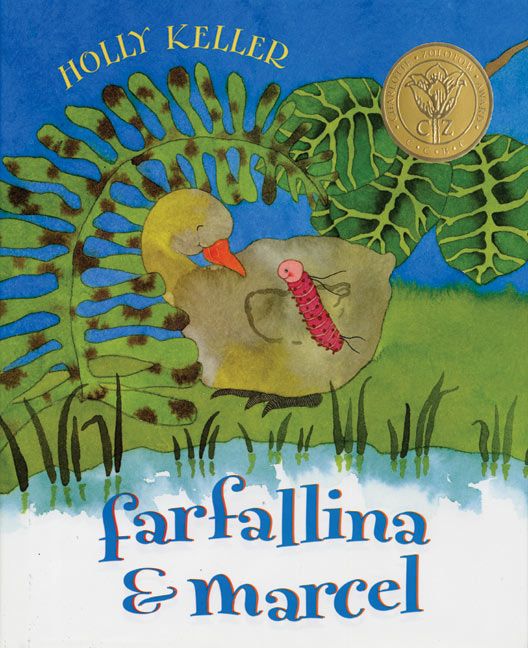
Farfallina and Marcel also by Holly Keller is one of my favourite picture books. 

Wednesday, February 3, 2021

Scary Bird by Michel Streich


Life is happy in the aviary until one day a strange bird arrives. "He looked SCARY!" 


In the opinion of the other birds this new fellow is very odd, his habits are strange, and he chirps in a different language which no one can understand - he needs to GO! 

Important wisdom comes from a small mouse who sneaks into the cage to take a little birdseed.

"Hey, birdbrains! Don't you know you're ALL exotic birds."

The birds don't listen to the mouse, "nobody listens to a mouse". One day a small bird ventures down from a higher branch to listen to the pretty song sung by "scary bird". It only takes one bird to make the move. Now the other birds join in and gradually the new arrival learns to chirp like the others albeit with an accent. He is able to talk about his home and share his customs and eventually he becomes accepted as one of the group. 

"But then some thing REALLY and TRULY SCARY happened."

Have you guessed - another new bird has arrived.

I am very wary of books with an 'agenda' or a didactic message but if a book contains some wisdom which is conveyed skilfully through a clever story then that will be a book I am really happy to promote and celebrate. You can probably tell I love Scary Bird.

In this video Michel Streich explains his illustration processes. Here is another one where Michel shows the stamps he used for the end papers.  This would be great to show to a Primary class because Michel demonstrates his drawing and shows his book as a sketched draft. Here is his website.

I would pair this book with:


I mentioned previously that I am reading Australian picture books published in 2020 with aim of identifying books which might make our CBCA Notables list. Surely Scary Bird will make the Early Childhood list of 12 notable titles.


A lively little book, Scary Bird puts diversity, adjustment and acceptance into an understandable parable for little listeners (though plenty of big listeners would also do well to pay attention to its message!) and it will sit well with other recent children’s books exploring similar themes.  Books and Publishing