Showing posts with label Australian outback. Show all posts

Tuesday, October 28, 2025

Going Fishing with Nana by Frances and Lindsay Haji-ali illustrated by Karen Briggs


"As the sun rises on brand new day.
It's time to pick up Nana. We're going fishing today."

Publisher blurb: This ... children’s picture book takes readers on an exciting fishing trip with Nana in the far north of Australia. Through repetition and rhyme, readers are introduced to early education concepts such as ordinal numbers, counting by twos, and adjectives, all while seeing many cute and cheeky outback animals along the way.

Thanks to Magabala Books for sending a review copy.


Things I like about this book:

  • Map end papers - this really is a mud map because for much of this journey across remote areas of Western Australia I am sure there would be no paved roads - but you could also talk to your students about the real meaning of the term mud map
  • You could use the map on the end papers to compare the way we draw maps and also to locate this area on a larger map of Australia
  • After talking about the map grab your copy of Are We There yet by Alison Lester or Dirt by Sea by Michael Wagner.
  • I'm curious about the dedication to the children of Roper River and Manyallaluk School (perhaps the author worked there)
  • Taking this book further than counting one to ten but also including the idea of doubling number gives this book scope for discussion and innovating on the text
  • The inclusion of less well-known Australian birds such as jabirus and pink galahs
  • It would be good to share this book with a preschool group as a way to practice counting and also introduce doubles

Things I wish the publisher had done differently:

  • This book has less visual appeal because with the use of digital illustrations - although the notes say they are created "using acrylic paint on canvas paper" so perhaps it is the high gloss paper that gives the illustrations a digital feel
  • I am not a fan of cartoon-style faces and eyes (especially on the frog, snake and children)
If your young reading companion is keen on fishing here are a few other titles to explore

Here is the companion book:


Frances Haji-Ali is an educator. She has worked in Catholic schools across the Kimberley and is currently a school principal in Perth. Frances is a non-Indigenous collaborator.

Lindsay Haji-Ali is a descendant of the Yawuru/Karajarri people of the West Kimberley region of Western Australia. He is an accomplished artist and his designs and artworks are held in private and corporate collections.

Karen Briggs is an illustrator, graphic and digital designer, and contemporary First Nations artist. She is a Yorta Yorta woman whose ancestral homeland radiates from the junction of the Goulburn and Murray Rivers in Northeast Victoria. Karen illustrates from her home in the Adelaide Hills and runs her own freelance design business. Her first book was Kick with my Left Foot written by Paul Seden, was published by Allen and Unwin in 2014, and shortlisted for the CBCA Crichton Award in 2015. Long-Listed, CBCA Book of the Year, Early Childhood, 2015. Short-Listed, Speech Pathology Book of The Year Awards - Indigenous Children, 2015.

Friday, August 8, 2025

Lizzie Nonsense by Jan Ormerod


"When Lizzie's mama and papa were married, the sun shone on fields of yellow wheat which grew right up to the door of the tiny church. But for as long as Lizzie can remember, she and mama and papa and baby have lived in their little house in the bush, and the church and the neighbours are far away."

Papa needs to take the timber to a faraway town, so mama and Lizzie and baby are left alone for many weeks. As mama completes her chores Lizzie tags along. She sees the world in a different way - using her imagination. The baby in the bath is really floating in the wide blue sea; the flowers from the garden become a bridal bouquet; and for dinner Lizzie declares they will have peaches and cream and sweet little cakes. Of course they are actually having turnips! The church is too far away but on Sunday's they put on their best clothes and walk along the track pretending they are returning from church. Finally papa arrives home:

"And they walk together back to their little house in the bush."


Lizzie Nonsense has a special dedication to "my grandmother Beatrice Evelyn Harvey 1883-1972", so we know this book is based on true events. Jan Ormerod, who died in 2013, also wrote The Water Witcher based on the life of her grandfather.

Here is the full Kirkus Star review: When Papa takes the cut sandalwood into town, Lizzie, Mama and the baby are all alone in their little house in the bush. Lizzie is always playing and pretending; Mama calls it Lizzie nonsense, but her imagination helps lighten the daily chores and hard work. While Mama tends the garden, she picks flowers and becomes a bride; as she helps Mama prepare the usual turnips for dinner, they become peaches and cream; as they mend clothes, Lizzie pretends to make a party dress with buttons and bows. Mama even joins the playfulness when they dress in their best on Sunday and walk along the track and back, pretending they’ve been to church. The beautiful painterly, watercolor illustrations are a departure from Ormerod’s earlier cuddly style. The earth-hued wispy and airy paintings affectionately embellish Lizzy’s nonsense, conveying a warmhearted snippet of time when a family bond overcame the hardships of Australian pioneer life to make a home in an untamed land. Based on anecdotes from the author’s own family history.

Lizzie Nonsense was published in 2004 and shortlisted by the CBCA in 2005. In 2006 IBBY Australia selected Lizzie Nonsense as our Honour Book title for illustration. Here is the catalogue annotation:

Lizzie lives with her mama, papa and baby brother on a remote farm in the Australia bush. Papa leaves the family for weeks on end while he delivers wood to the distant town leaving Lizzie, her Mama and baby alone in the bush. Lizzie is a lively girl with a vivid imagination. Her brother in his bath is floating in the ocean, a fallen log is her brave steed and flowers in the garden become a bridal bouquet. Lizzie is such a happy girl. She finds delight in the smallest of things and her buoyant outlook and positivity help her Mama during these difficult days. Even though she dismisses Lizzie’s ideas as nonsense Mama has her own daydreams too. On Sundays they put on their best clothes and pretend they have walked to church. Finally, after all the long weeks, they hear a sound. Is that harness jangling just in the imagination? No it is papa! Lizzie Nonsense is dedicated to the memory of Jan Ormerod’s grandmother and her life in the 1890s. It is a tale told with warmth, tenderness and humour. The images are built up from pencil drawings. Watercolour and ink are used to evoke the light of the Australian bush and the simple candlelight of their home. Several illustrations are presented as an oval similar to a framed picture placed on a dresser or mantle.

Sadly, it is now out of print. I thought of it again when it was mentioned in a recent podcast when the presenter listed books about weddings. I did a blog post about this a few days ago. Today I discovered the 2013 paperback edition of Lizzie Nonsense and it does look like a wedding story even though in my mind this is still a minor aspect of the story. The cover image comes from the title page of the original book. 


I have talked about many books by Jan Ormerod in the past. Click on the label for this post to find more of her books. 

When I first read Lizzie Nonsense I thought of this wonderful Australian poem which I learned by heart for a play called Yarns and Woolley Tales in 1984:

Before the glare o’ dawn I rise
To milk the sleepy cows, an’ shake
The droving dust from tired eyes,
Look round the rabbit traps, then bake
The children’s bread.
There’s hay to stook, an’ beans to hoe,
An’ ferns to cut in the scrub below,
Women must work, when men must go
Shearing from shed to shed.

I patch an’ darn, now evening comes,
An’ tired I am with labour sore,
Tired o’ the bush, the cows, the gums,
Tired, but we must dree for long months more
What no tongue tells.
The moon is lonely in the sky,
Lonely the bush, an’ lonely I
Stare down the track no horse draws nigh,
An’ start . . . at the cattle bells.

Friday, July 28, 2023

Clancy of the Overflow by Banjo Paterson illustrated by Andrew Mclean


Clancy of the Overflow is a very famous Australian poem and this new edition illustrated by the wonderful Andrew McLean will give you (here in Australia) the perfect book to share with grades 4-6. This book should be added to every school library. 

You are sure to notice and appreciate the wonderful book design. The front cover stretches across to the back and you can see Clancy himself with his Blue Heeler* dog rounding up a mob of cattle. The land is dry and you can almost hear the grasses crunching under the feet of the lumbering beasts. There is a low mountain range on the horizon and the colour blue suggests this is near the end of the day. Notice how the cattle are running towards the reader inviting you to join in this rollicking tale. 

On the front end paper, Clancy races across the red dirt on his horse with two of his faithful dogs in front racing possibly to their camp site. On the half title page we see Clancy's kit - hat, tin mug, swag and billy. On the imprint page the two dogs face the reader resting but ready for action. By the time we reach the title page Clancy has packed up and he has his dog in his arms while he rides his horse off to another day of droving.

"He was shearing when I knew him ..." but now we learn "Clancy's gone to Queensland droving .. "

The final end paper is set at the end of the day with the drovers gathered around a camp fire as their dogs watch on. 

This wonderful poem lives again. With a salute to Andrew McLean for his stunning visual narrative ... Kids' Book Review

McLean’s artwork is beautifully woven throughout the text and provides for poignant pauses in the read aloud of the story. The endpapers are equally beautiful and depict all the shades of the sunburnt Australian landscape and end with a star-speckled bush campsite. Reading Time

The illustrations by Andrew McLean give a brilliant visual for the contrasts, with soft, sunset and bush colours for the scenes set in the bush and darker greys and browns for the city scapes. This reiterates the feelings of the narrator as he ponders Clancy’s journey and reflects on how he feels trapped in the city. The book Muse

I was surprised the Andrew McLean version of Clancy published in 2021, was not entered in our CBCA 2022 awards. This is not the first picture book version of the famous poem - here are some others:


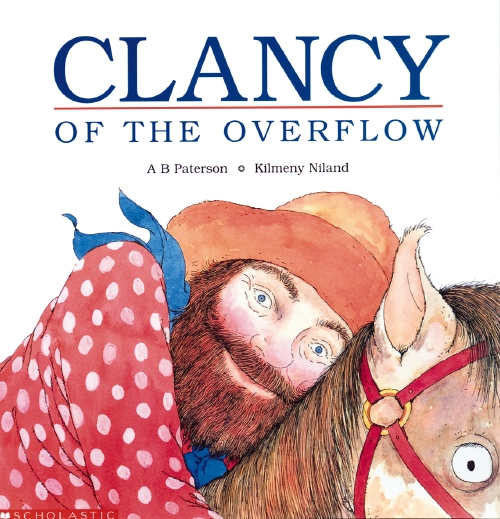
Illustrated by Kilmeny Niland


Illustrated by Robert Ingpen


You should also look for Drover by Neridah McMullin illustrated by Sarah Anthony as a comparison text. 


Here is the full poem from 1889 by Banjo Paterson.

Clancy of the Overflow

I had written him a letter which I had, for want of better

   Knowledge, sent to where I met him down the Lachlan, years ago,

He was shearing when I knew him, so I sent the letter to him,

   Just "on spec", addressed as follows: "Clancy, of The Overflow".

And an answer came directed in a writing unexpected,

   (And I think the same was written in a thumbnail dipped in tar)

'Twas his shearing mate who wrote it, and verbatim I will quote it:

   "Clancy's gone to Queensland droving, and we don't know where he are."

In my wild erratic fancy visions come to me of Clancy

   Gone a-droving "down the Cooper" where the western drovers go;

As the stock are slowly stringing, Clancy rides behind them singing,

   For the drover's life has pleasures that the townsfolk never know.

And the bush hath friends to meet him, and their kindly voices greet him

   In the murmur of the breezes and the river on its bars,

And he sees the vision splendid of the sunlit plains extended,

  And at night the wondrous glory of the everlasting stars.

I am sitting in my dingy little office, where a stingy

    Ray of sunlight struggles feebly down between the houses tall,

And the foetid air and gritty of the dusty, dirty city

   Through the open window floating, spreads its foulness over all.

And in place of lowing cattle, I can hear the fiendish rattle

   Of the tramways and the buses making hurry down the street,

And the language uninviting of the gutter children fighting,

   Comes fitfully and faintly through the ceaseless tramp of feet.

And the hurrying people daunt me, and their pallid faces haunt me

  As they shoulder one another in their rush and nervous haste,

With their eager eyes and greedy, and their stunted forms and weedy,

   For townsfolk have no time to grow, they have no time to waste.

And I somehow fancy that I'd like to change with Clancy,

   Like to take a turn at droving where the seasons come and go,

While he faced the round eternal of the cashbook and the journal -

   But I doubt he'd suit the office, Clancy, of "The Overflow".


I am a huge fan of Andrew McLean's work - I even own a small piece of his art from the book Hazel Green by Odo Hirsch. If you share this book with a group of students you could also explore the way Andrew McLean illustrates another famous Australian poem My Country by Dorothea Mackellar and his version of On the Road to Gundagai. 


* yes people reading this in another country the Blue Heeler is that little tv star Bluey!

I'd also like to mention this poem - The Shearer's Wife by Louis Esson -  which I once recited in a theatre production:

Before the glare o’ dawn I rise
To milk the sleepy cows, an’ shake
The droving dust from tired eyes,
Look round the rabbit traps, then bake
The children’s bread.
There’s hay to stook, an’ beans to hoe,
An’ ferns to cut in the scrub below,
Women must work, when men must go
Shearing from shed to shed.

I patch an’ darn, now evening comes,
An’ tired I am with labour sore,
Tired o’ the bush, the cows, the gums,
Tired, but we must dree for long months more
What no tongue tells.
The moon is lonely in the sky,
Lonely the bush, an’ lonely I
Stare down the track no horse draws nigh,
An’ start . . . at the cattle bells.


Monday, December 5, 2022

The Shop Train by Josie Wowolla Boyle illustrated by Paul Seden


"The railway track stretches across the plains as far as the eye can see. 
Rosie and her mother are waiting in the crowd to catch their first glimpse of the train."

Blurb Magabala Books: The Shop Train was inspired by the Tea and Sugar train that began operating in 1917 to provide supplies and services for rail workers and people living in remote communities between Port Augusta in South Australia and Kalgoorlie in Western Australia. The Shop Train is a heartwarming story about Rosie and her mum, and the rickety journey in their old car to pick up stores from the shop train. The train carried everything they needed, and was an exciting time for all who lived near its tracks. Rosie and her mum slowly wind their way through Wonghi country, on its dusty tracks and never-ending horizon, until they reach the train, brimming with activity and treasures from other places. Paul Seden’s evocative illustrations effortlessly capture a bygone era, rendering the past with a deep sense of nostalgia, whilst capturing its uncluttered beauty. The Shop Train was inspired by similar journeys author Josie Wowolla Boyle took as a young girl. It was these journeys that left unforgettable memories on Josie, no matter how young or old she may have been.


Here are a set of teachers notes for this book. I love the ending of The Shop Train where Rosie and her mum arrive home with their "fluffy flour, grainy rice, fine sugar, powdered milk, arrowroot biscuits and black tea leaves". Unfortunately, as they have travelled over the bumpy road, the paper bags have "split open and everything is mixed together".  

Luckily mum has a yandy or yandi dish. Mum is able to use this to sort out all the mixed up foods.


It would be good to read this book alongside Tea and Sugar Christmas and to compare the illustrations by Robert Ingpen with the work of Paul Seden. 

Illustration by Paul Seden

The pencil illustrations by Paul Seden, from the Wuthathi and Muralag people of North Queensland, give the reader a real sense of the vastness of the landscape. With the low scrub, flat plains, and Australian animals dotted around, it is difficult to imagine anyone living there. Glam Adelaide


Similar scene by Robert Ingpen


Thursday, July 21, 2022

Drover by Neridah McMullin illustrated by Sarah Anthony


Courageous, clever and daring, Drover is one of a kind. Travelling through the heart of the outback, Drover delivers a mob of cattle. Searing heat, dust and flies, hardship and danger: these are just part of the job. But there’s no place Drover would rather be.


Drover is a beautifully told, quintessentially Australian story which will give readers an insight into an interesting aspect of rural life.  The energy of the story perfectly matches the pace of the cattle, from slow moving through to still and at rest and then onto the wild night-time stampede. 

The writing in this book is nostalgic and it is also evocative of time and place – the heat of midday, the cool of the evening and the rising dust are explained using lyrical phrases such as ‘A hush descends over the bush’; ‘At full tilt, they nudge and bump into each other, dangerously teetering’; ‘They lie down near the fire, letting out a huff as they fall asleep.’   

It was wonderful that Neridah McMullin waited until the second last page to reveal the gender of Drover although readers could discover this from the back cover blurb. I wish Walker Books Australia had not included her name and instead had written "This is the truly remarkable story of a legendary drover."

The spare text allows readers to ‘fill in the blanks’ working out who Drover is, where she is going and why. The use of droving terminology adds an authenticity to the story. Shifty, the naughty one, is also perfectly named and depicted. His eyes look so shifty. 

The book mentions Lancewood and I discovered it is a species of Acacia with long dark thorns. These trees grow in Queensland and the Northern Territory. I think this detail could perhaps have been included in the glossary but that is a very minor criticism. The glossary and biography pages are very useful additions to this book. The glossary is not in alphabetical order but then I realised it was presented in the order in which the words were used in the story and this makes it easier for younger children to navigate. 


Image source: Neridah McMullin


The illustrations in Drover instantly plunged me into the dry and dusty outback, and brought the words to life. Sarah Anthony demonstrates her artistic skills in this book especially with her use light (bright sunlight) and dark. There is so much to enjoy about these illustrations. Sarah Anthony perfectly captures the colour of the red soil in the outback. Her night time scenes add to the atmosphere of the story. I love the change from the red ochre to the dark teal blue of the night skies. Her horses are also perfect and the cattle are beautifully rendered with their stark white faces and the way she shows their temperaments so clearly on their faces. There is so much movement, too, such as in the scenes where Drover chases the marauding herd. The pages somehow feel hot in the summer sun and cool in the night air and you can hear the stillness of the night and the thunder of the hooves as the cattle stampede into the night. 

In this stunning book those pleasures are brought to life by the lyrical text and the evocative illustrations as the reader joins Drover on the trail as the herd of bullocks are moved over the vast interior of this country.  Even though each day seems to be a repeat of the routine of the one before it, the ever-changing land and skyscapes make each unique and enjoyable, even though they are bone-weary and saddle-sore The Bottom Shelf

This is a fine, heroic tale, strong on iconic images of Australian ruggedness Reading Time

You could pair this book with our famous poems:


You could also contrast the life of the Edna Jessop with the woman in this poem.

The Shearer's wife by Louis Esson

Before the glare o’ dawn I rise

To milk the sleepy cows, an’ shake

The droving dust from tired eyes,

Look round the rabbit traps, then bake

The children’s bread.

There’s hay to stook, an’ beans to hoe,

An’ ferns to cut in the scrub below,

Women must work, when men must go

Shearing from shed to shed.

 
I patch an’ darn, now evening comes,

An’ tired I am with labour sore,

Tired o’ the bush, the cows, the gums,

Tired, but we must dree for long months more

What no tongue tells.

The moon is lonely in the sky,

Lonely the bush, an’ lonely I

Stare down the track no horse draws nigh,

An’ start . . . at the cattle bells.


Read more about Edna Jessop

The Weekly Times Edna Zigenbine drove 1550 head across the country at 22

Background information from Neridah McMullin

Here is an interview with illustrator Sarah Anthony

The other day I explored a different book about droving written for a younger audience.


Here is another book by Neridah McMullin:


Saturday, December 25, 2021

Christmas Day


This is my final post for my 2021 Twelve Australian Books for Christmas because today is Christmas Day!


Kathleen screamed with delight as she saw him. Father Christmas. 
His beard was blinding. 
His clothes were so Christmas red! Just like all the pictures she had ever seen of him. 
And here he was. Real. Here, in the middle of the desert. 


Blurb  by Jane Jolly: The Tea and Sugar Train only came once a week on a Thursday. But the special Christmas train only came once a year. Today was Sunday. Four more days without sugar. Four more days until the Christmas train. Please, please be on time. Please don’t be late. Join Kathleen in the Australian outback as she eagerly awaits the Christmas Tea and Sugar Train. Will she meet Father Christmas? Will she receive a gift from him? A delightful, heartwarming story from the National Library of Australia that will intrigue and captivate readers, and introduce them to a slice of the past.

Tea and Sugar Christmas by Jane Jolly illustrated by Robert Ingpen would seem to be a perfect choice because:

  • The scenes in this book could only happen in Australia
  • The setting of this book is outback South Australia (the end papers are maps)
  • Jane Jolly comes from South Australia
  • Father Christmas gives Kathleen the best present possible - a book to read
  • The illustrator of this book - Robert Ingpen - won the IBBY Hans Christian Andersen Award
  • This is a longer picture book which can be shared with older children (and younger ones too)
  • Tea and Sugar Christmas is based on real events (watch the video on this link) - from 1915 until 1996, the Tea and Sugar train travelled from Port Augusta to Kalgoorlie one a week. 
  • Tea and Sugar Christmas was an Honour Book for the CBCA Eve Pownall Award in 2015. The winner that year was A–Z of Convicts in Van Diemen’s Land by Simon Barnard. 
  • You can see the whole book on Story Box Library if you have a subscription. It is beautifully read by Ursula Yovich.
  • Here is a very comprehensive set of teaching notes
  • Good news this book is still available

Try to find some other books by Jane Jolly - One Step at a Time; Glass Tears; Ali the Bold Heart; Limpopo Lullaby; and Radio Rescue (also illustrated by Robert). Jane has a new book but I can't talk about it here because it has been entered for the CBCA Picture Book of the Year award (and I am a judge and so it has to stay a secret!). 

This book was also included by Natalia Bragaru on her blog Kids Book Explorer this year as a Christmas favourites. Take a look because her post contains many pages from this scrumptious book. You can also read about other books illustrated by Robert on this her blog

IBBY Australia will have a special presentation for International Children's Book Day in 2022 where you can discover a little more about Robert Ingpen and our other Australian nominees for the Hans Christian Andersen Award. Save the date - 2nd April and join IBBY Australia.

Robert Ingpen's timeless, soul-stirring illustrations and paintings make for a goosebumpling and emotional production. Featuring striking, monochrome pencil sketches that fold out into divine, full colour vistas, the book is a true feat in striking production. The four-page-fold-out scene of the inside of the train is just breathtaking, and the landscape vistas are equally beautiful. The pencil sketch of Kathleen when she sees Santa will not fail to bring a tear to the eye. Kids' Book Review

Friday, November 26, 2021

Picture Book Month Day 26


My book today, Mallee Sky by Jodi Toering illustrated by Tannya Harricks, is Australian and fairly new(ish) because I know I have shared quite a few older books for Picture Book Month.

The art in this book is truly special and a terrific way to showcase our Australian landscape.


Here are a few of the lyrical sentences from this book:

"When the sun goes down, the red heat of the day bleeds into the sky and sets it on fire."

"Heat shimmers and the bitumen melts. The red dirt cracks; the scrub sighs, still and thirsty."

"Ancient gums perish where they stand, grey, ghostlike; a memory of themselves."


Saturday, February 27, 2021

Haywire by Claire Saxby


"You think I want to be here? You think I had any choice? ... They just rounded us up like so many cows. Did they ever ask why we were in England? Why we'd left Germany? Did they ask what we thought about Hitler and his madmen. No. They just stuck us in a prison like we were criminals, then bought us halfway round the world and dumped us in the middle of a desert."

It is October 1939. Two boys live on different sides of the world. 

Tom Hallon, aged 14, lives in Hay, NSW Australia. Tom has two older brothers who have just signed up, an older sister on the cusp of falling in love with a young soldier, a baby sister, and his mum and dad. Tom has ambition - he hopes to win a scholarship and go to university in Sydney but with his brothers now gone Tom must leave school and help his father in the family bakery. 

Max Gruber, aged 14, lives in Bockhurst, Germany. He is an only child. Hitler has just invaded Poland and so his mother takes him from school and sends him off on his own to the safety of London where his Uncle Ferdy now lives. But London is not safe. Uncle Ferdy and Max are first sent to Huyton internment camp then they are put onto a ship which is supposed to take them to Canada - the Arandora Star - but the ship is bombed. It sinks. Max and his Uncle survive but his Uncle is badly hurt in body and mind. Once more they find themselves in a UK internment camp but the government don't want them and so they are ordered onto another ship - the Dunera. This ship is travelling to Australia and once again Max is placed in an internment camp - this time in Hay, NSW and this time he is alone.

This book is on CBCA 2021 Notable list for Younger Readers which is how I discovered it. Haywire is also on the NSW Premier's Reading Challenge in the 7-9 category. I think this book will be enjoyed by mature readers aged 11+. The story is told through alternating voices. Claire Saxby gives each boy a unique and authentic voice. Haywire is the perfect title - something to discuss with a class. I also need to mention the two bullies who regularly attack Max. They are so horrible. I was desperate for Max to find peace and for these two older boys to be caught and punished.

Here are some text quotes to give you a flavour of the writing:

Max

"Papa and I will come soon.' She nods firmly. 'But now you must go now.' Her shoulders are tight and her brow furrows ... One side of her mouth lifts a little, but only for a second, and the smile does not fit with her worried eyes."

"Jump!' a sailor tells me. 'Then swim to the life raft. Understand?' ... The tilting ship gives a whale-size burp and makes the decision for me. I tumble over the railing into the water. I sink, then pop back to the surface, the life jacket around my ears. The icy water quickly finds the last warm parts of me, soaking through everything."

"I trip into something soft and squelchy. It's hard to tell, but I think it's a dead lamb. I feel bones inside the softness and deadness fills my nostrils. Even in this light though, I see maggots twist and squirm. I retch ... "

Tom

"I knew that working in our bakery wasn't just jam and cream, but I didn't realise just how hard the work is. Or how much carrying and cleaning there is. My arms ache, my back aches, my everything aches. ... Each morning as a crawl out of bed, I curse every German who ever lived. They started the war, they took my brothers away."

There are two scenes in this book that linger with me.  One comes after Max escapes. Tom tracks him down but the situation is very dangerous. A loner, a man damaged in the Great War, is holding Max captive. Tom knows he cannot fight this angry man so instead he reaches out to shake his hand. This diffuses the situation in such a perfect way.

The second scene is near the end of the story. Mrs Brandon visits Max in hospital. While Max was on the run he took food from their house. Mrs Brandon brings Max clothes and food. She hopes her son, who is away fighting in the war, might receive the same kindness from another mother far away.

 This story has an authentic Australia feel with expressions such as: don't get ya knickers in a knot; back-of-bloody-beyond; strewth; poor buggers; and stone the flammin' crows.

Publisher blurb: In 1939, 14-year-old Tom lives in Hay where his family runs the local bakery. Max Gruber is nearly 13. He is sent to his Uncle Ferdy in London, but is then interred and shipped to Australia aboard the Dunera. He arrives in Hay and meets Tom. The two boys become friends and find their lives and their friendship influenced by a far-away conflict in Europe.  Shortlisted, 2020 NSW Premier's History Awards.

Superbly written and presented, Haywire is a powerful read. It focuses historically, on the prelude to WW2 and the crumbling of people’s lives. Reading Time

This is a novel that deserves a wide readership among young readers with an appetite for learning something about our history while being taken on an adventure.  Claire Saxby’s prose is crisp. Short and sharp sentences provide bold, vivid images that carry urgency and tension equal to the characters’ actions and emotions. Kids' Book Review

Background reading:

BBC News  The Dunera Boys - 70 years on after notorious voyage

National Museums Liverpool Maritime tales - tragedy of the Arandora Star

BBC Liverpool  Wartime camps in Huyton

Take a look here to see other books by Claire Saxby.


Haywire is the second book in this series entitled Australia's Second World War.  Here is the first book by Sophie Masson:


There are other books for Middle Grade readers which explore the conditions in internment camps during World War II. This is a list of books set in camps for Japanese Americans. Here are four books I suggest as companion reads after Haywire:


Monday, July 11, 2016

Hello from nowhere by Raewyn Caisley and Karen Blair


Our Book Week slogan for 2016 is 
Australia : Story Country

My friends and I have been talking about Australian themed books we can use to explore this slogan. Hello from nowhere was mentioned in our discussion so I bought it home to read.

This is a very special book and a great way to give city children a little insight into life in a remote corner of Australia.  Read more about the inspiration for this book.

Eve lives at a roadhouse. The map on the final end paper shows the exact remote location somewhere in south western South Australia in the Nullabor desert.


Eve is a very self sufficient child but she desperately misses her grandmother and hopes one day she might come out to Nowhere for a visit.  Eve has her animal friends, her cat called Livestock, and the regular visitors to the roadhouse - tourists, truck drivers and grey nomads. Eve writes to her Nan and the day she arrives (after such a long wait) is utterly joyous. Eve shares all the good things of her environment.  Nan does have to leave at the end but she gives the promise of returning again very soon.


Take a look here for some teaching ideas to use with this book.  You might like to look at my review of With Nan also illustrated by Karen Blair.

Other books we will explore this term include Are we there yet? by Alison Lester, Possum Magic by Mem Fox and Tom the outback mailman by Kristin Wiedenbach.

Thursday, December 31, 2015

Rain for Christmas by Richard Tulloch illustrated by Wayne Harris


Even though Christmas is now past I wanted to mention Rain for Christmas because all around the world our news has been dominated by catastrophic weather events.  Here in Australia we lurch from drought to flood, from wild thunderstorms to bushfires. This is best captured by the famous poet Dorothea Mackellar in the second verse of her poem My Country.

I love a sunburnt country, 
A land of sweeping plains, 
Of ragged mountain ranges, 
Of droughts and flooding rains. 
I love her far horizons, 
I love her jewel-sea, 
Her beauty and her terror 
The wide brown land for me!

Rain for Christmas takes this theme of drought which Dorothea Mackellar explains in the fifth verse of her poem.

Core of my heart, my country! 
Her pitiless blue sky, 
When, sick at heart, around us 
We see the cattle die 
But then the grey clouds gather, 
And we can bless again 
The drumming of an army, 
The steady soaking rain.

As this story opens Sally is writing her annual Christmas letter to Santa.  She asks for a long list of special gifts including a little boat to sail in the rock pool in the creek near her outback home.  While this is a lovely idea Sally knows she will not be able to sail her boat.  "The creek had no water and the rock pool was nothing but a patch of sticky mud."  Sally sees the bush animals have come close to the house in the hope of some water.  You can see them gathering near the water tank in the illustration below.


Sally re-writes her Christmas letter.

Dear Santa.
I don't want any presents this year, but please, please, please could you make it rain on Christmas Day?
Your friend Sally.

Just as Santa is about to set off from the North Pole he sees Sally's letter in the snow.  He is puzzled at first but then he has a splendid idea.  "We can take a giant snowball to Australia!"

This is an old book first published in 1989 but you might be lucky and find a copy in your library. Please don't wait until next Christmas - this book is worth hunting for now.

Richard Tulloch uses a brilliant word in this book and I will use it to sum up Rain for Christmas :

fantabulous!

Thursday, April 25, 2013

It's a Miroocool! by Christine Harris illustrated by Ann James


The first thing that struck me reading It's a Miroocool is the wonderful way Ann James has captured the scene.  Her depiction of the Australian bush, a farm in drought and the red dirt and spinifex grass around this outback station are perfect. The book almost feels hot and dry.

I adore reading books about the tooth fairy to children in Grade 1.  It is about this time that nearly all children have lost at least one and often many more teeth.  At this age children are so caught up in the magic of the tooth fairy.  That you could lose some thing and perhaps get money is so exciting.

When we talk about the tooth fairy I like to read Little Big Feet by Ingrid Schubert, Oliver Sundew Tooth Fairy by Sam McBratney, April Underhill tooth fairy by Bob Graham and Andrew's loose tooth by Robert Munsch.

I think the most special part of It's a Miroocool is the ending but I won't spoil this. I also like the way the story has two halves.  Preparation for the arrival of the tooth fairy and the events during the night that threaten to destroy these careful arrangements.

My friend at Kinderbookswitheverything recently showed me her favourite Easter book called Muddy Footprints.  Sadly this book is out of print and I do not have a copy in my school library but if you can find this book it would be fun to compare Muddy Footprints with It's a Miroocool.

There are other books about Audrey but I must confess I have not read them.  Now that I have met Audrey I plan to bring them all home.  Here is a little song about Audrey. Here are some teaching notes.

I always make great discovering when I write this blog and I have just discovered Ann James illustrated the wonderful book A pet for Mrs Arbuckle.  This is such an old book but one that I adore sharing with our students.  I have also found a blog for Audrey herself!

It's a Mirocool is another book short listed by the CBCA.  We now need to wait and see if it is a winner in the eyes of the judges.  I am very sure it will be a winner in the eyes of the children!