Showing posts with label Dysfunctional families. Show all posts

Friday, November 14, 2025

Free Lunch by Rex Ogle


Ministers and priests and Buddhist monks and talk-show hosts—all those people who are supposed to be real smart and wise and stuff—always say dumb things like “Money isn’t everything,” or “The best things in life are free.” 
But they’re wrong. Money is everything. The best things in life aren’t free.

I hate Sam 'cause he beats Mom. I hate him even more for beating me. I hate Mom for beating me. And I hate her even more for going crazy all the time. I hate that they don’t have money. I hate that they always fight about not having money. I hate that all the kids at my school seem happy all the time. Sometimes I hate the whole world. Sometimes I don’t know who to hate. I guess, most of the time, I just hate myself.


Rex lives with his mum, her partner Sam and their son Ford. It is a home filled with violence, neglect and often there is no food. School is a refuge for Rex, but it is also a tough place with traps and rules. Thank goodness Rex does make a friend - I just wanted to hug this kid named Ethan. Ethan just accepts Rex - no judgement - only genuine kindness. His grandmother is also someone wonderful but sadly her daughter, Rex's mum utterly rejects her help and even throws away all clothes, toys and the groceries she brings on her visit.

Even though his situation is utterly dreadful Rex has intelligence and integrity. He does understand his mother, he tries to help her, and he would deny this, but he deeply cares about his much younger brother. I was sure Rex would make something more of his life - it is fantastic to read that he wants to succeed at school and while he knows others have a way better life than his I felt certain Rex would be okay. 

Here are some text quotes (note this book has strong language and explicit violence) - I really enjoyed taking this journey with Rex. I recommend this book for readers aged 13+. Free Lunch was published in 2020 and it is still available in paperback. There is a sticker on the front cover because this book won the YALSA (Young Adult Library Services Association) Excellence in Nonfiction for Young Adults Award.

It’s not just Mom’s fault—it’s mine too. I shouldn’t have raised my voice at her. I really do try to be a good kid, but sometimes I get so angry. Everything turns red. Feels like my blood is on fire and I’m going to puke or pass out or . . . I don’t know. Next thing I know, I’m screaming so hard. But that’s all I do is yell.

This year was supposed to be great. It’s only the first day, and everything is falling apart already. Yesterday, I was so excited. Now, I’m angry and pissed off and alone. All ’cause of . . . ’cause of what? I come to school with a black eye and have to beg for a free lunch. It’s bull crap. No one should have to ask for handouts. No one. Especially not kids. Now everyone knows I’m nothing but trailer trash.

I hate that Mom and Sam are in charge of me. Adults aren’t always smarter than kids. I’m always doing stuff that parents should do. Like hooking up the wires for the TV or the stereo, or jump-starting a car. That stuff is easy for me. Mom doesn’t even know how to make toast, and I can cook, like, twenty kinds of meals, even stuff without recipes. Plus, I know a bunch of facts ’cause I read a lot. I for sure know more than Sam. He can barely write a full sentence. Sometimes he has me fill out job applications for him. And I’m good at math. Mom has me double-check hers in her checkbook all the time.

Mom’s bedroom is empty except for the mattress and the box spring under it, and the metal frame under that. Some clothes are in the closet on wire hangers. There’s a fan in the corner. That’s it. No photos. No albums. No books. No jewelry box with a ballerina in it. No tin of little keepsakes. My mom doesn’t have anything.

I think about how we were homeless for one night, and that was awful. But now we have a roof over our head. And Sam and Mom never let us starve, even if we have to do without TV or a toaster for a little while. Mom didn’t sign me up for the Free Lunch Program to punish me. She did it so I could have food.

I guess I should have realised this book is a true story because the name of the author and the main character match, but it just didn't occur to me until I read the heart wrenching afterword.

Bookseller blurb: Instead of giving him lunch money, Rex’s mom has signed him up for free meals. As a poor kid in a wealthy school district, better-off kids crowd impatiently behind him as he tries to explain to the cashier that he’s on the free meal program. The lunch lady is hard of hearing, so Rex has to shout Free Lunch is the story of Rex’s efforts to navigate his first semester of sixth grade—who to sit with, not being able to join the football team, Halloween in a handmade costume, classmates and a teacher who take one look at him and decide he’s trouble—all while wearing secondhand clothes and being hungry. His mom and her boyfriend are out of work, and life at home is punctuated by outbursts of violence. Halfway through the semester, his family is evicted and ends up in government-subsidized housing in view of the school. Rex lingers at the end of last period every day until the buses have left, so no one will see where he lives. Unsparing and realistic, Free Lunch is a story of hardship threaded with hope and moments of grace. Rex’s voice is compelling and authentic, and Free Lunch is a true, timely, and essential work that illuminates the lived experience of poverty in America.

Ms Yingling has written a very thoughtful review of Free Lunch - please take the time to read it. 

A mighty portrait of poverty amid cruelty and optimism. Kirkus Star review

There is a rawness to Ogle’s writing, an honesty that shines on the page. His weaving in of hope makes reading this book possible, not leaving the reader to languish in the haunting and horrible world he writes of. That hope is vital for the character of Rex too, it keeps him making new friends, finding a way forward, and being willing to change himself to make his family better. Profoundly honest and full of heart, this book is one that all teachers and librarians need to read to understand the children they serve.  Waking Brain Cells

Here are some words from the author about his life:

The worst part of living like this is thinking as I did—that I was alone, that I was shameful, and that I had less worth because of the situations into which I was born. But that couldn’t be further from the truth. No child should feel alone. Or ashamed. Or worthless. They need to know that their circumstances are not their fault. ... No matter how bad your circumstances may seem, things can change. And until they do, no one can take away your most powerful gift—your ability to hope for the better.

Companion books:


Orbiting Jupiter


Thursday, August 21, 2025

The Same Stuff as Stars by Katherine Paterson


“It means a lot to me,” she said, “you showing me the stars.” 
“It means a lot to me,” he said, “you wanting to see them.”


Before you read this book it is essential to read the introduction but I do need to say it made me cry. Katherine Paterson visited a jail many years ago and talked to a group of inmates about her book The Great Gilly Hopkins. Here is part of her introduction:

I do know that no child makes it without at least one caring adult in his or her life. ... “What’s your name?” I asked a young man handing me his book. “Oh, it’s not for me,” he said. “It’s for my daughter. Her name is Angel.” ... I wrote this book for the many Angels in our world. I hope they find it. And I hope those of us who are more fortunate will take a wiser, more empathetic look at the Angels in our midst and remember that we all are made from the same stuff, the stuff of stars.

Angel and her brother Bernie have very difficult lives. They keep moving house, dad is in jail, and mum seems to have no idea how to care for her kids so all of that responsibility falls onto the shoulders of eleven year old Angel. In the opening scene they go to the jail to visit her dad but then we learn that this will be the last visit - not because he is being released but because Verna has decided to move on again. This time, after a long drive to a remote farm house, they end up with an elderly relative Angel vaguely remembers - this is her great grandmother and things are about to become even more difficult for Angel. 

Things that I loved about the way Katherine Paterson has written this book:

  • Little Bernie always repeats important words three times - he is so used to no one listening properly to what he has to say.
  • I could almost taste all the food in this book - from the disgusting to the delicious. And I desperately wanted Angel to fill a glass with milk - she shouldn't have to keep worrying that there won't be enough for her brother. Luckily they do eat some delicious popsicles. 
  • The Star man is a very special character who shows his love through his kind actions even though he knows his mother has decided he does not exist. Thank goodness he leaves food and milk on her doorstep each week. Spoiler alert - his funeral will leave make you cry.
  • The town library (and the school library) are so important in this story as is the beautiful librarian Miss Liza. I would love to hug her tiny, damaged body. 
  • Angel should not have to take on such enormous responsibilities of care for her young brother, but it is just so special the way she is always trying to keep him safe and happy - she truly loves him.
  • Angels' huge toy bear named Grizzle is almost another character in the story. I loved the way he bought comfort to the kids, but I did want someone to give him a bath. 
  • Even though there are really heavy themes in this book every now and then Katherine Paterson gives her read a tiny smile moment such as when Bernie says to Angel “How come you get to choose?” “Because I’m the biggest.” “You’re always the biggest.”
  • There is a reference in this story to making Maple Syrup which took me right back to another book I read this year Just Like Jackie.
  • I also find an old book series called The Stupids by Harry Allard illustrated by James Marshall (1974) - I didn't realise this was a real book! Well done to Miss Liza for sharing this book with Bernie - the right book at the right time!
  • Miss Liza also gives Angel a perfect book - Know the Stars by AH Ray (1962). She left the library with three books and a heart too full to speak.

Here are a few text quotes to give you a flavour of this story:

Bernie was watching entirely too much television. Angel knew about the evils of too much TV for kids. It was like getting only sugar in your mental diet—like not eating all the five major food groups. Ms. Hallingford, Angel’s fifth-grade teacher, was big on the major food groups. She’d also said TV could be a really serious hindrance in a child’s mental development, in the same way not eating right could stunt your physical growth. Angel grabbed the remote and punched the red button.

“Hurry up, and I mean both of you. I swear, sometimes you kids act like snails on Valium. . . . Get a move on, will you?” How could Angel hurry? She stared dumbly into the closet. Verna had said she could take only what fit into the green plastic suitcase that Welfare had given her last year so she wouldn’t have to carry her stuff around in a garbage bag.

It was one thing to leave your kids in an all-night diner by mistake. It was something else to leave them in the country on purpose. That would be too much like Hansel and Gretel.

Everything was going to be all right. ... She knew it, sitting on those steps eating a cherry Popsicle, a real backpack on her back with books inside waiting to be read, and groceries in all five major food groups waiting to be bought. She didn’t have anything to worry about today, and she wasn’t going to get all stressed out about tomorrow. Not while she had the chill syrupy taste of a cherry Popsicle in her mouth.

But now she knew it was true. At least in her head she knew it was a fact. All the things that had happened to her and Bernie hadn’t been their fault. She was sick and tired of thinking it was her fault when they got left at cold apartments and all-night diners and grandmas ... 

Word placement is everything - and Katherine Paterson is a master of this. Look at the highlighted words in this sentence which reveals so much about young Angel and her circumstances. She is getting ready for bed - which is the lounge room couch. She does not turn on the light because that will mean trouble from Verna, her mother: She yanked hard and lifted up the couch seat, turning it into her bed. ... Then she fumbled in the top drawer of the dresser for her nightshirt, really just one of Verna’s old T-shirts, and slipped it over her narrow shoulders.

Look at this sentence too - Angel is thinking about her responsibilities and also about the time when she first held Bernie. Katherine Paterson weaves in a reference which echoes Angels new found interest in astronomy: The thrill was long gone, but the duty had become like the sun in the solar system, the center around which all the other parts of her life revolved. Without it, she would likely fly to pieces.

The heartbreaking abandonment of Angel and her brother is sure to remind you of The Homecoming by Cynthia Voigt.

I am not very good at reading chapter headings especially in a book as good as this one where I just wanted to keep 'turning the page' so anxious for the outcome. But here are some of the chapter headings so you can see they are important and have been carefully worded by Katherine Patterson: A Is for Astronomy; The Swan; Miss Liza of the Library; Know the Stars; To School We Go; Draco the Dragon; Polaris; Consider the Heavens; Galileo Galilei; Falling Stars; Stardust to Stardust; Take Something Like a Star; Shining Stars.

A gently written tale of family caught in the most corrosive of situations, this is a story of guilt and reconciliation. Kirkus Star review

Publisher blurb (from author webpage): Angel Morgan needs help. Her daddy is in jail, and her mother has abandoned Angel and her little brother, Bernie, at their great-grandmother’s crumbling Vermont farmhouse. Grandma, aged and poor, spends most of her time wrapped in a blanket by the woodstove and can’t care for the children. That’s left up to Angel, even though she is not yet twelve. In this dreary world of canned beans and peaches, of adult worries and loneliness, there is only one bright spot—a mysterious stranger who appears on clear nights and teaches Angel all about the stars and planets and constellations. Angel’s quest to carve out a new life for herself and Bernie makes for a powerful, moving story that could arise only from the keen sensitivity, penetrating sense of drama, and honed skill of master storyteller Katherine Paterson.

I follow Katherine Paterson on Facebook and a few days ago she posted an article from a US Newspaper called The Mountaineer. In their religion section the reported talked about this book - The Same Stuff as Stars - by Katherine Paterson (2002). I have read lots of her books but not this one. I shared this with my friend and she hadn't read it either so we have both decided to find and read The Same Stuff as Stars. I added it to my Kindle library and read the whole book in one day - yes, it is that good - a completely engrossing story filled with heartbreak and deep honesty.

Here is part of the newspaper article (in case the link requires a subscription):

Newbery and National Book Award honored writer Katherine Paterson (“Bridge to Terabithia,” “Jacob Have I Loved”) illustrates this in her powerful, yet bittersweet, young adult novel “The Same Stuff as Stars.” I encourage you to find a copy and enter a story that broadens your understanding of what it’s like to live in childhood poverty and to wish for words of approval — to know you are beloved when you are abandoned and feel worthless. We all need to be needed. The story also captures the vastness of the universe in which we live. ...

Now that I hope I have convinced you to read this book you will have to visit a library or read the ebook version as it is now sadly out of print (published 2002) and I couldn't find any suppliers but here is the paperback ISBN [9780544540309] just in case you have another way of searching. 

After reading this book you need to find this title by Peter Sis:


You might also want to read the full poem: “Take Something Like a Star” from The Poetry of Robert Frost.

Companion books:


Ruby on the Outside


Alternate title The Faraway Truth


Thursday, June 12, 2025

The Final Year by Matt Goodfellow illustrated by Joe Todd Stanton


that next year will be tough ...
that it's time to knuckle down and focus
that it's all worth it in the end
that it's the most important year of our 
lives so far and we need to act like it ...
that it's time for us to step up and become top of the school
that it's the final year.

You can feel the tone of this writing from this extract near the beginning of the book. It feels a little like a rap song:

See the take-aways and neon-washed litter?
The disfigured pigeons 
huddled under railway bridges and flyovers?
Taxis buses pizza-boxes vape shops?
This is not a place of labradors and lattes and electric Audis
this is a place of staffies and cider
and exhaust-pipe smoke,
a place of one foot in front of the other brother
cos what else ya goona do?

Nathan Wilder (Nate) has two brothers, Dylan aged nearly four and Jaxon aged eight, and each of them has a different dad. Mum had Nate when she was just seventeen. Money is very short but mum is sure she can win at the bingo. Mum also likes to drink. Nate didn't ever meet his dad he just knows his name was Nick and he looks a little like Jesus. Jaxon's dad was a bully and a bouncer and he liked beer, lots of beer. He is now in jail. No one is sure about Dylan's dad. Dylan loves spiderman and he a kid always on the move. Nate loves his brothers, but Nate is also battling his own very serious anger issues. 

Early on we discover, just four little words my pile of books to show Nate is a reader (and a writer). Nate sleeps in the lounge room of their tiny flat - how does a kid like this have books? Why are the books hidden? Later we read "when I need to chill I head to the library." and "I've read everything I can find by David Almond. ... His style like music like poetry." Nate especially loved The Colour of the Sun. (I have added it to my own to read list). Then joy of joys the book his Grade 6 class will study is Skellig.


Notice the title - The Final Year. It is the final year of Primary. Nate has one great mate Parker Smith or PS. But when the new classes are formed the friends are separated. PS seems to have perfect life. Clean house, parents with jobs, food - regular stuff. Nate on the other hand has, in some ways, become a parent to his two young brothers.

Mum's out cold still
the morning after Bingo
so I get the boys ready
like I've done a thousand times before.

At the end of Gade 5 Nate and his class visit the room where they will go next year:

The classroom 
belongs to the old Year 6
stinks of 'em
and I mean stinks.
Their fadin name-tags are peeling off drawers
their work is all over the walls

Nate gets the new teacher Mr Joshua. He has no idea but this is so wonderful. Mr Joshua may be very inexperienced, but he is so wise and he offers gentle and caring support to Nate. He also loves to include music into his classroom which made me cheer. 

The other issue at school is Turner - the school bully and his gang. And now PS seems to be friends with Turner. 

Turner's no learner
he'll fight and he'll burn ya
he's done things that can't be forgiven.
Turner man, Turner
those fists gonna earn ya
a stay in triangular prison.

It is heart breaking to witness the disintegration of the friendship between Nate and PS. Thank goodness for his new friend Caleb. Then everything changes because Dylan is really unwell - seriously very very unwell. You will gasp over these scenes.

How can my head
be so full of stuff, Sir
so full of sadness
so full of questions
so full of danger
so full of pain
yet I am so empty?

Here is a description from their journey to the school camp in Windermer:

As we get closer
the hills are whiter than they looked
snow everywhere
like someone's laid down feathers
on the shoulders of a new world.

This book will break your heart and then mend it again. Please try to find this book and read it then give it to your young readers aged 10+ or pop it on display in your school library. This is one of those truly special books that needs to be in the hands of readers. This might be my book of the year. Teachers will love Mr Joshua and also the subtle commentary about the idiocy of state testing of our students - hooray! When you share this book make sure you find the music for "Every little things gonna be all right" (Bob Marley) and play it with the sound up LOUD. Here are some very detailed teaches notes. Matt Goodfellow introduces his book.

Carnegie shadow judges' notes say:

The Final Year is about …

 • The importance of friendship
 • How it is possible to control your anger
 • The power of writing
 • Putting family above everything else
 • How teachers can be inspirational
 • Growing up
 • How tough life is for some young people
 • Putting a brave face on things
 • The importance of kindness


Next step for me is to find the sequel published early in 2025 because the final words of The Final Year are ... 


Companion book:


Motormouth (now out of print but is sure to be in many Australian school libraries)


Monday, January 2, 2023

Mary Underwater by Shannon Doleski


I mentioned this book was on my November and December reading pile. I only just picked it up last night (it is January) and I finished in today - YES it is that good.  This story is confronting but it is also a gentle story of first love and somehow those tender scenes balance out the horrible violence by Mary's father.

Mary's father has been in jail. This means things are slightly less fraught at home but as the story opens he has been released and Mary knows things will soon turn bad - very bad. Her father is a violent man and he takes his anger out on his wife and daughter. Every day, every single day, Mary lives in fear of what this man might do to her. This means her school work is suffering. The nuns in her Catholic school have noticed and social workers are involved but Mary is desperate not to be sent to foster care. 

The science teacher sets a group assignment and a boy in Mary's seventh grade class, Kip Dwyer, asks to be her partner. Together they build a model submarine but that is only the beginning. Mary wants to do something bigger, something more heroic like her personal hero Joan of Arc. Mary also wants to escape from her father.

Interspersed through the book are extracts about Joan of Arc and her amazing life. 

Kip and Mary, with the help of new friends, work together to build a real submarine. This part does seem rather fanciful but I did find it quite fascinating (Ms Yingling agrees). Especially since I recently read another book about life in a submarine. (The Reindeer and the Submarine by Beverley McWilliams)

Here are some text quotes from Mary Underwater:

"He leans over and pulls me up by my hands. He doesn't drop them, and my palm is pressed warm against his. So warm. We are glued together. ... "Can I hold your hand when we walk back?' I nod because I don't trust myself to talk. He can."

"I panic, jumping up. After midnight with the boy I, well, I don't know. The boy I like. That seems dangerous. Handing him my heart, the one beating wildly against my ribs, seems dangerous."

"You deserve kindness, just like everyone else in this world. You're just not used to it ... You are worthy, Mary.' 'Worthy of what?' My heart feels like it's been split open. ... 'Everything , honey. Happiness. Love. You deserve it all. Your parents forgot to tell you that."

A ruggedly heartwarming tale of resilience and romance. Kirkus

The violence balanced against hope and the importance of terrific friends that are explored in this book reminded me of this wonderful Australian book:


I do not want you to worry about the domestic violence in Mary Underwater but I do wish the cover was a little less junior looking. I suggest this is a Young Adult book for readers aged 12+. The violence is truly terrible but the tenderness of first love is utterly beautiful. Here is the moment of their first kiss:

"I kiss Kip Dwyer on the mouth. And it is a little messy. But. It is starry nights on a bridge. And fireworks. Warm hugs on porches. It is floating and flying and drifting. It is perfect."

Here is the web site for US author Shannon Doleski. There is a link to hear the author read her first chapter. 

Just a quick note about my blog goals. In 2022 I completed 405 posts. I did have a goal of 4000 posts by the end of 2024 but I think I might need to extend this out to 2025. As of today I have had 896986 hits on my blog (nearly made the million - I am amazed) and 2786 posts. I've been visiting an older lady this week and today she asked me if I was famous - so funny - but I do hope you find my blog musings, and book choices useful what ever your circumstances - teacher, Teacher-Librarian, parent or even perhaps author. Thanks for dipping into my blog from time to time. Huge thanks to the people (including some amazing authors) who drop by with comments - these make my heart sing. 


Friday, January 3, 2020

The Fox Girl and the White Gazelle by Victoria Williamson


There are three disparate voices in this book.

Caylin, a girl from Glasgow, is barely surviving. Her mother is grieving and has turned to alcohol. Caylin has no money for clothes or food. She is reduced to bullying younger children at school and stealing their money. She has a tough exterior but underneath Caylin is terrified. Caylin names the fox Poppy. Caylin loves to run.

Reema is a refugee from Syria. Her father is unwell and her brother has been left behind in Syria and Reema and the family do not know if he is dead or alive. Reema wears a headscarf and suffers awful bullying at school. Reema has to take a lot of responsibility for her parents and younger sister because they cannot speak English. Reema names the fox Hurriyah which means freedom. Reema loves to run.

Reema moves into the same apartment complex where Caylin lives with her mother. Both girls, unknown to one another, discover an injured fox with two cubs in the back garden. The third voice in this book is the voice of the fox.

Here are some quotes from this book to give you a flavour of the writing:

Chapter 3 Caylin: "I shove her up against the wall and stare her tight in the eye until she shuts up and starts shaking. I've done this enough times to know that's all I have to do. All of the kids at school know my reputation."

Chapter 5 Caylin: "There's a big vinegar stain on my nightdress, but Mum's expensive vodka habit means we can't afford to buy laundry powder or the electricity to run the washing machine. We haven't done a clothes wash in ages. No wonder the other kids all laugh at me and never want to sit next to me in the dinner hall."

Chapter 12 Reema: "Then I realise Caylin is not staring at my scarf. It is the long braid underneath she is gazing at. There is admiration and more than a little envy in her eyes. She is not asking me why I wear a headscarf, she is asking me why I cover my long hair."

Chapter 18 Reema: "One of the boys snatches my hijab from my head before I can stop him and goes running off across the playground. ... The faded silk it fragile now, just like all of us who survived war. I cannot bear to see it torn to pieces in the careless hands of boys who have only every known peace and comfort."

Te Fox
Spring passes slowly, I grow ever restless.
My body is fragile, my leg does not heal.
The hunger is gone, instead fear gnaws my belly,
Bites at my insides by night and day.
With no den to hide them, my young are not safe here.


I finished reading this book several weeks ago but it had such a profound effect on me I just had to wait and draw a few breaths before I could talk about it here. This is a book for mature readers aged 11+. This is also an important book about overcoming adversity, making new friends, understanding difference and the journey to self acceptance. Neither girl in this book has an easy life but that is the power of this writing.  For a few hours you can walk in their shoes and hopefully gain a little understanding of a different life from your own.

You can hear Victoria Williamson talk about her book and read from the text. You can read part of the first chapter here.

I would follow The Fox Girl and the White Gazelle with The Present takers by Aiden Chambers; No Ballet Shoes in Syria by Catherine Bruton; The Weight of Water by Sarah Crossman; and Quicksand pond by Janet Taylor Lisle. If you love reading about the relationship between foxes and humans you should also read Pax by Sara Pennypacker.

Click these review quotes to discover more about Fox Girl and White Gazelle. I was so happy to see Kirkus gave this wonderful book a Star! This is a debut novel for Victoria Williamson.


Sunday, January 6, 2019

A Bridge to Wiseman's Cove by James Moloney


2018 marked the 40th Anniversary of A Bridge to Wiseman's Cove (I am a bit late) and reading it this week I am happy to say it has totally stood the test of time. A year ago I was helping a friend in her Primary School library. We were culling the older books when I saw this one. It is a Young Adult title and so, even though it is an important and terrific book, I knew we had to move it out of her library. I bought it home to read.

Last week someone was talking about Displaced Person by Lee Harding. This book was published at about the same time and it won the CBCA Book of the Year in 1980 and I still had my old copy which I then read. Looking along my shelf I spied A Bridge to Wiseman's Cove.

I read A Bridge to Wiseman's Cove in just one sitting. Yes it it that good. In this book you will find strong characters, a wonderful setting and a powerful emotional journey.

Carl, Harley and older sister Sarah have the same mum but different dads. Sarah is often left alone looking after the younger boys when mum takes off for a week or two but this time mum is gone and so is Sarah. Carl, aged 16, and his brother Harley aged 9 are sent to live with Aunt Beryl. She is not welcoming and when people in the town learn the boys carry their mum's surname of Matt they are treated with open hostility. Carl desperately misses his mother. He does not know why everyone despises him. He has to take care of Harley and that is not easy because Harley is running wild - shoplifting and worse.

Beryl tells Carl he has to earn money to support the family. He finds work as a deck hand on a barge which travels to Wiseman's Cove. Joy and Skip, owners of the barge, have their own sadness and reasons to dislike anyone with the name Matt but they give him a chance and Carl's hard work and problem solving make a huge difference to their profits but the old wounds go deep and there are many things that still need to be resolved.

If you can find a copy of A Bridge to Wiseman's Cove it would make a great Summer read for 12+.

You can read more plot details (spoiler alert) in this Wikipedia entry.

A Bridge to Wiseman's Cove won the CBCA Book of the Year in 1997. You can listen to an audio sample here.  You might find other books by James Moloney in a school library. He has a huge range of books from Aussie Nibbles, Aussie Bites, Aussie Chomps up to other Young Adult titles. I loved his middle grade titles - Swashbuckler and The Disappearing Act.

I was pleased to read A Bridge to Wiseman's Cove was one of Megan Daley's favourite books when she was a teenager. Here is a set of very detailed teachers notes. In an interview with James Moloney he lists a few of the books that influenced him - some of these are certainly favourites of mine - Homecoming Cynthia Voigt, Missing May Cynthia Rylant and Goodnight Mister Tom by Michelle Magorian. Here is a more recent cover.


Tuesday, June 26, 2018

You may already be a winner by Ann Dee Ellis

I am really struggling at the moment with suggested ages for many of the Middle Grade books I have been reading. The back cover of this book You may already be a winner suggests ages 10 and up but I feel it would better suit an older audience. Adding to my dilemma Kirkus suggest 8-12. I simply cannot imagine child in Grade 3 or 4 having any understanding or interest in this book. I was pleased to see Lamont books list this as a Secondary school title.

Having said all of that I did enjoy You may already be a winner and in fact I read the whole book in one sitting. Olivia is a day dreamer and her interspersed dreams make this a complex book to read because the lines between reality and her dreaming are often quite blurred. The Breakpoint review said "because of both the form and the content, some middle-schoolers may find it tough going."

In the opening scene Olivia imagines she has sunk to the bottom of the swimming pool, she has died and Troy, the lifeguard, rescues and revives her.  Troy, in her day dream, kisses Olivia. "Though I'd never been kissed, my soft mouth molded to his as he tried to breathe life back into my body."  This sentence alone gives me rise to recommend this book to 11+ along with the fact that Olivia herself is 12 years old.

Olivia lives in a trailer park with her mother and younger sister and a strange assortment of people on the edge. Her father has left the family supposedly to work Bryce Cannon National Park.  One strength in this story comes from the letters Olivia writes to her father pouring out her hopes and daily struggles. There is no money even though her mother is working long hours as a cleaner. They cannot pay day care fees for little sister Berkeley and so both girls are left at home. Olivia knows she is slipping behind with her school work but she tries to set up a daily routine of lessons, art and exercise.

Eventually the school authorities catch up with them. Berkeley cannot go to day care and so Olivia takes her to school and hides her in a supply cupboard. Olivia loves her little sister and she tries to hard to keep everything afloat.

"The bell rang which meant my next class was already starting which meant I wasn't going to get to check on Berkeley which meant she was going to be scared and what if she had to go to the bathroom and I had some crackers in my bag that I'd forgotten to leave with her and what if they'd found her because what if they used that closet even though it looked dusty and smelled like old rags and was clear out of the way but even though that, what if they found her?"

Read this review by Ms Yingling.  Here is a review with more plot details.

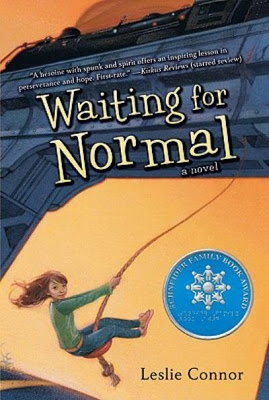
I would pair this book with Waiting for Normal - which had a more profound impact on me and Wish upon a Unicorn. You could also look for books by Jacqueline Wilson such as Lily Alone.