Showing posts with label Dyslexia. Show all posts

Monday, May 11, 2026

Romeo v Juliet by RA Spratt


"Pauline Lee has fractured her spine ... which is very sad for her ... but good news for you. Because now you get to play Juliet! ... You're the understudy ... you'll have to step in and perform."

Selby has not been listening in rehearsals, she has not read the play and she is terrified of any sort of performance. 

"To Selby's mind, nothing about Romeo and Juliet was romantic. She preferred the romance plots on soap operas, where problems didn't involve violent street gangs, controlling parents and interfering church officials. Soap opera characters had real problems - like your identical twin sister turning up and accidentally making your fiancé fall in love with her. ... Shakespeare could have learned a lot from watching The Bold and the Beautiful - mainly to have more fun and less stabbings."

Selby finds herself back in the real scene 

Here is what Selby thinks about Romeo:

"Romeo totally lived up to the hype. He was by every measure really, really good-looking. He radiated wealth and charm and athleticism, but not in an obnoxious way. He had the natural grace of someone who had been physically and financially blessed every day of his life. He made Selby think of an apex predator. He was an apex romantic hero. THE apex romantic hero."

And Juliet:

"She was beautiful. Like an angel. Her skin was flawless, her dark hair cascaded down her shoulders in shining waves and her face was stunning. ... Her expression spoke of sweetness, which made her seem young for her age."

And Selby:

"Jane Austen did nothing her whole life. She sat in drawing rooms. She never went anywhere, she never worked, she never travelled. And she created seven books that are among the most loved novels ever written.' 'Are you planning to write seven great novels?' asked Mrs Karim. 'No, I can't spell or do grammar,' said Selby. I'm just saying don't underestimate the importance of people who sit quietly in the corner doing nothing. Observers are important too."

And plot points of Romeo and Juliet - comments by Selby:

"Selby couldn't believe things were moving so quickly. 'Marriage? How has this escalated to marriage already ... they only met an hour ago ... first look to first kiss to marriage proposal in an hour is ridiculous."

"she is not the sun, the moon or a star. She is a regular girl who just happens to be beautiful. It is unfair to idealise who she is just because he judges her appearance to be ideal. It sets her up for failure. She can't live up to unrealistic worship. She isn't a goddess. She is a girl."

I explained to Rachel at Gleebooks kids that I am not really a fan of timeslip stories but she convinced me that I would really enjoy Romeo v Juliet and she was RIGHT even though yes this is a timeslip story and also it is slightly above my usual focus because I think this book will better suite a Young Adult audience of readers aged 12+ especially IF they are studying the famous play in their high school English class.

There are parts of this clever story that made me laugh out loud. RA Spratt is able to weave in lines from Shakespeare with a cheeky modern commentary from Selby. Her teacher has decided (rightly) that the best way for these modern teenagers to appreciate this famous play is to perform it. Selby has no intention of performing so she signs up to help with the scenery and props. Her teacher tells Selby she must also be the understudy for the main role of Juliet but Selby knows there is no way, no way ever, that Pauline would give up this role. Then Pauline is in an accident which you know from my text quote at the beginning of this post. 

Publisher blurb: Selby does not want to be in the school play. She is much happier behind the scenes painting sets – anything to avoid standing on stage in front of an audience, performing for disinterested classmates and overenthusiastic parents. So Selby did not plan on landing the lead role of Juliet . . . and she certainly never planned to land in Verona and meet Juliet in person. With chaos, wit and R.A. Spratt wisdom, if those who rush stumble and fall, Romeo and Juliet are about to crash-land into a modern-day town!

If you are a high school teacher and Romeo and Juliet is part of your class study, you MUST buy this book and share it with your students. It is simply perfect. And even readers with little or no knowledge of the actual play are sure to enjoy the banter, rapid fire scenes and modern commentary delivered by t the very feisty Selby. 

R.A. Spratt’s creative licence with what she allows Selby to do to the plays is amusing and a lot of fun. It makes Shakespeare engaging, makes it relatable and is a great way to show readers and kids who read this how retellings can work. It’s a clever way to make to plays accessible, and can be used as a good introduction to them. Seeing it play out simply like this helps understand the original, and all with R.A. Spratt’s trademark humour that makes her books shine and garners her lots of fans. The Book Muse

As characters move back and forth between past and present worlds, we laugh out loud when they misconstrue events. However, Selby and her classmates analyse the play with more modern sensibilities including the feminist perspective. Read Plus

Romeo v Juliet follows on from a previous Shakespeare book from RA Spratt:


Here is the Kirkus review - many of the points in this review also apply to Romeo v Juliet

Here are two other timeslips book featuring Shakespeare:


Wednesday, January 4, 2023

Storm Horse by Jane Elson

Daniel Margate has a very special family treasure. It is a scrap book filled with letters written by his great-grandfather, Cuthbert H. Brown Jr, who was a child during the American Great Depression. The letters are written to the legendary racehorse Seabiscuit, a horse who at the time captured the imagination of the nation. 

Parallel with this, Daniel and three other students in his "bottom" reading group have to meet two challenges. They have to read in front of judges and live television and Daniel has to run in a race. Daniel has great difficulty with running and he always falls over he is also dyslexic. The challenges seem impossible. The Skakespeare group are sure to win the reading challenge and the school bullies seem set to win the race but Daniel has a special gift. He sees things differently. He is a problem solver and this problem can be solved with help from a stray horse that he has befriended. 

In honour of Seabiscuit Daniel names the horse Jammy dodger. Australian children might need to see a picture of this type of biscuit.


This book was on my November and December reading pile. It's taken me until early January to read it. I did enjoy reading this story, especially the included letters from 1936, but it is quite long - perhaps a little too long for the target audience. One strength, though, is from the storytelling which contains just the right amount of tension has Daniel works hard to hide his horse, stay safe from the gang of bullies and master reading which he finds so difficult. Daniel is also a really wonderful friend to the others in his group.  Here is an interview with the author.  If you have a horse fan in your family this could be a good read aloud book to share. 


Sunday, July 31, 2022

When the Sky Falls by Phil Earle


All over Britain children are being evacuated to rural towns but not Joseph. His grandmother sends him to London to live with Mrs Farrelly. Mrs F comes from a family that owned and ran a zoo. Now that Hitler is sending bombs every night most of the zoo animals have either been sent away or sadly destroyed. The only animals still needing care are a couple of camels, some birds, two wolves and an old silverback gorilla named Adonis. 

Joseph feels rejected by everyone. His grandmother has sent him away.  His mother left when he was just five. His father has joined the army. School is hell. Joseph is regularly bullied and he simply cannot learn to read.  The words dance around on the page. 

Life in London takes on a new pattern. School is worse than ever but after school Joseph and a young orphan girl Syd help care for the remaining zoo animals cleaning their cages and scrounging food. Each evening when the bomb raid siren sounds, Mrs F heads to her zoo. Joseph is so distressed to discover she goes there to shoot Adonis. At first Adonis terrifies Joseph but over the weeks he comes to form a very special bond with this huge creature. Mrs F holds a gun during the bombing because she knows if the zoo is bombed and Adonis is set free everyone will be in danger. She does not want to shoot this noble creature but she might be forced to do this terrible thing. 

The young boy in this book is at times so astute about the emotions and motivations of others but he also totally misunderstands at crucial times and worse he never stops to think about his own reaction to events and others. I have never read a book filled with so much anger. I knew I was in safe hands or I hoped I was in safe hands with Phil Earle and that all of this would be resolved but the anger is so unrelenting in this story that at times I just had to put this book down. I think I almost held my breath for 257 pages of the 302 desperate for Joseph to open up to Mrs F. Desperate for Joseph to understand and accept the kindness of others. Hoping Joseph could rid himself of his terrible guilt and sense of worthlessness. 

Here are a few text quotes to give you a flavour of this writing:

"He had no idea why this woman had volunteered to take him in, or of the link that existed between them, but she clearly knew he had no mother; he saw it in her eyes. And her knowing bothered him."

"He didn't want to be here; in this room, this house, this city, but like everything in life, it seemed he had no choice in how it played out. At the same time, deep in his gut, he knew he was to blame."

"He didn't like the way she spoke, as if she knew exactly what was going on up there. And he certainly didn't like her talking about her dad. She didn't know him, about how Joseph missed him every day, not how angry he was that he hadn't been there when he really did need him."

"Today was different, for as Joseph crouched on his haunches facing Adonis, he felt the ape's fingers brush his. Joseph swallowed a gasp as a jolt of electricity ripped through him. It was thrilling."

"Joseph's heart rattled like a snare drum, then threatened to explode as Adonis patted his head gently, not with one hand, but with both. He felt tears spring into his eyes at the gentleness of the act, then fall down is cheeks as Adonis lifted his chin, resting Joseph's forehead against his own."

"Mrs F had no idea how to tell him, what words to use, or even how to think about calming him afterwards. How do you hold a boy together, when he was already broken? There were already too many pieces to manage, without dropping and damaging even more."

You can hear Phil Earle talking about his book. The publisher lists this book for 9+ but I think this is a book for an older reader 11+. Here is the US cover:


An unusual, moving war story with excellent writing and compelling characters. Kirkus

This is a beautifully written historical adventure story that will take readers on a very emotional and exciting journey. The pace is fast and the feelings run high. The reader ends up fighting for Joseph and Adonis all the way – and this book is almost impossible to put down. Book Trust

The deep anger and tense emotions in this book reminded me of The Night Bus hero.

Saturday, January 8, 2022

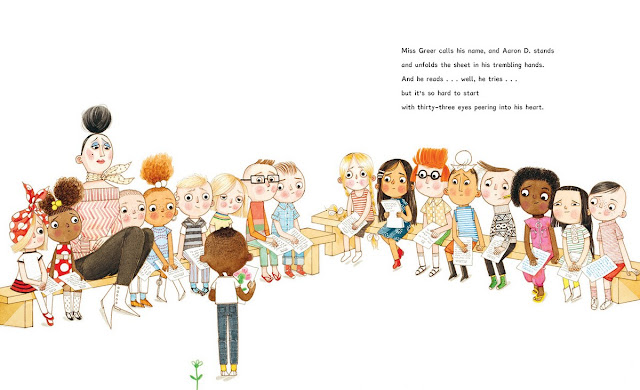
Aaron Slater Illustrator by Andrea Beaty illustrated by David Roberts


"Words drift like music. Melodious. Mild. A sweet summer song for a sweet summer child who drifts off to sleep as the cottonwoods sway at the end of the garden. At the end of the day."

"But what he loves most - what makes Aaron's heart sing - is to listen to books in the old garden swing. To write stories, he thinks, is the greatest of things."

Aaron loves stories but he finds reading and writing are complex - he can however tell wonderful stories and he can draw his ideas and luckily his beautiful teacher can see his talent. Aaron does not need to feel small - he can shine. And over time reading will become easier but for now art is the way his heart can sing.

"Like the mightiest flames that banish the dark, hope grows in the soul, from the tiniest spark. His art makes a difference. His art leads the way and helps him discover what he wants to say."

The character of Aaron is based on Aaron Douglas, an African American artist, muralist and graphic artist.

When you hold this book in your hands please take time to explore all the lively images on the front cover and back covers. You will see all the wonderful things Aaron holds in his imagination. The art in this book by David Roberts is simply marvellous. I love all these hairstyles.


Empathetic art and lyrical text blend for a touching and empowering tale. Kirkus Star review

One of the true strengths of this book comes from the beautifully composed and carefully constructed rhyme.  Writing a rhyming text requires enormous (ENORMOUS) skill.  In this article from The Picture Book Den the authors make some really important observations about this form. The words in BOLD are my emphasis:

So how do you acquire those skills? And how do you learn to tell the difference between top quality verse and terrible rhyme? The answer is straightforward, but getting there isn’t easy. You work, hard

You pick every word with consideration. You edit your own work ruthlessly and tirelessly. If there even might be a better alternative, you chuck out your favourite line and try a new one.

You keep all of the following in mind at every stage: plot, character, sense and logic, age appropriateness, commercial appeal, rhythm, timing, accent and pronunciation, syllables, stresses, emotional arcs, story beats, universality, originality, ...  page turns, potential changes of scene in the illustrations…

Andrea Beaty is a master of rhyme. This book could be used as an exemplar to show aspiring writer the best way to use this form. Read this and think about the genuine emotions that come from these lines:

"And he reads ... well, he tried ... but it's so hard to start with thirty-three eyes peering into his heart."

I am a bit late coming to this splendid series. There are picture books, project books and chapter books oh and even toys. Here are some of the previous titles:


David took that plain text and created a whole classroom of quirky, talented and passionate kids, each with a complete personality and backstory. He did not share that backstory with me. Still, those characters were so intriguing that I started thinking of stories for them. I followed the clues tucked into his art to figure out who these kids were and what made them tick. I wrote more stories and David created even more magnificent illustrations filled with even more clues to those kids and their personalities. Andrea Beaty

Other books illustrated by David Roberts:


Sunday, August 16, 2020

Annie Lumsden The girl from the sea by David Almond illustrated by Beatrice Alemagna


Annie lives with her Mam beside the sea. The description of Annie gives a strong impression that she might be a sea creature - a mermaid:

"I have hair that drifts like seaweed when I swim. I have eyes that shine like rock pools. My ears are like scallop shells. The ripples on my skin are like the ripples on the sand when the tide has turned back again. At night I gleam and glow like the sea beneath the stars and moon."

School is a terrible struggle for Annie and she is curious about her father. Her mother tells heartfelt stories of long ago and of love on the beach.  One day a mysterious stranger arrives. He takes a photo of Annie. Is this image a way to know the truth?

There are beautiful illustrations in this book and the image hidden under the dust jacket is very special.


I was asked to read Annie Lumsden, the Girl from the Sea, because a friend who is a Teacher-Librarian in a Kinder to Grade Two setting bought this book from a local book store. It was placed with the very junior books but, since Annie is actually thirteen, my friend rightly thought this book would be for older readers perhaps it might even be a YA title. I find it odd that the publisher rep (Walker books) did not advise the book store that this book, even though it looks appropriate for very young readers because it is slim (60 pages) and has colourful illustrations, is best suited to readers aged 10+. The book it is taken from actually suggests ages 12-17. How do I know this?  Teacher-Librarians are keen readers of imprint information - the tiny details found on the back of a title page.  Annie Lumsden, girl from the sea says:

"First published in 2007 as 'Half a creature from the sea' in Click." Naturally I was curious and my search took me to this title Half a creature from the sea:

Here is a quote from Publisher's Weekly:

Beyond offering eight alluring epiphany stories (most previously published elsewhere), Almond  provides a rare glimpse into the writer’s imagination and the process of creation. “I try to do what many writers have done before me: show that ordinary places can be extraordinary,” he notes in the introduction. The selections are prefaced with childhood memories that serve as inspiration for strange, mysterious narratives illuminated by Taylor’s haunting b&w drawings. Almond invites readers to journey through streets lined with small stores, to savor a saveloy sandwich from the local pork shop, and to ponder the possibility of fathers, dead and gone, returning to Earth. 

The title story, about “a daughter who might be half a creature from the sea”, is one of the strangest in the collection, subtly interweaving memories of the glorious Northumberland coast with myths of mermaids and sea gods. Like all the other stories, though, it charts that troubling but inevitable rite of passage from innocence to experience. It tells us that “Sometimes … the best way to understand how to be human is to understand our strangeness”. READ Research in English at Durham 

Then I dug further and found Click:

Ten distinguished authors each write a chapter of this intriguing novel of mystery and family, which examines the lives touched by a photojournalist George Keane, aka Gee. Publisher’s Weekly

Here are the ten authors: David Almond, Eoin Colfer, Roddy Doyle, Deborah Ellis, Nick Hornby, Margo Lanagan, Gregory Maguire, Ruth Ozeki, Linda Sue Park, and Tim Wynne-Jones. 

Putting all these puzzle pieces together Annie Lumsden was first a chapter in a story about a photographer, then it was added to an anthology by David Almond and finally it is a stand alone book. 

Annie Lumsden... reads like a fable and easily becomes part of the readers consciousness, causing a shift in perception (much like many of Almonds' other books and in particular, Skellig.) It is haunting, ebbing and flowing like the tides that create it. Gently humourous, astoundingly insightful and utterly enchanting … Fallen Stars Stories

David Almond’s thought-provoking, sensitive tale is as broad and as deep as the ocean it evokes and Beatrice Alemagna’s vivid, playful illustrations enrich the mystery and wonder on every page. Together they capture the elusive innocence of childhood and the beauty of nature with a magical realism that beckons the reader to dive in and interpret Annie’s world.Readings

The research I did for Annie Lunsden reminds me of another slim novel for older children which originally came from a anthology - Captain Rosalie.


Friday, July 17, 2020

The Truth as told to Mason Buttle by Leslie Connor


Mason is a character that you will  "love, cherish and hold close in your heart for a long long time." Colby Sharp

"Then he wanted to know did I throw away a handsaw. The one I had. From my birthday. He wanted to know did I toss it somewhere. ... And I was thinking why would I do that?"

Mason had a best friend, a true friend, his only friend but one day his friend died. The ladder to the tree house made by Benny and Mason broke and Benny Kilmartin was killed.  Mason was the last person to see Benny alive.  Mason tries hard to answer questions from Lieutenant Baird but the policeman is impatient and Mason is not good with obscure questions. He tells Mason to write down what happened but Mason is also not good with reading (its actually impossible for him) or writing. Thank goodness for the wonderful school social worker Ms Blinny. She introduces Mason to a computer with voice recognition software that she calls 'Dragon'.  Speaking quietly day after day Mason is able to tell his story and while he is doing this he makes a new friend called Calvin Chumsky.

Mason has more to contend with though because the boys who live near his house have decided to make his life 'hell' with their bullying, name calling and apple missile attacks.  Mason lives on an old apple farm. Most of the holding has been sold off by Mason's uncle and the apples are now left to rot on the ground. Each afternoon, when Mason and his new friend Calvin, get off the bus Matt Drinker and Lance Pierson attack.  Matt Drinker is an especially mean and nasty kid. Matt has a dog called Moonie. Mason loves this dog (think of Shiloh by Phylis Reynolds Naylor or the dogs in Where the Red fern Grows by Wilson Rawlins) - but the dog belongs to Matt.

Over the coming weeks, Calvin and Mason build something extraordinary, but the issues surrounding the death of Benny won't go away and the policeman keeps visiting and asking those impossible questions.


This one will touch your heart in the best way.  This one will stretch your heart in the best way. A Book and a Hug

Here is a comprehensive set of teaching questions from the publisher Harper Collins. Here is a video book talk with more plot details.  I adored a previous book by Leslie Connor - Waiting for Normal. In this video Colby Sharp talks about Read Aloud Week and The Truth as told to Mason Buttle. Here is an audio sample.

I would follow The Truth as told to Mason Buttle with these:


Wednesday, July 17, 2019

May B by Caroline Starr Rose

Ma and Pa want me to go
and live with strangers.

I won't go.


There are so many reasons why I was attracted to this book. It is a verse novel and I adore this genre. The setting is the prairie which is a place that fascinates me. I think this fasciation goes back to my childhood reading and enjoyment of the Little House on the Prairie. Finally this is an emotional story where the main character shows enormous resilience.

May B is sent away to live with Oblingers. Her family are so desperately poor that they accept money for her services. Mr Oblinger has a new wife.  "The brides not settled ... she's missing home." The new home is a soddy or sod house with dirt floors, thick walls and often only one window.

You can read more about the construction of a sod house here.

May B packs her few clothes, her only book and her slate. May B is desperate to learn to read. May B and her father travel the fifteen miles to the isolated home. Mrs Oblinger is not welcoming. It is clear she is desperately unhappy. Her treatment of May B seems almost cruel at times.  Then one day her demeanour changes. She asks for some biscuits and says she will take a walk. Later in the day May B finds a note:

Mr Oblinger,
You've been so kind,
but I can't stay.
I'm taking the train
back to Ohio.
Please understand.
Louise.

Mr Oblinger leaves immediately to retrieve his young wife. May B waits and waits but the pair never return.  What will May B do? She is supposed to stay here until Christmas. It is late August. In every direction the prairie looks the same. If she tries to walk home she is sure to become lost. Winter is approaching and supplies are running out.

Here are a set of teaching notes. These would be useful if you wanted to read May B with a Book Discussion group. I especially appreciated finding a comprehensive list of all the vocabulary used in this book and some background reading about life on the frontier.

I would pair this book with Sarah, Plain and Tall and Black-eyed Susan by Jennifer Armstrong. If you want to explore the topic of dyslexia you might like to read The wild book by Margarita Engle.

Kirkus use the word "extraordinary" in their star review:

As unforgiving as the western Kansas prairies, this extraordinary verse novel—Rose’s debut—paints a gritty picture of late-19th-century frontier life from the perspective of a 12-year-old dyslexic girl named Mavis Elizabeth Betterly… May B. for short. Kirkus

May B. can and will succeed. If she fails, she knows that she'll get up, shake off her disappointment and move forward until she finds her own place where earth meets the sky. Clear Eyes Full Shelves