Showing posts with label Individuality. Show all posts

Monday, August 24, 2026

Caramba by Marie-Louise Gay


In the world of this story cats are supposed to fly but Caramba simply cannot.

"It worried him a lot. 'Every cat in the world can fly ... except me'."

"What could he say? That he was afraid to fly? That flying made him dizzy? That he had tried over and over again and failed every time?"

At first his friends Bijou and Bug tease him but then they offer to help. Unfortunately while giving Caramba the experience of flying, they let him go and he plunges into the ocean. BUT wait - Caramba does have a talent - he can swim.

"What are you doing?' cried Bijou. 'Cats can't swim! Everyone knows that!' 'Well I can,' said Caramba."


"Then Caramba leaped off a chair ... and landed in his grandpa's lap.
'Ay, Carama!' cried his grandfather. 'What are you doing?'
'I'm admiring your slippers,' muttered Caramba. 'They're very nice."

This would be a perfect book to read to your preschool or Kindergarten group - it celebrates difference and talents and self-belief, friendship and even kindness. Caramba was published in 2005 but there is a 2022 paperback edition that is still available OR better yet head into your public or school library because they might have this book along with other titles by Marie-Louise Gay - fingers crossed.

I have now discovered there is a sequel:


On the final day of my visit to Canada for the IBBY Congress in Ottawa this month we visited several libraries including The Greenboro Branch of the Ottawa public library service. They offer so many rich programs and even loan membership cards so families can visit museums and art galleries and even the National park for free. Now that's an idea I'd love to see adopted here. 

As we entered the library we spied a cart of library discards - books for just CAN$1 and my friend saw this book Caramba - she knows I love art by the Canadian illustrator Marie-Louise Gay.


Wednesday, November 5, 2025

Frances Bloom by Katrina Nannestad illustrated by Marina Zlatanova

Recipe for Frances Bloom

  • A full to the brim cup or two of Pippi Longstocking by Astrid Lindgren
  • Three quarters of a cup of Gooney Bird Green by Lois Lowry
  • A generous dash of Leeva at Last by Sara Pennypacker
  • A quarter teaspoon of the illustrations in Maudie and Bear by Jan Ormerod illustrated by Freya Blackwood (read more here)
  • A small spoonful of Clementine by Sara Pennypacker
  • A tiny pinch of Matilda by Roald Dahl

Method - Pippi Longstocking lives alone and so does Frances Bloom. Pippi has special animal friends - her horse and monkey. Frances has a huge bear (and a garden gnome). Pippi speaks boldly and she enjoys her daily routines. Frances loves to swim every day, often in her clothes, and she has strong opinions about school. 

Gooney Bird Green loves to wear outrageous combinations of clothes and so does Frances. Gooney entertains her class with her tall tales. Frances is loved by her 22 Grade 3 classmates because she brings her eccentric grandparents to visit the class, she sets imaginative writing assignments and ultimately, she is responsible for 'getting rid' of their horrible teacher Ms Thistle. 

Frances is somewhat like young Leeva because she has to survive and avoid being 'found out' by adults. Maudie and Bear is about relationships - and Frances creates a special bond with her bear named Grandma Maude. And of course, Clementine and Frances are about the same age and have the same outspoken opinions and slightly naive view of the world. 

Here are some of the clothes worn by Frances Bloom. You could use these descriptions as a way to book talk Frances Bloom with your library group:

"Frances stepped from the fitting room wearing tartan shorts, a lime-green poncho with tiny pompoms along the edges, rainbow-spotted tights and purple clogs."

"She dressed in a floppy red smock, green-striped tights and bright yellow gumboots. She did not brush her hair."

"She wore long Johns, a stripy blue scarf, red lace-up boots and a green beanie."

Frances Bloom has 130+ illustrated pages, large print, short chapters, a very cheeky main character and a rollicking story so it will be a perfect addition to your library collection for readers aged 7+. I am not a huge fan of the cover but I really like the internal illustrations by Marina Zlatanova. 


To my mind this is a book for an individual child or one to share in a family but the publisher have produced some extensive teachers notes. It would be fun to talk about two of the 'naughty words' - Codswallop: an old-fashioned way of saying something is nonsense and Poppycock: another old-fashioned way of saying something is nonsense.

Frances Bloom is the first title of a planned series. 

The antics that Frances, her friends and new grandparents get up to make this book lots of fun for younger readers. The Book Muse

Frances Bloom is an appealing and likeable character. She strong, clever, resilient and loves life. She is her own person, full of fun and a tiny bit of mischief but her heart is in the right place. Read Plus

Publisher blurb: Frances Bloom lives all alone in a cottage by the sea. She's having a marvellous time until her nasty teacher, Ms Thistle, learns there is no-one looking after her. Frances needs to find a family, quick smart, or she'll be sent away to Bleak Island Home for Unwanted Children and Dogs. As hard as Frances looks, nobody meets her high standards ... until she stumbles across a large, honey-coloured bear raiding the rubbish bins ... and a garden gnome fishing in the flowerbed. Welcome, Grandma Maude and Grandpa Harold! Together, this strange trio creates a new family, writing their own rules with each misadventure!

Frances Bloom also reminded me of an earlier book written for an older audience by Katrina Nannestad - The Girl who Bought Mischief. I am a huge fan of her work - click on the label for this post to see other books. 


Meeting Grandpa Harold (the garden gnome) also made me think of these two books which are sadly long out of print but might be in your school library:


Marina Zlatanova is a Bulgarian-born designer, illustrator and printmaker living in Naarm/Melbourne, Australia. She has illustrated several picture books to date, including Charlie’s Shell, her debut as an author, which won a Speech Pathology Australia Book of the Year award. Her style is varied and eclectic, using a diverse range of media – from watercolour and inks to digital illustration and block printing – but her love for depicting the humorous and endearing always underpins her creations. Other books illustrated by Marina Zlatnaova are Gladys and Stripey: Two little fish on one BIG adventure; and Tink, Tink, Tink! (2025).


Thursday, September 5, 2024

Little Puggle's Song by Vikki Conley illustrated by Helene Magisson


All of the birds contribute to the bush chorus. You can hear the little blue wren, the fantail, the Sulphur crested cockatoo, and the laughter of Brown Feather. Little Puggle longs to join them but he just cannot make a sound. Even the Kangaroo and Koala can grunt and click. Brown Feather is in charge of the orchestra. Brown Feather is a kookaburra but on the day they all need to sing to help the emu family with their eggs, Brown Feather is ill. How can the chorus still sing without their leader? Little Puggle has the answer. He has been quietly watching Brown Feather. He plucks a long quill from his back and the singing can begin!

Little Puggle's Song was a Notable Early Childhood Book of the Year by The Children's Book Council of Australia in 2020. Here are some brief teachers notes. I this interview Vikki Conley talks about the inspiration for her story and here is her webpage. Read this extensive review on The Neverending Bookshelf. In this video Vikki Conley reads her book. 

This deceptively simple story is  all about joining in, finding your own special talent and the warmth of community and of course, the power of music. Sure to appeal to the very young and everybody else as well. Storylinks

The stand out illustrations with beautiful colour and light create a dreamy Australian setting, and an instant connection with Little Puggle’s character. Vikki Conley’s captivating story-telling and Helene Magison’s pictures flow and lift each other to make a wholesome and stunning book with a cover so delightful that it warmed my heart before I even opened it. Kids' Book Review


Early in 2024 Orchestra Victoria turned Little Puggle's Song into a performance - I wish I had known about this - it must have been very special.

Hello and welcome to Little Puggles Song, one of Orchestra Victoria’s special Storytime Series, designed for our young and young-at-heart audiences. Telling stories is at the heart of what we do here at Orchestra Victoria, and we are so thrilled to bring you Vikki Conley’s book in a new and interactive way, with an enthralling composition by well-known composer Maria Grenfell and featuring a selection of our talented Orchestra Victoria musicians. We hope you enjoy the musical prowess of today’s performance as they bring this exciting musical score to life telling the story of Puggle, the young echidna who wants to find his voice so he can take part in the bush choir.

Here is the sequel:


I guess by now you have worked out the word puggle is the term for a baby echidna. I have often thought I would love to talk to an international audience of children's literature fans about our Australian animals and the way they are portrayed in picture books - especially the less well-known animals such as the echidna. 

  • Echidnas, along with the platypus, are the only mammals known to lay eggs, placing them in the unique mammalian subclass of monotremes.
  • An echidna’s tongue can shoot out of its snout at remarkable speeds, up to 100 times per minute, to capture ants and termites.
  • Echidnas have a highly developed sense of smell and a significant portion of their brain is dedicated to olfactory processing.
  • Echidnas make up 4 of the 5 surviving species of monotremes.
  • Echidnas are great swimmers.
  • Echidnas are covered in quills. These quills are made of keratin, the same material that makes up hair, claws, and fur. The keratin proteins harden into spikes that protect the echidna from harsh conditions and predators.
  • Echidnas are powerful diggers.
  • They produce milk from patches of skin. Young echidnas suckle on these patches and draw milk through pores in the mother echidna’s skin.
  • Young echidnas suckle on these patches and draw milk through pores in the mother echidna’s skin.

I previously talked about these books by Vikki Conley:


And I previously talked about these book illustrated by Helene Magisson:


Tuesday, August 13, 2024

Measuring me by Nicola Kent


This book is such a delight. It will help a child make sense of themselves through a series of easy to understand comparisons. This book should be added to all preschool and Kindergarten classrooms. Every child will also potentially see themselves in these pages too:

The children depicted are diverse: one uses a walking aid, for example, and the girl on the cover has a tracheostomy to aid her breathing. Kent has a tracheostomy herself, and knows how vital it is for children with physical differences to find themselves represented incidentally ‘as part of the rainbow of humanity’ in books and other media. It’s particularly welcome to see a book about the wonders of the human body quietly taking this approach. Books for Keeps

  • I'm as tall as ten tin cans.
  • My nose can detect 50,000 different scent and my tongue has thousands of taste buds.
  • The biggest bone is my thigh bone. It's about the height of a cat.
  • When I'm standing still my body gives off enough energy to power a light bulb.


Written from the perspective of a child and featuring bright, adorable illustrations of different children, the book captures the sense of curiosity and wonder that children have for the world around them. It introduces the concept of measuring in a personal and relatable way, making it easier for young learners to grasp – and to have fun with!  Book Trust

This book would make a wonderful gift for a young child aged 3-6. If you are reading this book to your class Kane Miller the US publisher have a set of discussion questions. 

A brilliant bonus at the back of the book is an equally ingenious, sturdy, height chart. This has the usual measuring tape along one side, but tins in the middle and animals beside them so you can compare them to your own height and to each other. Emperor penguins are much larger than I imagined! You are encouraged to find other things to measure yourself against too and I can see this provoking lots of excited activity. Love Reading 4Kids

You can see lots of other books by Nicola Kent here. They sure do look appealing.

Monday, July 29, 2024

Starring Walter Pigeon by Suzanne Houghton


Walter Pigeon knows he is different. He loves movies and hopes to be a star one day. He spies a poster for a movie starring Walter Pigeon entitled Ace detective Jack Parker. Yay - he is in a movie! Walter assembles his kit and sets off to solve a mystery. Greer, a meek little pigeon, explains she has lost her laugh.

"Greer couldn't explain what it looked like ... 'but I know what it feels like ... It's like the tickly fizzy bubbles from a glass of lemonade ..."

"My laugh makes me heart light up and brightens my day."

"My laugh turns my frown upside down. It makes me tingle all over. My laugh makes me feel happy."

How will Walter ever solve the mystery of the missing laugh?

Adults will also enjoy the name choice - Walter Pigeon (1897-1984) was an actor who was "known for his "portrayals of men who prove both sturdy and wise".  There is also a fun visual twist on the last page.  I discovered this book (which is sadly now out of print but might be in some Australian school libraries) because my friend sets out fabulous book displays every week or two. This book was part of her pigeon books display and three borrowers took it home in June which is why she regularly displays her books so that borrowers can find them!

Here are a set of discussion questions to use with Starring Walter Pigeon. This is the first book by Australian author/illustrator Suzanne Houghton. Here are some of her other titles and you can see her work on Instagram:


Companion books:


Thursday, March 21, 2024

Agatha May and the Angler Fish by Nora Morrison and Jessie Ann Foley illustrated by Mika Song


"Each of you scholars will research a creature that lives in the ocean. 
You'll learn all its features."

"Pick any sea-dweller from under the sun, but no two children 
may choose the same one!"


There is SO much to enjoy about this book. Agatha May is a clever child, but she is bouncing along to her own beat - I love her nonconformity. I also love her passion which in this case is for Anglerfish. Agatha waits in the line for her turn to select a fish to research:

"As Agatha listened, the tears gathered fast. She had no merit points! Her turn would be last! She was tardy and dreamy, her interests were odd, her fingers were charcoaled, her breath smelt like cod!"

I have listed this book as a picture book (fiction) but really it is both fiction and nonfiction. Agatha talks with so much authority about this fish and at the back of the book there are two pages of facts and further read. 

One of the brightest students I was ever lucky enough to work with in my Primary school was a little like young Agatha. Her schoolwork and desk were always completely messy (seemingly disorganised) but young Blair knew where everything was. I am sad to say her messy habits did infuriate her class teacher just as we see in this book with Mrs Marino. I wish I could wind back time and share this book with that teacher from my school. Blair was one of our school leaders and I know by the end of the year the teacher did come to appreciate her outstanding intelligence, but it did take a long while for him to understand this Grade Six girl. (She is now a senior associate in a legal firm).
Read more about the Anglerfish here. You might find a book in your school library about Anglerfish or a general fish book might have a chapter with details of this curious creature.


The satisfaction of seeing Agatha May rewarded for her fixation is rivaled only by Song’s marvelous watercolor embodiment of Agatha May’s untidy, obsessive self. Kirkus

Wednesday, March 20, 2024

Can you teach a fish to climb a tree? by Jane Godwin illustrated by Terry Denton


Einstein did not say: "Everybody is a genius. But if you judge a fish by its ability to climb a tree, it will live its whole life believing that it is stupid."

This quote, by an unknown person, is the inspiration for this quirky book which celebrates difference and talent.

"Could a dog play the violin?"

"Could a baby bake a cake? Or a horse drive a car?"

"Do you think a lizard could ever learn to sail a boat?"

All of these propositions are preposterous but  then in the second half of this book Jane Godwin shines a spotlight on each animal and their own unique talent which, in an interesting twist, are mostly about survival such as the lizard camouflaging to avoid the kookaburra and the penguins huddling together to keep warm. Of course, the final focus is on all the wonderful things YOU can do. You almost need a magnifying glass to explore all the activities on this double page spread. 

The CBCA (Children's Book of the Year) Early Childhood judges said: Children will initially find the series of posed questions in this imaginative book, both preposterous and comical, a great device to engage them in reflections and discussions about self-acceptance, diversity and understanding others. Quirky, loose ink and watercolour illustrations, abounding in small humorous details, enhance the succinct narrative inviting children to follow the unfolding visual stories and create their own. The pace builds with the increasing silliness in the first half, which is followed by a more considered, thoughtful second half, cleverly incorporating fascinating facts about remarkable attributes of various animals (and human babies). Powerful yet with a light touch that feels fresh and unique, this interactive picture book will sit well in homes, libraries and educational settings.

I like the debossed cover of Can you teach a fish to climb a tree? Children will enjoy running their fingers over the title. I am also happy to see Terry Denton returning to his earlier art style. Of course, he is famous for all the Storey Treehouse books but I am a huge fan of his early books such as Felix and Alexander and the little obscure book The Story of Imelda who used to be Small (two illustrations below) and also Night Noises by Margaret Wild, Ducky's Nest by Gillian Rubenstein and At the Cafe Splendid.


Two pages from The Story of Imelda who used to be small by Morris Lurie (1984)


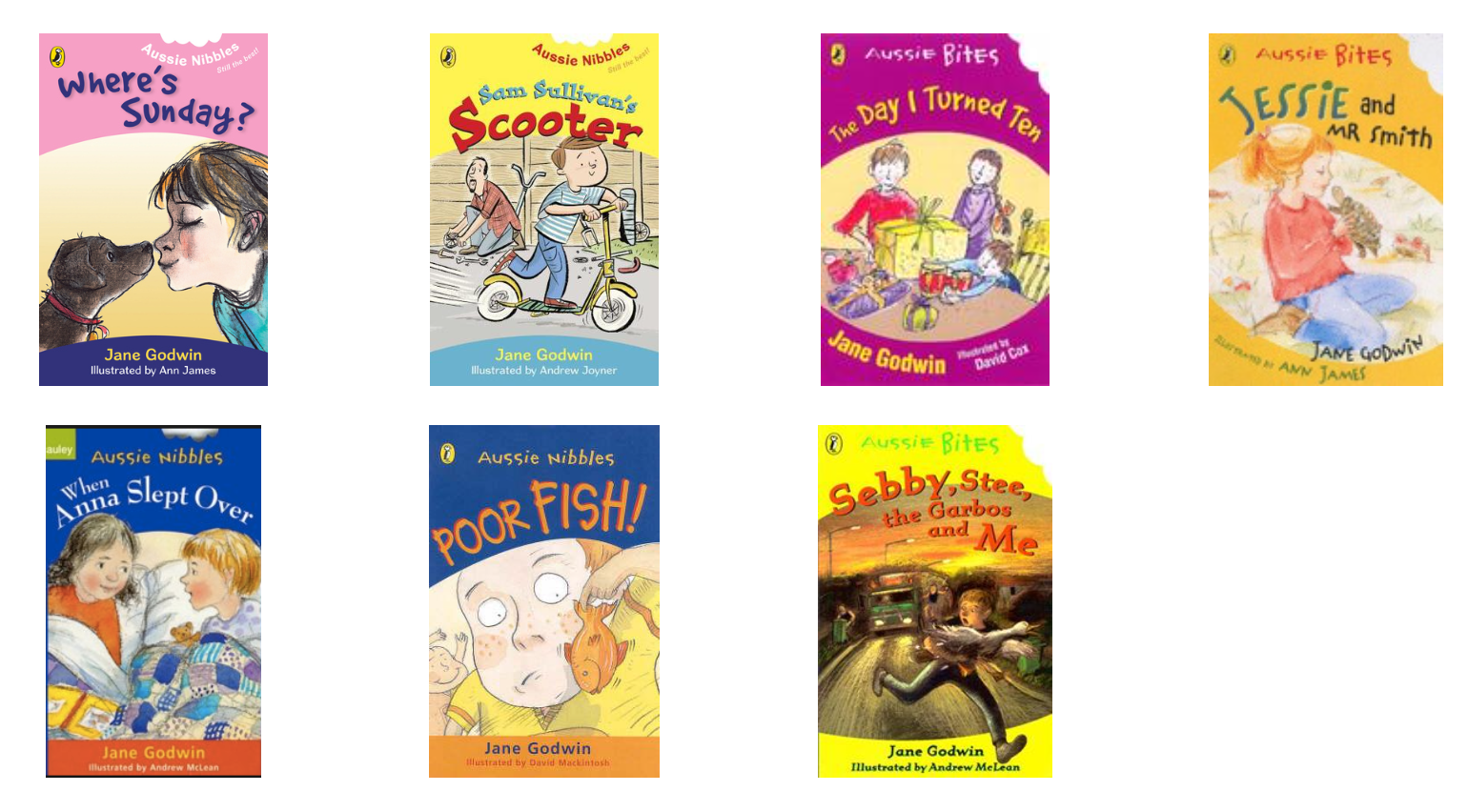
Here are some other books by Jane Godwin. I especially love Ivanhoe Swift left home at Six, Poor Fish, What do you wish for?  and The Best Hiding Place:


Monday, March 4, 2024

How to Build a Hug by Amy Gugliemo and Jacqueline Tourville illustrated by Giselle Potter


How to Build a Hug: Temple Grandin and her amazing squeeze machine 

Many Grade 4 classes here in NSW are reading a book called The Thing about Oliver which is a story told from the point of view of Oliver's sister. Oliver is severely autistic and this makes life very hard for Tilly. It seems everything they do is organised around the needs of her brother. Tilly lives on edge feeling responsible to keep her brother safe. Her own dreams are always pushed into the background.

Publisher blurb for How to Build a Hug: As a young girl, Temple Grandin loved folding paper kites, making obstacle courses, and building lean-tos. But she really didn’t like hugs. Temple wanted to be held—but to her, hugs felt like being stuffed inside the scratchiest sock in the world; like a tidal wave of dentist drills, sandpaper, and awful cologne, coming at her all at once. Would she ever get to enjoy the comfort of a hug? Then one day, Temple had an idea. If she couldn’t receive a hug, she would make one…she would build a hug machine!

You can see inside this book here. You can hear the book here - it begins at minute 4.25. How to Build a Hug was published in 2018. It is still available but sadly it is quite expensive here in Australia. 

I think it would be excellent to share How to Build a Hug after reading The Thing about Oliver. Temple Grandin is an autistic woman (albeit not as severely affected as Oliver) and this book we read about how she makes a success of her life. Dr Temple Grandin is now a professor of animal science and an advocate who shares her personal experiences of autism. Reading this book may give students a more balanced view of autism and other neurodivergent conditions. Also, this story is told from Temple's point of view which could allow some good discussion and comparison with The Thing about Oliver. 

"Sometimes when Temple was having a really bad day, she crawled under the sofa cushions and asked her little sister to hop on top. The smoosh of the heavy pillows felt cozy."

Temple Grandin is well-known for being an autism advocate, and this peek into her younger years, and her aversion to hugs is wonderfully done. We see the bright little girl struggling to enjoy something she knows others enjoy and how hard that is for her to live with. Stories like these help children understand how other children on the spectrum might think of touch and sound and could be comforting for children struggling to avoid touch – they are, after all, not alone. The Children's Book Review

You might like to explore other books illustrated by Giselle Potter. If you are interested in reading more picture book biographies (perhaps of people like Temple who I had not heard of) my friend from Kinderbookswitheverything has a splendid Pinterest collection which is well worth exploring. 

I do not agree with the way our NSW English units intensively study one text but if you want to see the Grade 4 (Stage 2) unit on the book The Thing about Oliver here is the link. I do wish the syllabus writers had considered including a list of other books to read either after or alongside The Thing about Oliver such as How to build a Hug.

Monday, January 15, 2024

Faelan the Wolf Book One: Odd Wolf Out by Juliette Maciver


Before I talk about this book I do need to give you a warning - this is Book One in a planned three book series and the first book ends with a cliff hanger which will leave you desperate for Book 2 which is published and available and then for Book 3 which is not out yet!

Faelan is different - he is a non-conformer in the wolf pack. He does not enjoy hunting for prey. He does not want to eat the forest creatures that are caught by the pack. He lives on his own in a small hut constructed from debris discarded by humans. He has a small vegetable plot, and he enjoys eating beans which he cooks on a small fire. The other wolves are suspicious of Faelan, they fear fire and so, many of the young wolves bully and ostracize him. Faelan is lonely but he has made friends with a skunk named Flora. Of course, this also horrifies the other wolves because they expect to eat creatures like Flora and not invite them to be a friend. 

The pack is ruled by an old wolf named Bardolph Lupus but he is growing old and weak. To some extent Bardolph has protected Faelan, but his son and heir named Weylin has a plan to reverse this. Faelan has been told his father and mother are dead. He has a faint memory of his mother and her singing, but his father is a mystery. Then he learns his father is not dead. He was banished from the pack and is now rumored to be the leader of the rival pack. His father's name is Varg and he is very dangerous.

This book is only 172 pages. It does contain some interesting ideas - such as the issue of battery hens, conformity versus nonconformity and the abuse of power. The character of Weylin is especially curious and I expect we will learn more about him in book 2. He wears gloves:

"Weylin rose to his hind legs, smoothed down the white gloves he always wore on his forepaws ... "

When Faelan visits Weylin's den he sees Weylin (who always purports to be brave and 'manly') has decorated his space with flowers and art. 

"Covering the entrance to this private chamber hung fine curtains of spider weave, again interlaced with flowers, this time tiny blue forget-me-nots, which were worked into the curtains in intricate patterns."

Here are the teachers notes from the publisher who describes this book as an anthropomorphic fantasy. These notes have more plot details.

If you are sharing this book with a class or introducing it in your library you could talk about the author's choices for character names: Avian (the chicken); Granny Beowulf (the healer who understands how to use herbs collected in the forest); and Flora (the skunk - she does not smell like flowers).  I also learnt a new word in this book ‘mouflon' - this is a type of sheep which should make you laugh when you think about where this book comes from! Readers aged 10+ who enjoy quirky books told from a different point of view will enjoy Odd Wolf Out. 

Odd Wolf Out is published by Scholastic in New Zealand. It was offered on our Australian Scholastic Book club brochure which explains how I came to find it in the Westmead Children's Hospital library (Book Bunker) where I volunteer. The library is a philanthropic cause supported by Scholastic Australia and that company are our main source of new books for the collection.

Faelan Maculf’s story may not be a laugh a minute, but it is an important story about tolerance, kindness, and complicated family—with a bit of humour. The Sapling

Here is book two:


Companion reads although these are both more serious and not anthropomorphic:


In some ways this book reminded me of this one:


Sunday, August 20, 2023

Frank's Red Hat by Sean E Avery


Frank is a creative soul. He discovers the joy of knitting and he makes a splendid hat but the other conservative penguins are not sure this is a good idea. They like their safe predicable black and white world and then when their friend Neville is eaten by a killer whale they are convinced nothing good will come from wearing Frank's hats.

But Frank is not a penguin who accepts defeat.  He continues to make his hats embracing so many exotic colours. 


He tries to share his best hat with his old penguin friends but the run away terrified. Luckily for Frank someone else has been watching all of this. The seals love his hats and so Frank regains his confidence and his creativity. Frank has been given a very distinct and very appealing personality.

This book gave me a huge smile. I adore the illustrations which remind of the award-winning illustrator Jon Klassen who also uses similar textured effects.The use of analogue and digital illustrative techniques lends this book an air of sophistication. 

There are some deeper meanings here but I just love the lightness of touch given to the story, the perseverance of Frank, his creativity, and the hilarious twist at the end. This book will open up conversations about risk taking, difference and courage along with a terrific discussion about the names we give to colours. It also opens up opportunities to think about other perspectives such as the penguins and their resistance to change. 

The end papers are perfect. I love the way the illustrations delightfully extend the text such as when Frank uses the broken walrus tusk as fish spike. Those eyes on the walrus say so much. Then things go full circle when we see the walrus has his tusk tied on with pink wool and, like the seals, he too is wearing a special hat but wait a minute - look at the nose on the snowman - oh no!

The story pace is perfect too. Sean Avery shows us how to read a line like “it’s for keeping our head warm – in style” by the simple placement of that dash. In terms of the plot line, I enjoyed the moment of drama when Neville is eaten by a killer whale – the text makes this feel less tragic and more about the cycle of life and death on the ice.   

Frank’s Red Hat is one of those picture books that certainly can be shared with younger children but which will also generate deeper discussions and enjoyment for older students too. This story addresses so many themes: the other, fear, conformity, 'group think', diversity. 

Frank's Red Hat was short listed for our Children's Book Council Book of the Year awards - Picture Book. I was a judge this year and so some of my comments are based on the critique I wrote which you can see here. 

Here are some junior teaching ideas from the publisher Walker books. Here is the website for Sean E Avery - he lives in Western Australia. Here is a video where Sean shows his art process. 


Saturday, November 5, 2022

Weirdo by Zadie Smith and Nick Laird illustrated by Magenta Fox


The Surprise arrives for Kit's birthday. Kit heads off to school so the pets in her room try to work out where The Surprise fits in. They decide she's a weirdo. The others leave to watch television which is a part of their schedule. In the bedroom, The Surprise works out how to fly and her balloons take her out of the window. She lands on a verandah and meets the wonderful Emily Brookstein. Others call her weirdo too. The Surprise has a wonderful afternoon with Emily sharing macaroons and card games. At three o'clock, Emily carries The Surprise back to her apartment and young Kit. Finally we discover her real name (Maude) and her skill with judo is recognised and can now be included in the schedule by the other pets - she is finally accepted. 

Which cover do you like? One is the hardcover and the other the paperback. I like the paperback. Zadie Smith and Nick Laird are married. Take a look at this review from Just Imagine where you can read more about the illustrations by Magenta Fox. 


A rather lovely picture book about being unafraid to be yourself, Weirdo features absolutely stunningly warm, characterful and adorable illustration from Magenta Fox, and a nicely paced text from Smith and Laird, who are usually found writing for adults. Book Trust

Here is the back cover:


This is a perfect picture book - yes I did say perfect! It is one I would add to every Primary school library collection. I loved the emotional arc of the story, the exploration of the power of words to hurt and heal and the kindness of strangers. It reminded me of the feelings I felt when I read Truman by Jean Reidy and Felix and Alexander by Terry Denton. 

I would Weirdo follow with these: