Showing posts with label Prisoners. Show all posts

Friday, July 11, 2025

Ruby on the Outside by Nora Raleigh Baskin


And the truth is I’ve never had a real friend. A best friend, not just a condo friend. 
I think, partly it’s because of my secret-keeping. I think the thing about having a best friend is that you don’t have any secrets, at least not from each other. 
Most girls I know, and even boys I know, have one really, really important friend 
that rises above all the others who are just regular friends.

When Ruby was just five years old her mum left her at home alone late at night. Mum has gone with her new husband and stepdad to Ruby to rob a convenience store. Guns were involved, the man fled but mum stayed beside the dying teenager. Jump forward six years and Ruby now lives with her aunt and they make a weekly visit to the prison. Ruby was so young when all this happened, but she has fragments of memory. More than this, though, she deeply misses her mother. She names her aunt Matoo - meaning second mum. Ruby learns it is best to keep all of this a secret, so she lives two lives - Ruby on the outside and Ruby on the inside. Mum will be in prison for 25 years and so Ruby will be aged 31 when she is released.

Ruby works hard to be a 'good student' and to make sense of the world. She has one friend a girl named Kristin but even Ruby knows this girl is not really a true friend. Over the summer Ruby meets Margalit and it seems she might have found that longed for true friend but navigating a friendship is new territory for Ruby and she is terrified she will 'mess it up'. 

I started this book yesterday on a bus trip and completed it this morning. I already knew some of the plot which at first distracted me but then I reached the best plot twist ever! I cannot spoil this but all my worry about Ruby and her precious new friendship evaporated.

Bookseller blurb: Ruby's mom is in prison, and to tell anyone the truth is to risk true friendship in this novel that accurately and sensitively addresses a subject too often overlooked-from the author ofThe Summer Before Boys. Eleven-year-old Ruby Danes is about to start middle school, and only her aunt knows her deepest, darkest, secret: her mother is in prison. Then Margalit Tipps moves into Ruby's condo complex, and the two immediately hit it off. Ruby thinks she's found her first true-blue friend-but can she tell Margalit the truth about her mom? Maybe not. Because it turns out that Margalit's family history seems closely connected to the very event that put her mother in prison, and if Ruby comes clean, she could lose everything she cares about most.

Hopefully your students who read this book will not have had the same experience of weekly visits to a prison or correctional facility or jail but sadly this is a reality for some children. I used to be a Teacher-Librarian in a town with a maximum security jail. There are parts of this story that will break your heart but I promise the ending will help heal it. 

Here are some text quotes to give you a flavour of this heartfelt first person narrative.

We put all our belongings in a locker, showed our IDs. But we still had to go through all the security: the metal detectors, the wand search, the hand stamp, the gated doors, the big black bars, the hand stamp check, the sign-in, more bars, and finally we got to the visitors’ room where we were assigned to a table.

So lying in the dark, I try to smile. I force my mouth to turn up at the corners. I think I am smiling and I wonder what my mother is doing. She is in her cell by now, the steel bars pulled shut and locked. Maybe she is asleep. Maybe she is thinking about me. I try to smile but I feel the wetness leaking out of my eyes and dripping down my cheeks onto my pillow. I miss my mother so much.

I’m sure it’s raining in Bedford Hills, too, and that thought comes into my head but I know if my mother is in her cell, she can’t see it. I wonder if she can hear it. I wonder if there are other ways to know if it’s raining. Can she hear it? Do the COs come into work and talk about the weather? What is it like not to see the sky when you wake up in the morning?

I rack my brain. I consider every possibility for how to live with this terrible truth and not lose my very first, very best friend. For a crazy second, I want to call my mom—which, of course, I know I can’t do—like I used to when I was little. I want her to put her arms around me and make everything all right. Or at least tell me what to do. And then I realize my mother can’t fix anything. Because she’s the one who broke it.

The officer behind the glass stamps my hand with an invisible stamp. Today it is the right hand. Yesterday must have been left. I am not sure why they switch it every day, but I am sure it has something to do with preventing the prisoners from getting out. Or the wrong people from coming in. ... Here there is a little machine that you have to put your hand under and suddenly, there it is, the glowing stamp they just put on your skin. I used to think that was so cool, so magical. Not anymore.

Visitors are not allowed to wear green, but that’s not a problem for me. I’ve made sure I don’t own one green thing. Not a shirt, or a sweater, a sweatshirt, or pants. Not even green socks.

A deeply compassionate exploration of an experience underrepresented in children’s literature but overrepresented in the real world. Kirkus

Australian readers may not be familiar with the game Ruby plays with her friend - carrom. It is a board game. Read more here. Also, you will want to read one of my favourite books - Sarah, Plain and Tall

Here are some other books I have read with jail settings:


Monday, December 11, 2023

The Thief who Sang Storms by Sophie Anderson


"My family are alkonosts, which means we're descended from the ancient bird-people of our island. Most alkonosts look similar to humans, although we're smaller and lighter, and have feathers, while humans have hair. ... The biggest difference between alkonosts and humans (have the) ability to sing magic."

Until three years ago alkonosts and humans lived in harmony but on the day of the Unity celebration one of their ships - Joy - sinks in a wild storm and the leaders of Morovia are drowned. The new leader blames the singing magic and all alkonosts are banished to the swamp lands. A new army of bogatyrs take control but they need protection from the singing magic and this comes from iron. Bogatyrs and their leader Captain Ilya clad themselves in iron from head to toe. The iron is mined from the waste land behind the castle and so alkonosts are captured and forced to undertake back-breaking labour. 

Linnet, an alkonost, watches as her father is captured. She is a resourceful girl and so she gathers her friends - alkonost and human and they make a plan to rescue Nightingale and all of the others. As she works on her plan unlikely ally arrives. Her name is Hero. Linnet and Hero were best friends before the sinking of Joy but something changed and straight after the sinking Hero utterly rejected Linnet blaming her and all alkonosts for the tragedy. Hero arrives in the swamp lands just as Linnet and her friends are about to be arrested but can she be trusted?

This book contains the most amazing, invented world. The days of the week for example have creative names: Songsday, Nestday, Liftday, Flightday, Glidesday, Soarsday and Swoopday. And the alkonost character names are all based around birds - Linnet, Nightingale, Jay, Kestrel, Robin and Lark. You are sure to also warm to Linnet's special friends - you can see them on the cover - Lumpy a toad and Whiskers a swamp rat. 

Reading this book does take some stamina - it has just over 400 pages and every few chapters there is a flashback where Linnet tells the story of past events which are linked to their banishment. I expected to read this book over a day or two but it took me over a week. I am not sure why but someone the action didn't seem to hold my attention. The title also continues to puzzle me, but I will leave you to ponder this yourself. Here are some very detailed teachers notes from the author webpage

Publisher blurb: The Island of Morovia is shaped like a broken heart. The humans live on one side of the island, and the alkonosts - the bird-people - live on the other. But it wasn't always this way...Linnet wishes she could sing magic. But magic is forbidden and she has been banished with her father to the Mournful Swamp. She misses her old life, and dreams of reuniting with her friends. When her father is captured for taking a precious jewel, Linnet must set out on a treacherous journey. Travelling through alligator pools and sinking sands with new friends, she learns how to be brave, and discovers something even more powerful than singing magic. Something that could save her father, and heal the broken heart of her island once more... 

Anderson delivers convincing, inviting worldbuilding, wide in scope, lovely in its evocation of landscapes, and entrancing in descriptions of foods, crafts, clothing, and feathers. ... Impressively different and captivating. Kirkus

This beautifully written tale of a divided nation is loosely based on characters from a Russian folksong. It explores bereavement and persecution, but ultimately celebrates the power of friendship, trust and hope to reunify enemies and establish peace. BookTrust

With a cast of wonderful characters – including a toad named Lumpy and a smelly but ever-faithful swamp rat named Whiskers – and an action-filled plot, The Thief Who Sang Storms is as entertaining as it is moving, and would be a fantastic addition to the bookshelf for kids aged 9+. Readings

Sophie Anderson has won the Independent Bookshop Book of the Year Award and the Wales Book of the Year Award, and been shortlisted for the CILIP Carnegie Medal twice, the Waterstones Children’s Book Prize, the Blue Peter Book Award, the British Book Awards’ Children’s Fiction Book of the Year, the Andersen Prize, and the Branford Boase Award. Here are three other books by Sophie Anderson.

Here is the US cover - which do you prefer?


Companion book: 


Sunday, October 8, 2023

Loteria by Karla Arenas Valenti illustrated by Dana Sanmar


"The issue of free will was one the two friends often debated. At the heart of the debate was the question of choice: whether a person's destiny was determined by past events or if people had the ability to shape their own future. Life believed that people created their own destiny. ... 
Catrina (Lady Death), on the other hand, argued that choice was an illusion."

Long ago I read the Greek myth based on the three women, the fates, who cut the strings of life. The Moirai, or Fates as they are known in English, wove the threads of fate on a great loom. Clotho, “The Spinner,” spun the thread of life from her distaff onto her spindle. At the moment of birth, she created the thread of a person’s lifetime. Lachesis, “The Drawer of Lots,” measured each thread. Finally Atropos, “The Unturning,” cut each thread at the appointed length, setting the person’s death. I don't know why but the image of this has lingered with me for over 40 years. 

In this book there are two players - Life and Lady Death. Once each year they play a game, in this instance to set the fate of a young girl named Clara. 


"La Loteria was a simple game of chance. The first to get four cards in a straight line - horizontal, vertical or diagonal - would win. A win by Catrina (Lady Death) would deliver Clara into her hand. A win by Life would spare the child, granting Clara a long life. ... The players had three days to complete the game and deliver their prize, after which they would part ways for another year, meeting only to play another round. "

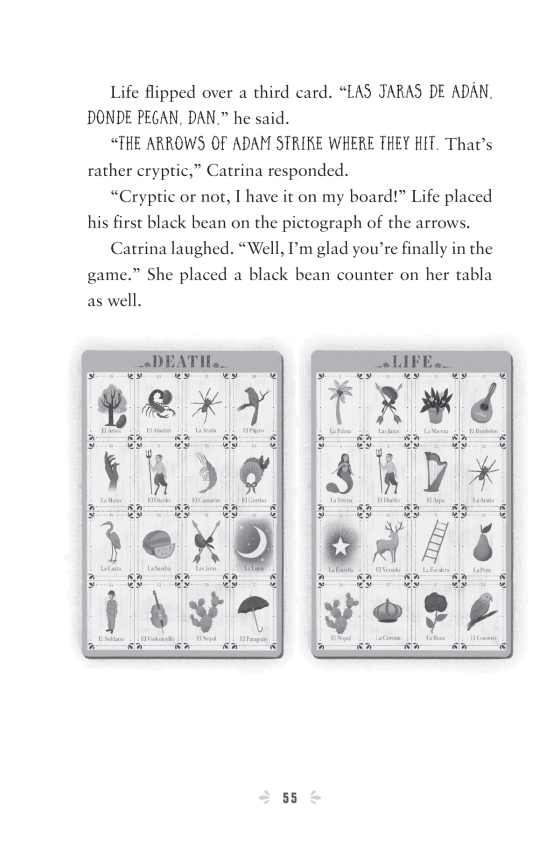
Each player has set before them a placard with a different image printed one each of the sixteen squares. (Here are some you could print for a class) Beside this the players have a set of fifty-three cards (here are a set to use with the game) each with a different image and the players also have a handful of frijoles - small beans as black as night. Lady Death and Life take turns to flip the cards and find matching images on their own placards - a bit like bingo (but this game might not have a happy outcome). 

The cards contain sayings that need to be interpreted such as EL QUE A BUEN ARBOL SE ARRIMA BUENA SOMBRA LE COBIJA - He who approaches a good tree is blanketed by good shade. Lady Death places a bean on the image of a tree on her tabla. 


Catrina and Life begin their game. A scorpion hides in Clara's sketchbook emerging as she shares her dragon drawing at a family picnic; nearby a young boy is trying out his new bow and arrow; Estaban's mother, a healer, rushes home for some herbs to help with the scorpion sting; at that moment the boy unleashes his arrow. These are the awful events that create enormous grief. Estaban has already lost his father and now his mother. When a stranger arrives, rather like the Pied Piper, Estaban believes he will be taken to see his mother. He can hear her singing. He follows the man in the red coat into another world.

Clara has promised to keep her young cousin Estaban safe and so she follows them into this dangerous and unpredictable place. Clearly the man has evil intentions but why does he want this young boy? As you might suspect this is all about power but you might be surprised to learn it is also about the elixir of youth. Yes, this sounds complex and it is, but it is also utterly riveting. 

One thing Clara has to do to survive and to find her cousin, is work out the bargaining system. At one point she meets a fawn hiding from some hunters. He will tell her how to climb through some impenetrable vines in exchange for colour - the colour of her hair! Pages 140-143 in my paperback copy could be a fabulous section to read aloud as a book talk to a group of students. 

The descriptions in this book are fabulous - they would be wonderful to use with a writing group:

"He looked quite dapper in his black suit and matching vest, with a crisp white shirt and the tiniest hint of red peeking out of his jacket pocket: a crimson handkerchief, monogrammed."

"Two fig trees heavy with fruit flanked the entrance to the path. Ceramic pots of various shapes and sizes lined the way. Some held tall and spiky cacti, while others boasted flowering plants with buds of yellow and orange; a pair of succulents grew in a rooster shaped pot."

"As she spoke, she plucked a petal off her crown and released it into the air. The petal folded into a rose-scented butterfly."

"The baby deer has left its hiding place and now stood behind her. It was completely white, a bright beacon against the greens and reds and yellow surrounding them. Its large black eyes gazed at her openly."

"A waterfall roared down the side of the cliff into a pool of clear water that branched off into dozens of canals. The canals snaked along the jungle floor toward fountains carved in the shape of mermaids or fish or outstretched hands with fingers reaching upward."

This book is filled with Spanish food and words but you will have no problem working things out. There is no glossary but this book does have a useful set of notes at the back. I did look up one important word: El diablo - the devil (the man in the red coat).

Loteria is a totally engrossing story. I know the bravery of Clara and the horrible scene where we discover why the boy king has taken these children will linger with me for years to come. This is another one of those books where I marvel at the imagination of the author.

You can read the first nine chapters here. The publisher - Random House Kids suggests ages 8-12 for this book but I would say it is for 11+. I have labelled it as Young Adult because a loved character does die very early in the story and the fate of Clara and her young cousin Esteban is a very complex one - not something a young reader would understand. Also, this book is written using a sophisticated vocabulary, and it is, as I said, filled with Spanish expressions and food. The scene with the enormous spiders when Clara is tossed into the underground prison are truly frightening. (Chapter 28).

Publisher blurb: In the hottest hour of the hottest day of the year, a fateful wind blows into Oaxaca City. It whistles down cobbled streets and rustles the jacaranda trees before slipping into the window of an eleven-year-old girl named Clara. Unbeknownst to her, Clara has been marked for la Lotería. Life and Death deal the Lotería cards but once a year, and the stakes could not be higher. Every card reveals a new twist in Clara’s fate—a scorpion, an arrow, a blood-red rose. If Life wins, Clara will live to a ripe old age. If Death prevails, she’ll flicker out like a candle.  But Clara knows none of this. All she knows is that her young cousin Esteban has vanished, and she’ll do whatever it takes to save him, traveling to the mythical Kingdom of Las Pozas, where every action has a price, and every choice has consequences. And though it seems her fate is sealed, Clara just might have what it takes to shatter the game and choose a new path.

Read some review comments on Karla Arenas Valenti's web page. Here's the Horn Book review. And here is a radio interview with the author. Here is a set of excellent discussion questions. See the cover being made here. And here is an interview with Betsy Bird - she loved this book too. And finally here is another interview from the blog - From the Mixed-up files