Showing posts with label Perception. Show all posts

Sunday, March 30, 2025

A Horse Called Now by Ruth Doyle illustrated by Alexandra Finkeldey


The horse is named Now and she is very wise. When the farm animals rush up to her full of worries she gently questions their fears. The Rabbits are sure a Fox chasing them but Now suggests they stop and look around. Can they see the Fox? No. Perhaps they should just enjoy some dandelions. Hen is sure the Magpie is after her chicks. But Now suggests she should look up. Can Hen see a swooping bird. No. 

"At this moment all is well. Why don't you search for some juicy grubs?

The Sheep is also very afraid but Now reassures her she is quite safe. Then a thunderstorm arrives - nothing to worry about - Now leads them all safely into the barn. Oh no - there are animals in the barn - are they scary? No. It's an old Fox, Magpie and a small puppy. 

"Now told the others. 'There's nothing to fear. Fox is looking somewhere warm to rest, Magpie only wants to collect shiny things and the Farmer's new dog is just a puppy, scared of the storm."

Anxiety is often about the 'what if' scenario. The animals express this as 'might'.

"... it might be his scarlet coat .... it might be his huge tail that trails fire ... he might sneak up ..."

"Magpie might have a beak as sharp as a famer's knife ... she might have wings that wrap and trap us"

This book could be quite didactic, but it is not. You could use this book to talk to young children about fear, anxiety, perception of danger, and point of view. I recommend you add this book to your school library. Nosy Crow consistently produce terrific books. 

The illustrations are also beautiful. A Horse Called Now was published in 2024 and it is available in paperback for a very good price.


Most mindfulness primers are a list of directives; this tale has the slow-moving grace of a fable. Kirkus

Doyle’s prose is beautiful and descriptive, introducing young readers to a lovely and sophisticated use of language through onomatopoeia, similes, and a rich vocabulary. Finkeldey’s expansive illustrations lend a vintage charm ...  School Library Journal

A Horse Called Now beautifully encapsulates the journey of overcoming worries and embracing the present moment. ‘When I’m afraid, I breathe in and out and let the feelings come . . . and then go. Nothing lasts forever.’ In today’s world, mental health awareness is paramount, especially for young children. The story instils the notion that it’s perfectly alright not to feel okay at times, and that seeking help is a commendable action. Through its narrative, A Horse Called Now emphasises the significance of friendship and support networks. Just Imagine

Here are two other books by Ruth Doyle:


Alexandra Finkeldey is a freelance artist based in Kingston, Canada. Her book titles include:  On a Mushroom Day by Chris Baker (Tundra Books, 2024), Saving the Spotted Owl by Nicola Jones (Kids Can Press, 2023), The Boy, the Cloud and the Very Tall Tale by Heather Smith (Orca Books, 2023), When the Storks Came Home by Isabella Tree (Ivy Kids, 2022) True Stories of Animal Heroes: Talala by Vita Murrow (Frances Lincoln, 2021). 


Thursday, May 16, 2024

Albert's Tree by Jenni Desmond

Never, never underestimate the power of a great story twist! And appealing illustrations and brilliant end papers. This book has it all. Jenni Desmond - well done!

Look at that face on the cover. Bear looks so content. We can guess he has found HIS tree! 

"Spring had arrived and Albert woke from his long sleep. 'Horray!' he shouted. As the snow was quietly turning to water and trickling down from the mountains, Albert raced to his favourite place. His tree."

This tree is perfect. Not too hard, soft, slippery or prickly. This is a place of peace and quiet.

BUT all readers know that at this point there is sure to be a complication. And yes, there is. Albert hears a noise. It sounds as though his tree is crying. Albert decides to ask his forest friends. Rabbit explains that digging holes makes him happy so the pair of friends dig lots of holes but the tree keeps crying. The Caribous suggests gathering lots of grass because it is delicious to eat but the tree keeps crying. The crying becomes louder and more intense.

Bear is at a loss what to do so he climbs his tree and he "gave the tree a huge, kind, bear hug." There are ten more pages in this book but I don't want to spoil the surprise. Bear does make a discovery about his tree but I am certain you will never guess the truth. This is a book you should add to your read aloud list. It would be perfect to share with a preschool group.

The picture book is as cozy and familiar as a teddy bear’s embrace, but smart touches elevate the story. They include vignettes against white space that contrast beautifully with more detailed and colorful spreads that give a wider view of the world around Albert. And by naming Albert alone of the characters, Desmond keeps readers’ sympathies squarely on the well-meaning mammal. If that weren’t enough, the endpapers include a lovely cutaway view of underground hibernation and a hilarious offhand joke that add beauty and charm, respectively, to an already endearing effort. There are lots of children’s books about cute bears who talk like people, but few are as cleverly put together and as witty as Albert’s little adventure. Kirkus Star review

Here are some other books by Jenni Desmond:


I have previously talked about these:


Monday, April 8, 2024

The Teeny-Weeny Unicorn by Shawn Harris

Begin with this post by my friend from Kinderbookswitheverything - I confess I was one of her library customers who asked about this book not knowing it cost almost AUS$40 - which is way too high for any school library to consider.

In this video Colby Sharp talks enthusiastically about this book.

I think The Teeny-Weeny Unicorn could be fun to read aloud mainly because the words 'teeny-weeny' are such fun to say. This book does have a 'message' but the funny parts of the story and the soft-focus illustrations along with the delicious twist at the end mean the moral "we are all just the right size" does not feel too heavy handed. There is also a satisfying structure to the story when the galloping, cantering, trotting and walking page is repeated.

Teeny-Weeny is bullied by his huge siblings. I love their names and wonder in a different context if they themselves might be subject to some bullying! - Fancy Annie and Prince Butterscotch. They use him as a piece in their giant chess game and tease him about being too small to swim in the castle moat. The mother and father unicorns never intervene and so finally Teeny-Weeny runs away! He accidentally steps onto, and crushes, a car belonging to a gnome. She is not happy. Note the gnome is a girl or a lady! And suddenly Teeny-Weeny is BIG. 

"Oh,' said the teeny-weeny unicorn. 'I'm sorry.'
'Sorry doesn't feed the bullfrog,' she said, trying to catch her breath."

The gnome demands $250,000 as payment for her broken vehicle. Luckily the Unicorns live in a castle filled with gold left by the previous owner. (You could talk to your class about this reference - hint I am thinking of dragons).

I won't want to spoil the final twist, but I will say the gnome now needs transport for all this treasure and you will remember two very large unicorns live in the castle!

One more thing - the preamble to this story really sets up the fun:

"Once upon a time, in a land where horses were mythical beasts, found only in the pages of books for children, it was common to see a unicorn. But not one this size."

At last! A unicorn book as charming as the species it highlights. Kirkus Star review Facial expressions and visual gags complement the text perfectly, all thanks to Harris’ particular skill with chalk pastel.

The book’s ultimate thesis is made clear by the droll narrator’s conclusion - “We are all teenyweeny. We are all giant,”—and the relativity of both size and wealth is driven home with a particularly hilarious close-up of the gnome, sporting some cool shades and lounging among coins and dollar bills. Harris’ chalk art is smudgy and vibrant, playing, quite appropriately, with size and perspective as the teeny-weeny unicorn explores his world. Bulletin of the Center for Children's Books

Shawn Harris (click this link to see inside The Teeny-Weeny Unicorn and here is a video of Shawn) is an award-winning creator of books for kids. His authorial debut, Have You Ever Seen A Flower, was called a “stunning tour de force…” by The New York Times, and was the recipient of a Caldecott Honor. The National Museum of Wildlife Art awarded Shawn’s cut-paper art in A Polar Bear in the Snow (by Mac Barnett) the Bull-Bransom Award for excellence in the field of children’s book illustration with a focus on nature and wildlife. Harris has illustrated a number of other books, including Her Right Foot by Dave Eggers, and Everyone’s Awake by Colin Meloy. He also illustrated The eyes and the Impossible. 


The size and perception issue in this book reminded me of this wonderful older book which sadly is long out of print.


Sunday, March 10, 2024

They all saw a cat by Brendan Wenzel

Begin with the title - what do you think of when you see a cat? Does it depend on the type of cat? The size, the colour or the location. Now turn to the end papers. The front ones look like messy fur and the back ones are the same fur now smooth and perhaps sleek. On the title page we see the bell - can you see it on the cover? For many animals this bell will be a warning that the cat is coming - that the cat is close - and this is especially an issue if you are prey to the cat such as a mouse! But what about the flea - does he care about the bell?

"The cat walked through the world, with its whiskers, ears, and paws ..."

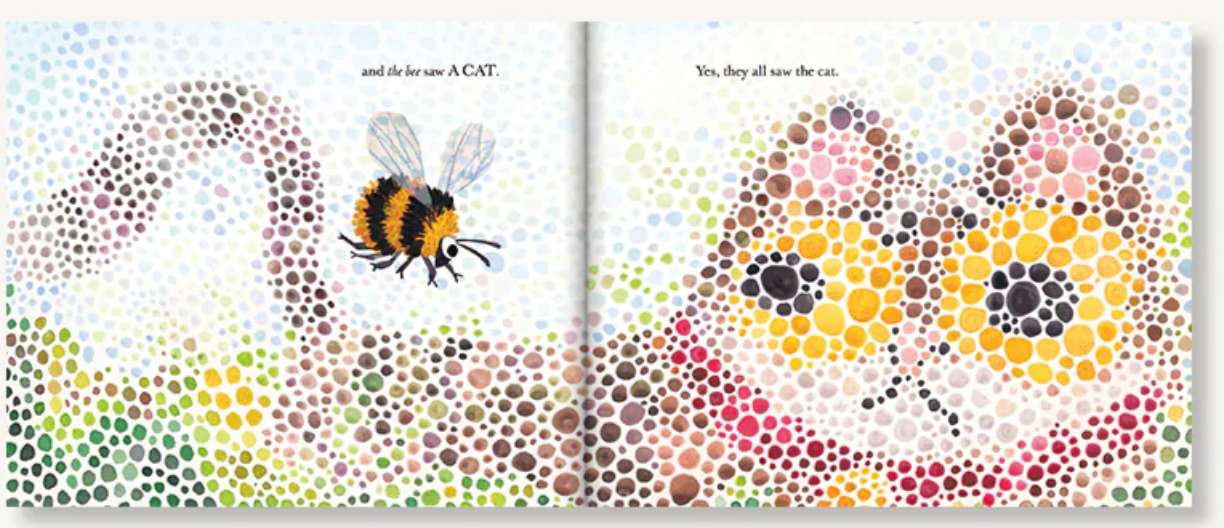
The cat is seen by a child, a dog, a fox, a goldfish, a mouse, a bee, a yellow bird, a flea, a snake, a skunk, a worm and a bat but they all see something different. Finally the cat reaches a pond and looks at its own reflection - what does the cat see?

Here is what the bee sees:


Bookseller blurb: The cat walked through the world, with its whiskers, ears, and paws . . . In this glorious celebration of observation, curiosity, and imagination, Brendan Wenzel shows us the many lives of one cat, and how perspective shapes what we see. When you see a cat, what do you see?

They all saw a cat was published in 2016 and the paperback edition in 2020. It was a 2017 Caldecott honour book and won a Giverny Award in 2020. It is also a featured book in the Empathy Collection.

Along with inviting more reflective viewers to ruminate about perception and subjectivity, the cat’s perambulations offer elemental visual delights in the art’s extreme and sudden shifts in color, texture, and mood from one page or page turn to the next. Kirkus

Like the very best of books this gives the reader pause for thought and remains in the mind long after the pages are closed. It instills a sense of wonder at how wonderful our planet is with all its different forms of life. A philosophical and beautiful picture book. Book Murmurmation

Let us do away with the notion of “cat people” vs. “dog people”. This book is for “people”. End of sentence. ... That tired old phrase to “walk a mile in someone else’s shoes” makes no sense to a kid. But travel a page through another animal’s eyes? There’s never been a better fictional picture book that allows you to do this. If we all see something as simple as a cat this differently, what else might we not see the same? It’s a treat to eye, ear, and mind, but don’t forget. We’re all going to see this book through our own lenses. What will your kids see when they look at it? Only one way to find out. Betsy Bird School Library Journal

Here is the webpage for Brendan Wenzel. Here is an interview where you can see more of the images from this book and read about the inspiration. 

They all saw a cat should be in every school library - Primary and Preschool. 

The companion book Two Together will arrive in Australia in June, 2024.


Cat and Dog are headed home. A simple route lies ahead of them . . . or does it? There’s so much to see and smell and hear, and the two of them experience the world very differently. A stream, for instance, is watery fun for Dog, but it may not be so delightful for Cat! As their journey becomes an adventure full of unexpected twists and turns, Cat and Dog show that it’s possible for two creatures to travel in the world together despite their distinctive perspectives and abilities—and even to appreciate and enjoy them.


Sunday, November 26, 2023

Tyger by SF Said illustrated by Dave McKean


When you see the cover of this book do you immediately think of the famous poem - that's good because the words of the poem are sure to resonate as you are reading this riveting novel by SF Said.

Tyger Tyger, burning bright, 
In the forests of the night; 
What immortal hand or eye, 
Could frame thy fearful symmetry?

In what distant deeps or skies. 
Burnt the fire of thine eyes?
On what wings dare he aspire?
What the hand, dare seize the fire?

And what shoulder, & what art,
Could twist the sinews of thy heart?
And when thy heart began to beat.
What dread hand? & what dread feet?

What the hammer? what the chain,
In what furnace was thy brain?
What the anvil? what dread grasp.
Dare its deadly terrors clasp?

When the stars threw down their spears 
And water'd heaven with their tears:
Did he smile his work to see?
Did he who made the Lamb make thee?

Tyger Tyger burning bright,
In the forests of the night:
What immortal hand or eye,
Dare frame thy fearful symmetry?

There is the most amazing dystopian world in this story. It feels like we are in London but this is a divided city. Rich people separated from poor. Migrants separated from - well I am not sure what to call the people who claim they have always lived in this city - especially since Adam was born in the city and so was his friend Zadie but they do not have the same rights as others because their families come from the "Middle East". Think about those words - the "Middle East". What does that mean? Adam is Muslim and Zadie has dark skin but why should that matter? Yet every day, as he does deliveries for his parents of garments from their shop in the ghetto, he has to stop at a check point and answer questions by a soldier.

"The soldier was a guardsman in a red coat, with a bristling white moustache. He looked Adam up and down, taking in his skin, his hair, his eyes. The fact that everything about him was just a little different, just a little darker. ... 'And where are you from, boy?"

Love Reading for Kids explains the setting: In this alternate universe slavery was never abolished, which has left the UK in a sorry state with rich overlords ruling over a sprawling poor and people with origins anywhere apart from the UK particularly vulnerable to abuse and exploitation. That includes Adam’s family of shopkeepers.

When Ben crosses to the other side of the checkpoint. He bumps into a man who leads him to a remote area intending to rob him but then a huge creature appears. It is the Tyger. 

Here is a text extract from Chapter two - you could use this in a book talk with your students:

And then something erupted out of the darkness, moving so fast, he saw only a blur at first. A streak of black and gold, leaping down from the roof beams to land on all four paws beside him.
An animal! A gigantic animal stood by his side, growling at the man with the knife. With one huge stride, she put herself between him and Adam. Then she threw back her head and roared, as if protecting Adam from the knife. The man screamed. He ran. He fled through the door he’d come in by and was gone. Adam couldn’t run. The animal still stood between him and the door. He could only stand there, staring at her, his senses filling with a sweet, high, musky scent, like honeysuckle growing wild. In her presence, everything else just melted away, even his fear. His skin was prickling and his eyes were wide. But inside him was a feeling stranger than fear. For this animal had come down from the darkness to defend him. Why?

And . . . what was she?
A flash of lightning revealed more of her form. She was ten feet long from her whiskers to her tail. So broad, she filled the doorway. Her fur was fiery gold with coal-black stripes. Time seemed to stop as she turned to look at Adam, and Adam looked back at her. He couldn’t look away. He’d never been so close to any animal before, let alone one so huge and wild. Her eyes burned like liquid golden fire. They were shining with a light that was different to any light he’d ever seen. Yet he thought he saw pain inside them, too. And now that she was facing him, he could see that she was wounded. There was blood on her fur, between her stripes, dripping wet and red. He breathed in sharply. Whatever she was – this animal was wounded. She shuddered as a blast of thunder shook the building. She turned and snapped at something over her shoulder, then growled when she couldn’t reach it. As she twisted and turned, Adam crept round to one side – and froze as he saw the shaft of an arrow, sticking out of her shoulder. On the other side, he could see the arrowhead. 

Ben helps the Tyger but now he is caught up in the danger of the situation. An evil man named Maldehyde is hunting Tyger. Why? I am not going to explain this - except to say be ready for a wild ride of twists and turns and danger and courage. There are some confronting scenes in this story so I would say it is for mature readers. 

I don't normally quote endorsements but these all ring so true for Tyger:

  • 'An out-and-out-masterpiece' Piers Torday
  • 'Next level excellent . . . This book is a gem' Malorie Blackman
  • 'A masterpiece' Frank Cottrell-Boyce
  • 'Profound . . . A triumph' Jacqueline Wilson
  • 'Perfection' Sophie Anderson
  • 'Beautiful, brilliant, perfect!' Peter Bunzl
  • 'A timeless classic' Sita Brahmachari
  • 'Visionary & exciting & hopeful & deeply-dreamt & truly-lived' AF Harrold
  • 'A glorious triumph' Berlie Doherty

This book has been on my to read list for a long time (since October 2022) but I needed to wait for the paperback edition to arrive here in Australia. I need a word to describe a book so wonderful that I read it in almost one sitting. So wonderful that I read it at 2am. So wonderful that I wish I could immediately pass this onto a reader aged 11+. 

Here is a video with SF Said. Please read this interview where SF Said talks about his book - here is a quote that resonated with me:

There are times I feel extremely doomy and apocalyptic. But there are times I’m extraordinarily moved and inspired to see the work that people are doing to build a better world. And that starts, for me, with children and the books they read, and the stories that fill their imaginations – the work I see teachers, librarians, booksellers, reading helpers, journalists, readers of all sorts, doing – there’s a lot of people working very, very hard, every single day, to inspire kids to love reading and books, and to get them the best possible books, the widest range, the most diverse, inclusive kinds of books, so that every child could see themselves reflected, so that every child can feel they could be a reader.

SF Said is the author of Varjak Paw - another book I adored. My blog post from 2009 is way too brief. Sometime soon I reread the two Varjak Paw books and pen a longer blog post.


Wednesday, October 18, 2023

Seven Blind Mice by Ed Young


Let's look at the title - Seven Blind Mice.  Seven is the perfect number to use giving the structure the days of the week which is a known pattern and will be enjoyed by very young children. Blind - the mice rely on touch which means the story has the extra delightful dimension that young readers will know more than the story characters. Mice - mice are small and the object of their interest is huge. Given their size it is understandable that they cannot get a full perspective and are only able to feel tiny parts of the whole.

Notice that the clever mouse, though, is the young girl. She is the only one who thinks to explore the whole beast not just a tiny part. This thing is not a pillar, snake, spear, rope, fan, or cliff.

The art in this book is also very appealing with the use of collage and full black pages. I talked in depth about Ed Young in a previous post. I am happy to see this book from 1991 is still available and in paperback.

Seven Blind Mice (1992), Young’s self-illustrated reinterpretation of an Indian fable, won the 1992 Boston Globe–Horn Book Award in the picture-book category and was selected as a 1993 Caldecott Honor Book by the American Library Association.

The mice might remind you of the ones created by Leo Lionni. Besty Bird mentions this in her podcast Fuse8n'Kate. 

This book is an innovative reworking of "The Blind Men and the Elephant" - an Indian folktale (see below).

Many years ago, a Kindergarten teacher asked me for some picture books that used days of the week as a story format. I did find some but not this one - which is just perfect. I have now added Seven Blind Mice to my Pinterest.

Here are some other books to link with Seven Blind Mice:


Here is the original poem:

here were six men of Hindustan,
to learning much inclined,
Who went to see an elephant,
though all of them were blind,
That each by observation
might satisfy his mind.

The first approached the elephant,
and happening to fall
Against his broad and sturdy side,
at once began to bawl,
"This mystery of an elephant
is very like a wall."

The second, feeling of the tusk,
cried, "Ho, what have we here,
So very round and smooth and sharp?
To me 'tis mighty clear,
This wonder of an elephant
is very like a spear."

The third approached the elephant,
and happening to take
The squirming trunk within his hands,
thus boldly up and spake,
"I see," quoth he, "the elephant
is very like a snake."

The fourth reached out an eager hand,
and felt above the knee,
"What this most wondrous beast
is like is very plain" said he,
"'Tis clear enough the elephant
is very like a tree."

The fifth who chanced to touch the ear
said, "E'en the blindest man
Can tell what this resembles most;
deny the fact who can;
This marvel of an elephant
is very like a fan."

The sixth no sooner had begun
about the beast to grope,
Than seizing on the swinging tail
that fell within his scope;
"I see," said he, "the elephant
is very like a rope."

So six blind men of Hindustan
disputed loud and long,
Each in his own opinion
exceeding stiff and strong;
Though each was partly in the right,
they all were in the wrong!


Wednesday, August 9, 2023

Bears don't cry by Emma Chichester Clark


The title of this book is sure to lead to an interesting discussion with your group of young readers. Should bears be allowed to cry? What might make a bear cry? What makes you cry? Is it okay to cry sometimes? Who might help you if you are crying? What do you thing the little girl might be saying to the bear? Flip over to the back cover. What is happening here?

This story is a sequel to an earlier book - Bears don't read.

Publisher blurb for Bears don't cry: George is no ordinary bear. He lives with a little girl called Clementine and her mother, who have taught him to read! One day, when George finishes his book early and knows it will be a long time before Clementine and her mother return home, he decides to go the library by himself. At first it’s exciting to stroll along the sunny street. But poor George’s trip soon ends in disaster and, to make things worse, his library book is ruined. Can anyone help George to feel better when his feelings are hurt?

In the first book George found a book then he found Clementine and her mother and he learned how to read. In this second instalment George loves living with Clementine's family and when they go out each day he is able to sit in the garden and read but on the day of this story he finishes his library book and so he decides to head into town to the library. Unfortunately none of the townspeople are used to seeing huge bears in the street and so everyone runs away in fear. George has no idea what is happening but then he slips on some fruit in the market and lands in the village fountain. The people all laugh at him but Clementine has something important to say about this:

"This is my dear friend, George ... He may be big but you have hurt his feelings."

As with all good books the final picnic scene back at Clementine's house with the librarian is sure to make you smile. 


Warning - if your library book falls into a fountain, as happened to George,  it really cannot be saved - I love that the librarian in this book offered to dry out the book but I think she was just being kind. 

Clever type design makes for easy reading, while lots of pictorial action adds drama to this tale that gently reminds readers not to judge by outward appearances. ... A sweet tale of a beloved bear defeating the tyranny of others’ expectations. Kirkus

Click on the name Emma Chichester Clark in my post labels to see more books by this wonderful UK author/illustrator. This story reminded me of this book:


Wednesday, August 2, 2023

Mina by Matthew Forsythe


Publisher blurb: Mina and her father live in a hollowed-out tree stump on the edge of a pond on the edge of a forest. Nothing ever bothers Mina, until one day, her father brings home a suspicious surprise from the woods. Should Mina trust her father—or listen to her own instincts?

This is one of those wonderful books where you, and more importantly your young reading companion, will know more than the characters. They might even be yelling at young Mina to alert her that her suspicions are correct and this huge creature dad has invited into their home is not a squirrel. Actually I want to write this again - this is NOT a squirrel!

Yes it is true squirrels are bigger than mice and yes they do have long bushy tails but ...  

When this huge animal just sits around Mina tries presenting it with a delicious acorn but this is ignored. Surely that is suspicious. Then horror of horrors her father brings home two more of these surprise creatures. Luckily they call on the doctor and he can see the truth perhaps because he has had an unfortunate accident some time in the past - you might notice he has a wooden leg. Was he once attacked by a cat? Oh no what can three tiny mice do when three enormous, yes they are cats, are set to eat them! The solution is certain to surprise and delight you.

See more work by Matthew Forsythe here. In this blog post you can read a very detailed description of Mina along with some ideas for sharing this book with a group of children. It is a good idea to read this book more than once and on your second or third reading pay special attention to the eyes of those cats - it is easy to 'read' their plans for those mice. 

Whichever way you think the story is going, it’s not, and Forsythe expertly subverts expectations with deadpan comedy and absurdist details that bring Mina’s tale perfectly full-circle. The Baby Bookworm

You can see inside Mina here. The end papers are fun - 


Awards for Mina:

  • 2023 Winner Wanda Gag Read Aloud Award
  • A 2022 Kirkus Book of the Year 
  • A 2022 Shelf Awareness Book of the Year 
  • A 2022 CBC Books Book of the Year 
  • 2022 Winner - Quebec Writers Federation Prize
  • 2022 Governor General’s Award Finalist
“This uniquely told, beautifully illustrated story manages to look directly at the big idea of parental fallibility—wrapped up with love and faith and trust—from such a distinctly child’s eye that we don’t even know it’s doing it.” - Jury’s Notes, Quebec Writers’ Federation

Ten years ago in 2013 I talked about another book illustrated by Matthew Forsythe:


Monday, February 8, 2021

I Feel a Foot! by Maranke Rinck and Martijn van der Linden


Turtle, Bat, Octopus, Bird and Goat are confronted with a huge creature. Each describe this monster from their own point of view. Turtle can feel a foot "just like my foot, but super big". Bat can feel a wing "just like my wing, but super big." Octopus is sure she is touching a tentacle, but extra super big. Birds find an extra superduper big beak and goat is sure the creature has a goatee which is "fantastically, amazingly extra superduper big."


What is the creature? Can you guess? What a shame I didn't discover this book last year. It links so perfectly with the 2020 CBCA slogan - Curious Creatures Wild Minds. I feel a foot was published in 2008 but an English translation in paperback was published in 2019. I was excited to read the publisher has plans to produce this book in a tactile format for blind children.


In this retelling of the familiar Sufi tale, a group of small animals meets a big new friend, one body part at a time. Kirkus Star review

I feel a foot was originally published in The Netherlands with the title Ik voel een voet! Take a look here at other books illustrated by Martijn van der Linden. Maranke Rinck is his wife. This is a book with wonderful illustrations which will inspire your school art teacher.

I would link I Feel a Foot with these:


Tuesday, June 16, 2020

The Seeing Stick by Jane Yolen illustrated by Daniela Jaglenka Terrazzini


Tuesday Treasure


Hwei - the lightless moon on the last day of the month
Ming - becoming luminous

Hwei Ming is blind. Her father the emperor offers a reward to anyone who can help her to see. Visitors come from all over the kingdom with prayers, potions, pins, incantations and spells. Nothing works. One day an old man hears about the blind princess.  He sets off on a long journey carrying a walking stick made from "a single piece of golden wood."

On arrival at the city gates the guards refuse him entry. He looks so ragged and poor. The old man reaches out to touch the faces of guards and then he sits down with his stick and his whittling knife. He shows the guards his carving of the journey he has made to Peking from his home to these city gates. The guards are entranced. His storytelling and carving are wonderful. They take the old man inside the city to show the guards at the gates to the inner city and from there he is taken to the door of the Imperial Palace.

The guards tell the emperor about the wonderful pictures carved onto the golden stick. Hwei Ming is sitting beside her father and she hears the story. She asks to see the stick.

"The old man leaned forward and petted Hwei Ming's head and caressed her cheek. For though she was a princess, she was still a child."  Placing his fingers on hers he helps her trace the stick and "see" the story. "And the princess' slim fingers felt the carved stick. Then he put her fingers onto his face and traced the same lines there. It was the first time the princess had touched another person's face since she was a very small girl."

This is a pivotal moment. Hwei Ming asks to feel the faces of those around her - the guards who are waiting close by and then her father, the emperor.

"She reached out and her fingers ran eagerly through his hair and down his nose and cheek, and rested curiously on a tear they found there. And that was strange, indeed, for had not the emperor given up crying over such things when he ascended the throne?"

You have probably guessed the rest of the story. The emperor gives the reward to the old man, the old man can now live in the Innermost City but he gives away the fortune in jewels. Have you guessed the most important thing about the old man himself?

Jane Yolen is the author of over 300 books. On her web page she talks about writing or retelling this Chinese fairy tale.

The illustrations in this book by Daniela Jaglenka Terrazzini are exquisite. They begin in black, white and grey but move to full colour as the old man shares his stories. Some of the richest pages are laminated giving them a beautiful texture reminiscent of cloisonne.

Image Source Books4yourkids

If you have been following my blog you will know my Tuesday Treasures are usually books that are now out of print. This edition of The Seeing Stick was first published 2009 and so it is out of print as is the earlier edition from 1977 which had illustrations by Remy Charlip and Demetra Maraslis.

I would pair The Seeing Stick with these: