Showing posts with label Urban life. Show all posts

Wednesday, March 13, 2024

Adoette by Lydia Monks

Stop - do not open this book - you need to linger over the cover. I failed to do this and assumed (completely wrongly or perhaps that was the author's intention?) that Adoette was the little girl - no no no - this is the name of the tree!

On the opening spread - which I assume is the end paper of the hardcover edition of this book - there is a sepia scene indicating this is long long ago. The woman is wearing a long old-fashioned dress and there are several horses with carts. A young boy, also wearing old fashioned clothes, is pointing to a tree. Spring is coming and the small tree has the tiny beginnings of new leaves. Meanwhile new buildings are being constructed and the brick layers are hard at work. 

Here is the next page:

"Do you remember when I first told you about Adoette? She lived on this street all of her life, until she was 100 years old. Just imagine all the changes she saw!"

"When Adoette was little this street was brand new. All the houses had just been built. There was no electricity and no cars. Lots of families moved in, and the street was full of children."

We watch the course of history as the pages turn - personal events like a wedding and major event such as the bombing of the city in World War II. Unfortunately, urbanization means people begin to complain about this tree which has grown quite large over time. There are parking issues, and issues with bird poo. It is time for community action. Some people protest to keep the tree others want it cut down. Sadly, the tree is cut down - on this page all we can see are a few remaining twigs and the huge tree stump.

"After Adoette had gone, the street seemed a much sadder place. ... The name Adoette means 'big tree', but Adoette hadn't always been big ... we wanted to do something to remember her by."

Perhaps you can guess the outcome.

Lydia Monks witnessed the destruction of trees in her town.

The seed for this ultimately uplifting book grew out of the author’s participation in a campaign to prevent the unnecessary felling of 10, 000 street trees in her hometown of Sheffield. Much of the story is shown in the immediately recognisable, detailed illustrations of street life through the ages. BooksforKeeps

Lydia Monks’s beautiful illustrations celebrate the importance of caring for nature and for each other by making time to look out for one another.  Love Reading4Kids

Here is a set of very detailed teachers notes. These teachers notes use the technique of reading the book without showing the cover - so the idea that Adoette is a tree will come as a surprise to your group.

Companion books (this could be a terrific mini theme for your library or classroom)


Thursday, February 22, 2024

The Great Stink by Colleen Paeff illustrated by Nancy Carpenter


I have decided I am not very good at asking questions. I need to be way more curious. I have been to London several times but it never occurred to me to ask about or research the word embankment. More about that in a moment.

This book begins in 1500. In London at this time sewers carry rainwater to rivers so the city won't flood. Poop or poo and pee go into deep holes called cesspools. When these become full it is time to hire nightsoil men who sell the poo (poop) to farmers as a fertilizer. Jump forward to 1819 and people are installing flush toilets. Some people connect their toilets directly to the sewer and so pee and poo now end up in the river!

The first epidemic of cholera hits London in 1832 and 6,563 people die. Problem is no one makes the connection between this catastrophe and the sewerage going into the river. The government believe the cause is in the air in pockets called miasmas. Oh no - now they order people to send their waste straight into the Thames. AND people are drinking this water too. Another cholera outbreak and 14,137 people are dead. 

Meanwhile a young man called Joseph Bazalgette takes on the job of mapping the sewers of London.

"The sewers are a disorganized, haphazard, higgledy-piggledy mess."

Finally, the authorities call for help - they need a civil engineer. Joseph is the chief engineer. He designs a system of gigantic sewer pipes which will move the sewerage out to the ocean. The debate continues into 1856. This scheme will be very expensive - too expensive. By 1858 the city is almost unlivable. The hot sun of summer adds to the stench - it is now the Great Stink! Finally, the parliament give approval for the building of the huge pipes.

"It is almost impossible for Joseph to find open space where he can build new sewer pipes without causing roadblocks, traffic and major headaches for Londoners. So in some areas he creates man-made riverbanks called embankments."

The final pages of this splendid book talk about the situation in our world today with the disposal of sewerage and also list alternate schemes. There is also a detailed timeline, further reading list and bibliography. 

Read a very detailed interview with Seven Impossible Things featuring Colleen Paeff and Nancy Carpenter. Colleen Paeff has other links on her web page. Here is a set of detailed teachers notes with science experiments. In this blog post Mr Schu talks to Colleen Paeff. 

This informative exploration of London’s sanitation history will delight nonfiction fans interested in history, ecology, biography, and more. Kirkus Star review

Back to embankments. You can read more here and here The story of London's embankment

As a part of their science or geography topic our Grade four students used to investigate waste disposal systems. I am not sure if this is still the case but I used to read quite a few books (some were very funny) about poo.


Here are a couple of videos you could use with a primary class:

Where does the water go? - Sewerage treatment Melbourne

How Do Sewer Systems Work?

A brief history of toilets TED (High School level)

Awards for The Great Stink:

  • 2022 Robert F. Sibert Honor Book, Association for Library Services to Children
  • 2022 Golden Kite Award for Nonfiction Text for Young Readers, SCBWI
  • 2022 Cook Prize Honor Book, Bank Street College of Education
  • 2022 Notable Book, American Library Association
  • 2022 Notable Social Studies Trade Book for Young People, Children’s Book Council
  • 2022 Texas Topaz Nonfiction Gem, Texas Library Association
  • 2022 Best STEM Books K-12, National Science Teaching Association
  • 2021 Best Informational Books for Younger Readers, Chicago Public Library
  • Junior Library Guild Gold Standard Selection

Saturday, September 30, 2023

Peregrines in the City by Andrew Kelly and Sue Lawson illustrated by Dean A Jones


"The tiercel hunts, searching for prey."


What is a tiercel? Where is this huge bird? Where does he take is prey? Is this the place you expect to find a nest?

"She settles back to incubate her clutch. Not all eggs may hatch and not all those that hatch may survive to fledge."

How long does it take to incubate falcon eggs? What does fledging mean?

"The tiercel arrives with the eyases' first meal. He strips meat from bone and delicately feeds the balls of wobbling fluffy down."


Some facts about peregrine falcons:

  • They live on every continent except Antarctica
  • The have a yellow ring around their eyes, yellow and feet with black talons.
  • The female is larger than the male.
  • They can reach speeds of up to 300km per hour.
  • Falcons eat pigeons, seagulls and other small to medium sized birds.
  • Falcons mate for life.
  • They lay eggs on high stoney ledges or cliff faces, in hollow trees and on skyscrapers.
  • Their nest is called a scrape, the chicks are called eyases.

This book is based on a pair of Peregrine Falcons who nested at 367 Collins Street in Melbourne back in 1991. In 2020 volunteers added raised nesting boxes to the ledge. The same pair have bred chicks since 2017. 

Publisher blurb: As urban development encroaches more and more on wild areas, many species have to adapt to survive. One species that has adapted to city living is the peregrine falcon. Falcons normally nest on high cliffs but in many cities across the world they can be found nesting on tall buildings.

The writing in this book is so powerful as evidenced by the poignant moment at the end when the three young birds leave the ledge and all that is left is one abandoned egg.

This is a fabulous book with such a striking cover. I well remember talking about peregrine falcons with all of the children in my school when Home by Narelle Oliver was short listed in 2007. 


I do wish this book had a glossary. I had to look up ‘tiercel’ and ‘gravel scrape’ and ‘eyases’.  I know some of these are explained on the falcon facts page, but I wanted a quick word list to refer to as I was reading. Here is a review of Peregrines in the City in Reading Time. And here are a set of detailed teaching notes. 

Peregrines in the City was a 2023 CBCA (Children's Book Council of Australia) Notable title (Eve Pownall - Non Fiction). I imagine it would have come close to short listing (6 titles) but was probably 'beaten' by Opal and Dart - a book with truly wonderful bird illustrations.


Recently I watched a video from the Evanston Public Library in Chicago where they also have had a pair of nesting falcons since 2004. Sorry the video on this page is not available in Australia. 

Friday, August 25, 2023

Crumbs by Phil Cummings illustrated by Shane Devries


A young girl and her dad have had a busy morning shopping and now they plan to eat lunch at some outdoor seating. While the girl waits for her dad to collect their lunch from the take-away counter Ella sees a little bird with only one leg. He is hopping around looking for crumbs but the people on the busy street either ignore the tiny creature or worse the shout or growl. At the same time Ella sees a man - read these heartfelt words by Phil Cummings:

"A man with prickle whiskers, wild hair and his life in a bag on his back came weaving through the flow of the crowd. ... Ella watched as the man sat and hung his head. His laden shoulders slumped like the broken wings of a storm-weary bird."

This man clearly has nothing but in a beautiful moment, when the sparrow hops over close to the man looking for crumbs, he reaches into his pocket and pulls out a crumpled bag. He pours crumbs onto his palm and the tiny bird hops up and gently (a perfect choice of word) eats the cumbs.

Ella's father has also seen the man and so, when he has collected their lunch, he walks across to the man, stretches out his hand and then leads the man over to their table to share their meal. 

This is a reassuring and compassionate story. The message in this book is clear but not heavy handed and the simple act of sharing lunch with a stranger will give readers room to imagine what might happen next.

The bird and the man both need food, and they are both obviously hungry and desperate, but the text has a quietness somehow, rather like the soft fog that surrounds the people in the street. The father and daughter clearly also have a very special relationship. 

The text is spare but filled with meaning such as when the father smiles kindly and then simply helps the man over to their table. So little is said but so much is implied.  I like the way Shane Devries gives the reader a different perspective as we look down on to the scene seeing the same view as the little bird. There are some exquisite phrases in this book – “a morsel was its gold”; “his life in a bag on his back”; “a smile shone from the deep shadows of his prickle-bush whiskers”. In the final illustration you can see Ella has given the man her scarf – a gesture which then gives the green spots on the end papers a much deeper significance. 

The colour palette used in this book conveys a sense of cold and bleakness which is essential to the overall impact of the story – we need to feel the cold ourselves, to understand the full desperation of the bird and the man. The cold colour backdrop also acts as a visual metaphor for human ignorance that the man and bird contend with every day. 

Crumbs was a CBCA (Children's Book Council of Australia) 2023 Notable title. I was a 2023 judge. We had over 200 books entered for this round of the award. Only 25 can reach the Notable list, then six on the short list and just one week ago the 2023 winners were announced. Check out my posts about My Strange Shrinking Parents; Paradise Sands; and Dirt by Sea

Companion books:


I have not read this book illustrated by our IBBY Hans Christian Andersen Award winner Robert Ingpen but a couple of readers have mentioned the link with Crumbs.


Shane Devries has illustrated another book by Phil Cummings - Boy. This book has been added to the prestigious IBBY Collection for Young People with Disabilities


I have happy memories of Phil Cummings visiting my rural school library in about 1989 just after he released his book Goodness Gracious (illustrated by Craig Smith). That book was a terrific one to read aloud to Kindy. I also loved sharing and recommending Marty and Mei Ling (illustrated by Craig Smith). This still is the PERFECT book to share during Harmony week here in Australia.


Tuesday, July 11, 2023

The Concrete Garden by Bob Graham


Amanda and her mum live on the fifteenth floor of an enormous apartment complex. Heaps of kids live in this building. Today is the day, after "a cold, hard winter", that the doors have been opened and so everyone jumps in the lift and travels down from their apartment homes to enjoy running and playing outside. It is true that their playground is just a large area of concrete but there is so much these kids can do there - ball games, bikes and scooters, and running and jumping with their dogs.

"Children spilled out like sweets from a box."

I love the image conjured by this phrase - happiness, surprises, colours, sweet times ahead.

Amanda is carrying a huge box. It is filled with chalks of every colour. She sets her box down on the ground and draws an interesting picture. If you share this image with a group of children I am sure they would have lots of ideas about Amanda's drawing and also creative ideas about how to add to this image to make it into something even more interesting or perhaps surprising. In fact that is exactly what Jack does. He picks up some green chalk and adds stem and instantly Amanda's picture is a dandelion.

Gradually the enormous picture grows. Every child has something to contribute. You can see some of the children's chalk ideas on the book cover. Bob Graham, as always, paces the page turns perfectly building up our anticipation until just past halfway when the full picture is revealed. 

"Someone drew butterflies, balloons, a caterpillar, and a bumblebee passing by. A beautiful exotic garden spread across the concrete."

From her balcony high up in the building Nasrin sees the wonderful picture. She snaps a picture on her mobile phone and sends it to her mother in Isfahan, Iran.

"With a tear in her eye, Nasrin's mother then sent it to everyone she knew."

The image travels across the world including to the apartments above the concrete plaza where the children have been drawing. The residents finally look out of their own windows, and everyone applauds - someone even throws down some flowers. The children have drawn the most amazing scene in the area below their huge, towering apartment building. It is a joyous moment. Days later though, (spoiler alert) it rains and the picture is washed away.  Once the rain stops, the children once again "burst from the building". Will the children draw another huge piece of art or are there other ways to play? 

Bob Graham gives the kids terrific names - Janet Fairly (it is so true some kids are always known by their full name); the Bradley twins; Lovejoy; Luke's dog Alfie; Indira; Cecilia; Arthur; Rosie and of course Amanda.

I really appreciate the way Bob Graham didn't give his story any hint of magical realism. Creating their chalk drawing has filled these kids with joy but Bob has not been tempted to recreate the famous scene from Mary Poppins and have the children jump into the picture to bring it to life. During Covid 19 lots of children drew games and pictures on sidewalks near their homes. You can see this idea on the cover a very old book by Bob Graham - Charlotte and Henry.


This sweet story - The Concrete Garden - celebrates simple things such as playing, having fun, cooperation and creativity. At no point does anyone ask Amanda if they can use her chalk - she has clearly bought it along to share. We are also left to guess how it is that mum had this huge box of chalk which is given to Amanda as she steps into the lift on the first day the children can all go outside to play. 

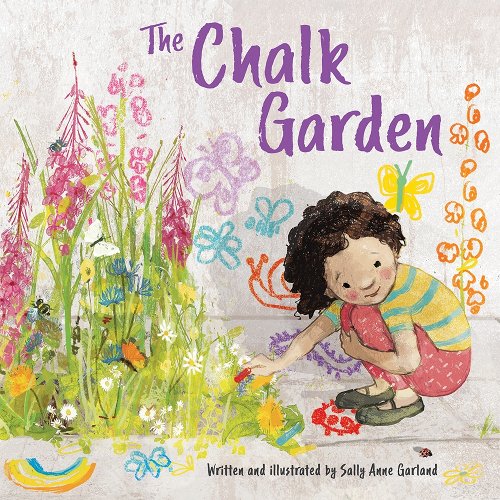
Take a look at other chalk books and a great idea for using this book with your classes from my friend at Kinderbookswitheverything.

Bob Graham is quite famous for his wonderful end papers but he has kept them quite minimal in his newest book (due for release August 2023). He does, however, begin the story on the page before the title page and then continues with a wordless story right across the double spread of the imprint page and title page. We see the kids all bursting out of the lift with so much excitement you can almost hear their laughter. Bob Graham pulls out all the illustration tricks as you would expect - full page spreads, small framed images, a birds-eye view (complete with a huge bird), and lots of glorious white space. And of course there are lots of tiny details that require close inspection and revisiting.

Walker Books: After a cold, dark winter, doors opened. Children spilled out like sweets from a box. Amanda was last one out of the tower block. She brought some chalk with her. On every inch of the concrete outside, the children drew pictures of everything they could think of, from flowers and snails, to spaceships and queens. Before long, a beautiful and exotic garden spread out across the concrete. From master storyteller Bob Graham comes a charming, and gently post-pandemic story about finding optimism after a dark spell, and the nurturing power of community friendships in an urban setting. The Concrete Garden will resonate with anyone who has been apart from their loved ones, and will encourage us all to find the brightness and colour within ourselves.

Bookseller blurb: Bob Graham’s heartwarming tale, The Concrete Garden follows Amanda and the other children as they burst from their tower block, armed with chalk and brimming with creativity. With pictures of everything from flowers to spaceships adorning the once drab concrete surroundings, a beautiful garden springs to life. This gently post-pandemic story celebrates the power of community and friendship to nurture optimism in dark times, and inspires readers to find their own inner brightness and colour. It’s a must-read for anyone who has experienced separation from loved ones.

In this book, The Concrete Garden, Bob Graham revisits the themes of A Bus called Heaven where, in a similar way, the small actions of a child lead to wonderful community connections. 


Other connections: The urban scenes in The Concrete Garden also echo the family travelling in the lift in Oscar's Half Birthday. Bob Graham also celebrates imaginative play in his book Libby, Oscar and Me and gardens in his books The Wild, Rose Meets Mr Wintergarten and Pearl's Place.

I was lucky to borrow this book from the library where I volunteer at Westmead Children's Hospital here in Sydney. I will now need to buy my own copy as I have a plan to own 'every' book by Bob Graham.

Here are some other picture books about drawing with chalk.


Friday, March 24, 2023

Grace Notes by Karen Comer


The only reason I gave this book four stars is because it has a very Melbourne setting and so I am not sure how well it will be understood in other parts of Australia and this probably limits sending the book to other English speaking countries. 

On the other hand this book is a splendid study of our modern times as we all negotiated Covid-19 and lockdowns, and daily government updates, and possibly even the death of a loved one. I do wish I could give it five stars because I found this story utterly engrossing. 

Grace is the third daughter in a high achieving family. Her father plays the violin beautifully but he gave up his dream to be a musician and became a communications trainer. But music is in her soul just as it is for her grandmother Ettie who was one a member of the symphony. Her mother is an international lawyer and as the story opens she has left for Italy. The date is 28th February, 2020 and the world is becoming concerned about a virus in China. Listen to the music Grace plays with her dad

Crux (James Michael Cruz) is an artist - he uses spray cans to create his huge works but for now he is limited to art on the garage wall because he is not allowed to buy spray cans until he is eighteen. His work is not tagging it is art. His father is a television cameraman so he is right in the thick of daily updates and news about Covid. He is also a youth counsellor. His mother loves crystals but she works as a nurse and so is all caught up in all the Covid panic, procedures and confusion.

Crux sees a YouTube video of Grace with her violin. He is invited by some street artists to assist with a huge commission piece in the city and when one guy fails to turn up, the other invite Crux to paint the violin girl.

This story is told in two voices, and it is a verse novel so it is filled with emotion. It is obvious from the beginning that Crux and Grace will meet but they will also have to navigate parents and the pandemic. The title has two meanings - grace notes are a part of music - optional but important and often beautiful. There are lots of notes in this book as Grace and Crux negotiate their new relationship, friendships and parents. They need to draw on grace to accept rules and change. They also have to convince their parents that even though they are both only fifteen they are old enough to make their own life decisions. 

"My violin always feels warm,

like there's still a breath in it

from the spruce trees,

from the maple tree,

living wood

cut down, carved out

to create a stringed voice.

There's still a life-force that sings

that can't ever be suppressed,

even when my violin lies alone in its case."


"Mum never let us wear

Disney princess dress-ups.

She never let us read

the pink-and-purple-coloured books

-a dozen in a series - 

with stories

about princesses who waited for princes

to rescue them.

So when we played princesses,

we rescued princes but refused to marry them,

fought dragons with homemade swords ... "

Huge thanks to Beachside Bookshop for my advance copy. Grace Notes was published on 1st February, 2023. I highly recommend this book as a terrific addition to a High School library especially one in Melbourne or Victoria but perhaps in other parts of Australia too. I'm sure teenagers will know the name Dan Andrews and many will vividly remember zoom lessons and lockdowns and even the toilet paper stampedes. 

I can’t recommend this stunning debut novel highly enough. It explores the challenges imposed by the pandemic but is also a beautiful rendering of how much we need art to sustain us during tough times. This highly accessible story will inspire readers to think about art and its role in society. For ages 12+. Readings Melbourne

"Six days later Dan the man is up for his presser,

North Face jacket,

grim determination on his face.

I watch him from my laptop in bed,

still in my pyjamas ...

I already know what he's going to say.

He will tell Victorians,

the deflated Victorians,

the number of cases 

in the preceding twenty-four hours - 274 -

the number of death in the preceding twenty-four hours

from coronavirus - 

nine."

"Mum's face has almost permanent lines

from her PPE.

The AFL players catch planes with their families.

play footy for us.

We judge daily numbers

on whether Dan Andrews

is wearing his North Face or his suit.

We are over sourdough bread."


Thursday, March 23, 2023

Neighbors by Kasya Denisevich


If you have children in your or library who live in an apartment building this would be a great book to share. And if the children live in free standing houses this might give them some idea about the differences other children experience from living in a building with lots of other people in homes that may look exactly like yours. 

I listened in to a library session with a kindergarten group in a school library today. The Teacher-Librarian asked the young children if they knew their address. Strangely very few children could repeat their full address (which is kind of scary if they were ever lost or needed to tell an authority person such as the police exactly where they live).  In this book the young child is moving to a new address:

"I know my new address by heart. 3 Ponds Lane, building 2, apartment 12."

The young girl is happy to have her own room but she also wonders about the people who live above, below and beside her. On one spread we see the real neighbors and then on the next page wonderful possibilities from her imagination. Do Snow White and her seven dwarf friends live on the floor above? Perhaps a mermaid lives on the top floor. You might also spy Cinderella's coach, three princesses enjoying dinner and a unicorn. The little girl has not yet met anyone and she begins to wonder if perhaps she is really all alone in this huge building. Luckily early the next morning as her mum walks her out their door she sees another young girl - the girl next door - and she is also heading to school. 


The art in this book is wonderful. Black, white and grey tones with spot colour of red and yellow. 

Denisevich’s fine-lined ink drawings are beguiling, and there’s a lot of detail to pore over here. It’s a book for lingering. She uses color, sparingly, to great effect. The grayscale illustrations pop with subtle spots of red, including occasionally in the text, to represent our narrator. It is not until her day of school that we finally start to see shades of other colors, including a sunny spot of yellow for a new friend in the hallway—and then in the blossoms of trees as they walk to school. The book’s endpapers—the tiles of the building’s hallway—also play cleverly with color.  Seven Impossible Things Before Breakfast

Kasya Denisevich is a Russian-born author and illustrator now living in Barcelona. Her work has been featured in the 2017 Bologna Book Fair Illustrators Exhibition. This is her debut picture book. 

I would pair this book with:


Friday, January 27, 2023

The Way of Dog by Zana Fraillon


"They say Cats have nine lives.

What I'd like to know as I tumble through the Sky

is how many lives do they say

a Dog has?"


Scruffity is being held in a concrete cell. He is just a pup and has been recently separated from his mother. There are nine pups in this small space. Then there are eight, seven, six and so on until Scruffity is left all alone. The owner of this ugly and dangerous place is an angry and violent man but luckily there is a boy who shows kindness to the pup. In fact he gives Scruffity his name and later, thank goodness, his freedom. But freedom comes at a price. It is dangerous in the city. The boy and his dog are now on the run. 

There is an accident and the boy is injured. Now Scruffity is on his own trying to understand and survive in the world of shoe-legs. All he has is the wisdom of the ages - the ways of dog from ancient times. 

"Dear Shoe-Legs

Are you coming? Are you? Are you?

Then shake wide awake and take my advice

throw the Burs from your fur and 

sliiiiiide on the Ice.

Come flat-foot follow and paw-pad on my way

for a I have thing

or four

to say about living this live according to

The Way of Dog."

I marvel at the way an author's brain works. The verse novel style of this book is so powerful. Every word is used so skilfully.  This is one of those special books that I would like to put into the hands of adults (and I seem to meet them regularly) who are utterly incredulous and sometimes also very negative about my passion for children's books. I am certain reading The Way of Dog would 'blow their mind' and demonstrate that the best children's books are for everyone!

This book is both a harrowing one and an uplifting one. Some pages are so hard to read but I knew I was in safe hands with this author and that she would protect Scruffity and hopefully help him find his true forever home. I highly recommend this book for readers aged 11+.

Here is some dog wisdom from this book:

"Meat is A Very Magnificent Thing. The Way of Dog is Meat."

"The Way of Dog is MyManpup"

"Run! The Way of Dog is to Run. Run. RUN!"

"To Dig is most definitely a Way of Dog too."

"The Way of Dog is to keep our shoe-legs safe."

In just one month the Children's Book Council of Australia will announce their notable titles for 2023. I am going to make a firm prediction that The Way of the Dog will be a notable title and from that list of around twenty titles, this book will go on to be short listed - one of the six top titles and in August, when the Younger Readers category winners are announced, I expect this book to be (fingers crossed) the winner!

Here is a review by a Primary school student.

What is outstanding about this engaging and emotional story is the visceral muscular poetry, crackling with energy, zooming all over the page. Fraillon captures the energy , the bounce and pounce of a young puppy, but also the loneliness and longing for family that is shared by both man and dog. ... This is the best verse novel I have read in a long time and I hope it wins every prize in the children’s literary universe. Mia Macrossan Storylinks

'Prepare to have your heart smooshed in the best possible way in Zana Fraillon’s tender and gritty The Way of Dog (UQP)...Fraillon’s unique verse novel zings with energy as she skilfully plays with language in a way that gives voice to Scruffity. His joys, losses, fears and hopes are all vividly conveyed thanks to Fraillon’s gift with words, and Sean Buckingham’s evocative illustrations. The Way of Dog has dark moments, but it’s a story that will warm readers’ hearts, not break them'  (The Sydney Morning Herald)


After reading The Way of Dog look for these other books with stories told from a dog's point of view:


If you are not afraid of books that explore violence against dogs (for mature readers) you could also look for these: