Showing posts with label fairies. Show all posts

Sunday, July 16, 2023

Pookie by Ivy Wallace


Fortune - a mixture of happiness, lettuce and kind words

Pookie sets off on an adventure to find his fortune. He encounters kindness, unkindness, danger, rain, snow and wind but eventually he does find his happy place. 

"This is the story of Pookie, a little white rabbit with soft floppity ears, big blue eyes and the most lovable smile in the world."

"Mother Rabbit said he was more trouble than Wiggletail, Swifflekins, Twinkletoes, Brighteyes, Tomasina, Bobasina and Weeny One put together. This made Pookie sad."

"He hopped out of bed and found his best handkerchief. Then he wrapped up his toothbrush, three acorns and a carrot, a clean vest and his red slippers. He left a note for his mother: Gon to ceek mi 4chune. Luv from Pookie."

"Please ... what does a Fortune look like?"

"A Fortune is ... something different for everyone. For some it is Money, for some it is Health and for some it is Love."

In 1997, when I had newly arrived in my school library my then school Principal asked to borrow a copy of Pookie to read with a group of children because it was her most favourite childhood book. Oddly, I didn't take the time to read Pookie back then but I was quite pleased that we had several books from the series.  Pookie was first published in 1946. 

Fast forward to 2023 and one of the library staff where I volunteer each week is working her way through books with very low or zero borrowing statistics. The library purchased Pookie in 2004 but alas it has never been borrowed even though it is in paperback with an appealing cover (the one at the top of this post). What is the issue here? Do children look inside and feel daunted by the amount of text on each page? Or is this because the little white creature on the front cover is difficult to identify - it this a rabbit or a cat or an imaginary creature? The figure of Pookie, on the cover of the library copy, is quite small. He has his knapsack and red scarf and is navigating a wild wind or storm. The back cover has a clearer image of little Pookie so if a child did flip the book over they would see his little green transparent wings. 


Here is the blurb from the back cover: In Pookie's first adventure, the little rabbit is teased about his tiny wings so he sets out to seek his fortune. After many adventures, Pookie is rescued by Belinda and finds his fortune at last; the love of a true friend. And he discovers a magical secret about his wings!

Ivy Lilian Wallace (1915 - 2006) was a British author/illustrator. She wrote ten books about her character Pookie. The stories were broadcast in Australia in Pookie's Half-Hour and thousands of children attended Pookie rallies. (Wikipedia) Here is the web site for Pookie Productions.

  • Pookie (1946)
  • Pookie and the Gypsies (1947)
  • Pookie Puts the World Right (1949)
  • Pookie in Search of a Home (1951)
  • Pookie believes in Santa Claus (1953)
  • Pookie at the Seaside (1956)
  • Pookie's Big Day (1958)
  • Pookie and the Swallows (1961)
  • Pookie in Wonderland (1963)
  • Pookie and his Shop (1966)


So what is my verdict? Should the library keep their copy of the first book from the Pookie series? YES they should. This is a very satisfying adventure story with that all important happy ending. I love that Pookie is a boy "fairy".  I think this book would be delightful to read at bedtime in a family. And as a bonus Pookie has some terrific vocabulary;

  • bunny hops and bouncings
  • flimsy, filmy wings
  • the great dark wood
  • music like the tinkling of a million silver bells
  • wispier
  • slimy weeds clutched at his fur
  • trudged
  • the moon-cool wood
  • Pookie's brave song wavered
  • like a wisp of thistledown

I also love all the hustle and bustle of the goblin market: stalls crammed with "golden pumpkins, fancy fruits, nuts for lazy squirrels, and baskets of scarlet and orange berries for the birds. Goblin tailors, wearing tiny leather jackets made from bats' wings, were stitching away at scented flower petals making filmy fairy frocks."

And all the references to honey - honey pies, honey tea, honeysuckle sandwiches (and buttercup biscuits with strawberry jam).

And the final sentence: "But by dawn he was always safely back in Belinda's basket, fast asleep, before waking up to another day of lettuces and love"

Belinda thinks Pookie's heart is broken which feels a little like classic story of The Velveteen Rabbit and the scene when he steals a lettuce leaf is surely a reference to Peter Rabbit. The illustration style is also reminiscent of other classic fairy illustrators - Shirley Barber and Ida Rentoul Outhwaite. The other obvious connection is with the Faraway Tree series by Enid Blyton. 

Take a look at this Guardian article where the author takes an even deeper look at Pookie. 

Thursday, June 8, 2023

Teatime by Tiffany Stone illustrated by Jori van der Linde


New authors should not attempt to write in rhyme - so often this can be simply dreadful - but when it is done well it can make a story sing. In this book the rhyme feels like a perfect little poem. It also matches the lightness of the two little, slightly unconventional, fairy friends.


Here is part of the rhyme:

"Please join me in a cup of tea.

There's lots of room, as you can see.

It's not too hot and nice and deep.

So climb right in or take a leap - right off the diving board.

The milky depth lie unexplored."

I picked out this book in a library for three reasons: I like the cover; it is a Canadian picture book and the name of the illustrator intrigued me. I now discover Jori van der Linde is from Vancouver while the author Tiffany Stone is from Maple Ridge in British Columbia.

If you have young reading fans who like to read books about fairies this one is well worth finding because the fairies (as I ready said) are quite unconventional and one is a boy and one is a girl! The story feels a little reminiscent of The Borrowers.  If you want to find more books about tea and tea drinking take a look at this post from my friend at Kinderbookswitheverything.

Saturday, November 12, 2022

The Three Wishes by Anthony Browne

A new book from Anthony Browne - hooray! On the cover we have three chimp children sitting on a lounge and the light seems to give the scene a glow reminiscent of the light from a television. And yes as we read on the children are sitting on their lounge watching TV. Is it significant that there are three of them? The scene also looks like a stage play with the large curtains you can see on the sides. Turn to the end papers which are filled with (as you might expect from Anthony Browne) bananas. On the back cover we see the TV and the rest of those red curtains. 

And as you turn more pages you will find them filled with so many of his trademark illustrations including the television on the title page which I think I've seen previously in Piggy Book. I need to check this. Later you will see wall paper which reminded me of Bear Hunt. And of course you will recognise Anthony Browne's icon lounge chairs and bananas. 

Our three siblings are named Lambert, Hilda and Ros. I just knew young Ros would be the hero of the story but I did not anticipate quite how this would work out. As the youngsters watch the TV a blue fairy steps out of the screen. She grants them three wishes and then she disappears.

Be careful what you wish for ...

Look a little more closely at the cover. The 'i' of wishes is a banana skin and young Ros is wearing a sweater patterned with bananas. 

My favourite part of this book is not the outcome of the wishes or the solution to their enormous problem but the quiet wisdom of Ros (I told you she was a hero) when she makes this suggestion early in the story when the Lambert wants to change the TV channel but Hilda says no.

"Well' said Ros, 'we could turn the TV off and do something else. Maybe we could go outside?"

It is interesting that the fairy in this book is blue - it reminded me of The Blue Fairy Book of 1889 which I now discover does contain the story of Aladdin and the Wonderful Lamp which is of course a quintessential wishes story. 

Here are a few questions you could use when you discuss this book with a group of children:

There are three children and three wishes - did you expect them to share the wishes? Why or why not?

From the early pages of the book where we meet Lambert, Hilda and Ros what do you think about their personalities? Which of these three would you like to be your friend and why?

Lambert didn't actually use the words "I wish" - do you think it is unfair - Lambert says "I didn't know that would count as a wish ... That's not fair."  

Hilda has a very strong reaction to the disaster. She calls Lambert a fool - is this helpful? Why do you think she reacted this way? 

How do you feel about Ros's decision to help Lambert?

Is their floor rug a magic carpet? Why is this significant?

My own favourite Anthony Brown books are the Willy books, Bear Hunt, Through the Magic Mirror, Knock knock who's there, Piggybook, The Tunnel and Kirsty Knows Best. 


Saturday, April 16, 2022

The Magic Faraway Tree: A New Adventure by Jacqueline Wilson


This is a brand new story inspired by the classic series by Enid Blyton. Once again we meet three children. It was Jo, Bessie and Fanny in the original book later updated to Joe, Beth and Frannie. In this book we have Milo, Mia and Birdy (real name Bethany). The children have, just in the original story, gone to stay in a cottage near some woods.  Milo, Mia and Birdy explore the forest and find the Faraway Tree and yes, all the characters you might remember from the original are still there - Silky the fairy; Moonface; Dame Washalot; Saucepan Man; and Mr Watzisname. And the children do go to different lands at the top of the tree - The Land of Unicorns; The Land of Dragons; The Land of Princes and Princesses and The Land of Bouncy Castles. Next year, 2023, marks the 80th anniversary of the publication of the original novel which might go part of the way to explaining why Jacqueline Wilson has written her own story. These were books she loved as a child. 

Jacqueline Wilson does add a few modern references to her story but they never feel forced or intrusive. For example Milo wishes his parents would let him have a mobile phone when he sees the dragons:

"One was large, its scales glistening in the eerie light, its head enormous, it spine sharply ridged, its tail whipping this way and that as a strode along on its powerful hind legs. The other was much smaller, not much bigger than Milo himself. Its eyes were big ...  its tail short and stubby. It gambolled along a little unsteadily. It was a baby dragon, newly hatched from its egg! Milo gaped at the pair in awe. Here he was, standing in this barren land, staring at a mother and a baby dragon. He'd done it! If only Mum and Dad had let him have a mobile. Would anyone believe he'd seen dragons if he didn't have a photo to prove it? But he had seen them - the image would be there for ever inside his head and he would remember it until his dying day."

I do hope this confession doesn't shock you blog readers but I have never read any of the Faraway Tree stories by Enid Blyton.  I did read books from the Secret Seven series in Primary school and I did own a few Noddy books and a Noddy puppet but no one shared any of the Faraway Tree series with me. Tonight I listened to a little of the audio version of The Enchanted Wood read by Kate Winslet. The language and tone do feel quite dated but as I have told you I have not yet read this book from 1939. 

Perhaps this is not a problem because I had no reason to compare this new adaption by Jacqueline Wilson with any aspects of the original. There are four books in the original series by Enid Blyton: The Enchanted Wood (1939), The Magic Faraway Tree (1943), The Folk of the Faraway Tree (1946) and Up the Faraway Tree (1951). Then later there were many spin off - shorter books and picture books that incorporated characters and events from the original series.  In her new adaption Jacqueline Wilson incorporates elements from the first book - The Enchanted Wood. This might make the title a little confusing for parents or grandparents who have nostalgic memories of reading the original.


One more confession. I did not expect to enjoy this book but I find myself thinking it could be a fun book to read aloud to young children in a family especially if the parent or adult reading the book has fond memories of the original. If you are curious about other books by Enid Blyton I found a board on Pinterest wtih over 1300 images which are sorted into useful categories. AND if you are a true fan take a look at the Enid Blyton Society web page. They are not too happy about this new story:

After Jacqueline Wilson was confirmed in making some significant changes to The Magic Faraway Tree, the Enid Blyton Society backtracked, saying that children should read the original text to understand changes in society, and that the new book itself will become “obsolete”. Similarly, Wilson has weighed in on the issue, suggesting that the original author would not like the changes. ... Jacqueline Wilson has a very natural, readable style, and I expect her book to become popular. It is a pity, however, that so much new material based on established Enid Blyton series are commissioned (from various authors) at a time when a number of Enid Blyton’s original books have been sold out for some yearsinewsUK

You can read more about this debate here. The Magic Faraway Tree: A New Adventure will be published in May, 2022. The illustrator is Mark Beech.  Mark has illustrated other original Enid Blyton books in the past. I am a little surprised the Enid Blyton Society did not comment on this - does it add to the confusion or dare I say deception, that this a "real" Faraway Tree book?

Tuesday, September 10, 2019

The Tooth Fairy by Peter Collington


Tuesday Treasure


Wordless, textless or silent books often contain very complex stories and if you take your time and quietly sit and 'read' them you are sure to enjoy the experience. The Tooth Fairy by Peter Collington is one of my favourites.

A young girl has lost her tooth. She places it in a tooth box beside her pillow. Outside the house we see a tiny fairy leaving her tree trunk home carrying a small, brightly glowing, lantern. The fairy lands on the forest floor where she lifts a huge stone door. The door reveals a long winding staircase heading down into an underground cavern.  In the cavern there is a trolley car on a track. It is filled with a pick-axe and spade. The tiny girl pushes the cart over to the walls of the cave and she begins to chip away at the rock. She places the rock fragments into her cart and heads back to the large equipment we saw earlier which turns out to be a smelter or furnace. The rock fragments are silver and, wearing protective gloves, the fairy melts the silver which she then pours into a mould in the shape of a coin.


The fairy retraces her steps back to the forest above. She flies across to the window in a human home. The fairy retrieves the tooth from the tooth box that we saw on the opening page and places the silver coin in the box. The fairy is so quiet the girl does not even stir in her sleep.

Now our tooth fairy has the tooth but what does she plan to do with it? We can see the fairy enter her tree trunk home. She places the tooth in a vice and she carefully cuts out an intricate shape. spoiler alert (this book is out of print) so I am going to tell you why she needed that tooth. Our beautiful fairy in her gossamer white dress has made a new key for her piano. The close up picture of the keyboard shows this is the final key and now she can sit down and play beautiful music.

Another book by Peter Collington that I adore is The Angel and the Solider Boy.  Take a look at this video with music by Clannad and narration by Tom Conti. Take a look here to see the full range of books by Peter Collington.  Here are some other wordless/textless books you could explore:


Tuesday, November 27, 2018

The Unicorn Prince by Saviour Pirotta and Jane Ray

Looking at her with eyes of summer-sky blue, was a unicorn. 
In his foot was a sharp bramble thorn.


Let's begin with the first sentence - read it slowly then read it again - these are simple words but they also set the scene for a powerful story.

"High on a hill, where the moors ended and the forest began, stood a lonely castle."

Annis shows great kindness to the injured unicorn and in return he takes her on a flying adventure. They find some fairies in need of a home. Annis offers hers but it is becoming quite squashed.

"That night it was more of a squeeze than ever in front of the great fireplace. But while Annis and her grandma, the unicorn, the chickens and the cow slept soundly, the fairies crept away from the hearth and set to work."

Do you recognise this theme? Help given in return for kindness. Think of the elves and shoemaker and have you guessed about the unicorn?  Annis is transformed into a beautiful young lady and her castle is restored.  This means suitors start to arrive from all over the kingdom hoping to win the hand of this beautiful girl before accepting she asks a simple question:

"Will you share our castle with the fairy folk?"

Finally she asks the unicorn (thank goodness) and so we have our happy and magical ending with a lovely surprise twist on the last page. Yes the unicorn is a prince as the title suggested but he can still be a unicorn.

I have mentioned the scrumptious work of Jane Ray previously and now we have a book about the very popular topic of unicorns! This book will be very, very popular with young readers.


Thursday, July 5, 2018

The First Third Wish by Ian Beck

As luck would have it though, the wish has found its way just to the place where it most needed, where it will result in a true happily ever after, not only for the young man who finds it, but for many others as well.  The Bookbag


Cobweb, the fairy, has the task of delivering wishes. It is her first day on the job. She delivers the first wish to the wood-cutter straight into his letter box. The next day she posts the second wish down his chimney but on the third day the final wish is lost. Cobweb does carry a spare so the wood-cutter will be okay if he thinks to look inside his seven league boot -  BUT what of the lost wish?

"A lost wish has no limits ... The person who finds it could make as many wishes as they want."

The wish is found by Dickon Barleycorn. He has no idea about its power. "He was a tall and handsome fellow, but he had not money and he was a bit of a dreamer."  He has all his possessions in a small pack including his telescope. Dickon sits to take a rest on his travels and wishes for a nice cold bottle of lemonade. As he takes a step his foot bumps into a bottle with a label which says "Home-made Lemonade". A short while late Dickon meets an old lady who has lost her cat. Sure enough the wish works and the cat emerges from under a bush. Night approaches. Dickson wishes for somewhere to stay. 

Each wish leaves a trace of fairy dust so it is not too hard for Cobweb to follow Dickon. when she finally catches up with him there is a complication. Princess Isabella is on the run. She needs to get away from a man she does not love and will not marry. In her bag she has her telescope. I hope you are making a connection here. The end of the story is close but Cobweb still needs to retrieve that wish.

This is another book from the Little Gems series. I am really enjoying exploring this series and this title is one of the best. I have already talked about Out for the Count and The Smile.

Ian Beck is such a talent. Take a look at my review of The Haunting of Charity Delafield. You can see the covers of some titles by Ian Beck below.


Monday, December 25, 2017

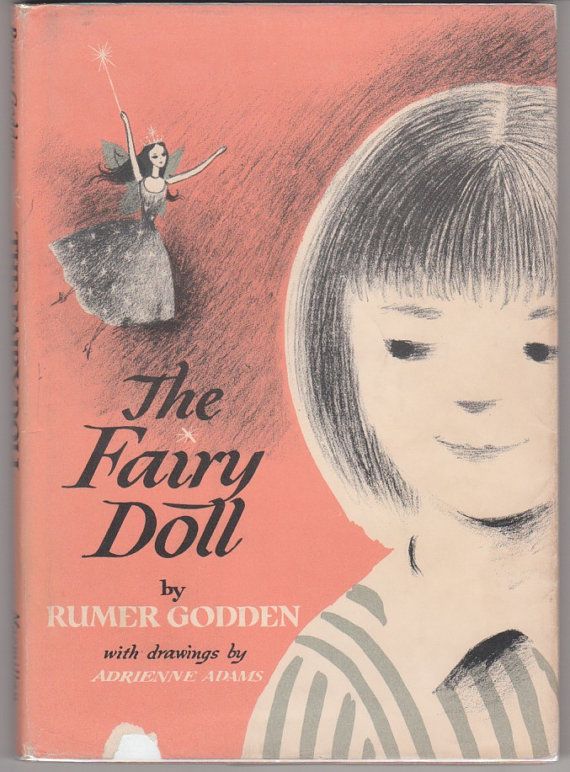
The Fairy Doll by Rumer Godden

"She was six inches high and dressed in a white gauze dress with beads that sparkled; she had silver wings, and a arrow silver crown on her dark hair, with a glass dewdrop in front that sparkled too; in one of her hands she had a silver wand, 
and her her feet were silver shoes"  stitched by fairies.


This is the cover of my old copy given to me by a family friend when I was in Kindergarten.


This is the new cover left for me to read today.

There are lots of reasons to talk about The Fairy Doll today!

  • YES it is really Christmas Day
  • YES this is a Christmas book  - a perfect one to read aloud to a young child
  • YES this book was put on the bedside table by a friend because I am house/cat sitting for her over the Christmas season - she left me The Story of Holly and Ivy too!
  • YES I did read this book as a child
  • YES I adore Rumer Godden


Another connection with this book - there is an online petition circulating at the moment because Oxford have removed some words from their junior dictionary.  I imagine there are lots of words in this book that Oxford would dismiss as too old but sure that adds to the charm of the story and also allows a modern child to gain a little insight into family life and Christmas celebrations of the past - and this past is really not so long ago.  The Fairy Doll is only a little older than me! 

Little Elizabeth is just that, little.  She is too little to join in with her brother and sister's games, she is too little to ride a 'proper' bicycle and she is too little to put high decorations on the Christmas tree.  No one seems to be on her side until the visit by Great Grandmother - a woman of magic and understanding.  Elizabeth keeps the Fairy Doll from the Christmas tree long after all the decorations have been put away for another year.  Elizabeth then spends the whole year creating a magical home for the fairy doll using her bicycle basket and moss. Each time she 'forgets' something she hears a ting and magically knows the answer to a school problem, or remembers the complex shopping list and even conquers her new bicycle.

Back to those special words I mentioned earlier. Nearly of these would be unfamiliar to an Australian child but knowing about them surely adds a special richness to our lives.

greengages
peony
pimpernels
crocus
catkins

I thrilled to find some of the original illustrations by US illustrator Adrienne Adams.  She illustrated more than 30 books including several by Rumer Godden.


"There were toadstools for stools ... on the table were acorn cups and bowls and small leaf plates. Over the writing desk was a piece of dried-out honeycomb; it was exactly like the rack of pigeonholes over her fathers desk. Fairy Doll could keep her letters there."

Tuesday, September 27, 2016

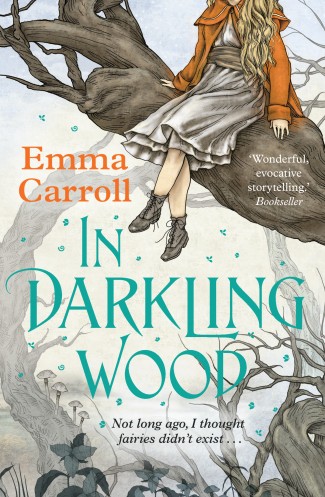
In Darkling Wood by Emma Carroll


From time to time school libraries and Teacher-Librarians debate the pros and cons of changing the organisation of fiction collections to reflect genre rather than using the traditional arrangement by author surname.

In Darkling Wood is a book that shows the complexity of using genre to classify fiction.  In Darkling Wood has historical elements, it is a fantasy with fairies, there is a strong environmental message and it is also a story about family relationships.  Not one of these themes or genres would adequately categorise this engrossing book.

Alice's brother needs a heart transplant.  Theo is only seven years old. Dad has moved away and started a new family so it is up to Alice and her mum to get Theo to hospital when they receive the late night message that a compatible heart has become available.  Alice cannot stay at the hospital so she is picked up by her grandmother - a reclusive and angry lady she has never met.

Nell lives two hours from London down a remote track.  Her home is called Darkling Cottage taking the name from the surrounding Darkling Wood.  The trees become a metaphor for the darkness in Nell's life.  Her younger son died when he was only eleven, she is estranged from her older son, Alice's father, and her efforts to remove the woods which endanger her home seem to be constantly thwarted.  Running alongside this story we read letters sent to a young soldier serving in World War I. Alfred's sister writes from Darkling Cottage in 1914 sharing her excitement.  She has found and even photographed fairies in the woods.

Meanwhile Alice meets a young girl called Flo.  "She looks about my age, only smaller than me.  And she's wearing the weirdest outfit.  Her boots make me think of ice skates without the blades, and she;s got on what looks like a petticoat.  Over the top of it, her red coat reaches almost to the ground."

Here is a ten out of ten review and one from Love Reading 4 Kids.

Emma Carroll is a wonderful storyteller and with In Darkling Wood she has taken quite a gallop of different aspects- the past and the present, the real world and a magical alternative- and blended them seamlessly into Alice’s story.

Friday, March 25, 2016

Peter Pan audio book read by Judy Dick

I recently read a review of Peter Pan and quite by coincidence I had been listening to the audio book each day driving to school.  In this review there were comments about the story being filled with stereotypes.  I disagree.  Peter Pan is a story written at a particular time and it is such a powerful adventure it seems silly to worry about whether Wendy is darning stockings or the way the boys expect Wendy to step into the role of mother and care for them.

The audio version bought this book to life for me.  Several times I had to stay sitting in my car so I could listen through to the end of a chapter.  I had forgotten about the devious ways of Tinkerbell and the long, hazardous journey to Neverland.  I had also forgotten the silly behaviour of Mr Darling and the heroism and insights of Nana.

One of the most interesting things that struck me as I listened to Peter Pan was the brilliant vocabulary employed by JM Barrie.  He absolutely does not talk down to his audience.  I adore words like :

miscreant
reproof
phlegmatic
strident
raconteur
perfidious
miasma
blithe
artifice

Using the audio book of Peter Pan would be an easy way to introduce this classic story to your class. There are so many cross references in modern literature which rely on a knowledge of books like Peter Pan.  One example from our library reading this term is Jeremiah in the Dark woods by Alan Ahlberg. In this little junior novel we meet several fairy tale characters and a crocodile with a clock inside.

There is so much to discuss in Peter Pan.  Here is a unit of work.  This description of Hook, for example, could be used in so many ways with a class.

"In person he was cadaverous and blackavized, and his hair was dressed in long curls, which at a little distance looked like black candles, and gave singularly threatening expression to his handsome countenance.  His eyes were of the blue of the forget-me-not, and of a profound melancholy, save when he was plunging his hook into you, at which time two red spots appeared in them and lit them up horribly. ... In dress he somewhat aped the attire associated with the name of Charles II ... "

Here is the cover of my edition of Peter Pan illustrated by Michael Foreman.  I have ordered some new copies of Peter Pan (the novel and some simpler picture book and junior editions) for our school library because oddly we only had an unappealing small paperback edition with tiny printing.  One of my treasured memories is of visiting the London statue of Peter in Hyde Park when I was travelling with my mum as a young teenager.


Sunday, October 25, 2015

The night fairy by Laura Amy Schlitz illustrated by Angela Barrett part two

Once again on Friday I looked around my library for a handful of books to bring home for the weekend.  I keep recommending The night fairy and one reader recently agree it was good so I thought I would re-read it.  I rarely do this but after reading this book again last night I can say I thoroughly enjoyed The night fairy all over again.

You might like to read my original post.  Today I am going to talk about using this book with a class and in particular the wonderful descriptions and amazing tension Laura Amy Schlitz provides in this little book.

Here is a perfect description :

"On the night of Flory's peril, she was less than three months old.  It was a windy night: cool and sweet with springtime.  Flory was coasting on the breeze, letting it toss her wherever it liked.  She was still very tiny - as tall as an acorn - and her green wings glittered in the moonlight."

There is so much to talk about here with your class.  The punctuation as a device to add meaning and pacing to your reading.  Glorious words such as coasting.  Phrases such as 'cool and sweet with springtime'.

Another description

"Her little house was full of things she has made : a lily-leaf hammock, a quilt of woven grass, and a score of airy gowns crafted from poppies and rose petals.  She had food saved for the winter ... three snapdragon flowers stuffed with pollen."


Here is a really tense scene when Flory is confronted by a praying mantis.

"Her heart stood still.  A praying mantis squatted in the barberry bush.  ... As Flory gaped at him, his antennae twitched.  He turned his head as if he knew she was there.  His head was triangular, with bulging green eyes on the side.  Flory went cold.  She knew how dangerous he was - how suddenly he could strike.  She also knew what was in store if he caught her.  His spiky forelegs would dig into her flesh. The mantis would lift her to his bristled mouth and bite through her neck. Then he would eat her body, saving her head for last."

If you need an extract to convince the boys in your class they will actually enjoy this "fairy book" I would use this passage.  Those final words "saving her head for last" are sure to cause a reaction! Look at all those verbs - squatted, gaped, twitched, dig, lift, bite.

The illustrations in this book are also very special and could easily be used as writing inspiration.  I have included one below.  In the US there has been a theatre adaption made of this book  That might also be a terrific project for your class - how would you turn this book into a play - write one scene in this format.  You can see a tiny part of the production here and some very detailed teaching notes.


Wednesday, September 17, 2014

Operation Bunny by Sally Gardner illustrated by David Roberts

An orphan baby is found in a hat box at a railway station.  Most readers will know that Emily Vole, the baby, will suffer some hardships (her adoptive parents are rich and cruel) but that after some suffering Emily will find her true destiny and some wonderful friends and she might even save the world from an evil power.  If you need to know more then I strongly suggest reading Operation Bunny.

Daisy Dashwood wishes to adopt the baby that has been found in the hatbox.  "Five years later, Daisy Dashwood had to admit that Emily Vole wasn't exactly what she had had in mind when she'd made her one and only wish.  What she really wanted was a baby girl with blue eyes and blonde hair, ideally the same colour as her own strawberry-blond hair extensions."

Poor little Emily is forced to wear a blond wig (Daisy is a hairdresser) and blue contact lenses.  Then things get even worse.  When Emily turns five Daisy falls pregnant with triplets.  Ronald Dashwood knows they can't send Emily back so he decides Emily can be the family servant.  She will now live in the laundry room and her bed is the ironing board.

Luckily for Emily the lady next door, Miss String, is really a fairy in disguise.  She and her huge cat companion befriend Emily and are able to assist her with the enormous amount of housework each morning and then provide brilliant lessons each afternoon. "Within a year Emily could read, write, do maths and speak fluent French and German.  Plus another strange language called Old English."

When things are going well in a story you just know things are probably destined for disaster and so it is not really a huge surprise that by Chapter eight disaster does indeed fall.  Miss Ottoline String is accidentally killed when Mr Charlie Cuddie is distracted by a witch on a broomstick.  This witch is the evil Harpella and she is desperate to get hold of a set of keys that Emily now holds.  At this point the plot becomes very complex and quite tense as Emily and her best friend Fidget (the giant cat) try to stay one step ahead of Harpella.  They need to prevent her getting hold of these special keys and also stop her turning humans into bunnies and zombies.

This is the first book in the series Wings & Co and as you can see it is quite a madcap adventure.  We will to add the next two to our library collection soon.

Here is the publisher web site which includes a generous audio sample.  Here is an excellent review from the New York Times.

You might also enjoy Emmy and the incredible shrinking rat and Mr and Mrs Bunny, detectives extraordinare, and you should also look for all the other books by Sally Gardner in our school library.

References to fairy tales add depth to the story and make a clever backdrop to this series kickoff, in which a Circe-like witch turns people into animals and lures fairies to their doom in a magical lamp.