Sunday, February 25, 2024

The Beehive by Megan Daley illustrated by Max Hamilton (Walker Nature Storybook series)


It is always thrilling to me when I see bees buzzing around flowering trees and small flowers. Megan Daley, the author of this new book, has loved bees nearly all her life beginning with times shared with her grandfather on his farm. Here is part of the dedication from her book:

"To Grandad for sparking and nurturing my love of bees, gardening and agriculture when I was very young."

The Beehive publisher blurb Walker Books: It's finally hive day! Willow has been waiting all year for groundskeeper Tom to split the school's native stingless beehive in two so she can take home her very own hive. Everything needs to be just right to help so that the bees forage and thrive in their new home. The dual text results in a charming story alongside an abundance of fascinating facts about Australia's native bees.

The Walker Books Nature Story series (formerly called Read and Wonder) are fabulous books to share with a young reader or in a library session. 


At the Sydney event to celebrate publication of The Beehive and on also this podcast (Words and Nerds) Megan explains that she loves to share nonfiction with her students and so about seven years ago she used the format of the Nature Story Book series to pen an innovation on this text style, writing her own book about our Native Australian bees. 

Native Australian bees are smaller than European bees and nearly all of them do not sting but they can nip you with their mandibles. The most special of our Australian Native bees are the Blue-Banded variety. I have listed further resources below. Read this review from the Australian Native Bee Association.

Prior to attending this event at our Sydney Bookshop - Gleebooks - I had read quite a bit about The Beehive via Megan Daley's own posts on Facebook and also via her group Your Kid's Next Read although I didn't know her story character Willow's name came from her younger daughter. Nor did I know she wrote 27 drafts of this text and that her beekeeper partner did not want the story beekeeper to look like an old man with grey hair. Here are the ideas Max Hamilton tried out before settling in the character of Tom who is based on a real person:


The really interesting part of the event today though, was hearing from the illustrator Max Hamilton. By happy coincidence this Sydney event was the first time Max Hamilton and Megan Daley had met in person. 


One lovely moment came when Megan talked about how she loved the AA Milne Winnie the Pooh books as a child - especially all the references to honey and bees. Then Max Hamilton showed that she had incorporated this classic story into her illustration without knowing this connection with the author Megan Daley!


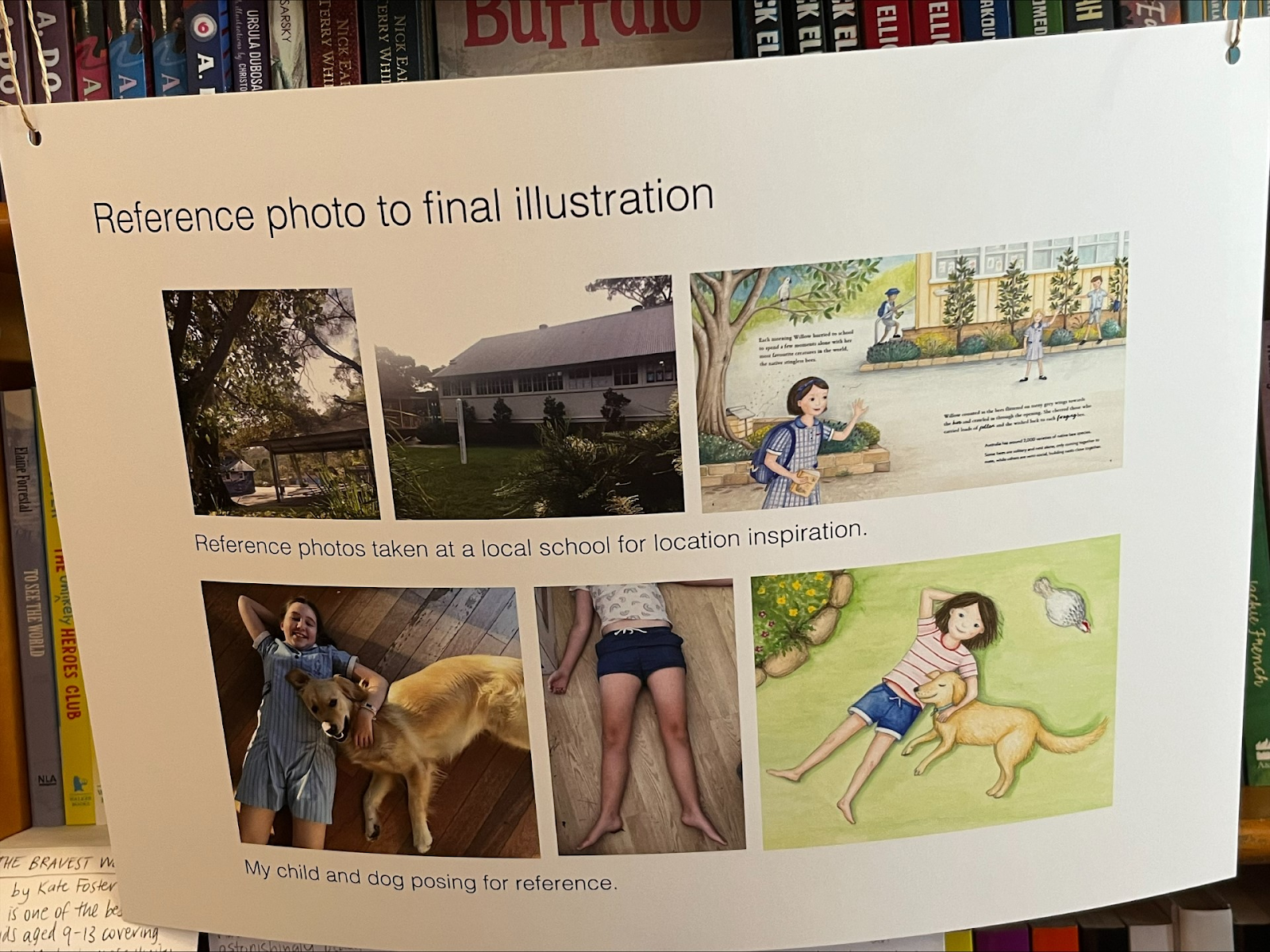
We also saw her thumbnails for the book layout, her changing ideas for the cover, and the photos she used as models for her illustrations.


Everything in this story is beautiful, with a unique voice that shines on the page, dancing its way around each word and image as the story and facts come together to create a book that readers of all ages will enjoy and find engaging. It is also bright and colourful, exactly as a book about bees should be as it celebrates nature and the natural world, and what it can give us. I loved that it spoke about how important bees are whilst also being entertaining and accessible, ensuring that the layers of understanding are there for a wide range of readers. The Book Muse

Further reading:

Aussie Bee

Wheenbee Foundation

Which Native Bees live in your area? (I would love to see a Teddy Bear bee)

ABC Education Bee Heroes

World Bee Day - 20th May

100 Hives in 100 Schools

Kinderbookswitheverything blog - World Bee Day book ideas

This book also has a link to IBBY Australia. Max Hamilton kindly donated a beautiful piece of original art for our mini masterpiece auction - it was the little girl from this book! And we found out why she is holding Gnomes by Wil Huygen.


You could also look for these in your school library:


I should also mention there were a number of famous children's literature supporters and creators at this event including members of the CBCA (Children's Book Council of Australia) committee; and authors and illustrators such as Nat A'MooreCheryl Orsini; Debra Tidball; Allison Tait; Jacqueline Harvey; Pip Harry; and Kristin Darell.  Thanks also to bookseller Rachel Robson. Her costume and enthusiasm made this event very special (and memorable). Best wishes for her move to the new shop just down the road - packing up all those books will be a mammoth task but I can't wait to see the newly renovated space (which will have a coffee shop).

The Circus Ship by Chris van Dusen


"Five miles off the coast of Maine and sightly overdue, a circus ship was steaming south in fog as thick as stew."

You could use this opening sentence as a way to begin your exploration of this book. If you are reading this in Australia, you will need a map to locate Maine. Then talk about what 'slightly overdue' might mean and the ramifications of this phrase. The fog is thick - how will that make an impact. What should the captain of the ship do? OH, and wait a minute what is a circus ship? Who or what might be onboard?

The next page helps a little. On board there are fifteen animals, and the ship is heading to perform in Boston. Over the page and yes, the captain - Mr Carrington - does think the ship should wait for things to clear but the aptly named Mr Paine, the circus boss, disagrees and so the ship continues on its journey but of course disaster strikes. The ship hits a reef and everyone, animals too, is thrown overboard. Luckily all of the animals can swim and so they make it safely to shore landing in a small village.

"They pulled themselves up on the shore - bedraggled, cold and beat - then staggered to the village on weary, wobbly feet."

The village people are amazed to find all of these exotic animals surrounding their houses. That night a building catches on fire. The circus tiger has been trained to jump through fire. He dives in and bravely rescues little Emma Rose. 

"The tiger's risky rescue changed everybody's mind - the animals weren't bothersome; the animals were kind."

That could be the end of this story BUT the circus owner is coming. He wants his animals back. The people of the village hatch a cunning plan. You will need to look very closely at this double page scene. Can you spot the fifteen animals? Luckily Mr Paine is not at all observant. 

This book is based on a true story. In 1836 a ship named The Royal Tar was sailing from St. John New Brunswick to Portland Maine. There were 103 passengers and the circus - a elephant, two lions, a tiger, a leopard, six horses, two camels, a gnu, two pelicans, snakes, birds and a full band. There was a disaster. The boiler overheated and the ship went up in flames. Many people and most of the animals perished but there is evidence that the elephant did end up on a nearby island and exotic snakes were also seen on a different island many years after the wreck.  I found this podcast (15 minutes) which recounts these events.

The Circus Ship was published in 2009 but the paperback version [9780763655921] is still available. Here is the webpage for Chris van Dusen. Read more about how he creates his art. If you haven't discovered his work, I highly recommend all of these:


With an older group of students aged 10+ The Circus Ship could be a terrific way to introduce this Australian middle grade book:


When you pick up this book make sure you share the title page with your class or young reading companion. It's a terrific example of why fonts are important. 


Children will pore over panoramic spreads that invite them to find each of the 15 animals and celebrate a denouement that serves up Mr. Paine’s just deserts. Splendid! Kirkus Star review

Saturday, February 24, 2024

We Know a Place by Maxine Beneba Clarke

"We know a place that's mysterious-magic, 
a window to lives you can't even imagine."

The place is a bookshop on Ballarat Street. We have a town in Victoria here in Australia called Ballarat and there is a Ballarat Street in the city of Melbourne in the suburb of Brunswick but I love the way this story is universal. International and interstate readers do not need to relate to any real place - Ballarat Street just has a pleasant ring. Of course there is also a real bookshop in Ballarat Street, Yarraville also in Melbourne - The Sun Bookshop and just up the road the sweet little Younger Sun children's bookshop.

The children in this family enjoy their visit to the bookshop each week once their chores are completed but this week their new book is filled with trolls and they escape from the pages and cause havoc in the family.

Publisher blurb: Every Saturday, when the chores are done, two children set out on a journey to their local bookshop, a magical place where sneaky stories escape as you peep in the door and there's plentiful magic for each and for all. Monsters, giants, trolls and pirates ahoy! But what happens when some cheeky creatures follow the children home one day?

If there was a prize here in Australia for end papers I think I might give Maxine Beneba Clarke and her book, We Know a Place, first prize.

I am trying to anticipate the 2024 CBCA (Children's Book Council of Australia) notable titles which is the first step towards the short lists (Picture Book, Younger Readers, Early Childhood, Older Readers, Non Fiction and New Illustrator). This book might make the Early Childhood notable selection. The announcement is due in just over a week. 

Here are some teachers notes by Dr Robyn Sheahan-Bright for We know a place. Here are a few quotes from the author notes:

If you look closely among the pages of We Know a Place, you will find fairytale characters you may recognise from other stories, including a runaway gingerbread man, Rapunzel, Little Red Riding Hood, one of the Three Bears from Goldilocks and the Three Bears, pirates, monsters and more. 

The illustrations were drawn with watercolour pencil and soft lead pencil on heavily textured cardstock. As an illustrator, I always like to start with a coloured page, rather than a white page, as it means there is already a ‘mood’ on the page. This is why you will rarely see white backgrounds in any children’s books I have illustrated.

The notes also contain a list of other picture books about bookstores, reading and libraries.

Friday, February 23, 2024

These Little Feet by Hayley Rawsthorne illustrated by Briony Stewart


This book has sweet end papers with an ownership space that says:

"These little footprints belong to:"

The text is written like a poem. Each stanza begins and ends with a repeated line.

These little feet so tiny and new.
The places they'll go the dances they'll do.
The mountains they'll climb, the dreams they'll pursue.
These little feet so tiny and new.

I often think about the process when an illustrator receives the text for a picture book. I assume this words for this book were sent on one page. Briony Stewart needed to interpret the words - she does that beautifully and she needed to position the text on each page.

This book will be given as a gift for a new baby due to be born in April this year. I have huge box of books ready for the arrival of this precious baby girl. Mum is from Bolivia so it is good to see Briony Stewart has included babies with different skin tones, a baby in hospital, and a baby with her dad. The final page acts as a recap where we can view the scattered photos from various family photo albums.

You can see inside this book on the author web page. Click here to see other books illustrated by Briony Stewart. And I talked about her work in a previous post


Of course I will also gift these two books:


Thursday, February 22, 2024

The Great Stink by Colleen Paeff illustrated by Nancy Carpenter


I have decided I am not very good at asking questions. I need to be way more curious. I have been to London several times but it never occurred to me to ask about or research the word embankment. More about that in a moment.

This book begins in 1500. In London at this time sewers carry rainwater to rivers so the city won't flood. Poop or poo and pee go into deep holes called cesspools. When these become full it is time to hire nightsoil men who sell the poo (poop) to farmers as a fertilizer. Jump forward to 1819 and people are installing flush toilets. Some people connect their toilets directly to the sewer and so pee and poo now end up in the river!

The first epidemic of cholera hits London in 1832 and 6,563 people die. Problem is no one makes the connection between this catastrophe and the sewerage going into the river. The government believe the cause is in the air in pockets called miasmas. Oh no - now they order people to send their waste straight into the Thames. AND people are drinking this water too. Another cholera outbreak and 14,137 people are dead. 

Meanwhile a young man called Joseph Bazalgette takes on the job of mapping the sewers of London.

"The sewers are a disorganized, haphazard, higgledy-piggledy mess."

Finally, the authorities call for help - they need a civil engineer. Joseph is the chief engineer. He designs a system of gigantic sewer pipes which will move the sewerage out to the ocean. The debate continues into 1856. This scheme will be very expensive - too expensive. By 1858 the city is almost unlivable. The hot sun of summer adds to the stench - it is now the Great Stink! Finally, the parliament give approval for the building of the huge pipes.

"It is almost impossible for Joseph to find open space where he can build new sewer pipes without causing roadblocks, traffic and major headaches for Londoners. So in some areas he creates man-made riverbanks called embankments."

The final pages of this splendid book talk about the situation in our world today with the disposal of sewerage and also list alternate schemes. There is also a detailed timeline, further reading list and bibliography. 

Read a very detailed interview with Seven Impossible Things featuring Colleen Paeff and Nancy Carpenter. Colleen Paeff has other links on her web page. Here is a set of detailed teachers notes with science experiments. In this blog post Mr Schu talks to Colleen Paeff. 

This informative exploration of London’s sanitation history will delight nonfiction fans interested in history, ecology, biography, and more. Kirkus Star review

Back to embankments. You can read more here and here The story of London's embankment

As a part of their science or geography topic our Grade four students used to investigate waste disposal systems. I am not sure if this is still the case but I used to read quite a few books (some were very funny) about poo.


Here are a couple of videos you could use with a primary class:

Where does the water go? - Sewerage treatment Melbourne

How Do Sewer Systems Work?

A brief history of toilets TED (High School level)

Awards for The Great Stink:

  • 2022 Robert F. Sibert Honor Book, Association for Library Services to Children
  • 2022 Golden Kite Award for Nonfiction Text for Young Readers, SCBWI
  • 2022 Cook Prize Honor Book, Bank Street College of Education
  • 2022 Notable Book, American Library Association
  • 2022 Notable Social Studies Trade Book for Young People, Children’s Book Council
  • 2022 Texas Topaz Nonfiction Gem, Texas Library Association
  • 2022 Best STEM Books K-12, National Science Teaching Association
  • 2021 Best Informational Books for Younger Readers, Chicago Public Library
  • Junior Library Guild Gold Standard Selection

Wednesday, February 21, 2024

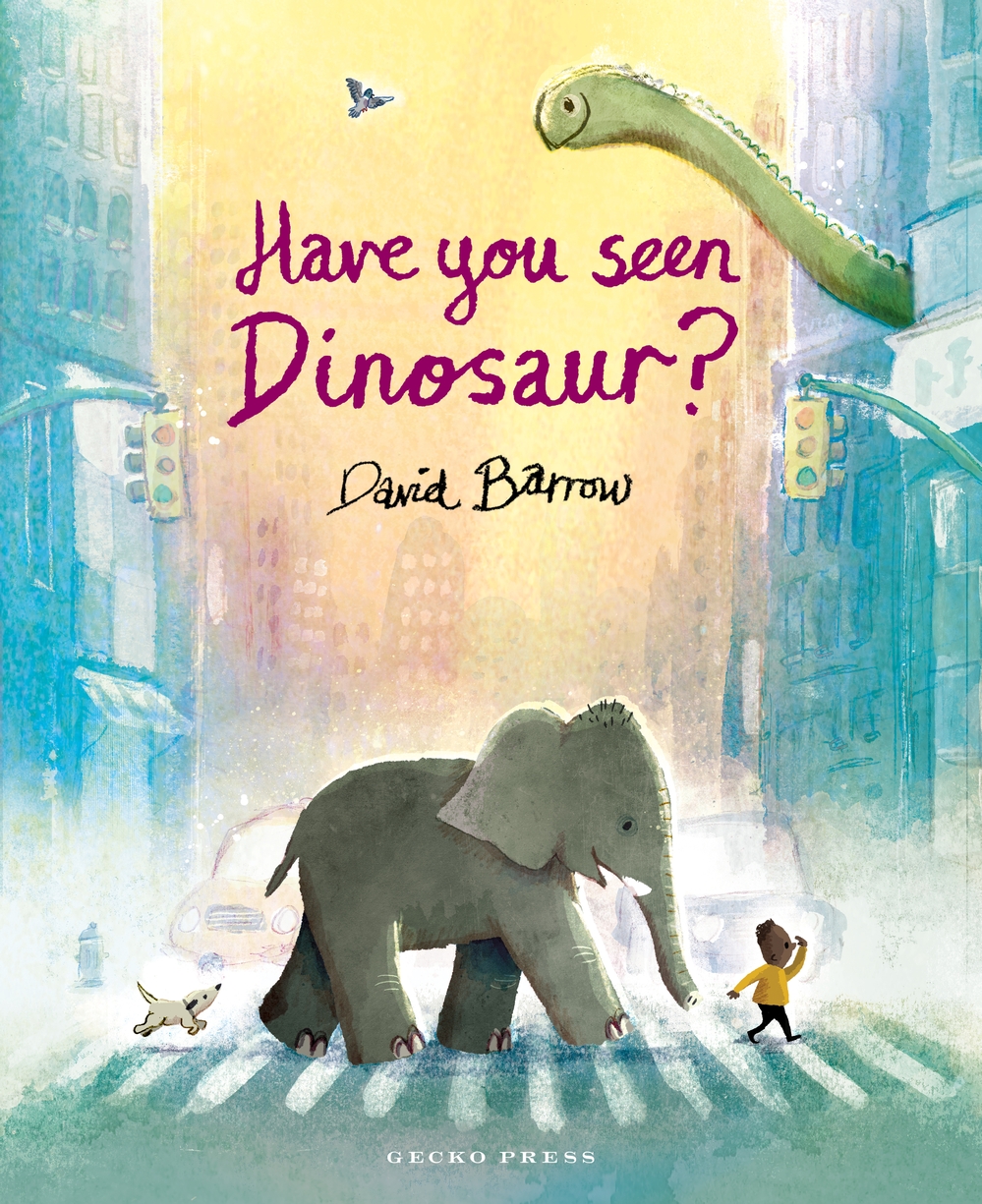
Have you seen Dinosaur? by David Barrow


This is one of those terrific books where your young reading companion (aged 2+) will know way more than the main character.  Yes, there are plenty of dinosaurs but the little boy keeps missing them. You will even see one on the end papers.


I counted seven dinosaurs on the final page. Why not head to your library now and go to the non fiction shelf [567.9] and grab a few dinosaur books and then try to identify the dinosaurs in this book. There are other visual jokes too - such as the pigeon and the dog on each page. Watch out - the pigeon is riding a skateboard. I also love all the characters on the train especially the punk girl with her spiked hair and nose ring. This is a book you could also share with a slightly older group who might identify all the environmental print - street signs, newspapers, even number plates!

This is also a lovely story about friendship, and Barrow’s artwork is dreamy, painterly and stunning as well as being totally perfect for young readers. A fabulous read for any time of day, which will definitely get plenty of repeat reads. Book Trust

Here is an interview with David Barrow. He lists his own favourite illustrators as:  Brian Wildsmith, Alice and Martin Provensen, Evaline Ness, and David McKee. I’m also drawn to modern artists with a unique visual language, such as Isabelle Arsenault, Marta Altés and Birgitta Sif.

Have you seen Dinosaur is the sequel to this:

Tuesday, February 20, 2024

Nightsong by Sally Soweol Han


The world is never quiet. Adults are talking, clocks are ticking, even the 'fridge is not silent. Lewis is surrounded by sounds indoors while he waits for his mum there are more sounds outdoors as they walk along a busy city street to catch the bus. They climb aboard and the hum of the bus engine nearly lulls Lewis to sleep until ...

A flat tyre! POP!

Lewis has his device which usually distracts him but out in the countryside it stops working (thank goodness) and so Lewis sets off to explore.

"The more he listens the more he hears. And the more he wants to see."

He hears the birds and insects. He hears an owl and a possum. He hears the splash of the fish in the creek and the ribbit ribbit of some frogs. It sure is noisy out here in nature.

"The night sounds become a song."

Finally, a new bus arrives, and everyone climbs on board, but Lewis is no longer tired. His mind replays all the wonderful sounds of nature all the way home.

You could easily share this book as part of a mini theme on listening, nighttime and the sounds of nature. Check out this post or type any of these titles at the bottom of this post into my side bar. If you read this book with your own children it would be fabulous to go outside and listen to all the night noises. You could also do this in the daytime to compare. In our city we have a display of hanging bird cages with electronic bird sounds - they change over the day to match when you would actually hear these birds in a forest. Strangely even though it is just a series of recordings it is a magical place right in the centre of the city.

Can I just also say NOTHING beats actually doing something relating to the book you are enjoying either with your young reading companion or even your class. I was talking with a friend today. Our NSW schools are killing books in their classrooms with over analysis. In the book read by this group - Storm Boy by Colin Thiele - the word tussock is used. Surely instead of spending an hour analyzing this word it would be way better to just head outside and look at some clumps of grass. Also, I am sure the wonderful illustrator Robert Ingpen shows readers exactly what this looks like around the sand dunes which are the setting of this famous Australian book.

Here are some other books to read alongside Nightsong.


Sally Soweol Han won the CBCA (Children's Book Council of Australia) New Illustrator award for her book Tiny Wonders.