Showing posts with label Amsterdam. Show all posts

Tuesday, April 15, 2025

The House on the Canal by Thomas Harding illustrated by Britta Teckentrup


"The girl with the sweet smile hid in the house with her father and mother and sister and four others. The top floors of the annexe were now a hiding place. They had to be silent, otherwise the police and soliders would find them. So still. Not a sound. Each minute was a day. Each day was a year."

The House on the Canal begins in 1580 when the land a marshland:

"With some cows. A few herons. A family of fieldmice. And in the sky above, a flock of seagulls. It was a calm and happy place".

By 1600 workers begin to reclaim the land and create the canals we all associate with Amsterdam. In 1635 the first house is built by a newly arrived stonemason. 

"The stonemason wanted more space. So they added an annex behind the main house with a large attic."

Yes, just in case you haven't worked it out - this is the famous annexe and attic where Anne Frank and seven other people stayed in hiding until their arrest in August 1944. But before we get to that point so many other people lived in this house with large and small families, or they used it for their business including a company that made metal beds and stoves; a small business that made piano rolls; and it was for a while used as a sewing workshop and even a horse stable. 

After the war the only survivor of the Frank family was Anne's father Otto. He worked hard with other members of the community to save the house on Canal Street and at last, in 1960 the house was opened to the public. 

Perhaps you are wondering about the chestnut tree that gives Anne comfort during her long days in hiding. It began to grow in 1853 so that means by 1940 when the family moved into the attic the tree was 87 years old. 

The text in this book will be accessible to children aged 10+ but I would also add this book to a High School library so that students who study history, or architecture or who read The Diary of Anne Frank can discover more about this famous house. This book could also be a fabulous way to show the depth of research completed by an author or an historian. See inside the book here. Read more about the author Thomas Harding. And this book should also be shared with an art class because Britta Teckentrup is an outstanding illustrator. 

Readers will emerge simultaneously awed by the passage of time and personally affected by the stories told. Teckentrup overlays her bright, exquisitely detailed sepia-toned depictions of the house and its environs with a misty haze; the results are hauntingly beautiful. Deeply moving, powerful, and breathtaking. Kirkus Star review

Readers will notice that the Frank family are not the first residents of this house to have experienced religious persecution, or to have been confined to the house for extended periods of times. At other times, the freedom enjoyed by previous residents poignantly contrast with the restrictions faced by the Franks – freedoms which all families want and which can easily be taken for granted. Just Imagine

I first saw a mention of this book over a year ago. I am so happy this book has now arrived here in Australia. It is a book to cherish. In 1974 I visited Anne Frank's House in Amsterdam. I was quite young but the experience affected me deeply. Later, in my school library I read these books to my Grade 6 library groups and we talked about Anne Frank.


I am also very keen to read this book from 2019 but sadly it is way too expensive here in Australia:


If you want to read another book that traces the history of a house try to find this one with scrumptious illustrations by Roberto Innocenti:


Thomas Harding and Britta Teckentrup have created two other books about the history of a specific house:


On the outskirts of Berlin, a wooden cottage stands on the shore of a lake. Over the course of a century, this little house played host to a loving Jewish family, a renowned Nazi composer, wartime refugees and a Stasi informant; in that time, a world war came and went, and the Berlin Wall was built a stone's throw from the cottage's back door. With words that read like a haunting fairy tale, and magnificent illustrations by Britta Teckentrup, this is the astonishing true story of the house by the lake.


In the northeast corner of the USA, near the city of Auburn, stands a red brick house. It was built 130 years ago and served as a farmhouse, old people's home, museum and a refuge for enslaved women, men and children. It was the scene of an extraordinary story: the American Revolutionary War, the Underground Railroad, the American Civil War, the fight for women's suffrage, and a safe place for Harriet Tubman, her family, and many others. This is the exciting story of a remarkable house.


Saturday, August 29, 2020

From Stella Street to Amsterdam and everything that happened by Elizabeth Honey


From Stella Street to Amsterdam is the fifth book in the series which began with 45 and 47 Stella Street and everything that happened. The original instllment was first published in 1995 and was awarded a CBCA honour in 1996. Twenty-five years later we can meet up with Henni once again but luckily she is not 25 years older. The newest instalment is due for publication in September.

Henni's Stella Street neighbour, Willa, is desperate to return to her home land - The Netherlands - specifically to Amsterdam. Willa's sister is unwell and there is a family wedding to attend but these are not the real reasons. Willa left Amsterdam just after WWII but she is haunted by events during the Nazi occupation. Willa has fragments of memory. She is driven by the need to complete a task set by her mother (Moeder). All she knows is she has to protect something called The Blue dog.  It is not a dog, it is not a place, it is some sort of object. This mystery also has a connection to a horrifying event. 

Willa's full name is Wilhelmina Roos Petronella van Veen. Her family call her Roos. During the war Willa's van Veen family were friends with a Jewish couple - Sara and Matius. As things become dangerous in the German occupied city, Moeder organises for her friends to come and hide. After many months of keeping the young Jewish couple safe Willa accidentally opens the front door and Sara is seen by a cousin of the family. The events echo the story of Anne Frank. What follows is betrayal, capture and ultimately the deaths of Sara and Matius.

These are the events of the past but Henni also has to negotiate her visit to modern day Amsterdam. She has to meet all the members of Willa's family. She has to master some of the language, learn how to navigate bike riding through the busy city and she has to make connections between all the people she meets. Henni discovers there are life changing secrets today with links to the events of the past.

In anther story thread Henni gives us the background to her trip, we can read her emails to family and friends back in Stella Street in Australia, and Henni, an aspiring writer, also shares her poetry writing.

This book has 432 pages and many story threads. It is a book that will be enjoyed by readers aged 11+ who have plenty of time and reading stamina. There are some harrowing references to the holocaust and (as they say on television) occasional strong language. This is an engrossing story. Yes it is a long book but I read from page 130 on wards in one sitting. I recommend From Stella Street to Amsterdam. It is well worth taking this journey of discovery with Henni Octon. 

Here is the original cover for 45 and 47 Stella Street and the newer one:


Here is the cover of the Dutch edition of 45 & 47 Stella Street:

Here are the other three books in the series:

Or you can read the first three Stella Street stories in this bind-up edition which has 672 pages!


I mentioned 45 & 47 Stella Street received a CBCA Honour. In 1996 the CBCA winner was Swashbuckler by James Moloney and The Big Bazoohley by Peter Carey was an honour book. I have shared some other books by Elizabeth Honey on this blog - Not a Nibble and Princess Beatrice and the Rotten Robber.

If you would like to read more about art that was hidden away during WWII I highly recommend this book - here are two different covers for Framed by Frank Cottrell Boyce.


Wednesday, June 24, 2020

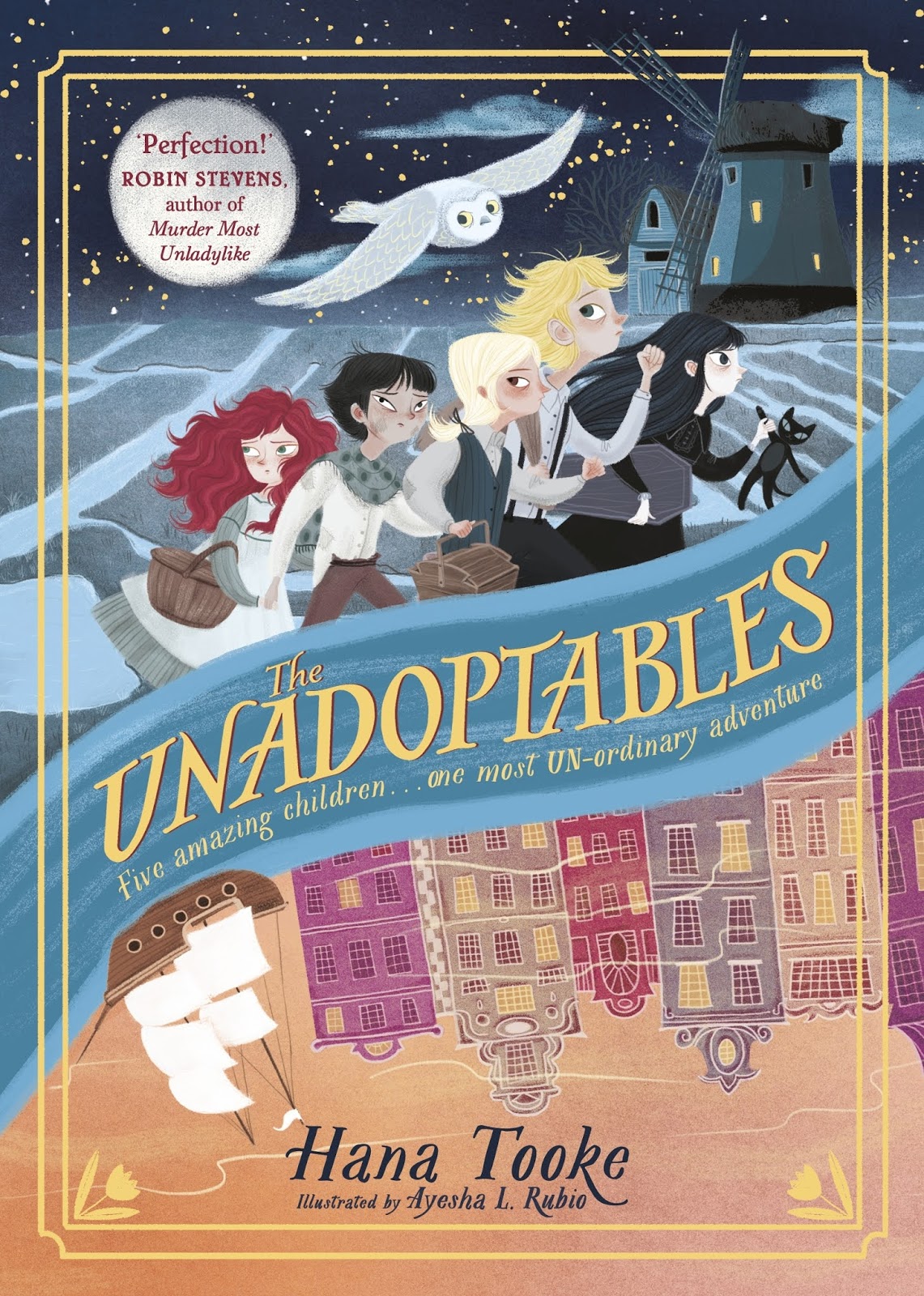
The Unadoptables by Hana Tooke


Over the course of a year five babies arrive at the Little Tulip Orphanage in Amsterdam. The Little Tulip doesn't that sound delightful - of course it is not!  Each arrival breaks one or more of the three rules set my matron Elinora Gassbeek. Wait a minute. Look at that name. Grassbeek. Sounds bad?  Yes she is!  Now back to those rules:

RULE ONE: The baby should be wrapped in a cotton blanket.
RULE TWO: The baby should be placed in a wicker basket.
RULE THREE: The baby should be deposited on the topmost step.

So what about our five babies.
Lotta arrives in a toolbox which has been wrapped in an emerald green ribbon
"a baby with coca-bean eyes and blonde fuzz on its head."
Egg (Egbert) arrives in a coal bucket wrapped in a soot-stained shawl
"A raven-haired infant... "
Fenna is found in the matrons picnic basket along with the sandwiches and almond cake
"It had a shock of curly red hair and was babbling incessantly."
Sem comes in a bucket wearing a wheat sack
"She looked at the baby's wonky ears, its gangly limbs and the wheat-coloured hair that stuck out from its head at the unruliest of angles."
Milou is found on the roof inside a coffin-shaped basket along with a cat puppet
"It had hair as dark as midnight and eyes that were almost black."

Are you wondering about those names.  I won't go into the details here but they are all the invention of Matron serving to emphasise the nastiness of her character. What you do need to know is that each of these children is blessed with a special talent such as mathematics, engineering, knot tying, sewing, map making, cooking and an affinity with animals. Milou has a fragment of information about her own family and she is desperate to find her parents who she is sure are out there somewhere looking for her.

When the group of kids escape from the orphanage they use this scrap of information having fled the matron and an evil man called Meneer Rotman who says he wants to adopt all of them but who is clearly planning something truly awful. Milou has over-heard the matron and Rotman talking:

"Then we have a deal, Matron. In return of a steady supply of orphans each year, I will provide you with coin and rid this place of vermin: both the rodent variety and the urchins you can't shift."

So now the kids are on the run. Where they go, who they meet and the way each of their talents are needed is thrilling. This story is a wild roller coaster ride. I am certain you will not anticipate the ending. When and if you need further reason to read this book pick it up and read chapters 28 to 30.

I especially loved the wonderful character descriptions:

Here is Matron Gassbeek - so many delicious words here:

Her "boots emerged a moment before the rest of her: twin points of polished, blood-red leather, with low, pointed heels, that were just as sharp as the expression on the matron's face ... (she had) the brutal sneer of a gargoyle, the soulless eyes of a werewolf, the skin itching screech of a banshee ... her vileness had transformed her features into something monstrous."

Meneer Rotman Have you noticed the name - Rotman (yes he is rotten!).:
"His face was half covered by a huge mustachio, which erupted from under his nose in two long curls and spread out towards his mutton chop whiskers. There were rings on almost every finger and a long tobacco pipe hung from his mouth." His smile was a parody "all teeth and no soul." His laugh "like a seagull cawing."

A little shiver ran up my spine this morning when I saw an announcement that it is only eight days until The Unadoptables hits the shops! SO grab your order form, email your local bookseller, lobby your local and school library NOW because you are really going to ENJOY this wonderful new book.


The story is set in nineteenth century Amsterdam, and Tooke, who is half Dutch, brilliantly evokes both the city itself with its narrow streets and tall, crowded-together townhouses, and also the countryside with its patchwork quilt of fields, canals and windmills. The Nerd Daily

Here is a web site for Hana Tooke with a terrific book trailer. I am also including the cover of the Advanced Reader copy which Beachside Bookshop kindly supplied earlier this year. You might be interested to see how covers evolve. My copy of this book only had draft illustrations. You can see the art here by Ayesha Rubio.


Aspects of this book reminded me of A series of Unfortunate Events. I would also link The Unadoptables with these books:

For a younger audience take a look at The Dunderheads: