Showing posts with label Difference. Show all posts

Wednesday, June 18, 2025

Bigfoot vs Yeti: a love story by James Foley

"The Bigfoot say it started when a Yeti threw a snowball across the rift. The Yetis say it started wen a Bigfoot threw some fruit across the rift."

Think about the word 'rift'. It can mean a large crack in the ground or a serious disagreement that separates individuals. In this book both meanings apply. 

Late one night two younger community members are left to guard the edge of the rift - a Bigfoot named Bevan and a Yeti named Yolanda. Yes, we have a boy and a girl. There is of course no way to cross the rift it is way too wide but "does it really go on forever?" After days of their journey Bevan and Yolanda finally come face to face and instead of fighting they help one another and "and slowly, ever so slowly, the rift began to narrow." Yes, this is a love story and the end does contain a heart-warming twist but for me the interesting part comes before this scene when it is clear there are still some community members Bigfoot and Yeti who "could neither forgive or forget." 

They were sent back "back to the village and the mist and the rift. And they're still there to this day, hurling insults into the wind."

As I was reading Bigfoot vs Yeti by James Foley I thought of these books (see below) which I used to share with my Grade Five students as part of a conflict resolution theme. Notice the title of Bigfoot vs Yeti also says - A love story. The ending reminded me of a favourite book - Clancy the Courageous Cow. 


Bigfoot vs Yeti (trailer)

Blurb: The Bigfoots say it started when a Yeti threw a snowball across the rift. The Yetis say it started when a Bigfoot threw some fruit across the rift. Who could say for sure? One night, a young Bigfoot and Yeti decide to find the end of the rift so they can finish the feud – once and for all. 

“So very clever! The buildup in this story and the unexpected (but perfect) change of colour from black and white to colour … James Foley has given us a story to remember and perhaps learn from too.“
– Dr Belle Alderman AM, Emeritus Professor of Children’s Literature, Director of the National Centre for Australian Children’s Literature

This link will take you to different teachers notes for Bigfoot vs Yeti. Readings Melbourne list three reasons to read Bigfoot vs Yeti. Here is the Storylinks review.


Look for this wonderful book by James Foley:


Sunday, April 27, 2025

Moon Rabbit by Natalie Russell


Moon Rabbit is a little like the famous story of Town Mouse and Country Mouse. Little Rabbit lives in the city. Her days go well as she enjoys all the sights and sounds and shops of the city but when evening comes she feels a little lonely. One day she goes to the park and hears some sweet music. She falls asleep in the sunshine but when she wakes up it is nighttime. She can still hear the music so she picks up her book and follows the sound. She is surprised to meet another rabbit. A brown rabbit. And he is playing a guitar. The pair quickly form a sweet friendship and enjoy their days together but when Little Rabbit looks back over at the city she feels homesick. The brown rabbit and white rabbit say goodbye and Little Rabbit heads back to the city but there is the promise that one day soon Brown Rabbit will come for a visit. Here is book two!


This story is fairly simple but it is sure to appeal to a preschool aged child. What really stood out of me when I saw it at a recent charity book sale were the scrumptious illustrations. The Kirkus reviewer said exactly the same words:

What really stands out are the gentle black-lined drawings resting comfortably in a patchwork of printed images. Vintage-looking patterns decorate shades, vases, even trees and create an experience as pleasant as tea and a scone. Kirkus

My copy of Moon Rabbit was published in 2011 (paperback edition) so it is long out of print. I love the way the cover has silver varnished letters and the way the moon looks like a patchwork. The cherry blossoms on the cover and end papers give this book a Japanese feel although Natale Russell lives in Dundee Scotland. Natalie Russell is also the illustrator of a series of book by Kobi Yamada - Because I had a teacher; Because of you, Mom; and Because of you, Dad. 


Here are some other books by Natalie Russell.


Saturday, March 15, 2025

Small Acts by Kate Gordon and Kate Foster


What if
we are all
searching for meaning
in all the wrong places.
What if we are
looking
in
mirrors,
websites
and catalogues
when meaning is not a thing that can be seen,
or clicked on 
or bought.
What if it is only something that can be given,
pushed out
into the world.
What if our own,
individual
meaning
does not exist,
but can only be shared,
like air,
like breath.
What if the only true meaning
is kindness?

In Small Acts we meet two kids - Josh and Ollie (Olivia). Both have issues and both find school and life itself can be difficult to cope with. Luckily in their Grade Five class they have the most wonderful teacher Mr Parham. As an aside if I could meet Mr Parham I would like to give him a huge hug and thank him for his kindness towards Josh and Ollie. He does not make a fuss about their autism - he just sets things in place which help both of them cope with their school day and he is always ready to listen. Oh, and unlike Josh, I think if I met him, I might make a comment about liking his red things - marker, socks, tie etc. 

Josh and Ollie do have things in common such as their autism and the fact that both of them have lost their very best friend - a truly devastating life change. But I love the way this book shows or tries to show that autism affects kids in very different ways and also the ways these two kids set up their own coping strategies are very different. And another interesting addition to this story is the character of Auntie Olive who is an autistic adult. Ollie's mum is her sister and when Aunty Olive was young she was lost in the bush for several days. This explains why Ollie's mum is so very protective her daughter Ollie. 

Both kids, independently of each other, decide the best way to get on in the world is to be kind. Josh is desperate to join one of the many clubs at school but none of them seem like a good fit. He decides to start a club of his own based around kindness. Meanwhile Ollie loves art. She sees a boy in the park who looks lost and alone. Her heart reaches out to him but she is so shy there is no way she could easily talk to this stranger so instead she makes a small sculpture and leaves it on the park bench for him to find. 

Here are some text quotes from Small Acts which is a narrative with a few sections in the form of a verse novel:

"Ollie was autistic like him and had been at Emu River as long as Josh, but he'd never really paid her much attention."

"It's okay. I was running with my eyes closed.' The boy smiled. It was like sunshine."

"Why was it so hard to make Ollie smile? Maybe he was only making Ollie smile on the inside. But how would he every know? He needed an outside smile."

"Ollie was more like Josh than he realised. Actually, Ollie was better at doing kind things than he was! Wow. Kindness was ... was contagious. That was a great word. Maybe doing kind acts wasn't only about making people smile; it was also to encourage other people to do kind things as well."

"I don't want to be one of your small acts ... I want to do Small Acts of Kindness, myself."

"... on that day Millie had broken her heart (and) Ollie had decided that she didn't deserve kindness. She didn't deserve friends. She didn't deserve people to like her. And so she would do everything she oculd to make sure nobody showed her kindness again."

If you are reading this book and you have not heard about the television series Bluey you will need to hunt out the episode called Sticky Gecko (referred to on page 133). Ollie also talks about her favourite book about a witch - The Worst Witch by Jill Murphy.


Small Acts will at times, break your heart, but under the skillful care of Kate Gordon and Kate Foster it will be made whole again by the end of the book not in a fairy tale way but in a very emotionally satisfying way. I highly recommend Small Acts for readers aged 10+. If this book was published in the UK I am certain it would be included on the Empathy Lab book list. If you read this book with a class your students could write their own lists of kind acts - and it would be even more powerful if they each did a small act of kindness anonymously. It seems obvious but an important part of reading a book about children autism (or any other 'disability') is that the story allows a child reader to enter the world of another child with a different set of life experiences or it shows a child who feels a like Josh or Ollie that they are not alone. If child is struggling with a 'label' like autism I'm not saying this book will make the experience any easier but perhaps it will help to both see the different ways Josh and Ollie experience peer relationships, the way they work hard to understand themselves, each other and others and also the way they bring others together through kindness.


Small Acts is a CBCA 2025 Younger Readers Notable title. I would not be surprised to see it make the shortlist of six.

Companion books:


The Unlikely Heroes Club (notice this is also by Kate Foster)


If you want to read another book about an inspirational teacher try to find this one:


Tuesday, June 4, 2024

Stitch by Padraig Kenny


Stitch and his friend Henry are creations of an old Professor. Stitch is indeed stitched together from various human body parts presumably retrieved from graves. You are right to think of Frankenstein. Please don't be concerned though, because Stitch is such an endearing and kind character, and his naive view of the world is sure to charm you. I think children reading this book are sure to emphasise with the way Stitch has difficulty making sense of the world and of big topics like life and death and betrayal and the human desire for immortality.

Early in the story we are told Stitch has been ordered not to disturb the old Professor. Each day Stitch has his routine. He counts the days he has been 'alive' so we learn the story opens on day five hundred and eighty-five (you will immediately work out that this is not much longer than a year). I did wonder just how long Stitch has tiptoed past the professor's door and then just a few days later two visitors arrive at his castle home. The man is the old Professor's nephew - Professor Hardacre and his 'assistant' Alice. Very quickly Professor Hardacre realises something is wrong. He opens the forbidden door and discovers the old Professor has died. Death is a mysterious concept that Stitch just cannot grasp. Down in the basement of the castle, Henry, another of the late Professors creations is held in a cage. Stitch knows Henry has done something 'wrong' and so the cage is for his protection. Every day, as part of his routine, Stitch feeds his pet named Brown Mouse and he thinks about his other friend, White Rabbit, who is no longer there. Then he visits Henry for a chat. His routine is thrown into disarray with the arrival of these two strangers. There is something slightly disturbing about Professor Hardacre. Alice on the other hand is so kind and speaks gently to Stitch trying to explain the ways humans behave especially in relation to creatures and people perceived as different. She has first-hand experience of this because she has a hump on her back (you might think of another famous story about human reactions to difference The Hunchback of Notre-Dame).

Professor Hardacre has obsessive reasons for want to experiment with Henry. He sets up his equipment and waits for a night of thunder and lightning, but Stitch can feel this is all wrong and he is sure his best friend Henry is in danger. 

Here are some text quotes to give you a flavour of this story. You are sure to enjoy Henry's quirky invented words:

"As if to prove his point to himself, Stitch holds his hands up. One is very definitely smaller than the other. This is his left hand. It has long slim fingers. The other is large, almost bloated in comparison. Its fingers are stubby and fat. Both hands are grey in colour because all of Stitch's skin is grey ... "

"But if you are a monster, Alice, then that should mean you are horrible and cruel, and I haven't known you for very long, but I know for a fact that you are not horrible and cruel. Far from it. To me you seem to be a very nice individual, wise and generous in your insights and behaviour."

"Dead,' says Henry. 'I believe I have heard the word, although I confess I do not fully understand it. This is quite surprising because I have picked up a lot of knowledge in my own studies and assessments of the world."

"Hodgepodge Henry Oaf. A mixture of bits and pieces of different people, which goes some way to explaining some of my more inexplicabubble bouts of mischief."

In her review for Magpies Magazine (Vol 39, issue 2, May 2024) Dr Robin Morrow said:

"This book succeeds as a gripping adventure story, while provoking thought and discussion about topics such as the humanness of these beings, friendship, difference, and responsibility."

Reading Zone: The overriding message is that it does not matter what you may look like. What is important is being a good person, doing the right thing, and standing up for your friends. As Stitch says, "Everybody is different, and this is what makes the world such a curious and interesting place". Padraig Kenny has managed to wrap up a vitally important message in a thrilling adventure story. I believe that this is an important book which will be read and enjoyed - on many different levels - by children and adults alike. Highly recommended.

Moving and powerful, yet delicate, this story celebrates the uniqueness of every individual. It would be a great one for classroom discussion. Books for Keeps

Thanks to Walker Books Australia - I won my copy of Stitch. You can see Padraig Kenny talking about and reading an extract of his book here. This link also includes an interview with Padraig. And here is a teaching guide

Your local or school library might have a version of Frankenstein abridged for children such as this one from Usborne books.

I previously talked about this book by Padraig Kenny. When you read Tin I am sure you will see some ways the story has links with Stitch.


I would follow Stitch with Cogheart which also explores the idea of immortality.


Tuesday, April 16, 2024

That Bird has Arms! by Kate and Jol Temple illustrated by Niharika Hukku and Ronojoy Ghosh


I would be very tempted to read this book to a group without showing the illustrations. You could show them later after a discussion about the story and its purpose. There is one page that is especially important. When the other birds discover Roy has arms, they tease and bully him and use social media (Tweets) to spread their 'hate speech'. Roy could do several things to react to this - your group could list his possible responses. What actually happens shocked me.

"The birds laughed. The mean laugh. The laugh that makes you sad and mad and bad with everyone. Roy started poking people. He picked his beak. He picked other bird's beaks. He flicked people. He did graffiti. He wiped his hand on stuff."

Luckily things do change - Roy to the rescue - when Marvin the pigeon is tangled in some wires. Again, you could talk with your group about possible reactions and why Roy decided to be kind. 


Roy saves the day and the other birds now see him as a hero BUT will this fame and glory be short-lived. We have already witnessed that the birds have short attention spans, and that social media quickly flips to other topics. What will happen next?

Bookseller blurb: Roy is an ordinary bird in every way. He is not the biggest, or the smallest. His squawk is not the loudest or the quietest. He even follows the same football team as everyone else. He was very normal except for one thing – he has ARMS. Absolutely nobody knows – and Roy would like to keep it that way...  That Bird Has Arms is a story about difference and identity. It’s about learning to see that what sets you apart is what makes you strong, and it’s about pride in your own uniqueness.

This is a decidedly odd book. I am only going to talk about it very briefly because it has been shortlisted for our Picture Book of the Year award by the Children's Book Council of Australia. As a previous judge of this award I did have to weather some criticisms of our short list (and winner) choices (see below). I wonder if the three judges for this round are receiving any comments about this selection?

CBCA Judges' Comments: This quirky story oozes originality. It embraces popular culture, such as social media and popularity contests and cleverly explores themes of identity and accepting difference 
through the main character, Roy, a bird with human-like arms. The use of language is sophisticated and engaging, featuring direct speech of the avian characters alongside more traditional narration. The high-quality, colourful and engaging illustrations represent characters effectively and provide a clever sub-text to the narrative, including gentle humour appropriate for a dual audience. There is pleasing symmetry between the text and visual elements that embodies the mood and enhances the narrative. The plot that follows Roy coming to terms with his difference, as well as others’ eventual acceptance of him includes a joy-filled resolution.

Here are some teachers notes to explore from Lamont (I highly recommend their standing order service).

Companion books:


Another book you could try to find which is VERY old, but it has a powerful story about difference and using your talent is The Mouse with the too Long Tail

Niharika Hukku is a ceramics artist practicing in Sydney, Australia. Her work has a deep connection to her heritage of India, drawing inspiration from traditional earthenware and ceramics. Prior to commencing her ceramic artworks, Hukku spent a over a decade as an illustrator. She fuses these talents by delicately hand-painting her ceramics with expressive skies, landscapes and Australian wildlife. She is married to Ronojoy Ghosh. Read more about Ronojoy Ghosh here. And also about Kate and Jol Temple.  I previously talked about this book:


Just for interest here are the 2023 Picture Book short listed titles - the winner was My Strange Shrinking Parents.


Wednesday, March 20, 2024

Can you teach a fish to climb a tree? by Jane Godwin illustrated by Terry Denton


Einstein did not say: "Everybody is a genius. But if you judge a fish by its ability to climb a tree, it will live its whole life believing that it is stupid."

This quote, by an unknown person, is the inspiration for this quirky book which celebrates difference and talent.

"Could a dog play the violin?"

"Could a baby bake a cake? Or a horse drive a car?"

"Do you think a lizard could ever learn to sail a boat?"

All of these propositions are preposterous but  then in the second half of this book Jane Godwin shines a spotlight on each animal and their own unique talent which, in an interesting twist, are mostly about survival such as the lizard camouflaging to avoid the kookaburra and the penguins huddling together to keep warm. Of course, the final focus is on all the wonderful things YOU can do. You almost need a magnifying glass to explore all the activities on this double page spread. 

The CBCA (Children's Book of the Year) Early Childhood judges said: Children will initially find the series of posed questions in this imaginative book, both preposterous and comical, a great device to engage them in reflections and discussions about self-acceptance, diversity and understanding others. Quirky, loose ink and watercolour illustrations, abounding in small humorous details, enhance the succinct narrative inviting children to follow the unfolding visual stories and create their own. The pace builds with the increasing silliness in the first half, which is followed by a more considered, thoughtful second half, cleverly incorporating fascinating facts about remarkable attributes of various animals (and human babies). Powerful yet with a light touch that feels fresh and unique, this interactive picture book will sit well in homes, libraries and educational settings.

I like the debossed cover of Can you teach a fish to climb a tree? Children will enjoy running their fingers over the title. I am also happy to see Terry Denton returning to his earlier art style. Of course, he is famous for all the Storey Treehouse books but I am a huge fan of his early books such as Felix and Alexander and the little obscure book The Story of Imelda who used to be Small (two illustrations below) and also Night Noises by Margaret Wild, Ducky's Nest by Gillian Rubenstein and At the Cafe Splendid.


Two pages from The Story of Imelda who used to be small by Morris Lurie (1984)


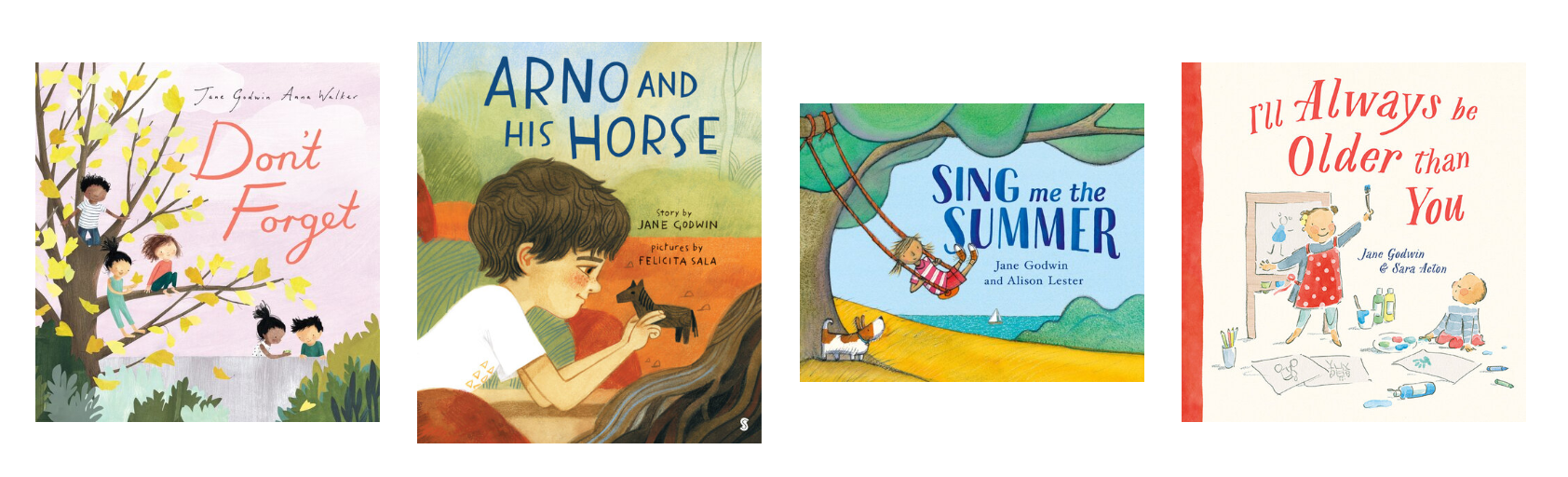
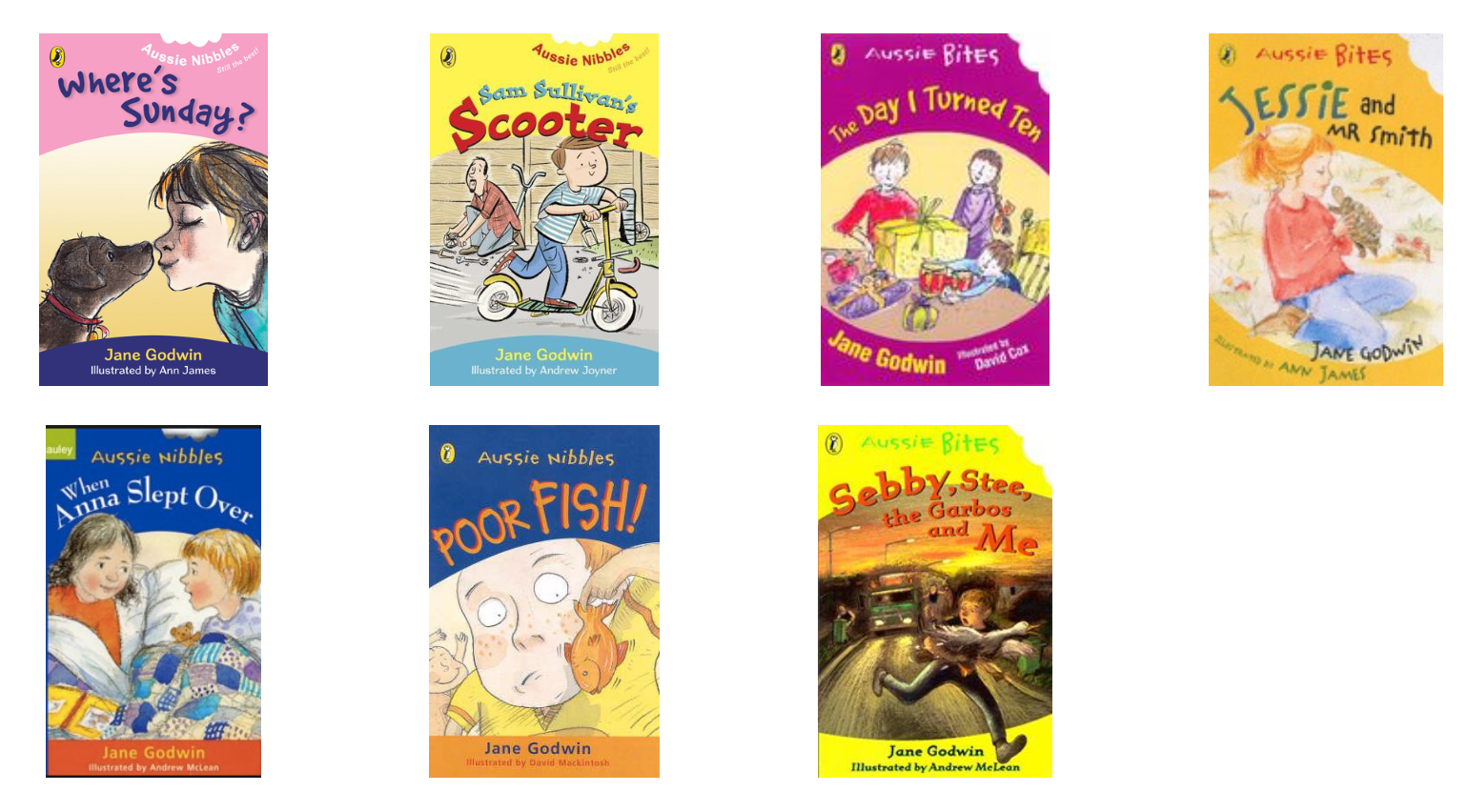
Here are some other books by Jane Godwin. I especially love Ivanhoe Swift left home at Six, Poor Fish, What do you wish for?  and The Best Hiding Place:


Sunday, March 17, 2024

Every Night at Midnight by Peter Cheong


Begin with the cover - can you see the shadow? This hints at the content of this story. The end papers also link nicely with the beginning and ending of this tale.

"Every night at midnight I turn into a wolf."

Stop and talk to your group. What does this mean? Has anyone heard of a werewolf? Look closely at the first page. The walls are black and filled with sketches by the young boy. If you look really hard you can see his book and pencil case with his name Felix. 

Once Felix is a wolf he sets off, wearing his red sweater, to explore the streets near his home late in the night. All of this makes for exciting adventures but when his friends invite him to a sleepover, he has to say no.

"So I keep to myself, and they leave me alone. I am perfectly fine on my own ... (but) I wish I didn't turn into a werewolf every night, though."

Then a new girl arrives at school. She is instantly popular and it turns out she can run much faster than Felix. Why? You need to read this book to find the answer which might surprise your young reading companion.

This story about loneliness, not fitting in, being different, and making friends is a timely reminder that we are not all the same. I did wonder about the boy/wolf’s parents who are conspicuous by their absence and how does he survive at school every day without any sleep?  These boring adult concerns are irrelevant as children mightily enjoy the fun and adventure of being able to shape shift and cavort about at night without supervision. Story Links

You can see inside this book on Peter Cheong's web site

This book is a CBCA (Children's Book Council of Australia) Notable title - or long listed title - for our book awards. In this case it is in the Picture Book of the Year category.

Here are the judges' comments: This highly original and engaging book about staying true to one’s identity and finding friendship in an unlikely place would be very appealing for the younger reader. Evocative language is used effectively, setting the tone for this whimsical story and maintaining mood throughout. Soft rhythm and effective repetition of phrasing reinforce elements of the narrative with a minimalistic approach used in placement of written text between each double page spread. Illustrative style is creative with colour palette perfectly matched to the written text. Design and layout are imaginative and creative in reinforcing and expanding on the narrative. Visuals provide added elements to the written text e.g. the subtle shadows in some windows towards the end of the book hint at another layer to the narrative.


Now for the final page - this is sure to elicit a lot of comments from your group. 

  • Look closely at the group of friends gathered in the white-haired girl's bedroom in the final scene. 
  • Think about the way we see Felix wearing his red sweater both as a human and a werewolf.
  • Did he really turn into a werewolf? Could this book really be about 'fitting in' or shyness or difference?
  • Does the final scene change the way you read the story a second or third time?
  • Are the 'kids' in the final scene from Felix's class?
  • What do you think about the boy who is dressed as a bear? Is this another story hint?
  • How does the red sweater work as a way to better understand more about Felix?
Here are the questions written by Scholastic in their Australian Standing Orders notes.

Take a look at the excellent set of ideas from Lamont Books. (I highly recommend their standing order service). 

The book design here is excellent contrasting night and day scenes and one wordless double spread. Peter Cheong also very effectively shows Felix and his new friend racing across the city.

With a group of older students, you could compare this book with this one - it is out of print but is sure to be held in many school libraries. 


And here is some background reading for adults about werewolves and some information you could share with a group of older students

I have written the notes for the Picture Books for Older readers database about Every night at Midnight - take a look here.