Showing posts with label Antarctica. Show all posts

Friday, October 24, 2025

All about Antarctica by Marc Martin


All about Antarctica - A fact book about the Southernmost Continent

Take a close look at the cover - there are two things I need you to see. The first is the series name - "An Everything and Everywhere book". Now move in even closer. Look at the author name Marc Martin. Move your eyes to the left - yes can you see him - a tiny penguin wearing a red hat! Now that you have found this little penguin on the cover of All about Antarctica keep going because he is on EVERY page. Oh, and make sure you run your fingers over the cover because it is embossed - I love this. In fact the production values of this book are very high and yet the price is so affordable - three cheers for Penguin Random House. Make sure you read the whole of this blog post because there is a surprise at the end!

I am not sure if this is still the case, but Grade Six students in my former school studied Antarctica and so along the way I read and learnt a lot about this wonderful continent. Like Marc Martin I found there was so much to discover and I totally agree with him that it needs to be cared for a kept as pristine as possible and this means, sorry if this offends you, less or even no tourists (those are my words not taken from Marc Martin).

In the library when we explored Antarctica, though books and journals and video clips, I loved discoveries about the layers of clothes, the job application process and personal attributes of the scientists who work there, life on the research station, the Antarctic Treaty, terminology used for icebergs, all the different penguins (my favourite is the Chinstrap) and of course stories of the heroic explorers. All about Antarctica covers all of this and more but in an easy-to-read format for younger readers aged 6+. Every page is filled with tiny images to explore so this is a book to savor and enjoy. 

And the text has a light layer of humour. Make sure you look at the faces of the poor ponies used by Ernest Shackleton:

"Also, Antarctica has penguins, and the Arctic doesn't, while the Arctic has polar bears, and Antarctica doesn't."   "Antarctica gets very cold so you need lots of warm clothing! ... so don't forget your jacket."

Marc Martin spoke at a city bookstore last night and he explained that he creates each image separately and then combines them onto each page in a form of digital collage - it is easy to see he once worked as a graphic designer because his page layouts are so perfect. Marc Martin uses digital technology, but he is so aware that "the more digital you do the less human it feels".  I cheered when he said this because it is so true. (Not to criticise another wonderful illustrator but one of our Australian and famous illustrators has a new series of books about emotions and they just don't reach out to me - now I know why - because every illustration has been done with digital techniques and both of the books in his series feel so clinical and cold).


Anyway, back to All about Antarctica, which is a book that should be added to every school library collection and a book that I am certain will be a CBCA Eve Pownall notable and shortlist title in 2026. The idea for a book about Antarctica came from a page Marc included in his book Lots. An interesting but important thing to know in the US, Lots is called Everything and Everywhere - can you see the link. I scoffed when he told us this because so many of our Australian books are given a new title by their US publisher but actually in this case there was a good reason. The word 'lot' has a different meaning in the US and often relates to a parking lot or a block of land. Marc plans to use the US title as a series name and his next book will be about Markets - such a wealth of things to explore under that title.


Listening to an author or an illustrator talk about their work is always so fascinating. He took enormous care creating this book - from page layouts, accuracy and the very important choice of font which needed to look like handwriting to give his book a journal feel. He used his own handwriting in Lots but with so much text in this book he was pleased to find the perfect computer font to match is style. It is called Blaue Brush. It is also clear that an enormous amount of research has gone into the thousands of facts inside this book. 

From award-winning Australian author/illustrator Marc Martin: A fact-packed illustrated journey to the coldest place on Earth - Antarctica! Antarctica is a fragile and fascinating world that most of us will never see . . . and it’s disappearing. Learn all about it before it’s too late. All About Antarctica is an inviting and exciting reading experience with brilliant color illustrations paired with bite-sized facts on every page. A thrilling illustrated adventure that allows readers to get a deeper understanding of this unique place and learn about the global importance of the southernmost continent. Offering a look at the world of Antarctica, a place where curiosity meets science. Great for readers ages five to ninety-five! From colossal squids and active volcanoes to research vessels and cricket matches, there’s a lot more to the South Pole than just penguins and icebergs (though there are also a lot of penguins and icebergs). Learn how humans survive in the coldest, driest, windiest place on Earth and discover what surprises await in this endlessly fascinating book. Publisher blurb.

BONUS - if you would like to own an original piece of art from Marc Martin IBBY Australia are running a fund raiser art auction and YES we have a beautiful image from this book!


Sunday, March 9, 2025

South with the Seabirds by Jess McGeachin

The subtitle of this book says: Follow four remarkable scientists to the edge of the world.

By being one of the first female scientists to join an Antarctic research trip, fearlessly exploring the globe, actively striving to conserve wildlife and leading by example Mary Gillham became an inspiration to female scientists helping to normalise the sight of women in a traditionally male-dominated field.

In this book we meet four scientists. The year is 1959 and that is very significant because only men are considered able to do research in Antartica. The four women we meet here are Mary Gillham from the UK; and Isobel Bennett, Hope Macpherson and Susan Ingham from Australia. Hope and Isobel are marine biologists who plan to study the animals in the rock pools on the shores of Macquarie Island. Mary has been studying birds, animals and plants in a variety of environments from the arid desert to rocky islands. She has a plan to study the seabirds and unique plants and to report on the damage caused by introduced rabbits. Susan wants to check on the seals to make sure their populations are recovering now that hunting is banned. And all four scientists are fascinated by the variety of penguins - Royal, King, Gentoo and the Southern Rockhopper. 


Image Source Antartcia.gov.au


The whole expedition was just 15 days. You can read more and this expedition and about Mary Gillham (1921-2013) and see photos and newspaper articles here. The end papers in South with the Seabirds show four places on Macquarie Island that celebrate the achievements of these women scientists. This book also has a useful timeline and a brief biography of each of the four women. I was thrilled to read that Mary Gillham achieved her PhD. 

Some facts about Macquarie Island:

  • Macquarie Island is located halfway between Tasmania and Antarctica and a station was established on the “green sponge” in 1948. The Island was used as a half way point to establish the first radio link between Australia and Antarctica during Sir Douglas Mawson’s 1911 expedition.
  • Throughout the year, the Macquarie Island teems with vast congregations of wildlife. Where the nutrient rich waters of the Southern Ocean meet warmer northern waters, rich feeding grounds are created and make the island an ideal haven for penguins, seals and seabirds to live and breed.
  • Macquarie Island was declared a wildlife sanctuary in 1933. In 1997, World Heritage status was granted due to its outstanding geological and natural significance.
  • Rabbits, rats and mice, brought to the island over nearly 200 years of visitation and occupation were finally eradicated in 2014, after a 7-year, eradication program. With grazing pressures removed, the island is returning to its former lush, green glory.
In my former school library our Grade 6 students completed a unit of work on Antartica. This book would be a perfect resource. Using this book you could also explore women in Antarctica - scientists, explorers and as people working in the various stations. The publisher webpage has a link to a set of teaching notes to use with South with the Seabirds. 

Here are some websites to explore:


When you introduce the topic of women in science you could also talk about Beatrix Potter. The children are sure to be familiar with her characters like Peter Rabbit and other animals characters who appear in her small books, but Beatrix Potter was also an amazing scientist especially in the area of mycoloy. I think your students will be amazed to learn that as a woman in 1897 she was not permitted to present her research to London’s Linnaean Society, the bastion of Victorian botany, which was exclusively male and barred women from membership, denied them access to the research library, and wouldn’t even allow them to attend the presentations of scientific papers.

We are so lucky to have a talent like Jess McGeachin producing books here in Australia.


South with the Seabirds is a CBCA 2025 Eve Pownall (Non Fiction) Notable title. I am very hopeful it will be one of the six short listed titles which will be announced at the end of March. 


The 2025 CBCA Book of the Year Awards Eve Pownall Award Notables are…

  • All About the Brain by Gabriel Dabscheck (Berbay)
  • Always Was, Always Will Be by Aunty Fay Muir & Sue Lawson (Magabala Books)
  • Anti-Racism Kit by Sabina Patawaran & Jinyoung Kim, illustrated by Emma Ismawi (Hardie Grant Children’s Publishing)
  • Australia’s Baby Animals by Jess Racklyeft (Affirm Press)
  • Before the Mountain had a Name by Fiona Levings (Forty South Publishing)
  • Come Together Again by Isaiah Firebrace, illustrated by Jaelyn Biumaiwai (Hardie Grant Explore)
  • Design & Building on Country by Alison Page & Paul Memmott, illustrated by Blak Douglas (Thames & Hudson Australia)
  • Extreme Animal Facts by Jennifer Cossins (Lothian Children’s Books)
  • Flora: Australia’s Most Curious Plants by Tania McCartney (NLA Publishing)
  • Follow Your Gut by Ailsa Wild & Lisa Stinson, with Briony Barr & Gregory Crocetti, illustrated by Ben Hutchings (Scribe Publications)
  • I am a Magpie, I am a Currawong by Bridget Farmer (Black Cockatoo Books)
  • The Illustrated Encyclopaedia of Extinct Animals by Sami Bayly, illustrated by Sami Bayly (Lothian Children’s Books)
  • Into the Ice: Reflections on Antarctica by Alison Lester & Coral Tulloch (A&U Books for Children and Young Adults)
  • Making the Shrine: Stories From Victoria’s War Memorial by Laura J Carroll (The Crossley Press)
  • Now for the Good News by Planet Ark Environmental Foundation, illustrated by Sarah Wiecek (Penguin Random House Australia)
  • Plantabulous! More A to Z of Australian Plants by Catherine Clowes, illustrated by Rachel Gyan (CSIRO Publishing)
  • Seed to Sky: Life in the Daintree by Pamela Freeman, illustrated by Liz Anelli (Walker Books Australia)
  • Sensational Australian Animals by Stephanie Owen Reeder, illustrated by Cher Hart (CSIRO Publishing)
  • South With the Seabirds by Jess McGeachin (A&U Books for Children and Young Adults)
  • Sunny Finds His Song by Catherine Storey & Penny Watson, illustrated by Sarah Matsuda (Wet Season Books)
  • Too Many Tigers by Monica Reeve (Forty South Publishing, Tasmania)
  • Unreal by Kate Simpson, illustrated by Leila Rudge (A&U Books for Children and Young Adults)
  • Walking the Rock Country in Kakadu by Diane Lucas & Ben Tyler, illustrated by Emma Long (A&U Books for Children and Young Adults)
  • Wedge-tailed Eagle by Claire Saxby, illustrated by Christina Booth (Walker Books Australia)
  • When the World Was Soft by Juluwarlu Group Aboriginal Corporation, illustrated by Alex Mankiewicz (A&U Books for Children and Young Adults)


Friday, January 3, 2025

Except Antarctica! by Todd Sturgell


You need to add this book to your school library. It is a perfect text for all your science units about animals, animal classification and habitats plus it is SO funny. The only question you might have to ask yourself is just where to shelve this book? Is it just a picture book about a crazy turtle who sets out to disprove the theory that turtles live on every continent except antarctica? Well yes. Turtle gathers all his friends, who also apparently do not live in Antarctica, and the team set off to check this out for themselves. So far this could just be a funny romp, a story, but the final pages - eight of them - are filled with animal facts - like a non-fiction book. Oh, and the end papers are world maps and a useful map of Antarctica showing all the research stations.

The swiftly rising, maniacal tone is highlighted by different, boldfaced types assigned to the narrator and the animals. Vivid, wildly imaginative illustrations add wonder and excitement to the proceedings. Readers will laugh out loud at the animals’ recalcitrance and the narrator’s frustrations, all the while absorbing a great deal of information. Delightful and hilarious. Kirkus Star review

This nature-documentary-gone-wrong is a gleefully funny lesson in determination, and includes educational backmatter and lots of animal fun facts! Penguin Books

Now think about the animals that travel with our hero - an owl, a dung beetle, a snake, a mouse, a bee, and a frog. Yes nearly every animal group is covered - birds, insects, reptiles, mammals, and amphibians. Only one group is missing - can your readers work this out and then can they talk about why.

Here are a few fun facts from the final pages in this book:

  • The oldest turtle in the world lived to be 255 and was named Adwaita.
  • Burrowing owls love to eat dung beetles.
  • Dung beetles navigate using the Milky Way.
  • Snakes smell with their tongues.
  • Bees love the colour blue.
  • Mice eat fifteen to twenty times a day.
  • Frogs were the first land animals with vocal cords.

Except Antarctica was published in 2021. It is still available and I found a copy for a good price but you might need to act quickly because I imagine their stock might be limited. Here are a set of teaching ideas from the publisher. 

This book is also an example of breaking the fourth wall - you will hear the voice of the off stage narrator trying to advise the turtle his mission is impossible. 

Here are some companion books:


Todd Sturgell is an illustrator, author, and freelance art & creative director. In his previous career as a corporate advertising art director, he worked with national brands including The Home Depot, Hyundai, Red Lobster, and 7-11; in his current role, he focuses on local and regional clients including universities, museums, and music, food, arts, and wine festivals. He lives, hikes, draws, and watches nature documentaries in the North Carolina Mountains with his wife, daughters, and dog Max (named for a certain famous picture book character). He has not yet been to Antarctica.

Monday, December 25, 2023

Twelve Days of Letters to Santa - Christmas Day


Dear Father Christmas by Alan Durant illustrated by Vanessa Cabban

Dear Father Christmas was published in 2005 and the paperback in 2013. I picked up a copy at a recent charity book sale for just 50 cents! This book is out of print but I am sure it will be in many school and local libraries and hopefully the final (vital letter) is still in the envelope on the last page.

After the children visit Santa in a big store Holly leaves him a letter above the fireplace:

Dear Father Christmas,
I hope you are well. Is it snowing in Lapland?
It is cold here. I saw a man in a shop today who said he was Father Christmas.
He was dressed like you, but was it you? Really?
He told me to leave my Christmas list by the fireplace, but I wanted to make sure it really was you.
Please answer.
love Holly

Father Christmas writes back to Holly. She finds his letter on her mantle. It is typed and has been sent from Lapland.


Dear Holly,
Thank you so much for your letter.
What a lovely Christmassy name you have!
"The Holly and the Ivy" is one of my favourite Christmas carols. 
I am also very fond of "Jingle Bells." I often sing it on Christmas Eve when I ride the sleigh
with my reindeer to deliver the presents.

Santa goes on to ask Holly to write her Christmas list. 

Holly wants something very special for Christmas, but she does not feel brave enough to ask so instead she writes back and asks about the elves. Once again Holly finds a reply on the mantle and once again she is not able to ask for her gift instead this time she asks about riding in the sleigh and Billy wants to know how Santa can fit down the chimney. The letters continue back and forth and Santa also gives Holly a decoration for her tree and a special guide explaining how to care for reindeer. On Christmas Eve Holly finally writes her Christmas list - you will never guess the one thing she wants most in the world but the envelope on the final page contains something so wonderful you are sure to sigh with happiness.

Here is a good idea - this reviewer suggests you treat Dear Father Christmas a little like an advent calendar - opening one letter each day in the lead up to Christmas. I would share this book with children aged 6+. Please don't use this with your child but if you need to see inside this book here is a video - it is read way, way too quickly. 

Meerkat Merry Christmas by Emily Gravett

Meerkat Christmas was published more recently in 2019. The paperback edition [9781509857302] from 2020 is still available. The publisher suggest this book for readers aged 3+ but to my eye this one is for an older child especially one who has enjoyed the other book from this series - Meerkat Mail (see below).

Bookseller blurb: A young meerkat travels the world looking for Christmas in this festive card-packed picture book, ...  Sunny isn't quite sure if Christmas in the desert with his meerkat family is the right sort of Christmas - there's no snow, no fir trees and no figgy pudding! So, he heads off on a journey round the world looking for the picture-perfect Christmas . . . before realizing he might have left it at home after all.

Begin with the cover - you need to stretch it right out.


Sunny reads a magazine article - How to have the Perfect Christmas. 

1. THE PERFECT WEATHER Must be snow. Crisp and deep.
2. THE PERFECT TREE Must be tastefully decorated
3. THE PERFECT PRESENTS There must be a huge pile.
4. THE PERFECT DINNER Must include well-boiled sprouts.
5. THE PERFECT MUSIC Christmas carols.

So Sunny packs his bag (which looks a little like a Santa sack) and he heads off - leaving the Kalahari - in search of a place that is more Christmasy than his desert home. 

First stop Australia and his friend Kev. But oh no they are having prawns and there is no snow and everyone is at the beach. Only one thing on his check list of five criteria receives a tick. 


Next stop Trevor's in the Philippines. Again, only one tick on the list although Sunny does enjoy eating crickets so this food be part of his Christmas dinner. He travels on to visit Robin, but it is raining and very gloomy. The birds are singing carols but there is no snow and the food on offer is worms! The weather is way better in Antarctica - snow tick, presents tick, but no trees, no dinner and no singing. Sunny travels on to the north. Snow tick, trees tick, but no presents, no dinner and no music. 

Finally "on the night before Christmas Sunny arrives somewhere perfect. The snow is falling (outside), everyone is singing, there is a beautifully decorated tree, plenty of presents and a HUGE Christmas dinner with all the trimmings (even sprouts).  It should be perfect."

It should be perfect but something is missing! Santa has the solution, and a wonderful present arrives on Christmas morning in the Kalahari. Oh, and remember Sunny had a sack - wait until you see what he has inside. And make sure you spend some time enjoying the brilliant end papers which are different front and back and contain some wonderful images to make you smile. 


Then re-read the book and find all the fun and corny Christmas cracker jokes. Here is a video of the book which is well done - good pace and full screen images but please only view this after you have enjoyed exploring the real book with your young reading companion or library group. 


Sunday, September 25, 2022

Iceberg by Claire Saxby illustrated by Jess Racklyeft


Antarctica is a fascinating place but it is also a place very few of us will ever visit. If you do visit Antarctica you will only be there for a very short time and only see a fragment of this huge continent. People do work at the various stations in Antarctica but only a small number of people will ever experience a whole year in the coldest, windiest, driest place on earth.

Every word in Iceberg is liquid gold. The text is informed by facts but expressed using a carefully constructed lyrical text. Referencing the seasons as a way to mark time is perfect in the context of an iceberg in Antarctica. The colours beautifully reflect the icy environment and a sense of wonder is created by the see-through transparent layers of water which allow the reader to see the mysteries beneath the ocean. 

This book has been carefully designed. The front cover has a stark image of an iceberg but closer inspection reveals the different animals that call this place home. The end papers actually look cold and contrast beautifully with the exuberant colours found on the fold out page later in the book. The text and illustrations in this book beautifully complement each other. There are tiny touches of humour in the faces of the sea creatures and this adds a lightness to the story. This book will stand the test of time, the sense of place is very strong and the text will give young readers a rich reading experience.

Publisher blurb (click this link to find very comprehensive teachers notes): In the final freeze of an Antarctic winter, green tails wave across a star-full sky, as if to farewell endless nights. If this world looks empty, look closer ... Penguins trek across the ice to their winter homes. As the temperature warms, birds fly above on their long migrations. And with the advent of summer, beneath an iceberg, the sea is teeming with life. Ocean, sky, snow and ice - minute greens and giant blues - dance a delicate dance in this evocative portrayal of the life cycle of an iceberg.

In 2017 Claire Saxby wrote a poem for our NSW School Magazine (Touchdown issue #1 February 2017).  I was luckily able to obtain a copy. Claire mentioned this in an interview with Joy Lawn for her blog Paperbark Words. Claire talks about this process here

Here is part of the poem:

In a blue Antarctic dawn

an iceberg calves - 

shears from a glacier

and is released to the sea

sharp and angular

it hoards ancient weather

layers of ice clothing

a coat for each year volcanoes blew

and black ash fell like snow

Iceberg was the 2022 Children's Book Council of Australia Picture Book of the Year winner but because it was entered for the CBCA Picture Book of the Year I haven't been able to talk about it until now.  Book Week and the announcement of the CBCA Award winners for 2022 happened last month. As a CBCA judge I had to wait to share these books until the judging was completed.

Here are the judges comments:

The writing is sophisticated; facts and technical vocabulary are lyrically combined with beautiful description. The sentences are perfectly balanced, and verbs are used precisely to describe the vivid life of this icy place. The choice of artistic medium offers a perfect complement to the text; the illustrations are subtle at times and commanding at others. The use of many shades of blue beautifully reflects this icy environment and immerses readers in the Antarctic. A sense of wonder is created through transparent layers of water allowing readers to spot life above and the mysteries below the surface.

Awards:

  • Adelaide Festival Award for Literature shortlist 2022
  • CBCA Notable Picture Book of the Year 2022
  • CBCA Notable Eve Pownall Award
  • CBCA Shortlist Picture Book of the Year 2022
  • CBCA Picture Book of the Year 2022 Winner
In this video shared on Facebook Jess Racklyeft talks about her research and processes in creating the art for this book. 

Here in Australia, by now, most children in Primary schools are sure to have heard (hopefully someone read the book in a library or classrooom) and/or seen (Storybox Library) this book but I know people from other places in the world read my blog so I do hope you can find Iceberg in your local library, school or book store. Here is the website for Jess Racklyeft and for Claire Saxby.

Her text is both narrative and non-fiction, effortlessly creating a wonderful reading experience for teachers, librarians or parents while also providing an educational, fact-learning feast for children in kindergarten to middle primary. Reading Time

Saxby’s text is sophisticated, poetic and accessible all at once and Racklyeft’s illustrations are multi-layered and luminescent; ‘Iceberg’ is text and images in perfect harmony ... Children's Books Daily

Here is the US cove which is slightly different - I wonder why they added a subtitle?


Here are some craft works inspired by this book:


Here are some books you could use to compare the way illustrators depict Antarctica:


Other books by Claire Saxby:


Wednesday, January 5, 2022

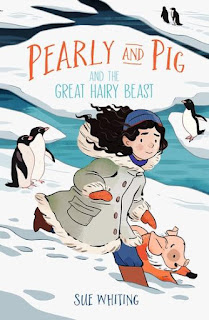
Pearly and Pig and the Great Hairy Beast by Sue Whiting


NO ADVENTURE TOO SMALL
NO CHALLENGE TOO GREAT
ADVENTURE BY STEALTH
LEAVING NO TRACE

Pearly is on her own. Well not quite, she has her pig called Pig. Luckily Pearly has some impressive skills especially with languages even animal languages such as 'pig'. Luckily Pig also has impressive skills with his fined tuned nose which can sniff out trouble in all its forms. Unluckily Pearly has been caught by a very deranged woman who is intent on travelling to Antarctica.

Antarctica?  Why does Emmeline Woods want to go there? 

This book is a rollicking adventure with plenty of twists to keep readers turning the pages. It will appeal to readers aged 10+ or slightly younger as a read-aloud. This book will be released in March 2022. Thanks to Beachside Bookshop for my advance copy. 

Publisher blurb Walker BooksPearly Woe is a worrier. She worries about everything, especially that she’ll never be brave enough to become a member of the top-secret group of stealth adventurers – The Adventurologists’ Guild. Pearly also has a special talent – she can talk to animals. Her favourite animal to talk to is her pet pig, called Pig. But with her parents missing, Pig pig-napped and Pearly a stowaway on an icebreaker heading for Antarctica, Pearly’s worries just got REAL.

Pearly's parents are members of the Adventurologists' Guild. At the back of the book you can read their Charter; Rules; list of Basics; and ten ways to survive a sticky situation.

Some rules are: 
  • Stay Alive
  • Tread lightly
  • Never answer the Adventure Phone - unless an authorised member of the Adventurologists' Guild

Surviving tricky situations:

  • Take initiative
  • Think outside the square
  • Make the impossible possible
  • Don't panic
  • Expect the unexpected
  • Knowledge is power
Companion reads:


Saturday, February 22, 2020

Antarctica by Moira Court


Antarctica will appeal to a range of readers - it certainly appeals to me. It is a counting book for the youngest children, it is filled with animals some of which you may not know (blackfin icefish) and the art work is so tactile. The language is also perfect to read aloud:

"Three lumbersome, cumbersome elephant seals lining the sandy shore."
"Ten crimson, vermilion sea stars creeping about on twinkle toes."

Have you heard of blackfin icefish? They live at the bottom of the ocean and have antifreeze in their blood!


I always find collage illustrations so appealing. The ones here by Moira Court are sure to inspire your students. You can see some of the art here from the publisher web site. The final pages of this book add so much with details about Antarctica and brief facts about each of the featured animals.

Here is a set of teaching notes and an interview with the author. There is also an interview from 2010 on the Kids Book Review blog.

You can tell this book is made with passion, great research and admiration for Antarctica, it would be a fun educational resource for young children, and could inspire further activities, artwork and discussions. Kids Book Review

Thursday, July 2, 2015

Blown away by Rob Biddulph


Stories told in rhyme always hold special appeal for young children.  Blown Away is a terrific example.  It is also a wonderful celebration of co-operation and teamwork.

A windy day.
A brand new kite.
For Penguin Blue
a maiden flight.

Needless to say Penguin Blue is blown away along with some wonderful friends who try to stop his kite.

The other joy you will find in Blown Away are all the visual jokes. On first reading you might miss the little stowaway from the jungle who joins the voyage back to Antarctica. Similarly, the gorilla on the last page will provide a good discussion point.  Make sure you also take time to read all the little signs too - such as "You are leaving the Antarctic. Please swim carefully."

Blown Away is the winner of Waterstones Children's Book Prize for 2015.

Here is a set of puzzles based on this book and some drawing ideas from the author.  Here is an interview with Rob Biddulph.  Make sure you read the Kirkus review too.

This tightly crafted tale shines with the hallmarks of accomplished picture-book making. From the clever (never cutesy) rhyming text through the visual jokes within the whimsical illustrations that amplify the storyline to the expert design of the endpapers—everything works, and it works together. Kirkus

You might also enjoy A wish for wings that work by Berkeley Breathed which is another splendid example of teamwork.


Sunday, January 26, 2014

Sophie Scott goes South by Alison Lester


This book is the perfect to introduce the topic of Antarctica to children.  It is personal - as we read of Sophie's experiences, it is factual with details of the climate, landscape, history and daily life of the expeditioners and it has the most fabulous illustrations because Alison Lester has incorporated her own art work with photos and captions and even stamps.

In 2005 Alison Lester travelled to Antarctica.  It was a six week journey and during this time she used email to share her experiences with children around the world.  The children in turn sent Alison their own stories and drawings.  Many of these appear in this book.

Sophie is lucky.  She travels to Antarctica with her dad - Captain Scott.  He is the Captain of the Aurora Australis - an icebreaker ship which is travelling to Antarctica to deliver people and supplies to Mawson station.  "As we head towards Antarctica it feels as though we are entering an icy kingdom and the icebergs are guarding it."

We will use this book in our library this term with Grade 6 as we begin to talk about this fascinating and important continent.  Here is a little video to view before you read Sophie Scott goes South.  This book also has an excellent glossary and the end papers present maps annotated with facts about Antarctica.


Saturday, December 8, 2012

Lost and found by Oliver Jeffers

I have just noticed that when you look on my sidebar books with the subject 'Friendship' out number all others. I wonder why?  Is this because so many books are about friendship or because I am some how drawn to stories with friendship at their heart. I will need to think a little more about this.

Once there was a boy and one day he found a penguin at his door. The boy asks everyone if they have lost a penguin and then he realizes the penguin needs to travel home to Antarctica.  He tries to attract the attention of a large ship but his calls are not heard over the ship's horn so he checks his own little row boat for sea worthiness, packs some supplies and the two of them head off to Antarctica.  Along the way the boy entertains the penguin with wonderful stories.

When they arrive the boy waves farewell to the penguin and he sets off home but he has not gone far when he realizes he has made an awful mistake."The penguin wasn't lost.  He was just lonely."

This is such a perfect book in every way. The illustrations, the emotions and the perfect ending.  You will cheer for our two little heroes as they sail in different directions around Antarctica.  Here is a video from Oliver Jeffers on how to draw a penguin.  Here is the author web site.  Here is a trailer for the 24 minute award winning film.  Take a minute to look at this it is so charming. Finally here is an amazing detailed review of this book.