Showing posts with label COVID-19. Show all posts

Thursday, July 2, 2026

One Sweet Song by Jyoti Rajan Gopal illustrated by Sonia Sanchez

A joyful celebration of music and community. Kirkus

Bookseller blurb: In a quiet neighborhood, a single note trills through the air. Another note joins, and then another. One by one, curious people are drawn to their windows, doorways, and balconies to support the medley. Professional musicians play instruments from around the world, while others bang pots and pans. All are welcome as the notes swirl and dip and crescendo, coming together to make one sweet song. And when the music fades and this diverse neighborhood is once again silent, the reverberations of unity remain. Written by a kindergarten teacher and inspired by the balcony singing in Italy during the pandemic—with a countdown from one to ten and back gently woven in—this rhythmic synergy of text and art is a buoyant, global-minded celebration of how music connects us, even in the darkest of times.


Do you remember some of the special parts of those Covid-19 lockdowns? I know it was a complex time but there were tiny moments of community joy such as people who placed teddy bears in their windows, chalk drawn games on the footpath, and shared music. 

Here in my street on ANZAC day, at dawn, someone played their trumpet and others joined in with sounds of the bird dawn chorus as an accompaniment - it was a magical morning.

In Italy and other countries people played music on balconies joining their sounds together into shared pieces and that is the premise of this story. As a bonus this book is a counting book one to ten and back again so it will appeal to very young children and many of the musical instruments are sure to be unfamiliar to your library group so there is also scope with this book for further exploration of instruments from around the world. AND you must link this book with the CBCA 2026 Book Week slogan Symphony of Stories. Instruments in this story: ghatam, flute, triangle, drums, cello, and a morsing

This lyrical counting book uses rhyme and color to celebrate the power of music and connection.  Rich vocabulary in charming couplets make for a delightful read aloud and the premise of the story is sure to inspire conversations about community and how to add more beauty in our everyday lives.  Vibrant, joyous digital illustrations depict a diverse group of neighbors of various ages and family units sharing their talents and instruments, and readers will love finding their favorite characters on each page spread.  YS Book Reviews

You can see more books by Jyoti Rajan Gopal here and other books illustrated by Sonia Sanchez:


Tuesday, December 30, 2025

The Trouble with Heroes by Kate Messner


Twelve weeks. 
46 peaks. 
Finish by Labor Day 
and all the charges go away.


A local youth has been arrested for vandalizing St. Mary’s Cemetery over the holiday weekend. Lake Placid Police responded to a complaint of someone kicking headstones shortly after 4:00 p.m. on Friday.

  • Why did Finn do this?
  • What will be the consequence?
  • What do we know about the grave?

School is not easy for Finn either. And now he is told he has to complete catch up work for English and PE. Here is his English assignment:

Poetry Project: What Makes a Hero?   Assignment: Draft, revise, and edit a collection of at least twenty poems about people you consider to be heroes. You may write about anyone who inspires you, living or dead. Your collection should begin with an introduction poem and must include at least five different poetic forms (haiku, sonnet, acrostic, concrete poem, found poem, riddle poem, erasure poem, free verse, magic 9, ode, pantoum, sestina, villanelle). Be sure to make use of poetic devices such as alliteration, onomatopoeia, similes, and metaphors. Have fun!

Finn's dad is famous in this town because there is a photo of him rescuing a girl after the tragedy of 9/11. Of course that was years ago. 

I see that photo in my sleep. 
Every detail. 
Dad’s black coat white with ash. 
His hair. 
His face. 
Like a statue carved in cold gray stone, 
lines chiseled in his forehead, 
around his eyes. 
Muddy tear streak down his cheek 
as he ran from the North Tower. 
He had a survivor! 
He was carrying her in those strong statue arms. 
Her leg was bleeding and she wore 
one red shoe, 
the other lost somewhere 
in the ashes, smoke, and screams.

The punishment for the vandalism is to climb 46 mountains. Finn is angry about his dad - but what has happened? You will adore meeting all the people who climb the mountains with Finn - they are compassionate and wise and quietly help him to make sense of his life and his personal tragedies. Oh and the dog is wonderful! I also loved the way Kate Messner structured this story. 

You will NOT be able to put this book down. It is such a page turner. Highly recommended for readers aged 10+.

Blurb from the author page: Finn Connelly is nothing like his dad, a star athlete and firefighter hero who always ran toward danger until he died two years ago. Finn’s about to fail seventh grade and has never made headlines . . . until now. Caught on camera vandalizing a cemetery, he’s in big trouble for kicking down some dead old lady’s headstone. But it turns out that grave belongs to a legendary local mountain climber, and her daughter makes Finn an unusual offer: climb all forty-six Adirondack High Peaks with her dead mother’s dog, and they can call it even. In a wild three months of misadventures, mountain mud, and unexpected mentors, Finn begins to find his way on the trails. At the top of each peak, he can see for miles and slowly begins to understand more about himself and his dad. But the mountains don’t care about any of that, and as the clock ticks down to September, they have more surprises in store. Finn’s final summit challenge may be more than even a hero can face.

Here are some text quotes:

She’s the prosecutor in charge of my case. There might not be a court appearance after all, she says, and I’m so relieved I miss what comes next but I snap to attention when she rattles off the price of the headstone I busted: $2,600 for a weathered hunk of rock.

It’s called PTSD. (That’s Post-Traumatic Stress Disorder, in case you’re wondering.) But if you’re a 9/11 firefighter’s kid you already know those letters, learned them with your ABCs, when you learned not to ask questions in September. When you learned how to make your own lunch and sign your own permission slips, and pretend everything was all right.

Some Awards:

  • New York Times Bestseller
  • USA Today Bestseller
  • National Indie Bestseller
  • Publishers Weekly Best Books of 2025
  • School Library Journal Best Books of 2025
  • Kirkus Best Books of 2025
  • Chicago Public Library Best of the Best Books, 2025
  • 2026-2027 Texas Bluebonnet List Nominee
  • 2026 Charlotte Huck Honor
  • 2026 NCTE Notable Novels in Verse
  • Best Kids’ Books about Mental Health 2025, Child Mind Institute

As I read this book, I was in awe of Messner’s skill. She combines so many disparate elements into a book that feels organic and beautiful. Her use of a verse novel format makes so much sense here, allowing us to feel what Finn does even as he is in denial about much of it. His poetry project weaves its way through the verse, capturing his voice and rage. Finn can’t see himself through most of the book, can’t see the people around him and their support, can’t see his father and the truth about him, can’t find his way through. This is a book about what nature can do for a person who is lost and not looking to be rescued. It is a book about the various ways that heroes enter our lives, the forms they take that are unexpected and sometimes drooling dogs, the connection that can result in shared experiences. It is about so much at once and yet again, is superbly focused and deftly written.  Waking Brain Cells

Companion books:


Thursday, June 20, 2024

Imagine a Time by Penny Harrison illustrated by Jennifer Goldsmith


"Image a time when all the world stops ... "

This might sound familiar. Everyone is now at home. No one goes to work or school. The aeroplanes stay on the ground, ships stop in their docks and cars, buses and trains all stop. This slow-down and stopping means people slow down too. They are allowed outside in family groups and many discover nature. Meanwhile nature itself begins to creep back into the city. People have time to ...

"hunt for orchids and gaze at the moon and they listen with hope to the birds' morning tune."

Eventually the clocks do restart but perhaps some magic from those very different times still lingers.

I wonder how many university papers will be written based around books that are set during the Covid lockdowns. There are middle grade novels and picture books - and that is the setting for Imagine a Time. When adults in the future try to explain the impact of Covid and the way we all stayed home and were forced to slow down, Imagine a Time would be a good discussion starter. I especially like the way these strange times are presented in a very positive light. We did stay home but many people also discovered bush walks in their local area and indeed some wild animals did find their way into deserted city streets.

Here are some simple teachers notes. Here is a review from The Bottom Shelf. 

Here are some other books by Penny Harrison and by Jennifer Goldsmith.


Saturday, February 17, 2024

Elf dog and Owl Head by M.T. Anderson illustrated by Junyi Wu


"Clay had never seen a dog like her. She was thin like a greyhound or a whippet. She was milk white. She had tall, pointed ears. And the inside of those ears was red. That was the strangest thing. The red pointed ears."

This wonderful dog has come from Under the Mountain. She was part of a pack chasing an old, clever wyrm. Later we discover her name, written on her collar in an ancient script, is Elphinore. 

Wyrm is derived from the Old English word “wyrm,” which means serpent or worm. It is often used to describe dragons that are more snake-like in appearance, with long, slender bodies and no wings. These dragons are typically associated with European mythology and are often depicted as evil or malevolent creatures. On the other hand, dragon is a more general term that can refer to any type of dragon from any culture. Dragons can vary greatly in appearance and abilities depending on the culture they come from. In Western cultures, dragons are typically depicted as large, winged creatures with scales and the ability to breathe fire. In Eastern cultures, dragons are often seen as benevolent creatures that bring good luck and fortune.

Here are some text quotes which might help you understand the plot:

"Except there was one dog left behind. The young elegant elf-hound with the sharp eye."

"She ran through the spruce woods and pine woods and a stand of maples. She ran to the bottom of the mountain. It was almost night when she got there. She sniffed at the ground, following the scent of her brothers and sisters. She smelled the horses of the Royal Hunt. Their track led right up to a huge cliff face. Then it stopped. But wasn't that where they had come out? Hadn't they all tumbled out into the sunlight in exactly this spot? But now time and magic and the curtain between worlds had shifted, and the door was not there anymore."

Clay is stuck at home because all of the world has shut down. (Covid is not mentioned but readers will link the fear, isolation, and home schooling to these times). Clay is allowed to wander in the forest area near his home and that is where he finds this glorious dog. Little does he know she will lead him to another world.

Clay stumbles on a village filled with strange people. He watches them using a strange powder and it seems to make their vegetable garden grow before his very eyes. Without thinking Clay steals the container and he takes the magic powder home but of course there are consequences.

"They were dressed in old-fashioned clothes, as if it were still 1800; long brown coats and wide black hats. one of the men started to turn his head. He did not stop turning his head. His head turned all the way around on his neck. A face was looking backward toward Clay. It was the face of a huge owl. The eyes were metallic like gold foil."

A young member of this strange community follows Clay and explains he must return the magic shaker. His name is Amos. Now the adventures can begin.

"Elphinore led them to places they had never seen before; seas of ferns and boulders in pure white marble. She bought them to a clock growing out of a tree, still ticking, but keeping the wrong time. She led them to a waterfall deep in the forest, where the river tumbled down a hillside and split into two - one part flowing toward the sea, and the other fell into a deep back hole, down into the world below the mountain."

I have one question for MT Anderson: Why did you name Clay's sister DiRossi?

Spoiler alert - I love the scene on page 154-155 and the way it links to the magical ending. 

"Nobody mentioned to Clay that they'd actually thrown Elphinore's old collar into the trash. A couple of days later, Clay's mom took the trash to the dump. No one in the family noticed."

I also loved the relationship that forms between DiRossi and the once sleeping pessimistic giant. I highly recommend Elf Dog and Owl Head. It would be a wonderful book to read aloud to a Grade 3 or 4 group or each night with your family. After reading this book you will want to keep your eyes open incase you  also find a wonderful dog like Elphinore.

Publisher blurbClay has had his fill of home life. A global plague has brought the world to a screeching halt, and with little to look forward to but a summer of video-calling friends, vying with annoying sisters for the family computer, and tuning out his parents' financial worries, he's only too happy to retreat to the woods. From the moment the elegant little dog with the ornate collar appears like an apparition among the trees, Clay sees something uncanny in her. With this mysterious Elphinore as guide, he'll glimpse ancient secrets folded all but invisibly into the forest. Each day the dog leads Clay down paths he never knew existed, deeper into the unknown. But they aren't alone in their surreal adventures. There are traps and terrors in the woods, too, and if Clay isn't careful, he might stray off the path and lose his way forever.

A hilarious, heartfelt triumph. Kirkus Star review

Elf Dog and Owl Head is a sly novel, told in a droll, wry cadence that conceals the increasingly fantastic nature of the story. Just as Clay begins to slowly realize the extent of the hidden worlds around him, so does the reader begin to understand the depth of the story being told. Book Page

It is a really good story, with the real world and the fantasy balanced beautifully.  The characters and relationships are rock solidly constructed, and the places appeared in glorious technicolor, as it were, in my mind's eye.  I especially was pleased, in one memorable scene of a nighttime magical revelry, to be reminded of my favorite bit of Moominland Midwinter, which doesn't often happen; probably not the author's intention, but it made me happy. Charlotte's Library

Clay and his family are complex, engaging characters whose love-hate-mostly-love relationships will feel familiar to many readers still remembering the frustrations of lock-down and learning from home. Although the story draws on familiar fantasy elements, such as the wild hunt and the wicked dragon, many of the fantastical elements of the story feel fresh and new – especially the severe Owl Heads and their magic gardens. The Children's Book Review

MT Andersen talks to SLJ and Betsy Bird about the real dog and forest wilderness that inspired him to write this story during Covid. 

A veritable plum pudding of energetic action and witty delights, but a -foundation of traditional folklore elements—standing stones, half-buried sleeping giants, fairy mischief, portals to the underworld, the Wild Hunt, and predatory wyrms—creates an underlying hint of genuine menace. Balancing this chill is the devoted relationship between Clay and his dog companion, a theme that stands sturdily in the middle of the mayhem. Black-and-white full-page pencil illustrations contribute to both coziness and eeriness. The Horn Book

Here is a discussion guide to use with this book.

Listen to a four minute audio book sample.

John Newbery Award 2024 - WINNER Eyes and the Impossible. 

Honour books:

  • Eagle Drums written and illustrated by NasuÄ¡raq Rainey Hopson
  • Elf Dog and Owl Head written by M.T. Anderson, illustrated by Junyi Wu
  • MexiKid: A Graphic Memoir written by Pedro Martín 
  • Simon Sort of Says written by Erin Bow
  • The Many Assassinations of Samir, The Seller of Dreams written by Daniel Nayeri, illustrated by Daniel Miyares

Friday, January 12, 2024

Queenie in Seven Moves by Zanni Louise


Let's begin with the title of this book. I thought it would be a book about chess. Yes, that famous game is mentioned, but Queenie is actually the name of the main character and seven moves refers to the way Queenie and her mum keep having to move either to a new house, or a share house and even a run-down caravan.

Homelessness is a VERY serious topic. When we meet Queenie Jean Anderson and her mum we discover they have to leave the home they have rented for many years. Queenie has named this house Peachy but the owner, who is also their neighbour and a friend, has decided to sell it and move on. Mum works in an aged care village and luckily one of the small homes in the village, named Diamonds, will be empty for the next couple of weeks so they can move in there even though this cannot become their home for very long. Once the new owner arrives in the village the mother and daughter move again into a share house with the Elliots.

"The truth is, the Elliots aren't Sarah's friends as such. Sarah's friend's neighbour's cat heard there was a family looking to share for a bit because the dad lost his job during COVID. When I quizzed mum more, she didn't know anything about the Elliots, which seems like a very dicey living arrangement." page 70

The cat heard? I am a bit confused. Also, it turns out the son of the Elliot family is a boy in Queenie's class - why didn't she recognise the surname? It is the end of Year Six so I would expect her to know the names of every student in her class. Queenie is aged eleven or twelve and so is Dory so, sorry to be negative, but I did wonder why her mum would have no concerns about a boy and girl sharing a room? 

"So, I am going from never talking to a guy-who-is- vaguely-good-looking in my life to sharing a bedroom with him."

This arrangement comes to an end quickly when the adults see Dory and Queenie kissing! Next stop - an old run-down caravan.

"Mum jostles the door of Terry's caravan. It takes a few goes, but eventually comes unstuck. True to the description, the caravan is leaky. A stream of water trickles down one wall. A line of mould decorates one of the other walls. The kitchen bench is saggy with moisture ... the place smells of mould and rotting leaf litter."

Remember my comment homelessness is a very serious topic - well I was quite dismayed by the way mum just seemed to accept living in this dreadful caravan. I expected to get some sense of her despair. Especially when all of their possessions are destroyed after the caravan collapses in the wild weather. 

There are a couple more moves after the caravan is wrecked and then finally, we reach the happy ending. I won't spoil this except to say Queenie and her mum do find a proper place to live. Can you count seven moves? Diamonds; Elliots; Caravan; Ruthie's house (the owner of the Caravan); and Dimitri's place equals five. Briefly they move to a tent so Queenie can enter a singing contest - that is move six. Then the happy ending is move seven.

I had a small problem with the Christmas scene in this book. Queenie and her mum head to a market on Christmas Day and there are lots of other people there. Here in Australia Christmas is in the Summer so a market at the beach makes sense but I am fairly sure there are no towns where a market would be held on the 25th December. Yes, there are plenty of Christmas markets, but these happen over the days leading up to big day. I guess you just need to go with the flow - the market does sound like fun with food and rides and Santa. 

"The beachside Christmas market is every year on Christmas Day. It's like an orphans' Christmas, for people who don't have big families to spend Christmas with. There are lots of tourists and young people."

I am not sure I entirely agree with these four reviewers, but I suspect this book might be a CBCA (Children's Book Council of Australia) 2024 Younger Readers Notable title and so to balance my review comments I am sharing these links. I read Queenie in Seven Moves quite quickly and it did hold my attention, but I cannot give it five or even four stars.

Mother and daughter are enriched by the diversity of the characters they encounter with each of their moves. Their homelessness exposes them to the many definitions of homelessness. Both reassess their understanding of friendship. Queenie in Seven Moves is a compassionate tale filled with images of human kindness, and the acceptance and change that seems to surface frequently in times of crisis. Beautifully written. A great read! Kids' Book Review

Queenie in Seven Moves is such a gorgeous story and twelve-year-old Queenie is a treat with her moods and possessiveness of her mother. It's all so relatable! Little Squirrels Bookshelf

This is a book about resilience, family, friendships and self-belief. Readers will enjoy this modern-day tale of urban adventure and quiet heroism. Georgina Gye

This is a well-paced, engaging and emotionally satisfying book, that hits all the right notes (excuse the pun). But if Zanni ever gets bored with writing books, she could easily move on to song writing. The song lyrics included in the book are a clever reflection of Queenie’s experiences and emotions and add to the tenor of the story (sorry, another pun). Storylinks

Here are some other books that explore this complex topic of homelessness. You can pop each title into my side bar to read more or click this link to a post which refers to nearly all of these:


Here are some picture books about homelessness - I highly recommend you share some of these with your students:

If you are in Australia you are sure to know some of these picture books by Zanni Louise. 

And here is her new junior book series:

I read her website and a few interviews with this author and I had one question - is this her real name?  I now discover her first name is Suzannah but is Louise really her surname?  Here are some interviews with Zanni Louise - I was surprised no one asked her about the name Zanni?

Reading With a Chance of Tacos

Your Kid's Next Read episode 81

Australian Writers Centre episode 169

Positive Parenting

Tuesday, July 11, 2023

The Concrete Garden by Bob Graham


Amanda and her mum live on the fifteenth floor of an enormous apartment complex. Heaps of kids live in this building. Today is the day, after "a cold, hard winter", that the doors have been opened and so everyone jumps in the lift and travels down from their apartment homes to enjoy running and playing outside. It is true that their playground is just a large area of concrete but there is so much these kids can do there - ball games, bikes and scooters, and running and jumping with their dogs.

"Children spilled out like sweets from a box."

I love the image conjured by this phrase - happiness, surprises, colours, sweet times ahead.

Amanda is carrying a huge box. It is filled with chalks of every colour. She sets her box down on the ground and draws an interesting picture. If you share this image with a group of children I am sure they would have lots of ideas about Amanda's drawing and also creative ideas about how to add to this image to make it into something even more interesting or perhaps surprising. In fact that is exactly what Jack does. He picks up some green chalk and adds stem and instantly Amanda's picture is a dandelion.

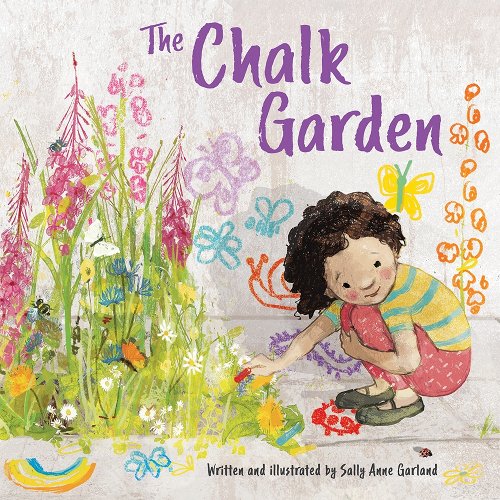
Gradually the enormous picture grows. Every child has something to contribute. You can see some of the children's chalk ideas on the book cover. Bob Graham, as always, paces the page turns perfectly building up our anticipation until just past halfway when the full picture is revealed. 

"Someone drew butterflies, balloons, a caterpillar, and a bumblebee passing by. A beautiful exotic garden spread across the concrete."

From her balcony high up in the building Nasrin sees the wonderful picture. She snaps a picture on her mobile phone and sends it to her mother in Isfahan, Iran.

"With a tear in her eye, Nasrin's mother then sent it to everyone she knew."

The image travels across the world including to the apartments above the concrete plaza where the children have been drawing. The residents finally look out of their own windows, and everyone applauds - someone even throws down some flowers. The children have drawn the most amazing scene in the area below their huge, towering apartment building. It is a joyous moment. Days later though, (spoiler alert) it rains and the picture is washed away.  Once the rain stops, the children once again "burst from the building". Will the children draw another huge piece of art or are there other ways to play? 

Bob Graham gives the kids terrific names - Janet Fairly (it is so true some kids are always known by their full name); the Bradley twins; Lovejoy; Luke's dog Alfie; Indira; Cecilia; Arthur; Rosie and of course Amanda.

I really appreciate the way Bob Graham didn't give his story any hint of magical realism. Creating their chalk drawing has filled these kids with joy but Bob has not been tempted to recreate the famous scene from Mary Poppins and have the children jump into the picture to bring it to life. During Covid 19 lots of children drew games and pictures on sidewalks near their homes. You can see this idea on the cover a very old book by Bob Graham - Charlotte and Henry.


This sweet story - The Concrete Garden - celebrates simple things such as playing, having fun, cooperation and creativity. At no point does anyone ask Amanda if they can use her chalk - she has clearly bought it along to share. We are also left to guess how it is that mum had this huge box of chalk which is given to Amanda as she steps into the lift on the first day the children can all go outside to play. 

Take a look at other chalk books and a great idea for using this book with your classes from my friend at Kinderbookswitheverything.

Bob Graham is quite famous for his wonderful end papers but he has kept them quite minimal in his newest book (due for release August 2023). He does, however, begin the story on the page before the title page and then continues with a wordless story right across the double spread of the imprint page and title page. We see the kids all bursting out of the lift with so much excitement you can almost hear their laughter. Bob Graham pulls out all the illustration tricks as you would expect - full page spreads, small framed images, a birds-eye view (complete with a huge bird), and lots of glorious white space. And of course there are lots of tiny details that require close inspection and revisiting.

Walker Books: After a cold, dark winter, doors opened. Children spilled out like sweets from a box. Amanda was last one out of the tower block. She brought some chalk with her. On every inch of the concrete outside, the children drew pictures of everything they could think of, from flowers and snails, to spaceships and queens. Before long, a beautiful and exotic garden spread out across the concrete. From master storyteller Bob Graham comes a charming, and gently post-pandemic story about finding optimism after a dark spell, and the nurturing power of community friendships in an urban setting. The Concrete Garden will resonate with anyone who has been apart from their loved ones, and will encourage us all to find the brightness and colour within ourselves.

Bookseller blurb: Bob Graham’s heartwarming tale, The Concrete Garden follows Amanda and the other children as they burst from their tower block, armed with chalk and brimming with creativity. With pictures of everything from flowers to spaceships adorning the once drab concrete surroundings, a beautiful garden springs to life. This gently post-pandemic story celebrates the power of community and friendship to nurture optimism in dark times, and inspires readers to find their own inner brightness and colour. It’s a must-read for anyone who has experienced separation from loved ones.

In this book, The Concrete Garden, Bob Graham revisits the themes of A Bus called Heaven where, in a similar way, the small actions of a child lead to wonderful community connections. 


Other connections: The urban scenes in The Concrete Garden also echo the family travelling in the lift in Oscar's Half Birthday. Bob Graham also celebrates imaginative play in his book Libby, Oscar and Me and gardens in his books The Wild, Rose Meets Mr Wintergarten and Pearl's Place.

I was lucky to borrow this book from the library where I volunteer at Westmead Children's Hospital here in Sydney. I will now need to buy my own copy as I have a plan to own 'every' book by Bob Graham.

Here are some other picture books about drawing with chalk.


Friday, March 24, 2023

Grace Notes by Karen Comer


The only reason I gave this book four stars is because it has a very Melbourne setting and so I am not sure how well it will be understood in other parts of Australia and this probably limits sending the book to other English speaking countries. 

On the other hand this book is a splendid study of our modern times as we all negotiated Covid-19 and lockdowns, and daily government updates, and possibly even the death of a loved one. I do wish I could give it five stars because I found this story utterly engrossing. 

Grace is the third daughter in a high achieving family. Her father plays the violin beautifully but he gave up his dream to be a musician and became a communications trainer. But music is in her soul just as it is for her grandmother Ettie who was one a member of the symphony. Her mother is an international lawyer and as the story opens she has left for Italy. The date is 28th February, 2020 and the world is becoming concerned about a virus in China. Listen to the music Grace plays with her dad

Crux (James Michael Cruz) is an artist - he uses spray cans to create his huge works but for now he is limited to art on the garage wall because he is not allowed to buy spray cans until he is eighteen. His work is not tagging it is art. His father is a television cameraman so he is right in the thick of daily updates and news about Covid. He is also a youth counsellor. His mother loves crystals but she works as a nurse and so is all caught up in all the Covid panic, procedures and confusion.

Crux sees a YouTube video of Grace with her violin. He is invited by some street artists to assist with a huge commission piece in the city and when one guy fails to turn up, the other invite Crux to paint the violin girl.

This story is told in two voices, and it is a verse novel so it is filled with emotion. It is obvious from the beginning that Crux and Grace will meet but they will also have to navigate parents and the pandemic. The title has two meanings - grace notes are a part of music - optional but important and often beautiful. There are lots of notes in this book as Grace and Crux negotiate their new relationship, friendships and parents. They need to draw on grace to accept rules and change. They also have to convince their parents that even though they are both only fifteen they are old enough to make their own life decisions. 

"My violin always feels warm,

like there's still a breath in it

from the spruce trees,

from the maple tree,

living wood

cut down, carved out

to create a stringed voice.

There's still a life-force that sings

that can't ever be suppressed,

even when my violin lies alone in its case."


"Mum never let us wear

Disney princess dress-ups.

She never let us read

the pink-and-purple-coloured books

-a dozen in a series - 

with stories

about princesses who waited for princes

to rescue them.

So when we played princesses,

we rescued princes but refused to marry them,

fought dragons with homemade swords ... "

Huge thanks to Beachside Bookshop for my advance copy. Grace Notes was published on 1st February, 2023. I highly recommend this book as a terrific addition to a High School library especially one in Melbourne or Victoria but perhaps in other parts of Australia too. I'm sure teenagers will know the name Dan Andrews and many will vividly remember zoom lessons and lockdowns and even the toilet paper stampedes. 

I can’t recommend this stunning debut novel highly enough. It explores the challenges imposed by the pandemic but is also a beautiful rendering of how much we need art to sustain us during tough times. This highly accessible story will inspire readers to think about art and its role in society. For ages 12+. Readings Melbourne

"Six days later Dan the man is up for his presser,

North Face jacket,

grim determination on his face.

I watch him from my laptop in bed,

still in my pyjamas ...

I already know what he's going to say.

He will tell Victorians,

the deflated Victorians,

the number of cases 

in the preceding twenty-four hours - 274 -

the number of death in the preceding twenty-four hours

from coronavirus - 

nine."

"Mum's face has almost permanent lines

from her PPE.

The AFL players catch planes with their families.

play footy for us.

We judge daily numbers

on whether Dan Andrews

is wearing his North Face or his suit.

We are over sourdough bread."


Thursday, July 7, 2022

Things to Look Forward to by Sophie Blackall

Things to Look Forward to: 52 large and small joys for today and every day


I first saw this book mentioned by Sophie Blackall on Instagram late in 2020 and so I placed an advance order for a copy. Today it arrived. 

In October 2020 Sophie wrote:

I am determined to make a list of Things To Look Forward To. Flowers which look like furry brains, for example. If you live in the Northern Hemisphere, cockscombs or celosia are blooming now. You can pat them. They might make your head feel a tiny bit better. ... (later she wrote) I’m making a list of Things To Look Forward To. A daily reminder that no matter how bad things seem, there is always something bright on the horizon, even if we have to squint to see it.


When Sophie mentioned her book idea in 2020 people responded with so many beautiful ideas such as: hugs, gardens, a blue moon, and grandchildren. 

In 2020 our world changed. Sophie Blackall, like many of us, was "full of anxiety and fear and grief and uncertainty."  One morning she decided to make a list of things to look forward to and now we have this gentle, wise, beautiful book. 

With fifty two things you could place this book on a stand and turn a page each week of the year. 

Here are some that resonated with me.

#1 The sun coming up

#4 Baking something for someone

#14 Listening to a song you've heard before

#16 A flock of birds

#21 The full moon

#32 Finding something you thought you'd lost

#51 Making a list

Here is an interview with Sophie and you can see some art from her book too.

"We can also look forward to everyday things that will buoy our spirits and make us laugh and help us feel alive and that will bring others comfort and hope. I hope this list will give you some Things to Look Forward To."   AND "Making this book felt a bit like building a life raft—a raft composed of wildflowers and songs, new words and old dogs, writing letters and falling in love,” Sophie says. “I felt sure, though, that by the time this book was published, the storm would have receded, and this collection of reminders to look for beauty and savour small pleasures, to find awe in the natural world and joy in our fellow human beings would feel less like a life raft and more like a cheerful tugboat. But here we are. There will always be storms of one kind or another, but I will always be buoyed by books—hopeful, encompassing, life-saving books.”  Sophie Blackall

One page that I also adored contained this image - you will need to read Things to Look Forward To - I am not going to tell you why this page is so special.


I have a plan to gift this book to a friend who is grieving some utterly dreadful life events.  I accidentally purchased two copies which turns out to be a very lucky mistake. This book will be a perfect gift for any adult that you cherish. 

A message of hope and solace in hard times and of joyful anticipation at times of new beginnings - whether you're grieving a loss or starting a new chapter - and for all the days in between - THINGS TO LOOK FORWARD TO is full of gentle reminders of the objects, occasions, gestures, and ideas that warm our hearts. LoveReading

Saturday, August 22, 2020

Contagion by Kerry Greenwood


"He told me that this flu is not just an epidemic. It is a pandemic. All over the world, people are dying of it. They have it very badly in America. And in Europe."  Charlotte McKenzie 1918

"The worst thing is that all the people who don't usually get the flu are getting it, and there is no-one to look after them but old people and children" Charlotte McKenzie 1919

"This is a new disease: it burns hot like a bushfire and it'll burn itself out. In the end." Doctor Barnes 1919 quoted by Charlotte McKenzie.

At first glance it seems Kerry Greenwood (author of the Phryne Fisher books) has been busy and very efficient producing a book this year that echoes our times with COVID-19 - a book about the 1919 Spanish Flu pandemic. Yes Kerry Greenwood has penned a compelling tale but she didn't write this book in 2020. Contagion was originally published in 2002 under the title A different sort of real - the Diary of Charlotte McKenzie then again in 2012 under the title The Deadly Flu (My Australian story series) and now again in 2020 with an appealing new cover and title - Contagion. So it's really the publisher Scholastic Australia who have seized the moment.


I highly recommend Contagion for readers aged 11+. If you were using this book with a group of students it would be good to talk about the work of cover designers. These three copies of the same book have such very different covers. Here is a set of comprehension questions written to accompany the 2012 edition of this book.

Charlotte begins her diary as World War One ends. Her soldier father has come home but he is suffering from severe shell shock. There are four children in the family and Charlotte's mother is a nurse. She works through the night and much of the care of the younger children falls to Charlotte along with laborious household duties. The process of washing sheets for example, takes a whole day and three women. "It takes both me and Amelia, one on each end, to wring out a sheet over the copper stick ... "

In her diary Charlotte shares her daily life from 16th October, 1918 up to 8th February, 1919. This is a short period in history but a momentous one. The historical notes at the back of Contagion explain - the Influenza Pandemic of 1918-1919 killed 27 million people world wide. It killed 5,000 people in Victoria and about 13,000 in Australia but Charlotte does not talk about these statistics. Her daily reality is about life and death as she works as a nursing assistant to her neighbour, Doctor Barnes. Travelling from home to home she witnesses shocking poverty, extreme sickness and distress. Charlotte demonstrates her enormous courage, her outstanding work ethic and best of all we can read about her personal life and the compassion she offers her own family and the families of strangers.

I often think about the rhythm of reading. Contagion (my copy was The Deadly Flu) has a definite rhythm to the writing which helps to keep the diary style format moving forward. Charlotte has a strong and compelling voice.

Here are few comparison observations between the times described by Charlotte and our lives in 2020.

Sewing - Charlotte's sister Amelia begins to sew as part of her recovery from the flu which has just claimed the life of her sister Lily. Amelia is sewing shrouds."Doctor saw that she wanted occupation and bought her a great basket of cloth. It's just straight seams with a frill around the neck and she can make them very fast, especially the little ones. She's sewing shrouds. ...  we can't send them naked into the earth, can we?" In 2020 people are sewing and selling masks.

Closures - "They are holding up trains at the border between New South Wales and Victoria." and "The government have closed all the cinemas, pubs, theatres, racetracks and music halls." Charlotte McKenzie tells us in 1919. By the 24th January 1919 the decision is made to close the schools. And in 2020 we have nearly all  the same closures.

Masks - In 1919 Charlotte wears a carbolic mask when she helps the doctor on his daily home visits - Carbolic is a disinfectant and masks were soaked in this liquid as a protection against the flu. In January 1919 the NSW Government made the wearing of masks compulsory. In August 2020 the Victorian Government also did this.

Shopping - "Dad went down to the grocer's shop himself. You have to hand in your list and the grocer puts the bags on the floor, a safe distance away. You put the money in a dish of carbolic on the floor." In 2020 we stand 1.5 metres apart and pay with a tap of a credit card!

Temperatures - Charlotte writes in 1919: "Doctor told the husband to keep giving her asprin and water and he would call in the evening. Her temperature was 105 degrees, almost at the top of the thermometer."  In 2020 I've had my temperature checked in shops, visiting the hospital where I volunteer and at a school reception. Explaining the numbers -  98.6 Fahrenheit is normal or as we measure it now in Australia it's 37 Celsius. 

Treatments for the influenza in 1919 - They use "Carbolic masks, as we think it might be airborne. Cool drinks, soup, cold sponging to bring down fever, aspirin, orange flower water ... fresh air, constant attention. That's all. .. (there is) no cure."

Charlotte McKenzie is an invented character but it is obvious Kerry Greenwood did a huge amount of research for this book. It is sobering to read her thoughts (written in 2002) on the final pages of her book:

"It could happen again. This time it would travel by jet, not by troop ship. The World Health Organisation has a disaster plan should another Spanish Flu come along, because there are a lot more people in the world now, and the flu would move much faster."