Showing posts with label Musicians. Show all posts

Thursday, July 9, 2026

The Musicians of Brennan Symphony of Stories

The “Town Musicians of Bremen” tells the story of four ageing domestic animals, who after a lifetime of hard work are neglected and mistreated by their former masters. Eventually, they decide to run away and become town musicians in the city of Bremen. Contrary to the story’s title the characters never arrive in Bremen, as they succeed in tricking and scaring off a band of robbers, capturing their spoils, and moving into their house.


Brian Wildsmith (see inside this book here)


Hans Wilhelm


Bernadette Watts


Gerda Muller


Thinking about the 2026 CBCA (Children's Book Council of Australia) slogan "Symphony of Stories" I had a chance meeting with a parent from a local school and she mentioned the younger children were about to perform The Musicians of Bremen.

There are plenty of picture book versions of this folk tale that you could explore in your library.

The tale was first published in 1819 in the second edition of Grimms’ Fairy Tales and there is a statue in the actual town of Bremen. 


If you want to take a deep dive into the story here is a very academic analysis. I also found a fairly sophisticated audio version.


Lisbeth Zwerger

The four animals put their heads together and came up with a plan. The donkey placed his front hooves on the windowsill. The dog jumped on the donkey's back. The cat climbed on top of the dog. And the rooster flew up and perched on the cat's head.

At a signal, they all began to perform their music at once: the donkey brayed, the dog barked, the cat yowled, and the rooster crowed. Then they crashed through the window into the room, sending glass flying everywhere! The noise was so tremendous that the robbers leaped from their seats, certain that a ghost had burst in, and they fled into the forest in terror.


This illustration is by Hans Fischer (1944)


This one is from 2009 - illustrated by Katrin Stangl


Saturday, May 30, 2026

A Symphony of Stories - Read a Picture Book


In all of my former libraries I really enjoyed exploring the CBCA (Children's Book Council of Australia) Book Week Slogans. I have listed some previous slogans later in this post. Thinking about Symphony of Stories I thought of a few very special picture books which you could read in your library as a way to explore music in stories. 

These could also be terrific books to share with your teachers - each class could explore one of these titles and then you could hold a sharing time perhaps at a Book Week Assembly. I have put a mix of books here - old, new; Australian; and suitable for Kindy right up to Grade 6. In many of the posts I have included the sheet music or links to videos/sound files so you can hear the music.

Check out these Pinterest collections. Book Week 2026; Songs in Picture Books; Carnival of the Animals; and Music Noise and Movement; 


Previous Book Week Slogans:

2025 Book an Adventure
2024 Reading is Magic
2023 Read, Grow, Inspire
2022 Dreaming with eyes open…
2021 Old Worlds, New Worlds, Other Worlds
2020 Curious Creatures, Wild Minds
2019 Reading is My Secret Power
2018 Find Your Treasure
2017 Escape to Everywhere
2016 Australia: Story Country
2015 Books light up our world
2014 Connect to reading
2013 Read across the Universe
2012 Champions Read
2011 One World, Many Stories
2010 Across the Story Bridge
2009 Book Safari
2008 Fuel Your Mind
2007 READiscover
2006 Book Now!
2005 Reading Rocks!
2004 Doorways
2003 Oceans of Stories
2002 Book Week – Book Feast
2001 2001: A Book Odyssey
2000 The Edge of Tomorrow
1999 Weave the Book Web
1998 Put Yourself in the Picture
1997 Bookaleidoscope
1996 Anywhere Anytime Anybook
1995 Celebrate with Stories
1994 Carnival of Books
1993 Go Under Cover
1992 Windows into Worlds
1991 Book into the Future
1990 Imagine if you will….
1989 Dream Time
1988 A Page of History
1987 Sail Away with books
1986 Key into Books


Monday, December 1, 2025

Naeli and the Secret Song by Jasbinder Bilan


Blurb from Chicken House: Naeli longs to know her English father, who abandoned her when she was little. All she has is his name – and his precious violin. Her chance comes when a ticket to England arrives mysteriously. Leaving behind her beloved India, Naeli embarks on an adventure that will take her from the streets of Victorian London to the wilds of Northumberland to discover the truth of her musical inheritance.

This book contains plot details that act like perfect coincidences:
  • On the ship, Naeli meets a boy called Jack who is also travelling to England. On the long three month voyage he is able to teach her English.
  • Naeli is taken to work in a bakery when she arrives and her violin is stolen. Then, very mysteriously, she is taken to the house of a wealthy member of parliament - he is her Uncle Daniel and he has the violin. He seems friendly but only at first. But then he turns nasty and demands Naeli play every possible tune on the violin - but why?
  • Jack is also in London at a boarding school near Westminster and Uncle Daniel lives close by so when Naeli escapes, she is able to find the school and by chance she finds herself in a laundry room so she can disguise herself as a boy from the school and then in the huge dining hall she is able to find Jack.
  • Luckily Jack has money and so they set off by train to the remote country mansion, Swallowfield Hall, in Northumberland. The two servants seem like very shifty characters and clearly they are hiding something - then Naeli and Jack hear mysterious noises in the night and Naeli sees an extra breakfast tray in the kitchen. Who are they hiding? Is her father really dead? Can a tune from her violin help to reunite them? And how lucky to find a map of the estate in the Swallowfield Hall library - because also luckily Jack recognised the clue of 5,3 as a map coordinate. 

Adults reading this book might laugh over all the 'contrived' plot details but I am sure the story will intrigue young readers aged 10+ who have less experience with mystery stories and skullduggery by greedy family members who are desperate for money. 

This story does have overtones of The Secret Garden - there is a mystery; someone is lost; there needs to be healing by a young child; the story starts in India with the death of a parent; and best off all the kids find a key and a secret door!

Here is the scene with the key (spoiler alert the clues were in the pegs of the violin):

"The door was only small, like an opening to a cupboard. ... Naeli's throat was dry. She thought about how long the key had been hidden in the violin and how Uncle Daniel had been desperate to find it. If the key did fit this tiny lock, she was sure it would reveal something important ... "

Read a book extract here. Read more plot details in this post from the Historical Novel Society.

Jasbinder Bilan has created a wonderful fast-paced tale, a mix of adventure, mystery and historical fiction, as we leave behind the traditional Indian world and enter Victorian England, where women are treated very differently of course than they are today. Our heroine Naeli is strong and determined, facing a new life and the many obstacles in her path with determination and courage as the twists and turns of her story unfold. Books for Keeps

Here are four other books by Jasbinder Bilan:


Companion books:


Withering-by-Sea (and sequels)


Sunday, March 9, 2025

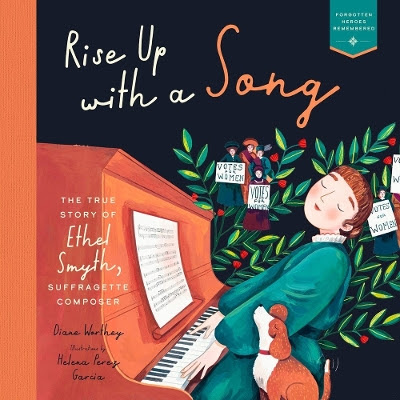
Rise up with a Song by Diane Worthey illustrated by Helena Perez Garcia

The subtitle for this book is: The true story of Ethel Smyth, Suffragette and Composer

From a young age Ethel Smyth loved music. She was a forthright girl, brave and daring. When she was twelve the family employed a new governess - a graduate of the Leipzig Music Conservatory. 

"From that moment, Ethel's desire burned. She spent hours each day writing music to accompany her favourite poems."

It seemed certain that Ethel will follow a career path into music but her father said NO. It took her five years to convince him to let her attend the Leipzig Conservatory in Germany. 

"People said she wouldn't succeed as a composer because she was a woman." 

This meant she had to publish her music with only her initials - E. Smyth. She composed operas, symphonies, and choral works and yes, they were performed. At first no one knew this music came from a woman but then it became popular and she no longer had to pretend to be a man. Of course, there were still some orchestras who would not perform music by a woman especially back in England.

In 1910 other women were also demanding to be noticed - the suffragettes. Ethel joined the movement and followed the creed of Emeline Pankhurst - deeds not words. She wrote music for the protesters to use as a battle cry. Ethel Smyth was becoming famous. 


Perhaps if she did something illegal and went to jail their cause would gain attention. Ethel hurled a rock straight into the window of a cabinet minister. (This is the opening scene from the BBC television series I mention later in this post). She served two months in Holloway prison. While in prison she went on hunger strike. 

Thomas Beecham visited the composer in Holloway Prison in 1912 and found her conducting her fellow inmates with a toothbrush. “I arrived in the main courtyard of the prison to find the noble company of martyrs marching round it and singing lustily their war-chant while the composer, beaming approbation from an overlooking upper window, beat time in almost Bacchic frenzy with a toothbrush”.

Ethel Smyth was born one hundred years before me. She lived until 1944 and was able to vote in eight general elections. I wonder if you have ever heard of her?


In spite of challenging the government through her activism, and her groundbreaking, unconventional life, Dame Ethel Smyth was knighted as a Commander of the British Empire in 1922. She became the first woman to be granted the damehood for her contributions to composition and publication. London Museum

Further reading:

Rise up with a Song is published by the wonderfully named Bushel and Peck. On the final pages there is a timeline of her life; a selected list of her music; and some further reading. See inside this book here. In Australia this book is distributed by NewSouth Books. 

Publisher blurb: In 1867 England, a girl learned to be proper and speak when spoken to. But one girl marched to a different beat. Ethel Smyth climbed fences, explored graveyards, and yearned to become a famous composer at a time when only men could publish their music. But become a composer she did, first signing her music as E. Smyth so people couldn't guess her gender, then eventually writing openly as a woman (but still sometimes not getting paid!). Ethel had had enough. She joined the suffragette movement, marching in the streets and fighting for the right to vote. She even composed the famous "March of the Women" battle cry—and directed it from her cell window with a toothbrush when she was put into prison.


The music to her suffragette anthem - The March of the Women - is presented on the end papers of Rise up with a Song.


Verse 1 
Shout, shout, up with your song! 
Cry with the wind, for the dawn is breaking; 
March, march, swing you along, 
Wide blows our banner, and hope is waking. 
Song with its story, dreams with their glory 
Lo! they call, and glad is their word! 
Loud and louder it swells, 
Thunder of freedom, the voice of the Lord! 

Verse 2 
Long, long—we in the past 
Cowered in dread from the light of heaven, 
Strong, strong—stand we at last, 
Fearless in faith and with sight new given. 
Strength with its beauty, Life with its duty, 
(Hear the voice, oh hear and obey!) 
These, these—beckon us on! 
Open your eyes to the blaze of day. 

Verse 3 
Comrades—ye who have dared 
First in the battle to strive and sorrow! 
Scorned, spurned—nought have ye cared, 
Raising your eyes to a wider morrow, 
Ways that are weary, days that are dreary, 
Toil and pain by faith ye have borne; 
Hail, hail—victors ye stand, 
Wearing the wreath that the brave have worn! 

Verse 4 
Life, strife—those two are one, 
Naught can ye win but by faith and daring. 
On, on—that ye have done 
But for the work of today preparing. 
Firm in reliance, laugh a defiance, 
(Laugh in hope, for sure is the end) 
March, march—many as one, 
Shoulder to shoulder and friend to friend.

Helena Perez Garcia is the illustrator of these books:


I first heard about Ethel Smyth on the 1990s BBC television series called A Skirt Through History. There were six episodes and the stories of Ethel Smyth and another suffragette Sarah Benett were told in the episode entitled The Wreckers which is the name of an opera composed by Ethel Smyth. I think you may be able to find this program on Amazon Prime.


I did once have a VHS video of this episode and I regularly used it with my Grade 6 classes in the library as a part of their unit of work on democracy and voting and suffragettes. Sarah Benett is not part of this book but a few years ago I travelled to Lyme Regis because her diary, which forms the basis of much of this show, was found in the Lyme Regis museum. Unfortunately no one there knew anything about this and my email to the museum curator yielded no answer. 

Here's a summary of this program: "The fight for women's voting rights is told through the writings of two turn-of-the-century British suffragettes - Ethel Smyth and Sarah Benett. Composer and writer Smyth comments on her libertarian life, and her promotion of women's rights through her highly praised opera, The Wreckers. Based on the 1910 window-breaking campaign launched by the Suffragette movement to further their cause, the opera is her most famous work. Also quoting from Benett's diaries, an actor provides a first-person account of the campaign and the hardships suffered by jailed Suffragettes, who were often beaten, raped, and subjected to psychological torture."

The National Portrait Gallery in London have several paintings (including a pencil sketch by John Singer Sargent) and many photographs of Ethel Smyth. Here is a her statue:


Statue in Woking UK


Tuesday, August 20, 2024

Song of the Dove: A love story by Errol Broome illustrated by Sonia Kretschmar


Composer Vincenzo Bellini was born in Sicily in 1801. He gave music lessons to the young daughter of the President of the Supreme Court of Naples. Her name was Maddelena and they fell in love. Alas, her parents would not give permission for their marriage, so Bellini moved to Milan where he composed ten operas for the La Scala opera house. He died in Paris in 1835. His most famous opera is Norma. You can hear a tiny sample here. 

Errol Broome takes the relationship between Bellini and Maddelena Fumaroli and uses it to develop her picture book story. In this fictionalized account Bellini tells Maddelena he will return to ask for her hand again after he composes ten operas. 

"After the tenth opera we'll be together, dead or alive."


Image Source: Sonia Kretschmar

This statement comes true because before the tenth opera is finished, Maddalena dies. Bellini had likened their destiny to be together with the pairs of doves seen in Naples. 

"In Paris, Bellini began work on the score for his tenth opera. Each evening, a white dove fluttered into his bedroom and settled on the pages of music. When he reached out to touch it, the bird disappeared."

Shortly after composing his tenth opera, Bellini dies. But in real life he had lost interest in Maddalena long before this time. 

As I am about to head off to Italy this seems like the perfect book to share. It is an Australian book and it is set in Italy and about a famous Italian. My copy came from a recent charity book sale and there is an inscription on the title page which I think might be from the illustrator herself. I have discovered Sonia Kretschmar did covers for books by Cassandra Golds such as Clair de Lune. Also, the cover the Tensy Farlow. She is also the illustrator of Do not Forget Australia which is a book you may have in your ANZAC Day collection. Song of the Dove is a NSW Premiers Reading Challenge title for grade 5 and 6 [19214].

Errol Broome (1937-2022) grew up in Perth and after an Arts degree at the University of WA, she began her career as a newspaper journalist. After starting a family, Errol decided to tackle a long-held ambition, to write a book, and began with short stories which won several prizes. More than thirty books have followed, many short-listed and winners of awards, as well as being widely published overseas. I well remember having some of her books in my former school library but oddly Song of the Dove published by Walker Books did not reach me. I do remember Gary Keebles Kitchen (I often recommended it to my library readers) and Dear Mr Sprouts which was a story told with letters. 

  • Wrinkles, illustrated by Terry Dyer, Collins, 1978.
  • The Smallest Koala, illustrated by Gwen Mason, Buttercup, 1987.
  • Dear Mr. Sprouts, Knopf (New York, NY), 1991.
  • Garry Keeble's Kitchen: How One Boy Left Home and Survived with 28 Recipes That Anyone Can Cook and Everyone Will Eat, illustrated by Maya, Random House (Australia), 1992.

  • Tangles, illustrated by Ann James, Allen & Unwin (St. Leonards, Australia), 1993, Knopf (New York, NY), 1994.
  • Rockhopper, illustrated by Ann James, Allen & Unwin (St. Leonards, Australia), 1995.
  • Nightwatch, illustrated by Helen Brooshooft, Fremantle Arts Centre Press (South Fremantle, Western Australia, Australia), 1995.
  • Splashback: A Great Greasy Journey, illustrated by Gregory Rogers, Allen & Unwin (St. Leonards, Australia), 1996.
  • Fly with Me, illustrated by Jane Walker, Fremantle Arts Centre Press (South Fremantle, Western Australia, Australia), 1996.
  • What a Goat!, illustrated by Sharon Thompson, Fremantle Arts Centre Press (South Fremantle, Western Australia, Australia), 1997.
  • Quicksilver, illustrated by Anna Pignataro, Allen & Unwin (St. Leonards, Australia), 1997.
  • Tough Luck, illustrated by Sharon Thompson, Fremantle Arts Centre Press (South Fremantle, Western Australia, Australia), 1998, published as Drusilla the Lucky Duck, Annick Press (Toronto, Ontario, Canada), 2003.
  • Magnus Maybe, illustrated by Ann James, Allen & Unwin (St. Leonards, Australia), 1998, Simon & Schuster (New York, NY), 2004.
  • Away with the Birds, Fremantle Arts Center Press (South Fremantle, Western Australia, Australia), 2000.
  • Missing Mem, illustrated by Ann James, Allen & Unwin (St. Leonards, Australia), 2000, Aladdin (New York, NY), 2002.


  • Cry of the Karri, Allen & Unwin (St. Leonards, Australia), 2001.
  • Some Dog, Thomson, 2001.
  • Ms. Yellow Teeth, Thomson, 2003.
  • The Judas Donkey, illustrated by Sharon Thompson, Fremantle Arts Centre Press (Freemantle, Western Australia, Australia), 2003.
  • Gracie and the Emperor, Allen & Unwin (St. Leonards, Australia), 2003.


Friday, January 12, 2024

Queenie in Seven Moves by Zanni Louise


Let's begin with the title of this book. I thought it would be a book about chess. Yes, that famous game is mentioned, but Queenie is actually the name of the main character and seven moves refers to the way Queenie and her mum keep having to move either to a new house, or a share house and even a run-down caravan.

Homelessness is a VERY serious topic. When we meet Queenie Jean Anderson and her mum we discover they have to leave the home they have rented for many years. Queenie has named this house Peachy but the owner, who is also their neighbour and a friend, has decided to sell it and move on. Mum works in an aged care village and luckily one of the small homes in the village, named Diamonds, will be empty for the next couple of weeks so they can move in there even though this cannot become their home for very long. Once the new owner arrives in the village the mother and daughter move again into a share house with the Elliots.

"The truth is, the Elliots aren't Sarah's friends as such. Sarah's friend's neighbour's cat heard there was a family looking to share for a bit because the dad lost his job during COVID. When I quizzed mum more, she didn't know anything about the Elliots, which seems like a very dicey living arrangement." page 70

The cat heard? I am a bit confused. Also, it turns out the son of the Elliot family is a boy in Queenie's class - why didn't she recognise the surname? It is the end of Year Six so I would expect her to know the names of every student in her class. Queenie is aged eleven or twelve and so is Dory so, sorry to be negative, but I did wonder why her mum would have no concerns about a boy and girl sharing a room? 

"So, I am going from never talking to a guy-who-is- vaguely-good-looking in my life to sharing a bedroom with him."

This arrangement comes to an end quickly when the adults see Dory and Queenie kissing! Next stop - an old run-down caravan.

"Mum jostles the door of Terry's caravan. It takes a few goes, but eventually comes unstuck. True to the description, the caravan is leaky. A stream of water trickles down one wall. A line of mould decorates one of the other walls. The kitchen bench is saggy with moisture ... the place smells of mould and rotting leaf litter."

Remember my comment homelessness is a very serious topic - well I was quite dismayed by the way mum just seemed to accept living in this dreadful caravan. I expected to get some sense of her despair. Especially when all of their possessions are destroyed after the caravan collapses in the wild weather. 

There are a couple more moves after the caravan is wrecked and then finally, we reach the happy ending. I won't spoil this except to say Queenie and her mum do find a proper place to live. Can you count seven moves? Diamonds; Elliots; Caravan; Ruthie's house (the owner of the Caravan); and Dimitri's place equals five. Briefly they move to a tent so Queenie can enter a singing contest - that is move six. Then the happy ending is move seven.

I had a small problem with the Christmas scene in this book. Queenie and her mum head to a market on Christmas Day and there are lots of other people there. Here in Australia Christmas is in the Summer so a market at the beach makes sense but I am fairly sure there are no towns where a market would be held on the 25th December. Yes, there are plenty of Christmas markets, but these happen over the days leading up to big day. I guess you just need to go with the flow - the market does sound like fun with food and rides and Santa. 

"The beachside Christmas market is every year on Christmas Day. It's like an orphans' Christmas, for people who don't have big families to spend Christmas with. There are lots of tourists and young people."

I am not sure I entirely agree with these four reviewers, but I suspect this book might be a CBCA (Children's Book Council of Australia) 2024 Younger Readers Notable title and so to balance my review comments I am sharing these links. I read Queenie in Seven Moves quite quickly and it did hold my attention, but I cannot give it five or even four stars.

Mother and daughter are enriched by the diversity of the characters they encounter with each of their moves. Their homelessness exposes them to the many definitions of homelessness. Both reassess their understanding of friendship. Queenie in Seven Moves is a compassionate tale filled with images of human kindness, and the acceptance and change that seems to surface frequently in times of crisis. Beautifully written. A great read! Kids' Book Review

Queenie in Seven Moves is such a gorgeous story and twelve-year-old Queenie is a treat with her moods and possessiveness of her mother. It's all so relatable! Little Squirrels Bookshelf

This is a book about resilience, family, friendships and self-belief. Readers will enjoy this modern-day tale of urban adventure and quiet heroism. Georgina Gye

This is a well-paced, engaging and emotionally satisfying book, that hits all the right notes (excuse the pun). But if Zanni ever gets bored with writing books, she could easily move on to song writing. The song lyrics included in the book are a clever reflection of Queenie’s experiences and emotions and add to the tenor of the story (sorry, another pun). Storylinks

Here are some other books that explore this complex topic of homelessness. You can pop each title into my side bar to read more or click this link to a post which refers to nearly all of these:


Here are some picture books about homelessness - I highly recommend you share some of these with your students:

If you are in Australia you are sure to know some of these picture books by Zanni Louise. 

And here is her new junior book series:

I read her website and a few interviews with this author and I had one question - is this her real name?  I now discover her first name is Suzannah but is Louise really her surname?  Here are some interviews with Zanni Louise - I was surprised no one asked her about the name Zanni?

Reading With a Chance of Tacos

Your Kid's Next Read episode 81

Australian Writers Centre episode 169

Positive Parenting