Showing posts with label Singing. Show all posts

Tuesday, June 9, 2026

Alice and Gert: An Ant and Grasshopper story by Helaine Becker illustrated by Dena Seiferling


Alice is the ant; Gert is the grasshopper. Alice is a worker. It is a hot summer, but she is preparing for the winter which is coming very soon. Gert is a dreamer and composer. She spends her days singing and relaxing and cannot understand why Alice is working so hard. Then of course winter arrives and this is where the story becomes a dilemma for the reader and for Alice. Gert has done nothing to prepare for the cold and lack of food over the coming months and so she might starve BUT Alice is kind and compassionate and is able to see Gert has actually helped in her own special way.

"Perhaps you should have planned better,' said Alice. 'Instead, you sang and danced through the long hard days of summer.' ... 'But ... your (songs) lightened my load, and now it's time for me to repay your kindness. I've collected enough food to last the winter - for both of us."

It is so important to share Aesop Fables with children in your library, classroom and home. AND there are so many fantastic versions to use with truly special illustrations. Dena Seiferling creates beautiful pages in this book:

Her illustrations are as classic as the fable, having used her pencil to create profound scenes that are steeped in atmosphere and characters evocative with feeling. From the dramatic Gert who never looks silly as she enjoys her creative pursuits to the tireless Alice who takes the time, amidst her work, to feel, Dena Seiferling makes us appreciate the depth of the story through her characters and the setting. Can Lit for Little Canadians

Here are a couple of other versions of The Ant and the Grasshopper:


Amy Lowry Poole


Jerry Pinkney


In the library where I volunteer each week the most recent book display showcased the Aesop Fables held in the collection. As I was reshelving these to make way for the new display (Yarn Yarns knitting in picture books) I stumbled upon Alice and Gert and on the cover I saw the name Dena Seiferling. Over the last eight years my field knowledge of international illustrators has grown exponentially thanks to this fantastic library where I am so privileged to work each week. I previously loved art by Dena Seiferling in these two books:


Dena Seiferling is a Canadian illustrator and instructor at AuArts, Alberta. Her illustrations are characterised by a love for animals and nature, and she works with a variety of mediums including drawing with graphite and needle-felted sculpture. She has won the Best Illustrated Children’s Book of the Year Award from the New York Times and New York Public Library for Night Lunch, written by Eric Fan. She is the illustrator of King Mouse by Cary Fagan and illustrated for Joseph Coelho’s Ten-Word Tiny Tales.

Dean Seiferling's newest book is Things I learned from my Dog (due out this year). I am very keen to find this book from 2022:


Saturday, February 21, 2026

The Mighty Miss Malone by Christopher Paul Curtis


In summation and conclusion, the Malone family has four members who are very bright, very good-looking and uniquely talented, just not all in one person at the same time. We are the only family in the world, in my ken, that has a motto of our own! That motto is “We are a family on a journey to a place called Wonderful.” I can’t wait until we get there!

Hoping is such hard work. It tires you out and you never seem to get any kind of reward. Hoping feels like you’re a balloon that has a pinhole that slowly leaks air.

Meet Deza - "I am neither very intelligent nor very tall. I also have not been blessed with a beautiful singing voice. I have a pleasingly even disposition unless it’s one of those times that I become very angry or scared and have embarrassing wishes to hurt someone real bad." "My most annoying trait is that some of the time I might talk a little too much, I can be very verbose. I also exaggerate but that is because I come from a family of great storytellers which is not the same as great liars."

And her mother - "My mother, Mrs. Margaret “Peggy” Sutphen Malone, was born here in Gary, Indiana. She is willowy and radiant and spell-blindingly beautiful. She is also very intelligent. She has a great job cleaning for the Carsdale family. Yes, that Carsdale family! The family whose patriarch is the president of the Gary Citizens’ Bank. Her most endearing trait is that she is the glue holding this family together."

My father who uses alliteration every chance he has - "He always calls me his Darling Daughter Deza, and I’m supposed to answer that he is my Dearest Delightful Daddy. He calls Jimmie the Genuine, Gentle Jumpin’ Giant, and Jimmie’s supposed to call him his Fine Friendly Father Figure. Father also calls Mother the Marvelous Mammalian Matriarch ... "

And Deza's brother is Jimmy - "The oldest child in our family, Mr. James Edward Malone, is fifteen years old and has been blessed with the singing voice of a angel. Jimmie’s most annoying trait is that he has what Mother says is a napoleon complex. That means Jimmie is not as tall or robust as most boys his age and tries to make up for it by being as loud and full of braggadocio as he can. He also gets in lots of fights. Jimmie’s most endearing trait is that he loves me more than any big brother has loved a little sister since time immoral."

The year is 1936 - the years of The Great Depression. The Malone family are poor. The have to rely on community food handouts. Deza desperately needs to see a dentist and her brother is bullied and taunted for being small and 'slow'. 

“And I know you, Peg. I know you’re going through the same thing, we both know that that little brown-skinned angel is something beyond special. You know if there’s any chance in the future, it’s riding on her narrow shoulders. So you tell me, you tell me how can I come home empty-handed knowing that that sassy, smart, beautiful, charming little girl…my Mighty Miss Malone…is slowly rotting away on the inside and we can’t afford to have her teeth looked after, we can’t even get them pulled?"

Her father is badly hurt on a fishing trip. Her mother loses her cleaning job. Then Deza's Daddy heads away to find work in Flint. Mother, Deza and Jimmy try to follow him but one night Jimmy heads off. He has a dream to be a singer but is he just being conned? These are dangerous times for the mother and daughter who find themselves living in a camp or shanty town with other displaced people. Their dream, though, is to try to find a place called Wonderful with a house of their own and everyone reunited. 

Deza is a top student and her teacher recognises her abilities and also her poverty. In a beautiful scene near the beginning of the book Mrs Needham gifts Deza some shoes and clothes. 

Inside the bag there was a beautiful pair of new patent leather shoes and some folded-up clothes. Mother says it’s rude to set shoes on anything but the floor so that’s where I put them. “Do you wear a size five?” “I’m not sure.” “Try them on.” I picked up the first shoe. There were some socks rolled up in it. “Should I put on the socks too?” “Yes.” I was glad I was behind her desk and she couldn’t see my shoes and socks. My shoes are quite tired and my socks have been darned a million times. Jimmie says our socks and clothes are very religious because they are so holey. My hands were shaking, but I pulled the new socks on and slipped my feet into the shoes. I knew just how Cinderella felt! They were a little big, but maybe that was because mine were so tight. I sat on my socks so Mrs. Needham wouldn’t see them. She said, “My niece from Cleveland spent the summer with me a while ago and left a few things. I thought they might fit you.” Did Mrs. Needham really mean these shoes were for me?

I've included this long quote above because I was utterly devastated later in the story when Deza accidentally leaves her precious clothes behind. 

To get to Flint they jump a train. They are given some really important advice about ways to stay safe in the camp - these were called Hooverville during the Depression.

"You gonna have to be extra careful when you get to camp, that’s unsafe too, if you don’t know what you’re doing.” “What do you mean?” “It’s just like anything else, there’s just enough bad folks in camp to make it so you got to keep your guard up at all times. It’s especially hard on women, and even worst for little girls.” She looked at me and a shiver went through my heart. “You just gotta keep your wits about you and don’t let no one in on your business. Keep it to yourself why you’re on the road alone.” ... “Always let folks think your husband or your brother is with you, always tell ’em that he’s gonna be back later tonight. There’s strength in numbers so let folks think there’s a lot of y’all. You’re a good-looking woman, you gonna have to be careful not to draw a lot of attention you don’t want.” Mother’s jaws tightened. “And don’t let no one get too familiar either, man or woman. Don’t let ’em know where y’all are really from. They’ll start prying and before you know it they’re looking to help you out in some way that ain’t no kind of help at all. Just keep your head low. Don’t look weak or scared.”

Spoiler alert - there were moments I cheered in this story: When Deza and her mother move into a room in a real house; when Deza has an address so she can get a library card; when Deza finally gets good dental help; and when the series of letters arrive with money and news about her father. AND there were moments of despair: When Deza lost her clothing gift; when she couldn't go to the special extra lessons with Mrs Needham; and in her new school when 'black' students are always given low grades no matter how well they perform. 

Bookseller blurb: Deza is the smartest girl in her class, singled out by teachers for a special path in life. But the Great Depression hit Gary, Indiana hard, and there are no jobs for Black men. When her beloved father leaves to find work, Deza, Mother, and her older brother Jimmie go in search of him, and end up in a Hooverville outside Flint, Michigan. While Jimmie's beautiful voice inspires him to leave the camp to be a performer, Deza and Mother continue on, clinging to the hope that they will find Father. The twists and turns of the Malone's journey reveal not only the devastation of the Depression but also the enduring strength of family bonds and the mighty heart of young Deza Malone.

Listen to an audio sample here. The Might Miss Malone was published in 2012 but because it won the Coretta Scott King Award it is still in print and available in paperback. 

Each of these reviews has more plot details:

Vivid picture of what it was like to live through the Great Depression, as well as what it was like to live with every day prejudice. Deza is a strong character, and her family tries their best to survive and prosper during a difficult time. Ms Yingling

The Mighty Miss Malone is a Superlative Stupendous Story and a Totally Awesome Book. The Book Smugglers

The fluidity of the writing, the strong sense of place and time combined with well-drawn characters will captivate and delight. Kirkus Star review

We talk now about the importance of representation in books for children. Here is a wonderful quote from The Mighty Miss Malone which epitomises this:

"When I was in Gary and would read novels I used to put myself right in the middle of the story. I knew it was a great book when it felt like the author was writing about me. Some of the time I’d get snapped out of the book when I read things that I couldn’t pretend were about me, even if I had the imagination of Mr. William Shakespeare. Words like “her pale, luminescent skin” or “her flowing mane of golden hair” or “her lovely, cornflower-blue eyes” or “the maiden fair.” I would stop and think, No, Deza, none of these books are about you."

Deza is a character from a previous book by Christopher Paul Curtis:


Sunday, November 30, 2025

Lost Evangeline by Kate Di Camillo illustrated by Sophie Blackall


"The shoemaker and his wife had no children, and they had long given up hoping for them. And so it seemed an entirely miraculous thing when one day, the cobbler sat down to work on repairing an old boot and found, hidden in its squared-off toe, 
an extremely small child."

No one comes back to claim the boots or the child. The shoemaker creates tiny clothes, shoes, furniture and a miniature ship's lantern and he names her Evangeline but his wife does not like the child. 

The small ship's lantern "was surely the shoemaker's finest creation. It was accurate in every detail, smaller than a thimble, and painted bright red. Within the lamp waws a wick of fabric that could be raised and lowered with a small knob, and the lamp, when it was lit, gave off a steady, gentle light."

Reader I need to take a small detour at this point and draw your attention to the word placement in this sentence - think about those words - steady and gentle. As with all good stories we know something is sure to happen - will this lamp help young Evangeline when she is faced with great danger? Of course you may have already anticipated this from the title.

Long ago the shoemaker dreamed of a life filled with adventure, of journeys to far away lands on ships that anchor in the harbor. Evangeline does not grow bigger, but she does become a wonderful daughter to the shoemaker and together they watch the ships and talk of future adventures, but the shoemaker knows there could be danger if Evangeline is discovered. He keeps her well-hidden and makes sure she knows how to hide if a customer enters his store - the door hinge is rusty and the sound alerts Evangeline that she must 'make herself disappear'. I actually gasped when the shoemaker's wife oiled the hinges:

"And so, without telling her husband, the shoemaker's wife oiled the hinges on the door ... She opened the door and closed it again and the hinges made no sound at all."

Meanwhile in a different part of the town an elderly rich widow has a dream about some fabulous shoes that will grant immortality. Oh no are you following along with this story - we have some dangerous ingredients here - jealousy, pride, greed, and the desire for immortality. Surely little Evangeline is heading towards a disaster.

The rich widow Mrs Penrith-Smith sends her servant to visit the cobbler BUT of course the door longer alerts Evangeline to hide and so she is seen by the aptly named Gristle. He takes the news of the tiny girl back to his mistress.

"I think I understand now ... the dream of the shoes was merely a vehicle. The dream served to bring you to the cobbler's so that you might see this wonder. The shoes are not the point. I will have her come here and sing to me, and then I will get better. Her song will cure me ... I will have her."

And so the adventures begin. Yes, Evangeline is stolen; she escapes; she persuades a huge ginger cat to help her; she is stolen again by a truly despicable man; and then she finds a friend and a way to fulfill the dream she shared with her father.  So many twists and turns and all in just 152 pages.


"The cat had seen the girl of course. That little morsel of humanity had led her to the sea, to this wondrous place she had not even known existed. And, too, the cat knew exactly what had become of Evangeline. She had witnessed her demise. ... The cat recognised the man for what he was: a predator. ... She had watched as he captured the girl, watched as a single tiny shoe went flying through the air and landed on a rock."

Before or perhaps after you read Lost Evangeline it would be good to revisit classic fairy tales - The Eves and the Shoemaker and also Thumbelina. You might also think of Pinocchio and Snow White. I read one Good Readers review that said "This (book) had all the whimsy and heartbreak of a Hans Christian Andersen fairy tale."

Author blurb: When a shoemaker discovers a tiny girl (as small as a mouse!) in his shop, he takes her in, names her Evangeline, and raises her as his own. The shoemaker’s wife, however, fears that Evangeline has bewitched her husband, so when an opportunity arises to rid herself of the girl, she takes it. Evangeline finds herself far from her adopted father and her home, a tiny girl lost in the wide world. But she is brave, and she is resourceful, and with the help of those she meets on her journey — including a disdainful and self-satisfied cat — she may just find her way again. Kate DiCamillo

This is the third Norendy Tale and it is the one I loved the best but be warned this tale does not quite have that all important or expected happy ending although I am sure all readers will be able to imagine one. Kirkus explain this:

In true DiCamillo fashion, the ending is suffused with the gentlest melancholy, allowing readers to either believe in their reunion or dismiss it entirely. ...  There are no easy answers in a Norendy tale, but there is great courage, even when it comes in the smallest of packages.

Readers who aren’t used to a story with an ambiguous ending may feel cheated by the lack of an on-page reunion, but upon reflection, they will likely see how it is exactly the right end for such a dreamy little novel that prioritizes the whimsical vibes of Norendy over answering every question raised within it. Bulletin of the Center for Children's Books

The feeling of a fairy tale is enhanced by the very atmospheric illustrations which show the spirals of song which weave their way through the story right to the end. Although there is no instant happy ending with father and daughter reunited once more, it is through the final illustration which the reader is left with a thread of hope that this might yet happen. Through the Bookshelf

Here is a link to a set of discussion questions from the publisher.

I do need to mention the rich vocabulary you will encounter in this book. Here are a few examples: misspoke, due haste, marooned, morsel, modicum of alacrity, vermin, scrutinized, treachery, intercede, consumed, dolt, somber, and penury.

Each of the Norendy Tales features a different, fabulous illustrator. This one is Sophie Blackall. Previously we had Julia Sarda and Julie Morstad. It would be so special to display all three of these on your family bookshelves.


Thursday, August 28, 2025

Candle Island Lauren Wolk


"Six mysteries waited for me on Candle Island.
One involved a bird.
The second a hidden room.
A song the third.
A poet the fourth.
A cat fifth.
A fire sixth.
Each of them exciting in its own way.
But none more interesting than the mystery I took there with me."

Begin with the cover - I really like it and after reading this book you will want to go back and see how an important story element has been incorporated into this illustration. 

Here is the quote on the opening page - it is very pertinent to this story:

"As music is the poetry of sound, so is painting the poetry of sight." James McNeill Whistler


I think sensitive readers (with some reading stamina) aged 10+ will really enjoy Candle Island. I had no idea this story was set in the 1970s (see the Kirkus review).  I loved the island setting and the way Lucretia and her mum were keeping the identity of the artist of their famous paintings a secret kept me turning the pages knowing that they were sure to be discovered. I was also happy that there was no twist at the end and that the bad things that happened on the island were all down to those awful rich kids as Lucretia, Bastian and Murdock suspected. If you look at the labels I have assigned this post you can see the plot covers a lot of things - Lucretia finds a wounded baby bird (an osprey) and she nurses him back to health; there are three summer kids who are dreadful bullies; there is an art theft; the island is small and suspicious of strangers; Lucretia and her mum are experiencing terrible pain after the death of her father; and each of the three island kids has a special talent. Oh, and I do need to mention two more things - mum cooks delicious food in this book and I adore the town librarian (I think I need to make a list of books that feature very special librarians).

Curious readers might want to know more about osprey birds after reading this book. Also Lucretia is named after Lucretia Mott - a Quaker suffragist and anti-slavery campaigner. You might also want to learn more about the scale of being or the Great Chain of Being

Candle Island is set on an island - I know that is obvious - so I was not surprised to read Lauren Wolk lives on Cape Cod. I really enjoy visiting islands and I enjoy books set on islands and even though I have not been there for some reason Maine, USA has a special fascination for me.

Here are some text quotes:

"When I let myself spill onto the canvas like melted wax, I built a world where I felt exactly right, entirely who I really was. Free. Unwatched. Alone."

"He was singing a story. A sad one that suddenly became something else and then something else again, the colour changing as the story did, from a radiant magenta to some kind of violet. And then a gold I rarely heard."

"When I hit the water, my head exploded. Every particle of my body panicked. It was as if I'd been injected with frozen mint. As if my skin was size too small. As if I'd been scoured with a wire brush dipped in acid. All of that, all at once."

The town librarian - notice the placement of the word beautiful: "She was old. Thin. In a black dress with a lace collar. Her hair was a beautiful white, twisted into a crown on top of her head. Her skin was the same deep brown as my eyes. ... At her full height she was smaller than I was, but she seemed much taller."

"The most common form of despair is not being who you are - Soren Kierkegaard"


And bottom line, this is a beautiful book set on a beautiful island off the coast of Maine. It will linger in your heart. Sonder Books

Wolk’s latest novel wonderfully portrays new relationships while tackling grief and self-discovery. The characters are well developed, and readers can see parts of themselves and those they know. The book also has several small mysteries that readers will be itching to solve. While a work of historical fiction, the story has the modern feel of a quiet life without current technology and trends. School Library Journal

Here is an interview with Lauren Wolk.

I spied this book some weeks ago and knowing how much I loved every previous book by Lauren Wolk, I added it to my 'to read' and 'to buy' list. Luckily for me this book has appeared in the library where I work as a volunteer, so I borrowed it and read it over one or two days. This is a longish book with 340 pages, but the print size makes it easy to read and of course Lauren Wolk creates a page turning story with characters you really care about. The library has a copy because this book was sold as a Scholastic Australia Book Club title (issue 5, 2025 AUS$12). We are having extreme rain conditions in my city and so today (after some very necessary chores) I snuggled down beside my heater and finished read Candle Island.

Publisher (Scholastic Australia) blurb: Lucretia and her mother have come to tiny Candle Island, Maine (Population: Summer, 986; Winter, 315) with a secret to keep ... and to escape—escape memories of the car accident that killed her father and escape the journalists that hound her mother, a famous and reclusive artist. The rocky coast and ocean breeze are a welcome respite for Lucretia, who dedicates her summer days to painting, exploring the island, and caring for an orphaned osprey chick. But Candle Island also has secrets—a hidden room in her new house, a mysterious boy with a beautiful voice—and just like the strong tides that surround the shores, they will catch Lucretia in their wake. With an unforgettable New England setting and a complex web of relationships old and new, this is a powerful story about art, loss and the power of being true to your own voice.

There is a huge error in my Scholastic Australia copy of this book. This book was originally published in hardcover by the Penguin Young Readers Group [9780593698549]. My copy in paperback is a new 'edition' BUT the imprint page does not acknowledge the original publisher or date of publication AND the author's name is spelt incorrectly as Wolke. This is funny but also disturbing. 

Other books I have loved by Lauren Wolk:


Thursday, July 3, 2025

The Frog's First Song by Jazz Money illustrated by Jason Phu


First, the world is all dark. A little bit muddled and confused.
The only sound dripping water and small bubbles gurgling.
In that darkness and quiet, everyone is alone.
This is the world in the well.


This book opens with black pages. We can see a solitary frog sitting at the bottom of a well. He makes a little croak and then discovers he can sing. I am thinking the acoustics in the well would be fabulous. His song is heard by others. It is the first song and now it swells into a chorus of voices. 

"Their song is friendship and family, and with it the frogs feel brave."

Singing together makes the frogs feel so brave that they are able to venture out into the world where they are greeted by the night sky and the moon - "a perfect circle moon". (A great opportunity to talk to a young library group about the significance of the full moon and also the phases of the moon).

Do you love the sound of frogs - especially at night? I do. I sometimes hear them near my house. This book explores a reason why frogs love to sing in the night. You can hear 15 Australian frogs here - this is well worth a listen. 

Here is another text quote:

"That even in dark times, when we come together with song or dance or story, suddenly the world is brighter and no one needs to be alone."

You can see Jazz Money a Wiradjuri poet and her friend artist Jason Phu talking about their book here. This is their debut picture book. And here are some teachers notes from the publisher and a set from Lamont.

Read more about Jason Phu here. He has been a finalist in the Sulman Prize (2023, 2022, 2019, 2018), The Archibald Prize (2023, 2015, 2014), The Wynne Prize (2023), the Ramsay Art Prize and Australia’s premier prize for emerging artists (2017), the NSW Emerging Visual Arts Fellowship (2017), and the Brett Whiteley Travelling Art Scholarship (2016). He is clearly a very successful artist.

Jazz Money talks about her story:

A few years ago, Jason asked me to write about an artwork he was making, which was all about singing frogs. We spoke about ancestral frog stories, and at that time I was really obsessed with choirs and the joyful act of singing in groups – I still am obsessed with how special it is to sing with other people! Instead of writing an art essay I decided to write a short story about singing frogs. I wrote the first draft of the story very quickly. I was having so much fun writing. After finishing the story, I thought it would make a good children’s book and asked Jason if he would like to illustrate. In the story the frogs find one another first through song, then by dancing, hopping and moving out of the well into the light of the moon. I think being a part of communities is so important to help us feel safe, nurtured, joyous and supported and I am glad that the frogs reminded me of the power of gathering together.

Thank you to University of Queensland Press for sending me a review copy of The Frog's First Song. On Saturday 12th July you can meet the creators of this book at our city bookstore Kinokinuya and also on 5th July at Gleebooks Kids

The supplied notes say this book was inspired by a Chinese parable 'The frog in the well' and First Nations Creation stories. I would like to find a list of First Nations Stories featuring frogs - I can only think of the famous one about Tiddalick but I am sure there are others. If I was sharing The Frog's Song with a group of students I think I would read the text without the illustrations as a first experience and then allow some time for the group to talk about the art used in this book. 

I found this information about the Chinese proverb:

The idiom the frog at the bottom of the well (or “look at the sky from the bottom of a well) is from “Zhuang Zi”, a famous Taoism Book. It means to have a narrow view of the world, to have only superficial knowledge of something, or to be short-sighted.

My friend from Kinderbookswitheverything remembered The Peasant Prince - the story of the dancer Li Cunxin - also referred to this Chinese story:

"The story of Li Cunxin’s remarkable life has already reached thousands of readers throughout the world, a story that was first published in 2003 as Mao’s Last Dancer.  But it has always been a story about childhood, and now, with the publication of this picture book version, Li’s story will be enjoyed by very young children as well. Our picture book story begins with Li and his beloved father flying a kite together on the bleak, wind-swept fields around Li’s childhood village.  It is here that Li’s father tells him an old Chinese fable - a  story about a frog who was determined to escape from a deep, dark well. This story of the little frog’s determination touched Li so much that it became a constant reminder to him of his own life and of how, if he was just as determined, he might be able to escape from his life of poverty". Scholastic.  Read more on the NCACL (National Centre for Australian Children's Literature) Picture Books for Older Readers database. You can see a video of The Peasant Prince here.

Here are a couple of other splendid Chinese stories, I have previously discussed, by the Hans Christian Andersen award winner Cao Wenxuan (I am keen to see his new book Flying High):


With older students you could compare The First Frog's song with this famous story from Iran:


Friday, January 12, 2024

Queenie in Seven Moves by Zanni Louise


Let's begin with the title of this book. I thought it would be a book about chess. Yes, that famous game is mentioned, but Queenie is actually the name of the main character and seven moves refers to the way Queenie and her mum keep having to move either to a new house, or a share house and even a run-down caravan.

Homelessness is a VERY serious topic. When we meet Queenie Jean Anderson and her mum we discover they have to leave the home they have rented for many years. Queenie has named this house Peachy but the owner, who is also their neighbour and a friend, has decided to sell it and move on. Mum works in an aged care village and luckily one of the small homes in the village, named Diamonds, will be empty for the next couple of weeks so they can move in there even though this cannot become their home for very long. Once the new owner arrives in the village the mother and daughter move again into a share house with the Elliots.

"The truth is, the Elliots aren't Sarah's friends as such. Sarah's friend's neighbour's cat heard there was a family looking to share for a bit because the dad lost his job during COVID. When I quizzed mum more, she didn't know anything about the Elliots, which seems like a very dicey living arrangement." page 70

The cat heard? I am a bit confused. Also, it turns out the son of the Elliot family is a boy in Queenie's class - why didn't she recognise the surname? It is the end of Year Six so I would expect her to know the names of every student in her class. Queenie is aged eleven or twelve and so is Dory so, sorry to be negative, but I did wonder why her mum would have no concerns about a boy and girl sharing a room? 

"So, I am going from never talking to a guy-who-is- vaguely-good-looking in my life to sharing a bedroom with him."

This arrangement comes to an end quickly when the adults see Dory and Queenie kissing! Next stop - an old run-down caravan.

"Mum jostles the door of Terry's caravan. It takes a few goes, but eventually comes unstuck. True to the description, the caravan is leaky. A stream of water trickles down one wall. A line of mould decorates one of the other walls. The kitchen bench is saggy with moisture ... the place smells of mould and rotting leaf litter."

Remember my comment homelessness is a very serious topic - well I was quite dismayed by the way mum just seemed to accept living in this dreadful caravan. I expected to get some sense of her despair. Especially when all of their possessions are destroyed after the caravan collapses in the wild weather. 

There are a couple more moves after the caravan is wrecked and then finally, we reach the happy ending. I won't spoil this except to say Queenie and her mum do find a proper place to live. Can you count seven moves? Diamonds; Elliots; Caravan; Ruthie's house (the owner of the Caravan); and Dimitri's place equals five. Briefly they move to a tent so Queenie can enter a singing contest - that is move six. Then the happy ending is move seven.

I had a small problem with the Christmas scene in this book. Queenie and her mum head to a market on Christmas Day and there are lots of other people there. Here in Australia Christmas is in the Summer so a market at the beach makes sense but I am fairly sure there are no towns where a market would be held on the 25th December. Yes, there are plenty of Christmas markets, but these happen over the days leading up to big day. I guess you just need to go with the flow - the market does sound like fun with food and rides and Santa. 

"The beachside Christmas market is every year on Christmas Day. It's like an orphans' Christmas, for people who don't have big families to spend Christmas with. There are lots of tourists and young people."

I am not sure I entirely agree with these four reviewers, but I suspect this book might be a CBCA (Children's Book Council of Australia) 2024 Younger Readers Notable title and so to balance my review comments I am sharing these links. I read Queenie in Seven Moves quite quickly and it did hold my attention, but I cannot give it five or even four stars.

Mother and daughter are enriched by the diversity of the characters they encounter with each of their moves. Their homelessness exposes them to the many definitions of homelessness. Both reassess their understanding of friendship. Queenie in Seven Moves is a compassionate tale filled with images of human kindness, and the acceptance and change that seems to surface frequently in times of crisis. Beautifully written. A great read! Kids' Book Review

Queenie in Seven Moves is such a gorgeous story and twelve-year-old Queenie is a treat with her moods and possessiveness of her mother. It's all so relatable! Little Squirrels Bookshelf

This is a book about resilience, family, friendships and self-belief. Readers will enjoy this modern-day tale of urban adventure and quiet heroism. Georgina Gye

This is a well-paced, engaging and emotionally satisfying book, that hits all the right notes (excuse the pun). But if Zanni ever gets bored with writing books, she could easily move on to song writing. The song lyrics included in the book are a clever reflection of Queenie’s experiences and emotions and add to the tenor of the story (sorry, another pun). Storylinks

Here are some other books that explore this complex topic of homelessness. You can pop each title into my side bar to read more or click this link to a post which refers to nearly all of these:


Here are some picture books about homelessness - I highly recommend you share some of these with your students:

If you are in Australia you are sure to know some of these picture books by Zanni Louise. 

And here is her new junior book series:

I read her website and a few interviews with this author and I had one question - is this her real name?  I now discover her first name is Suzannah but is Louise really her surname?  Here are some interviews with Zanni Louise - I was surprised no one asked her about the name Zanni?

Reading With a Chance of Tacos

Your Kid's Next Read episode 81

Australian Writers Centre episode 169

Positive Parenting

Thursday, January 31, 2019

Just Dance by Patricia MacLachlan

If you want to find the love of your life, go to the Hideaway Cafe in Cheyenne, Wyoming. When a tall cowboy with a ponytail comes up to you and takes your hand, you don't have to speak. It's better not to speak, actually. 
Just dance.


Mum was an opera singer (see music list below) but then she fell in love with a cowboy who loves Willie Nelson and Roy Orbison. The family live on a farm in Wyoming. There are two kids - Sylvie and her brother Nate. Now mum sings to the chickens and cows and she sings every day in the shower. Sylvie worries her mum is missing her stage career. This has become especially concerning as her mum's old opera partner James is coming to perform and he has invited Sylvie's mum Melinda to come to the show. Sylvie worries her mum might want to leave and return to her stage career leaving them all behind.

Sylvie loves to write. It is the summer holidays so her teacher, who is married to the town sheriff, suggests Sylvie could write a column for the town newspaper. It is called Ludolf's Log and is usually written by Sheriff Ludolf. Spelling and writing are not his forte.

Here are parts of their conversation:

"This is a contract to hire you to write Ludolf's Log this summer."
"You're going to pay me? For writing?"
"Yes. You'll cover the town, like a reporter. You can ride your horse sometimes. Or ride with me."
"You can write the log any way you want."
"Could I write poetry?
"You can do whatever you want. Do it your way. Maybe we can call it Sylvie's Summer Log. All righty then!"

All righty then is a trade-mark saying of the Sheriff. I love it! His real name is Rudolph Ludoff. His mother called him Luddy Buddy. Sylvie decides the best name is Bud and there are smiles all round. And yes Sylvie does write poetry. One day doing their rounds of the area she and the Sheriff come across some boys lighting a fire:

Boys too young to say
Build a fire on windswept day
Sent home, ponder deeds


Have you ever thought to look for threads in the books by Patricia MacLachlan?

Music - Just Dance; Fly Away; The Truth of Me; Sarah Plain and Tall
Dogs - The Poet's Dog; White fur flying; The Truth of Me; Waiting for the Magic; Just Dance
Poetry - The Poet's Dog; Just Dance; Fly Away
Farms and rural communities - Fly Away; Just Dance; Sarah Plain and Tall
Seeking answers to questions - Just Dance; The Truth of Me; Sarah Plain and Tall
Family relationships - Sarah Plain and Tall; Just Dance; The Truth of Me; Fly Away

It is truly special to have a book that deals with small and very personal concerns in an honest way.
In this book, as with all her titles, you will find the lyrical language we've come to expect from Patricia MacLachlan. Here is an example. One of the people Sylvie meets is Tinker. He has a pet coyote and he also writes haiku. They become instant friends.

Tinker: "His eyes were sharp and steady. And a blue I had no name for."
Bernie the coyote: "I slowly turned my head and looked into the very close, yellow eyes ... There were black spots like marbles in the middle of the yellow. He was so close."

The family and community relationships in Just Dance are warm and reassuring. There are no big plot moments or catastrophes. This is just a beautiful quiet book. Sylvie observes her community, makes new and surprising friends and discovers something important about her mother and about love.

Music in this book:
Un bel di by Puccini  Page 7
Caro Nome by Verdi  Page 16
Casta diva by Bellini  Page 22
Plaisir d'amour  Page 86
Con te partino  Page 97


Sunday, October 11, 2015

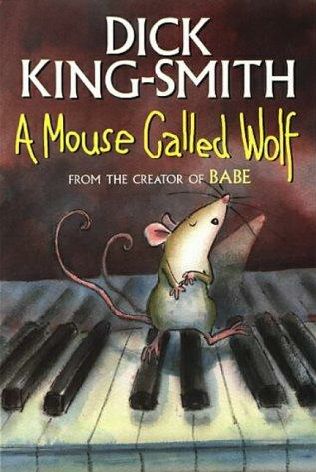
A mouse called Wolf by Dick King-Smith

Last week as I was heading home I quickly browsed my library shelves looking for some weekend reading.  I picked up a few books including A mouse called Wolf.  Why did I pick up this book which was first published in 1997?  I always enjoy books by Dick King-Smith, author of The Sheep pig later turned into the movie called Babe.  I really liked the cover of our copy but now I have discovered new editions have even better covers.  This looked like a short book for a quick read and it was a book I had not read.

I sat down for a little while this morning and read the whole book right through in one short sitting. What a delight.  Here we have a charming story about music, mice, chocolate and one very special older lady who with patience and care befriends a little mouse called Wolf.  Actually his real name is Wolfgang Amadeus Mouse but this has been shortened to Wolf.  He is a mouse with a special musical talent as befits his prestigious name.  He is also a mouse with courage and perseverance.

I think the publisher is missing a terrific marketing opportunity here.  I am planning to recommend this to my Grade Three teachers as a read-a-loud title. This book should come with a CD containing all the music that Wolf and Mrs Honeybee (I love that name) enjoy together.

Here is a partial list of some of their favourites:


  • Mendelssohn Song without words
  • Just a song at Twilight
  • Food glorious food from Oliver
  • Climb every mountain
  • Help by the Beatles

The best scene comes at the end of the book when Wolf sings his own composition entitled Swallow Sonata to Mrs Honeybee :

"I never taught him this, she thought, I've never heard this piece of music before.  Never in all my concert playing days did I hear this, and yet it must be by one of the great classical composers.  How light it is, how airy, how wonderfully joyful!"

If you enjoy this book follow it up with Walter which is also about a very special rodent.

Here is the web site for the author.