Showing posts with label Literacy. Show all posts

Monday, May 4, 2026

The Day of Ahmed's Secret by Florence Parry Heide illustrated by Ted Lewin


Image from this video (well worth watching)

"Today I have a secret, and all day long my secret will be like a friend to me. Tonight I will tell it to my family, but now I have work to do in the city."

Ahmed rides on his small cart pulled by his donkey. The city of Cairo is noisy and filled with people trading and shopping. Ahmed notices the sounds and the colours. He enjoys a quick meal of beans and noodles, but he cannot pause for long because he has deliveries to make - heavy bottles of fuel. 

With older students I would like this book with the UNICEF Rights of the Child:

28. EducationEvery child has the right to an education. Primary education should be free. Secondary and higher education should be available to every child. Children should be encouraged to go to school to the highest level possible.

32. Protection from harmful work: Children have the right to be protected from doing work that is dangerous or bad for their education, health or development. If children work, they have the right to be safe and paid fairly.

When I spied this book at a recent charity book sale I knew it would be a terrific choice. As is often the way with books I pick up at the fair, I do wonder how this book came to be here in Australia. Someone has inscribed it "to Leo happy reading love Grandma Bea". I wonder if Leo read his gift. I wonder if Bea knew the author or illustrator or if she realised this book (published in 1990) contains an important story about the power of education and literacy? 


Publisher blurb (spoiler included): Ahmed drives his donkey cart through the streets of Cairo, delivering butane gas cylinders to his father's customers. He knows everyone and has a part to play in the life of the city. He is proud to be strong enough to help his family, but most of all he is proud of his precious secret, a secret that he keeps until the end of the day. The book reveals a lot about Ahmed's life, and finally his secret - that he can write his name.


Florence Parry Heide died in 2011. She wrote over 100 books including the famous series about Treehorn. The co-author of this book Judith Heide Gilland is her daughter. Ted Lewin died in 2021. He illustrated over 200 books. (Kirkus have talked about lots of them). I have already talked about his book about puffins! Here are two others:


Sunday, March 29, 2026

Astrid Lindgren Memorial Award

A total of 263 candidates from 74 countries and regions have been nominated for the 2026 Astrid Lindgren Memorial Award, including 78 candidates new from previous years. The list includes authors and illustrators, as well as storytellers and reading promoters. The laureate will be announced on 14 April 2026.

Here are some highlights and familiar names:

AUSTRALIA - Alison Lester; Ursula Dubosarsky 


NIGERIA/UK - Atinuke


GERMANY - Axel Scheffler

ITALY - Beatrice Alemagna

CHINA - Cao Wenxuan


IRELAND - Chris Haughton

UK - David AlmondJackie Morris; Quentin Blake; Michael RosenJulia Donaldson; Nicola Davies; Philip Reeve

CANADA - Deborah EllisElise GravelIsabelle ArsenaultJon Klassen; Sydney Smith.


NEW ZEALAND - Gavin Bishop

COLOMBIA - Ivar Da Coll

POLAND - Iwona Chmielewska

USA - Jason ReynoldsKate DiCamillo


BELGIUM - Leo Timmers

SWEDEN - Marit Törnqvist

IRELAND - Oliver Jeffers; Sarah Crossan

CHILE - Paloma Valdivia


BRAZIL - Roger Mello

SOUTH KOREA - Suzy Lee

FRANCE - Timothée de Fombelle


And some terrific Organisations:

ITALY - Silent books Lampedusa (IBBY) Here are the books from IBBY Australia

USA - A Book a Day; Dolly Parton’s Imagination Library

UK - Centre for Literacy in Primary Education; Empathy Lab.


These are titles from The Empathy Lab


Friday, April 18, 2025

Mr George Baker by Amy Hest illustrated by Jon J Muth


"See this man? This one here, sitting on the porch?
That's Mr George Baker, and he's a hundred years old, no kidding."

Harry sits with Mr George Baker - it is clear this is a daily routine.

"See his pants, all baggy, baggy, baggy? What holds them up - suspenders!"

Mr George Baker is good a tying shoelaces but strangely he also has a book bag (a school bag) just like the one young Harry is carrying. There is a book inside his bag, but Mr George Baker cannot read. He is indeed a hundred years old, but he never learned how to read. Now we know where these friends are going. 

Finally, the yellow school bus arrives. There are twenty-two kids on the bus, but George always sits with Harry. Learning to read is hard but there is a gentle assurance at the end of this book that both of them will conquer this important skill with patience and perseverance. You might also like to listen to some gentle jazz tracks after reading this book - Mr George was once a fine jazz drummer and there is a lovely scene in this book where we see him dancing with his wife. 


Publisher blurb: George Baker and Harry don’t seem the likeliest of friends. Yet, sitting side by side on George’s porch, waiting for the school bus to come, the two have plenty in common, this hundred-year-old musician with the crookedy fingers going tappidy on his knees and the young schoolboy whose shoelaces always need tying. They’re both learning to read, which is hard — but what’s easy is the warm friendship they share. In an inspired pairing, a best-selling author and illustrator pay tribute to the power of language and intergenerational bonds.

I have been SO privileged to visit one of the best school libraries in an independent school here in Sydney over the last 8 years (minus those covid years) and every week I have been able to borrow new books, Australian books, picture books, translated picture books, books from Canada, books from USA, books from UK, books I will always cherish. Along the way this reading journey has led me to discover hundreds of new authors and even better hundreds of fantastic illustrators from all corners of the world. Sadly, my days of visiting this treasure trove may now be ending. Finding Mr George Baker is a great example of the books I have found in this library, and it is also a reminder that there were SO many more books I didn't discover. And it shows the joy that comes from discovering a wonderful book. Oh and yes this confirms why libraries are SO important as places that hold all kinds of books - old and new - because I am sure you have guessed Mr George Baker is long out of print. It was published in 2004 with a paperback edition in 2007. Here is the Kirkus review.

The Teacher-Librarian was curating a 'bulk loan' for the four Grade One classes in this school. A 'bulk loan' is the loan of piles of books on a theme or class topic. In this case their focus was/is a topic I call 'Life in the Olden days' with particular reference to changes to our homes, way of life, toys and clothing. As a library volunteer, I used the library catalogue (which is another excellent resource in this library) to hunt out and fill boxes with books on this topic. Along the way the Teacher-Librarian and I were talking about these two books which I had seen previously and then she mentioned Mr George Baker. 


I often cry over books and television advertisements and when little children sing at a school assembly but it is rare for me to cry over a picture book - Mr George Baker made me cry. It is a book to love and to read slowly and a book with the most beautiful illustrations. Amy Hest also made me cry over these middle grade books:


Monday, March 17, 2025

Stitched Up by Steve Cole


Hanh is sold by her parents to two strangers who offer her a good job as a shop assistant in distant Hanoi. She and other girls from her village are taken to the city but that's when all the promises are broken. They are locked inside a factory, fed only rice, they are only allowed to use the bathroom twice a day, and all of them are forced to work in very dangerous factory conditions manufacturing jeans for the fast fashion industry. Perfectly good denim is distressed by sandblasting. Fabrics are dropped into vats of dangerous chemicals. Machines are used to press creases into the legs of the pants. And embellishments are added by machine and by hand. The young overseer girl wields a stick and she beats any child who does not perform their tasks quickly. Quotas, money and greed drive this industry. Reading this book will most certainly make you reconsider that next purchase of fast fashion.

The story does have a resolution but clearly Hanh will be damaged for the rest of her life and her parents suffer from the most dreadful guilt. They never did receive the promised money. In this book you can read about modern slavery and organisations who are working to rescue children like Hanh and her friends. There is also an afterword about ways to avoid fast fashion. I had no idea 8,000 litres of water are used to make one pair of jeans 

This book is from the Barrington Stoke (Dyslexia friendly) book series. They produce books for all ages and this one is most certainly a Young Adult title for mature readers aged 12+.

You're going to read about the processes which go into the manufacture of garments such as the jeans. They're complex and require a great deal of skill. Hanh and the other girls get just two poor meals a day and are allowed only two toilet breaks. Violence is commonplace - and vicious. No account is taken of any illnesses or injuries: the girls are, after all, expendable. It's a dreadful situation but Steve Coles tells the story with sensitivity and compassion but still manages not to shy away from the brutal truth about why fast-fashion clothes are so cheap. BookBag

Children who are passionate about social justice are sure to devour this book. Scope for Imagination

In the context of a High School this book could be used in many different ways. If your school runs a social justice program this book explores modern slavery. This book is also about textile manufacturing and in particular 'trendy' jeans with distressed fabrics, rips and tears and embellishments and so it could be used in Design and Tech. If you have a group of students exploring the UN Rights of the child this book could be added to a wide reading list.

Here are all the titles in this series by Steve Cole:


I would pair Stitched up with these books:


Monday, November 27, 2023

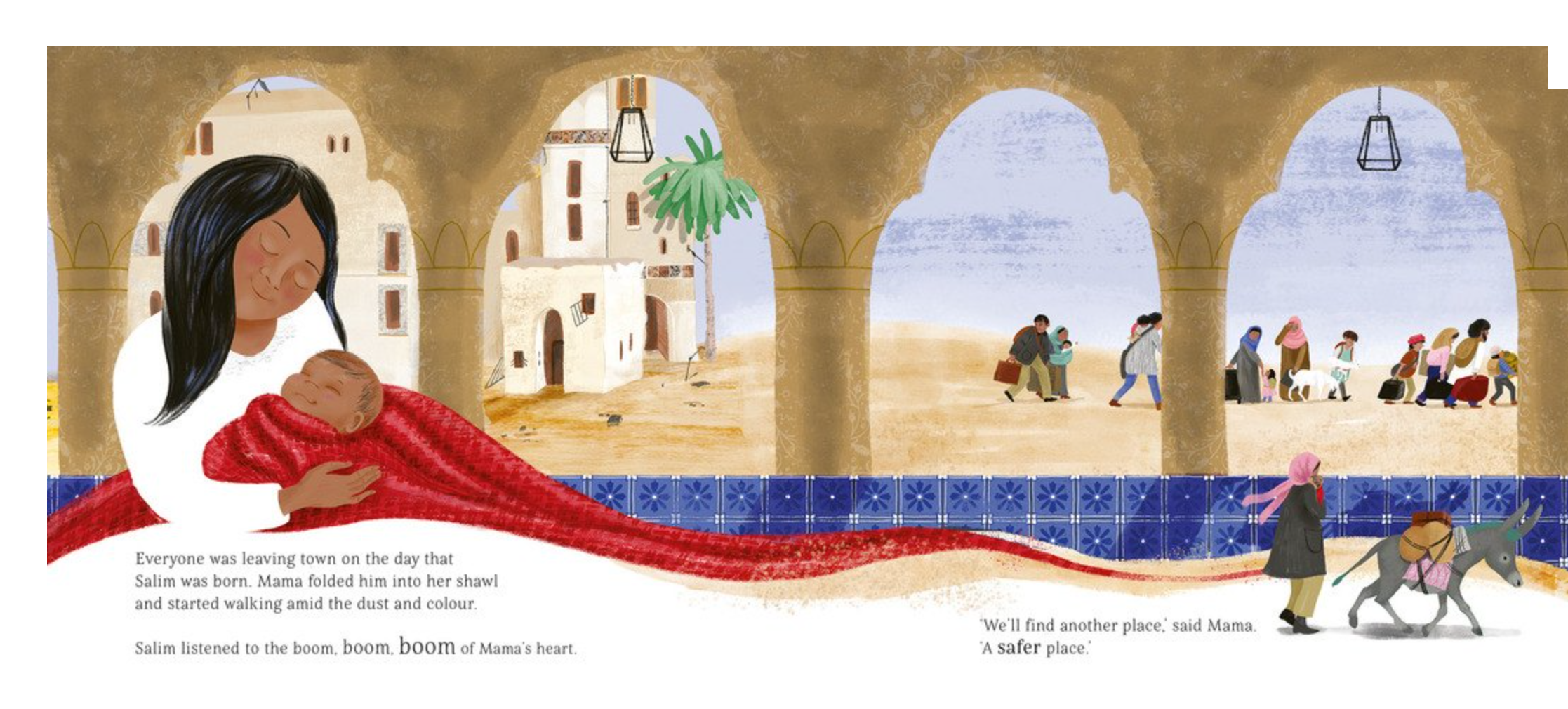
Under the Red Shawl by Vikki Conley illustrated by Martina Heiduczek


I wrote this story to explore the many challenges that our world presents for our children. We all have different homes and places where we live (cities, towns, villages), but for some children they are forced to leave for different reasons, and that can be hard. Vikki Conley

It is interesting to ponder the passing of time in this story. When we first meet Salim he has just been born. He hears the boom boom boom of his mother's heart but there is also the boom boom boom all around. We know this is a dangerous place when we read that the mother and child need to begin their journey to a safer place today. Salim is folded into her beautiful red shawl. 

The journey is long and very difficult through all weathers and landscapes but Mama tells her little son that they will find a place of safety.

"Mama whispered stories about green grass, bouncing balls and laughing children."

Publisher blurb: Starting out in a new place is tough, but friendship, kindness and imagination help Salim, Mama and Donkey discover their new world. In this stunning picture book, by award-winning creators – Vikki Conley and Martina Heiduczek – we journey with Salim as he grows up creating a new life around him. This is a story about a journey, hope and creating fun with the little that you have.

Vikki Conley has brought the reality of the world of the refugee child right into the realm of more fortunate children ... The Bottom Shelf

Teachers Notes from the publisher.

Pair this with these books:


I am also keen to find this book.  I am sure I have seen another book about kids who make a ball out of found materials set either in Africa or South America but I can't think of the title.

With older children you might also like to look at these books:


Monday, June 26, 2023

My Brigadista Year by Katherine Paterson


Reading this book you will quickly fall into the gentle rhythm of the writing. The story, told here by Katherine Paterson, is easy to read but it also offers an amazing insight into a piece of history, especially the history of Cuba, that I knew absolutely nothing about.

Based on the true experiences of those involved in Fidel Castro’s universal literacy programme, which aimed to bring literacy to all of Cuba in just 12 months, this is a fascinating look at a period of recent world history seen through the eyes of an idealistic young woman. A vivid portrayal of the value of education in empowering even the poorest people. Book Trust

750,000 volunteers signed up to teach people in remote areas of Cuba how to read and write. In just one year the United Nations declared Cuba to be an "illiteracy-free" nation.

Lora aged only 13, travels to a remote farming area where she meets a wonderful family - all of whom are determined to learn to read and write even though at the beginning none can even write their own name. Lora is patient and also very keen to learn farm chores so she can assist the family. The materials supplied for teaching do contain propaganda about Castro but Katherine Paterson does not dwell on this. For myself, I was curious to see these primers used by the young teachers. As a reader I was totally caught up in watching Lora work and live with this family. Some learn quickly others have to work very hard and the whole time Lora shows a quiet wisdom well beyond her years. Katherine Paterson also creates just the right amount of tension in her story when we read that a year ago another young volunteer eighteen year old Conrado Benitez was murdered by insurgents. Lora's team are named after this young man. "Conrado Benitez Brigadistas—100,000 young volunteers (ages 10–19) who left school to live and work with students in the countryside." All of the young teachers are on edge throughout the year knowing these insurgents are still very active. 

Here are some text quotes:

"Even if they didn't like me, they had asked for a teacher and volunteered to take one into their home - so they must want to learn - they must want to be able to read and write. ... But was I up to the task of teaching them?"

"Step by step, students would move from learning vowels and consonants to learning words, short phrases, then sentences. At the same time the lessons would help our students understand about our country after the revolution - about land reform, cooperative stories, the conversion of buildings that once belonged to the rich into homes and schools for the poor."

"I learned a lot that day - how to fill the large cans with water from the river ... how to boil coffee, how to wash clothes on the rocks by the river, ... how to feed the chickens and the goats and the oxen, how to prepare a meal. I would even learn how to skilfully milk a goat, cut corn with a machete, ride a horse, and plow a field behind a team of oxen."

Publisher blurbWhen thirteen-year-old Lora tells her parents that she wants to join Premier Castro’s army of young literacy teachers, her mother screeches to high heaven, and her father roars like a lion. Lora has barely been outside of Havana — why would she throw away her life in a remote shack with no electricity, sleeping on a hammock in somebody’s kitchen? But Lora is stubborn: didn’t her parents teach her to share what she has with someone in need? Surprisingly, Lora’s abuela takes her side, even as she makes Lora promise to come home if things get too hard. But how will Lora know for sure when that time has come? Shining light on a little-known moment in history, Katherine Paterson traces a young teen’s coming-of-age journey from a sheltered life to a singular mission: teaching fellow Cubans of all ages to read and write, while helping with the work of their daily lives and sharing the dangers posed by counterrevolutionaries hiding in the hills nearby.

Readers should not expect an action-packed tale, but the writing is straightforward and moves at a swift pace. ...  Paterson offers a glimpse of the daily life of a brigadista, redressing the cursory associations many have about Castro’s Cuba. Hers is a positive study of an amazing moment in history that nonetheless acknowledges the darker political machinations at play. Kirkus

Foremost this is an engaging story about a young girl asserting her independence at a time of change and following through with her convictions. A strong message to share with young girls, especially. Just Imagine

Here is an interview with Katherine Paterson where she talks about this book. The video is 40 minutes but it is well worth taking the time to listen.  You can read here why Katherine Paterson wrote this book. Read more about the literacy program in 1961 here. Five Questions plus one with Katherine Paterson

The endorsement on the back of this book is so wonderful - it is from an actual brigadista. Emilia says: "it was an experience of solidarity, in the very best sense of what each of us as a human being has to offer."

When I was helping a friend re-shelve her extensive book collection recently we discovered she had two copies of My Brigadista Year and so she offered this copy to me. This is the real joy of reading - walking for a few hours in the shoes of another person. Lora is a quiet hero and I am thrilled to have discovered her story. 

Here are some quotes from the book review by Dr Robin Morrow for Magpies Magazine (Paterson, Katherine (My Brigadista Year) Magpies Vol.33 No.1 March 2018 p.37):

The arresting cover accurately signals the content of this book. A bright-eyed girl strides purposefully forward, clad in khaki uniform, carrying not a gun but books and pencil, against a background of workers in the fields. 

With short sentences and plenty of dialogue, veteran storyteller Katherine Paterson uses Lora’s first-person narration to draw the reader into this tale of resilience and deep change ...

This late-career book from Katherine Paterson shows she has retained her courage, deft touch and depth of feeling.

Companion books set in Cuba:


Tuesday, October 11, 2022

Sky Chasers by Emma Carroll


Magpie, an orphan living in France, finds herself involved with the famous Montgolfier family. Does that name sound familiar? More about these two brothers in a minute. Magpie is snatched off the streets by a wealthy looking woman and offered a large sum of money to steal a large red box from the attic room of a house in a wealthy district of the town. Magpie is poor and homeless. She has no idea about her father and her mother died long ago. The woman offers her a large amount of money. Magpie's only companion is a scraggy rooster that she recently rescued. So after midnight, Magpie sets off to take this red box but as she arrives at the house, a young boy emerges from the front door with a duck. Magpie stays hidden and then, when she thinks the coast is clear, she breaks into the house, finds the red box and gets ready to escape. The boy and the duck appear again, there is a scuffle and the box is dropped. Magpie is sure Madame Delacroix does not need the box so she scoops up a bunch of the papers that lie scattered on the floor and flees. 

Magpie is wrong - Madame Delacroix does want that box. She threatens to harm Coco the young rooster so Magpie heads back to the house. On the day she arrives two men brothers - Joseph-Michel Montgolfier and Jacques-Étienne Montgolfier are conducting a test flight with a balloon. It lifts off into the air and Magpie somehow gets a hold on the rope - and suddenly she is air born. But of course what goes up must come down. After a glorious few moments of flight Magpies plummets to the ground. 

When she wakes up the Montgolfier family have taken her into their home and so she is now well and truly caught up in these historic events of 1783.

Spoiler alert - This story is so well constructed. early on we meet Magpie and her "pet" rooster called Coco and Pierre with his duck companion Voltaire. I did wonder, as I read this book, why Emma Carroll added a rooster and duck to her story but they are so essential if you know the history of hot air balloons - not a topic a knew anything about. I am certain reading this story will raise your curiosity and the curiosity of readers aged 10+. I should mention Magpie in this story is credited with seeing how hot air lifts silk but of course in history a young, black, illiterate orphan would have been given no credit for her ideas. 

19th September, 1783 - In 1783, the first hot air balloon was set to fly over the heads of Louis XVI, Marie Antoinette, and the French court in Versailles. Like monkeys in space, this odd assortment of animals was chosen to test the effects of flight. Sheep, thought to be similar to people, would show the effects of altitude on a land dweller, while ducks and roosters, which could already fly (albeit at different heights), would act as controls in the experiment. The balloon flew on a tether for 8 minutes, rising 1500 feet into the air and traveling 2 miles before being brought safely to the ground. The animals were unharmed. Columbus Aeronaughts


There used to be a competition in the UK called The Big Idea. This book comes from an idea by Neal Jackson in 2017. When Neal won the competition his story idea was presented to Emma Carroll and she developed it into this terrific fast paced story. This is a another splendid book from Chicken House. I love the cover of this book by David Litchfield. Read the first chapter here. You can hear an audio sample here - its the night of the robbery. You could use this for a book talk with your students. Here are some book reviews by young Primary school students

The story is structured around the rhyme which is about magpies. I read that magpies are known for stealing shiny things, such as jewellery and deceiving others. The magpie is associated with bad luck in some cultures. In the UK, this dates back to the early parts of the 16th Century.

One for sorrow,

Two for joy,

Three for a girl,

Four for a boy,

Five for silver,

Six for gold,

Seven for a secret,

Never to be told.

Historical figures are woven seamlessly with the invented characters, as are imagined events with the actual, recorded fact of the balloon demonstration. Magpie is at once suspicious and accepting, grateful and wary, a good true friend, and altogether delightful. Kirkus

The hardcover edition has a different cover:

Monday, October 18, 2021

The Beatryce Prophecy by Kate DiCamillo illustrated by Sophie Blackall


A luminous tale of fate, love and the power of words

Beatryce is found in a barn nestling beside a goat. This is not just any goat. Her name is Answelica and she has a reputation as a bossy, belligerent creature who usually butts people out of her way. She also has fierce teeth. The young girl has been found by Brother Edik. He is a monk from the Order of the Chronicles of Sorrowing. Brother Edik is a kind man even though in his own life he has had his own share of suffering. 

Have you ever given much thought the idea of a prophecy. The book called Chronicles of Sorrowing contains prophecies. Some are good and some are bad.  The king has heard this prophecy:

"There will one day come a girl child who will unseat a king and bring about a great change."

If you go back to my quote at the beginning of this post I mentioned the power of words. In the prophecy there are several very important words. Obviously the dangerous character will be a girl but what of the king. The words say "a king".  Who is this king? Is he the rightful monarch?

And why is a girl considered dangerous? What power could she possibly have? Read on my friend.

Back to the story. Beatryce is injured. Answelica will not leave her side so the pair are bought inside the monastery. Brother Edik gently cares for Beatryce and eventually she recovers enough to tell him her name but the rest of her memory is lost for now. Beatryce has no idea how she came to be found at the monastery but there is deeper mystery - the astonishing discovery by Brother Edik, that Beatryce can read and write.

"Only brothers in service to God could read, and also the tutors and scholars who came and studied the prophecies. And counsellors to the king. And the king himself. In the whole of the world ... there was only a handful of people who could read. All of them male. None of them were female. It was against the law to teach a girl to read, or a woman to write."

So the stage is set. Beatryce has a destiny to fulfil. The current king is determined to stop her. Brother Edik will be her travelling companion as will the goat Answelica. Along the way Beatryce will make new friends, a young boy called Jack Dory and an old man called Cannoc, and she will gradually remember all the pieces of her past life. 


Readers will also be given, from time to time, small glimpses into the machinations of the king and his power hungry adviser until eventually we reach their anticipated but also surprising meeting. 

In keeping with the medieval setting, Sophie Blackall has included an illuminated letter at the beginning of each chapter and there is one also hiding under the dust jacket. 

Sophie has designed end papers which are printed on a rich gold background and inside her black and white full page illustrations seems almost cinematic. When you finish reading this book take some time to linger over and marvel at the cover. Beatryce has something to share with you - she's looking straight at the reader inviting you to enter her story. You can read the first 48 pages of this book here

"We shall all, in the end, be led to where we belong.

We shall all, in the end, find out way home."

I read that an edition of this book has been released in a special box with a ribbon book mark (it costs over $75 here in Australia but if you are tempted here is the Gift edition ISBN 9781536218671). When ribbons like this are added to a book they make it seem extra special and I think this anticipates the fact the The Beatryce Prophecy is destined to become a Children's Literature classic. I read this book in one sitting. I did not want it to end but when it did I smiled a huge smile because, as usual, Kate DiCamillo has penned a glorious story filled with tiny details which feel like glistening jewels and which are all brought together at the end into one truly special object to treasure.

You MUST listen to this Podcast interview with Kate from The Children's Book Review

Here is a quote from the interview:

My outrageous hope … that somebody will feel less alone, that they feel like they’re walking through the world with somebody, and that it will help. The book will help to make some more sense out of the world. Kate DiCamillo

I just loved spending time in that world, even though it’s a world in which lots of bad and dangerous and sad and troubling things happen. There is this light of hope and joy and overcoming obstacles and friendship and love and forgiveness and all of these things that Kate does so beautifully and mesmerizingly ... Sophie Blackall Children's Book Review interview

The story is told in language as clear and beautiful as an illuminated manuscript, with characters who spring instantly to life. The fairy-tale conventions give it a sense of timelessness and omnipresence without once becoming twee or unwieldy. Kirkus Star review

It is, in short, a very good book, worth any kid’s time to read. And that, my dears, is the kind of book that you should probably read too. Betsy Bird School Library Journal

I love it when the book itself shows how important reading is and how important words are, how words and reading connect us to the world and how, ultimately, through education, we can begin to make wiser choices. The Children's Book Review interviewer - Bianca Schulze

A final wise word from Kate about books and reading (one of the important themes of The Beatryce Prophecy):

And the other thing is, having somebody reading to you seems like such an act of love to me. So, I just want to say thank you to everybody who puts a book in somebody else’s hand and everybody who’s reading to somebody. That goes for kids too. I say, when I talk to kids, you can read to the adults in your life. They need it too, you know.

Companion read:


You might also like to explore some books involving journeys, young and very brave girls, wise mothers who may be imprisoned, and helpful travelling companions: