Showing posts with label Displaced people. Show all posts

Thursday, July 16, 2026

Island Born by Junot Diaz illustrated by Leo Espinosa


"Mai was from a city so big that it was like its own country. India and Camila were from a stony village at the tippy top of the world. Matteo had lived in a desert so hot even the cactus fainted. Nu was born in a jungle famous for its tigers and poets. And Lola was from the Island."


Lola, who immigrated when she was six years old, does not remember the Dominican Republic, and sets out to fill in her missing memories by talking to members of her family and community. 

I especially love the vibrant illustrations in this book. I can imagine using this book with a class as a jumping off point to talk about family and heritage and also here in Australia to talk about our multicultural community. You could also talk about displacement, refugees, immigrants, sharing memories, adult child relationships and why people move from one country to another.


Publisher blurb: Every kid in Lola’s school was from somewhere else. Hers was a school of faraway places. When Lola’s teacher asks the students to draw a picture of where their families immigrated from, all the kids are excited. Except Lola. She can’t remember The Island—she left when she was just a baby. But with the help of her family and friends, and their memories—joyous, fantastical, heartbreaking, and frightening—Lola’s imagination takes her on an extraordinary journey back to The Island. As she draws closer to the heart of her family’s story, Lola comes to understand the truth of her abuela’s words: “Just because you don’t remember a place doesn’t mean it’s not in you.”

I picked up this book at a recent charity book sale - it is in mint condition with a dust jacket. This book was published in 2018 and I suspect it has been sitting quietly on a family bookshelf for many years. Take a look at this review. 

I have a Pinterest entitled "She looks like me" - this book will be a perfect addition to that collection. 

Awards: 2019 Pura Belpre Illustrator Honor.

Companion book for an older reader:


Wednesday, July 8, 2026

Shakespeare in the Orchard by Danielle Binks


"I suppose we'd like to feel human again' ... A small, mean part of him wanted to make fun and mock - a bunch of Germans wanting feel human in the middle of a war that their lot had started, by play-acting death and destruction, ... but then he heard the others murmuring their agreement with Georg's answer, and he swallowed the acid words he was thinking."

The real strength of this story (apart from learning about Internment camps here in Australia, in particular in Victoria) is the way, very gradually, Jack grows in his understanding of humanity. 

This quote comes near the end of the book:

"All those stories we tell and get told, it's to make them less human ... you know that, because you know them. It's not true, it's just easier to be cruel and look away from what we have in common ... It's harder to kill a man if you know him."

It is 1914 and World War I has just begun. At first Jack is swept up in the war propaganda of Germans as the enemy and of course he is so proud of his brother heading away to train as a soldier. Jack is also learning some army skills himself through his replacement teacher Mr Kempster who is a war fanatic and actually a very dangerous man but not as dangerous as one of the horrible soldiers, Lance Corporal Wright, who has been sent to guard the enemy aliens who are now imprisoned in the rural community of Langwarrin on the Mornington Peninsular. 

Jack has joined the cadets and at first he enjoys the training along with his good friend Walter. But then he witnesses several things in his town which cause him to question the idea of 'the enemy'. Meeting the German prisoners who are sent to help in the apple orchard allows Jack to move beyond that word 'enemy' and understand that these are real people who just happened to be born in a different country and who happened to be here in Australia when we decided people from 'over there' were our enemies.

"if he was honest, there was a lot he hadn't told his mother lately - like the conversations he'd found himself having with the prisoners and his odd curiosity about their lives before the war. Not to mention the Maberly's white feathers and his agreeing to pass Lotti's letters onto Georg (her father) ..."

Jack and his mum anxiously wait for letters from Jack's brother Matt. There is a moment of terrible tension in this story when one of the letters arrives but before Jack can read it to his mother (I am guessing she may had have dyslexia) the letter is lost (Chapter 32). The dreadful Lance Corporal Wright has attacked Lottie (daughter of one of the German prisoners) and he has violently bashed Jack's friend Walter. This horrific incident and my worry over that important letter kept me turning the pages hoping that letter would be found - but it wasn't. 

Blurb from the author page: The whole world is at war. In Langwarrin on the Mornington Peninsula, fourteen-year-old Jack Thorning is the best marksman in military cadet training. His brother, Matt, taught him everything he knew, after their father died. But now Matt has joined the war effort, and it’s up to Jack to hold down the home front and help his mother run the family orchard. When a group of ‘enemy aliens’ are sent to Langwarrin to be held prisoner at the Military base, tensions in the town run high. For Jack and his best friend, Walter, the war feels closer than ever. Like the rest of the town, Jack and Walter want nothing to do with the German prisoners. But as the war progresses, the inmates at the camp are put to work doing manual labour on the farms around Langwarrin, including Jack’s family orchard, and Jack begins to see that the prisoners are people, too. What could Jack possibly have in common with the people responsible for keeping his beloved brother at war? And can Shakespeare bring them all together?

Five years ago I talked about another book based on Internment camps here in Australia (Interned by Pamela Rushby) and in that post I used this article to talk about the features of a good historical novel. I am going to repeat them here because I am so happy to say Danielle Binks does all of these things and she does them brilliantly:

1. Have fun with the research but do your homework. 

This should go without saying, but I’ll say it anyway. Borrow some good reference books. Become comfortable with the time period. Try to understand both the larger scope of the period, while examining aspects of daily life. This will help create an authentic backdrop for your novel.

2. Let the characters engage with the historical details. 

This goes along with that “show don’t tell” truism writers are told all the time. Rather than just dumping a bunch of facts on the poor reader, let your characters interact with these details with all these senses. Let them smell the offal dumped onto the cobblestone streets. Let them squint in the fading light of the tallow candles. Let them feel the tingling sensation as the physician places a leech on their bare skin.

3. Allow your characters to question and explore their place in society. 

This will help reveal the larger political, social, cultural context of the time. What were the expectations for women? For sailors? For criminals? How did people from different parts of society interact with one another?


By coincidence as I finished Shakespeare in the Orchard I picked up our Sydney Morning Herald and saw an article by Danielle Binks under the heading Empathy.

“I am an author who writes sad kid’s books, and I maintain that children are a lot stronger than we give them credit for, and their inner universes so much more complex than we acknowledge. I never try to make my readers upset, I just hope they care enough to feel empathy for the characters I’m giving them.” Danielle Binks Sydney Morning Herald 27 June 2026

She goes on to say:

The book is set during World War I and is inspired by the true events of Australia’s home-front war that unfolded in my hometown of Langwarrin. In 1914, the Australian government suspended habeas corpus for the first (but not the last) time, and imprisoned “enemy aliens” of German and Austro-Hungarian descent. I chose to tell the story from the point of view of a 14-year-old boy named Jack, a military cadet whose brother has joined the war effort and who is being fed a jingoistic form of hyper-nationalism, right when the military reserve across the way from his family’s apple orchard opens its doors to German prisoners. It’s a true but shameful tale of Australia’s war history; a moment when our government arguably did the wrong thing, for the right reasons. The book also tells the true story of how those German prisoners staved off boredom and retained their humanity in the face of such adversity: with theatre. When Jack overhears the prisoners practicing Hamlet, he’s shocked and horrified by their humanity – and his curious response to it.

In this Instagram post you can hear Danielle Banks describing her book. Shakespeare in the Orchard was published yesterday - 7th July. Huge thanks to Gleebooks Kids for loaning me the advance reader copy. 

Daneille Binks suggests her book is for ages 10+ but I am going to say it will better appeal to readers aged 12+ firstly because it is long book (300+ pages) of very small print; secondly because the motivations of several of the Anti-German characters such as the teacher Mr Kempster and Lance Corporal Wright are distressing and complex; thirdly because I think readers will appreciate this book if they have some understanding of or have studied the Shakespeare play Hamlet; and finally because the main character, Jack, is aged 14. I did start this book three times but I kept putting it aside. Then I read a review on social media and the reviewer convinced me to start again and stick with this book - she was right. From about chapter 23 (of the 45 chapters) onwards I was able to read in a more sustained way.

It is a thoroughly heart-warming story demonstrating that prejudices and intolerance are so often created by pure ignorance and willful misunderstandings. A particularly resonant episode is the underlining of the most violent, dangerous and intolerant person in the plot – one of the soldiers reputedly safeguarding the community, not one of the prisoners who remain docile albeit dejected – a thoroughly nasty piece of work. Just so Stories

High School history teachers could make really good use of the letters from Matt that are included in this book especially if the topic is the lead up to the Gallipoli campaign. Here is some background reading about internment camps in Australia. And here are some stories/first-hand accounts. Here are more details in an article from The Conversation. 


Companion books:


Monday, November 27, 2023

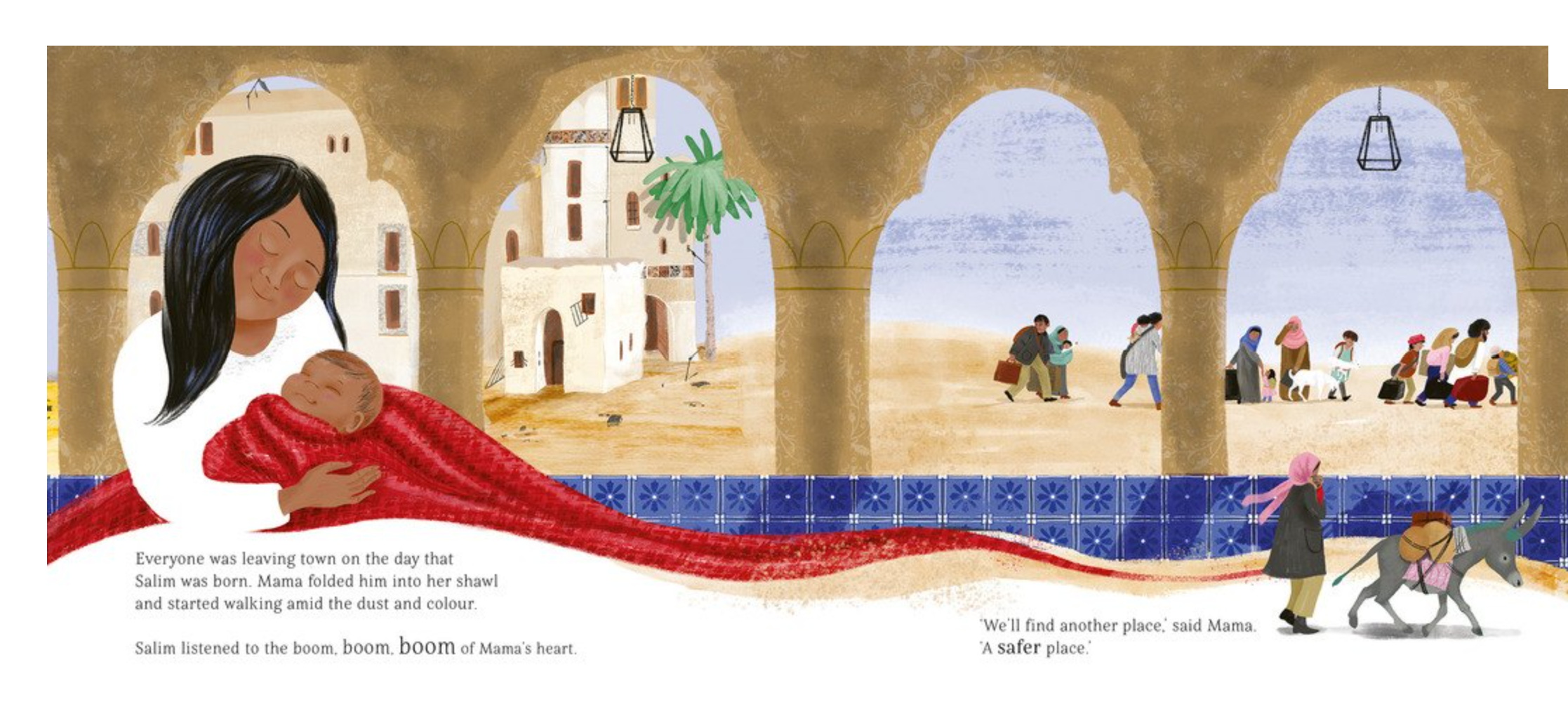
Under the Red Shawl by Vikki Conley illustrated by Martina Heiduczek


I wrote this story to explore the many challenges that our world presents for our children. We all have different homes and places where we live (cities, towns, villages), but for some children they are forced to leave for different reasons, and that can be hard. Vikki Conley

It is interesting to ponder the passing of time in this story. When we first meet Salim he has just been born. He hears the boom boom boom of his mother's heart but there is also the boom boom boom all around. We know this is a dangerous place when we read that the mother and child need to begin their journey to a safer place today. Salim is folded into her beautiful red shawl. 

The journey is long and very difficult through all weathers and landscapes but Mama tells her little son that they will find a place of safety.

"Mama whispered stories about green grass, bouncing balls and laughing children."

Publisher blurb: Starting out in a new place is tough, but friendship, kindness and imagination help Salim, Mama and Donkey discover their new world. In this stunning picture book, by award-winning creators – Vikki Conley and Martina Heiduczek – we journey with Salim as he grows up creating a new life around him. This is a story about a journey, hope and creating fun with the little that you have.

Vikki Conley has brought the reality of the world of the refugee child right into the realm of more fortunate children ... The Bottom Shelf

Teachers Notes from the publisher.

Pair this with these books:


I am also keen to find this book.  I am sure I have seen another book about kids who make a ball out of found materials set either in Africa or South America but I can't think of the title.

With older children you might also like to look at these books:


Monday, November 20, 2023

The Treasure Box by Margaret Wild illustrated by Freya Blackwood


"This is a book about our people, about us ... 
it is rarer than rubies, more splendid than silver, greater than gold."

Publisher blurb: As war rages, Peter and his father flee their home, taking with them a treasure box that holds something more precious than jewels. They journey through mud and rain and long cold nights, and soon their survival becomes more important than any possessions they carry. But as the years go by, Peter never forgets the treasure box, and one day he returns to find it...  From two of our most talented picture-book creators comes this celebration of things that can't be destroyed by bombs or fire. A haunting and beautiful tale of the power of words, the importance of stories and the resilience of the human spirit.


Image Source: Freya Blackwood

Treasure Box was published in 2013, the paperback in 2017 and it is still available. I picked up my copy from a recant charity book sale. Here is a review and some teaching ideas (2013) from Megan Daley. Here is an excellent set of questions to use with students prior to reading this book. There is a comprehensive list of teacher resources on the National Centre for Children's Literature database Picture Books for Older Readers page. 

This story is a reminder that war doesn't last forever and that the stories of a culture can survive even the bleakest times. ...  All books are treasures, but most particularly this one. Kids' Book Review


Read more about Margaret Wild - our national children's book treasure.

Companion books:


Thursday, June 30, 2022

Amira's Suitcase by Vikki Conley illustrated by Nicky Johnston


Amira finds a tiny plant in her suitcase. Why does she have a suitcase? Where do Amira and her family seem to live? This is a strange place filled with make-shift shelters and dirt floors yet it seems to be her new home. Amira, we read, had been looking for a place to hide but now, instead, she has a tiny life to nurture. She makes sure the fragile seedling has sunlight and water. Each day the tiny plant grows a little bigger and curiosity about her suitcase plant draws attracts the attention of living in this place. Amira meets Nala and she shares the happiness of watching her plant grow. Nala shares a seed and they plant this inside the suitcase. Then Tien joins the girls and he passes on another small seed. 

Over the following pages we watch as the plants grow so tall they no longer fit into their suitcase.

So "together they dug a new home for the plants. Together they smiled at the flourishing leaves. And together they climbed up, up, up towards the sun."

From the front cover this book looks so inviting. The colours are appealing and the design elements will help make a reader curious. There are hints of a journey along with the small shadow of a plant. I agree with the words of the blurb which say this is "a gentle, thought-provoking tale about friendship and hope".

I love the way the cover looks like the suitcase – the words ‘tratar con cuidado’ means ‘handle with care’ in Spanish. The end papers match the suitcase lining. 

On the half title page, it is clear the suitcase is heavy – the story has started before we even reach the first page of print. Amira does not talk about where she lives or why but the background images of corrugated iron and dirt and the way she has no shoes speak volumes about her situation and the situation of her family. This is reinforced when we see the mattress on the floor of their ‘new home’ and the way the family possessions are in cloth bundles and recycled boxes. 


Please take a few minutes to read this piece where the author talks about the inspiration for this book.

Every line of the text has been placed carefully on the page and the illustrations move from large to small to double page spreads. There is a strong emotional component to this story. When Amira smiles at her plant something blossoms inside her. And there is a sense of hope conveyed through the growth of the plant and the new friendships. The language is also very special – word placement such as ‘a finger of sunlight’; ‘a bud of warmth’ and ‘Amira’s hand quivered and tingled’. 

I like the way the image from the title page is repeated near the end but this time with the addition of her two new friends. The sequence page where we see the plant growing is another page is the perfect way to show the passing of time. This book will also give readers things to think about – Why was Amira hiding? Where is this happening? And most importantly What will happen next?

This is one of those deceptively simple books that, with close reading, reveals a deeper story. You could share this book with your youngest students but it is your older upper primary students who will see further possibities as you guide the discussion. 

The family’s struggles are presented in an age-appropriate and relatable way, as is Amira’s ability to adapt and find hope in her new environment. ... A poignant tale of new beginnings.  Kirkus

Amira's Suitcase has been shortlisted for the 2022 CBCA Book of the Year awards (Early Childhood). Here are a set of teaching notes where you will find some discussion questions which might be useful for a group of very young children. Read the judges report here. 

I would pair this book with any of these:


You could also explore books which feature seeds and plant growth:


Friday, December 31, 2021

Interned by Pamela Rushby


Authors of historical fiction set themselves a huge task. They need to be dedicated to their project in order to complete the hours of research needed so their book is accurate. At the same time the writer needs to weave together a story with an engaging narrative. In some books of historical fiction it feels as though the author has a pages of facts which they want to showcase or even shove into the plot.  That is not the case here with Interned.  It is very clear Pamela Rushby has done an enormous amount of research for her book but then, as I heard Jackie French once say, the author needs to throw all of that away and just let the flavour of the historical period naturally percolate through the story. 

Jackie says: Perhaps that’s what my books really are -- a whisper that becomes an obsession; years of research that suddenly crystallise into a story, and then the labour of turning the past into fiction, woven with facts.

In this article for Writers Digest I found these wise words about writing historical fiction. Pamela Rushby follows all of this advice:

1. Have fun with the research, but do your homework. 

This should go without saying, but I’ll say it anyway. Borrow some good reference books. Become comfortable with the time period. Try to understand both the larger scope of the period, while examining aspects of daily life. This will help create an authentic backdrop for your novel.

2. Let the characters engage with the historical details. 

This goes along with that “show don’t tell” truism writers are told all the time. Rather than just dumping a bunch of facts on the poor reader, let your characters interact with these details with all these senses. Let them smell the offal dumped onto the cobblestone streets. Let them squint in the fading light of the tallow candles. Let them feel the tingling sensation as the physician places a leech on their bare skin.

3. Allow your characters to question and explore their place in society. 

This will help reveal the larger political, social, cultural context of the time. What were the expectations for women? For sailors? For criminals? How did people from different parts of society interact with one another?

Interned is set in 1914. Gretta lives in Singapore and Tilly lives in Brisbane. 

"When war breaks out and both countries turn on their families for being German , the two girls find themselves taken from their homes, interned at a camp in rural New South Wales. Far away from everything they have ever know, Gretta and Tilly are forced to face prejudice, overcome adversity and to make their own community."

This story is told though the eyes of these two very different girls using alternating voices. Both girls demonstrate enormous courage and enormous care of their families. 

I knew about the internment camps which were set up here in Australia during WWII but I had no idea about the situation during WWI. Pamela Rushby gives her readers a strong sense of the place, the confusion, the harsh climate, the recurring heartbreak, and the strong bonds of family relationships. Pamela wrote this book because she discovered her own grandfather came to Australia from Germany as a tiny baby in 1880 and the family settled in Queensland. In 1900 the largest non-British immigrant group in Australia were people of German descent. Many lived in Queensland and South Australia. 

In the author notes Pamela writes about the beginning of World War I:

"Almost immediately after war was declared, a wave of anti-German propaganda swept the nation. ... German schools and clubs were forced to close. German music was banned. Communities with German names were renamed. ... Almost seven thousand people of German descent were detained... (including) German families that had been living and working in British colonies in New Guinea or south-east Asia."

I highly recommend this book for readers aged 10+ especially for those with an interest in history. Interned will be published in March 2022. Huge thanks to Beachside Bookshop for my advance copy. 

Companion reads (note these are all set during WWII):


Monday, July 26, 2021

As Time Went By by José Sanabria


As Time Went By is the perfect title for this book. Part One begins with the ship.  "Once upon a time there was a ship that sailed beside the sun with very important people on board." Over the the ship is sold on to a merchant. In the illustration you can see it is now loaded with cards and cargo including a train engine and a small aeroplane. The next owner is a fishing company and then the ship is abandoned. 

Part Two Begins with an echo of the opening lines "Once upon a time there was a family for whom the sun was always shining." Over the the family squander all their money and eventually they become poor and have to move to a small house, then a smaller house until finally they move into one room near the harbor. Then in a chilling scene we see all of the people from this village are evicted. They walk towards the waterfront carrying their few possessions.

Part Three Again we hear similar words "One upon a time there was a village of homeless people and an abandoned ship." The displace people climb aboard the old abandoned ship and begin to rebuild it. The old ship becomes their home, it can sail again and in the final scene we see it carrying everyone in their newly created village on the water.

On the last page the words from the first page are repeated but this time they have a very different meaning. 

"Once upon a time there was a ship that sailed beside the sun with very important people on board."

As Time Went By is another of those splendid picture books which can be read on many levels. I highly recommend this as a book to use with Senior Primary students. It is sure to generate some deep discussions. You can see some art from this book here. If you are discussing this book you might also like to share the comment from the School Library Journal which described this book as "both heavy-handed and opaque, this melancholy parable is not recommended."  I utterly disagree but this I think this strongly expressed view is very interesting. 

Publisher blurb from Walker Books: Once upon a time there was a ship that sailed beside the sun with very important people on board. The spirit of reinvention – and the importance we place on things – is beautifully expressed in Jose Sanabria's visually evocative story. A steamship makes a journey across time from luxury and exclusivity, industry and abandonment, to stewardship and inclusion as we see the evolving functions of the ship and the changing faces of the people who cherish it most of all.

There was a discussion recently on a Facebook group about end papers. The example found in this book is perfect. A the front you will find a fleet of ships. The waterway looks very crowded. The final end paper is filled with people, many of whom are smiling.

A lovely, rich book to spend time with. Kirkus Star review

As Time Went By is a beautiful portrayal of the changing fortunes of people and things over time. It is a picture book that has much to offer readers of all ages, from stunning illustrations to social commentary. Planet Picture Book

An excellent reminder of the value of friendship, home, and belonging — especially when it seems all is lost. Horn Book

José Sanabria is a Colombian illustrator based in Argentina. He won the Batchelder Honour Award in 2017 for As Time Went By which was first published in Switzerland with the title Wie die Zeit vergeht. 

I am very keen to see another book illustrated by José Sanabria: