Showing posts with label Suffragettes. Show all posts

Monday, June 9, 2025

11 Ruby Road 1900 by Charlotte Barkla


Bookseller blurb: It is 1900 and Dorothy and her family have just moved to a new house at 11 Ruby Road. Ruby Road is a busy street, bustling with activity - families and children, noisy carts and animals. The house is close enough to see the city and very different from the rural life Dorothy has known. Best of all it has a secret writing room that only she knows about! Dorothy has big plans for her new neighbourhood - she wants to put on a play and write it herself! But there are other reasons for her family's move to the city and, as Dorothy starts to learn about her new house, she discovers more about the period of time she's growing up in.

I picked up 11 Ruby Road 1900 from a charity book sale for just AUS$2 - this is a little surprising because this is a fairly new book published in 2024. The book that focuses on 1950 will be released in August this year. 

I would have liked a little more detail on historical facts but all in all, a jolly good read for kiddos from around Year 3 upwards. It would certainly be a good read-around-your-topic for history topics focused on this period ...  Just so Stories

Dorothy is bright, driven and rebellious, regularly in trouble at school but only for matters of principle! As the middle child of 6 girls, she looks to her older sisters for social precedents and sees herself as a trailblazer for the little ones. Curious and willing to break tradition, she is a perfect translator for young readers of the morals, values, opportunities and limitations facing young Australians, particularly women, in this era. Storylinks

Here are all three books from the series so far:

Here is the Lamont review of 11 Ruby Road 1900. Read more about Charlotte Barkla here. Walker Books have written some very detailed teachers notes. I am not sure I would use this book as a class novel but if you had a small book club style group (probably of girls) these notes might give you some ideas to discuss. As a character Charlotte annoyed me - she is too selfish and bossy for me. But I did enjoy the way she changed her play to link with the pressing issue of the times - votes for women. You could perhaps read chapter 20 and link this with your study of Australian history. The teachers notes have some useful ideas about this aspect of the story. I also worry about the awful teacher but perhaps her attitude to 'naughty' students is more a reflection of the times. 

The obvious companion text is this famous Australia book My Place.


I also thought of this book where a group of kids are putting on a play:


And this wonderful book by Katrinia Nannestad:


Sunday, March 9, 2025

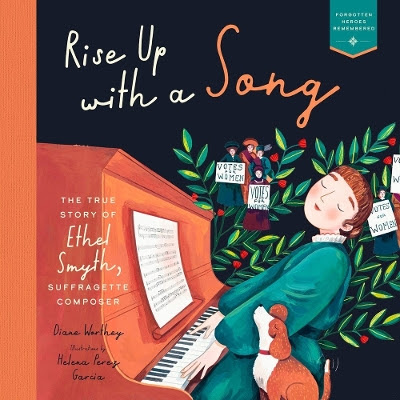
Rise up with a Song by Diane Worthey illustrated by Helena Perez Garcia

The subtitle for this book is: The true story of Ethel Smyth, Suffragette and Composer

From a young age Ethel Smyth loved music. She was a forthright girl, brave and daring. When she was twelve the family employed a new governess - a graduate of the Leipzig Music Conservatory. 

"From that moment, Ethel's desire burned. She spent hours each day writing music to accompany her favourite poems."

It seemed certain that Ethel will follow a career path into music but her father said NO. It took her five years to convince him to let her attend the Leipzig Conservatory in Germany. 

"People said she wouldn't succeed as a composer because she was a woman." 

This meant she had to publish her music with only her initials - E. Smyth. She composed operas, symphonies, and choral works and yes, they were performed. At first no one knew this music came from a woman but then it became popular and she no longer had to pretend to be a man. Of course, there were still some orchestras who would not perform music by a woman especially back in England.

In 1910 other women were also demanding to be noticed - the suffragettes. Ethel joined the movement and followed the creed of Emeline Pankhurst - deeds not words. She wrote music for the protesters to use as a battle cry. Ethel Smyth was becoming famous. 


Perhaps if she did something illegal and went to jail their cause would gain attention. Ethel hurled a rock straight into the window of a cabinet minister. (This is the opening scene from the BBC television series I mention later in this post). She served two months in Holloway prison. While in prison she went on hunger strike. 

Thomas Beecham visited the composer in Holloway Prison in 1912 and found her conducting her fellow inmates with a toothbrush. “I arrived in the main courtyard of the prison to find the noble company of martyrs marching round it and singing lustily their war-chant while the composer, beaming approbation from an overlooking upper window, beat time in almost Bacchic frenzy with a toothbrush”.

Ethel Smyth was born one hundred years before me. She lived until 1944 and was able to vote in eight general elections. I wonder if you have ever heard of her?


In spite of challenging the government through her activism, and her groundbreaking, unconventional life, Dame Ethel Smyth was knighted as a Commander of the British Empire in 1922. She became the first woman to be granted the damehood for her contributions to composition and publication. London Museum

Further reading:

Rise up with a Song is published by the wonderfully named Bushel and Peck. On the final pages there is a timeline of her life; a selected list of her music; and some further reading. See inside this book here. In Australia this book is distributed by NewSouth Books. 

Publisher blurb: In 1867 England, a girl learned to be proper and speak when spoken to. But one girl marched to a different beat. Ethel Smyth climbed fences, explored graveyards, and yearned to become a famous composer at a time when only men could publish their music. But become a composer she did, first signing her music as E. Smyth so people couldn't guess her gender, then eventually writing openly as a woman (but still sometimes not getting paid!). Ethel had had enough. She joined the suffragette movement, marching in the streets and fighting for the right to vote. She even composed the famous "March of the Women" battle cry—and directed it from her cell window with a toothbrush when she was put into prison.


The music to her suffragette anthem - The March of the Women - is presented on the end papers of Rise up with a Song.


Verse 1 
Shout, shout, up with your song! 
Cry with the wind, for the dawn is breaking; 
March, march, swing you along, 
Wide blows our banner, and hope is waking. 
Song with its story, dreams with their glory 
Lo! they call, and glad is their word! 
Loud and louder it swells, 
Thunder of freedom, the voice of the Lord! 

Verse 2 
Long, long—we in the past 
Cowered in dread from the light of heaven, 
Strong, strong—stand we at last, 
Fearless in faith and with sight new given. 
Strength with its beauty, Life with its duty, 
(Hear the voice, oh hear and obey!) 
These, these—beckon us on! 
Open your eyes to the blaze of day. 

Verse 3 
Comrades—ye who have dared 
First in the battle to strive and sorrow! 
Scorned, spurned—nought have ye cared, 
Raising your eyes to a wider morrow, 
Ways that are weary, days that are dreary, 
Toil and pain by faith ye have borne; 
Hail, hail—victors ye stand, 
Wearing the wreath that the brave have worn! 

Verse 4 
Life, strife—those two are one, 
Naught can ye win but by faith and daring. 
On, on—that ye have done 
But for the work of today preparing. 
Firm in reliance, laugh a defiance, 
(Laugh in hope, for sure is the end) 
March, march—many as one, 
Shoulder to shoulder and friend to friend.

Helena Perez Garcia is the illustrator of these books:


I first heard about Ethel Smyth on the 1990s BBC television series called A Skirt Through History. There were six episodes and the stories of Ethel Smyth and another suffragette Sarah Benett were told in the episode entitled The Wreckers which is the name of an opera composed by Ethel Smyth. I think you may be able to find this program on Amazon Prime.


I did once have a VHS video of this episode and I regularly used it with my Grade 6 classes in the library as a part of their unit of work on democracy and voting and suffragettes. Sarah Benett is not part of this book but a few years ago I travelled to Lyme Regis because her diary, which forms the basis of much of this show, was found in the Lyme Regis museum. Unfortunately no one there knew anything about this and my email to the museum curator yielded no answer. 

Here's a summary of this program: "The fight for women's voting rights is told through the writings of two turn-of-the-century British suffragettes - Ethel Smyth and Sarah Benett. Composer and writer Smyth comments on her libertarian life, and her promotion of women's rights through her highly praised opera, The Wreckers. Based on the 1910 window-breaking campaign launched by the Suffragette movement to further their cause, the opera is her most famous work. Also quoting from Benett's diaries, an actor provides a first-person account of the campaign and the hardships suffered by jailed Suffragettes, who were often beaten, raped, and subjected to psychological torture."

The National Portrait Gallery in London have several paintings (including a pencil sketch by John Singer Sargent) and many photographs of Ethel Smyth. Here is a her statue:


Statue in Woking UK


Monday, December 25, 2023

The Fortune Maker by Catherine Norton


"It meant living in the cheapest room in Silvertown, in a house on Pilchard Street at the very end of a terrace that tilted towards a lake of dark, oozing run-off from the coal tar factory. Their room had one tiny window they had to keep closed against the stench, especially in summer, and tide water seeped up through the floorboards all year round. Silvertown itself was built on a boggy bit of land between the river and the docks, in the shadow of dozens of factories that filled the streets with the foul stinks of sulphur, tar and the boiling bones and guts of slaughtered animals."

Maud Mulligan lives in desperately poor circumstances in a London slum. The year is 1913 - think about the significance of that date - suffragettes; Emaline Pankhurst; World War I is not far off; and the Industrial Revolution means thousands of people have come to London and many work in very dangerous factories. Maud might have a tough life, but she also has a dream to leave the slums and travel with her father to a better place. In their lodgings they have a jar and every day for the last seven years she has been saving so that one day they can buy two tickets on a streamer to somewhere else. Sadly, this cannot happen because the very old building where they live falls into the Thames. The money is gone. Then her father is killed by an elephant that was being winched off a ship down on the docks. He was knocked into the river and drowned. Now Maud has no family, no home, no money and only the clothes she had been wearing the day her home fell into the river.

Maud and her father had been living in an unused pantry in the home of Mrs Wray. Her husband is a violent man and for a while Maude manages to keep out of his way but then she is discovered and so now she is forced to live on the streets. 

This is a time of superstition. Maud is desperate to know the future. 

"Underneath the river, between the factories on the north bank and the gun yards on the south, there was a tunnel. ... for a few pennies you could find out your future."

In a heartbreaking scene we see Maud exchange her mother's beautiful green shawl so she can learn about her future. 

"How will I get out of Silverton?"
"Ruin! You will lose everything."

What does this prophecy mean? Maud is kidnapped by a man connected with a factory that makes dyes. The rich owners have also consulted a fortune teller - a famous and rich one. Somehow the colour yellow is important, as are chemistry lessons. Maud will escape, then be recaptured, then escape again. Along the way she meets rich people, corrupt people, and surprising new friends. She is even caught up in a suffragette protest march - a violent one. And there is another layer over the top of all of this which is hinted at on the cover. Maud herself is able to see the future - this is a gift but it could also put her in grave danger.

Maud is told to predict the colour that will be in fashion next year.

"Maud carefully lifted the crystal ball from the velvet-lined box and carried it to an armchair. ... She gasped when the flames flickered and changed. They became a column of figures, so indistinct as to be almost silhouettes. Even so, she could tell they were not ladies but men, moving slowly forwards and swaying.  ... The dying men were sucked abruptly into the ground."

All she can see is grey and black and mud and sludge. What does this mean?

This book has 312 pages and I read it all on one day - yes this book is THAT good. The final sentence made me gasp! I sincerely hope this book has been entered in our CBCA (Children's Book Council of Australia) awards and if it has, I am certain it will be a Younger Readers Notable title and almost certainly a short-listed book too. I am surprised I haven't heard more people talking about this book which was released in August, 2023. That said, do take a look at all the positive comments on Catherine Norton's web page. I also really like the cover - in fact that is what drew me to this book when I saw it in a local independent book shop. Catherine Norton's book Crossing was a 2015 CBCA Notable but I somehow missed reading it. 

Publisher blurb: London, 1913 Twelve-year-old Maud Mulligan knows there's no future for her in London, in the rat-infested slum where she grew up. But in the tunnel under the river are fortune tellers, Seers, who will tell your fortune for a few pennies. And then there is Mr Mandalay, Seer to the king and anyone else rich enough to afford him. When Mr Mandalay sees Maud in a foretelling for a wealthy factory heiress, she believes Maud can save her family from financial ruin. But how? And why? In a world shaken by suffragettes, scientists, and the threat of war, what could a girl like Maud do to change anyone's future - or even her own?

This is a mystical adventure about strength, determination and changing times. Full of optimism even in the most desperate of situations, it shows how survival can be achieved through the worst or best experience, depending on the strength within to face whatever you are dealt. A stunning, eye-catching cover equals the fantastic read. Kids' Book Review

This reviewer inhaled this book - I did too. 

Serious themes of grief and loss, gender roles, power and resilience underpin this adventure but never overburden this exhilarating roller coaster read. The writing is assured, rich in historical detail, and enlivened by delightful insights into character. ...  I inhaled this book in one sitting and I think many others will do the same. ... Its high production values indicate the publishers think they have a keeper and I agree with them. Story Links

This story feels like the writing of Charles Dickens. You could share some children's abridged versions of his famous stories with your child after reading The Fortune Maker.

Here are some teachers notes from the publisher. You can read chapters one and two here. 

Companion books:


Friday, May 4, 2018

Crossing Stones by Helen Frost

With care and precision, Frost deftly turns plainspoken conversations and the internal monologues of her characters into stunning poems that combine to present three unique and thoughtful perspectives on war, family, love and loss.  West Texas Bookworm (also in Kirkus)

I seem to be reading Young Adult books right now but I thoroughly enjoyed Crossing Stones by Helen Frost so I thought I would share a few thoughts here.

When I read Applesauce weather also by Helen Frost I went in search of more books by this talented writer because as you may know I do enjoy verse novels. I found a used copy of Crossing Stones (2009) for a very reduced price. Mine is a discarded library book from Gilmer Public Library in West Virginia. I love their address of Walnut Street. It actually looks as though this book had only one loan which is sad.

The setting for Crossing Stones is from April 1917 to January 1918 - yes it is World War I. This is also the time women are fighting for suffrage. America joined World War I in April 1917.

"We've all heard what is coming: we know
        the president will take us right into the middle
              of this war they're fighting overseas, yet I can't help
                   hoping against hope that someone, somehow
                        might find a way to keep us out of it."

Muriel Jorgensen is eighteen. She lives on one side of Crabapple Creek with her family - mother, father,  little sister Grace and younger brother Ollie. On the other side live Emma Norman, her brother Frank and their parents. Just as Muriel starts to realise she is falling in love with Frank he enlists. There are letters and small gifts but sadly he is killed. Ollie is too young to sign up but he lies about his age and he is sent off to fight too. Ollie does return but he is badly hurt. As all of this is happening Muriel's aunt Vera is in Washington DC on the picket line fighting for the right to vote. She has been arrested and has been on a hunger strike. Muriel goes to Washington to bring her aunt home after her release from jail. It is from this experience that Muriel discovers a little more about the wider world and the possibilities for women which could mean a different future she had imaged only last year.

There is so much in this book - history, a love story, politics, women's suffrage, self discovery, grief and family love. I recommend this book for age 12+.  High School English teachers will find lots to explore in the form of these poems - Muriel's are shaped like the river while the other poems look like the stones. These are "cupped hand sonnets" fourteen line poems with complex rhyming patterns which are explained at the back of the book.

Take a look at this review by Anita Silvey. You can listen to an audio sample from page 19 onwards. Here is a set of teaching notes.

Thursday, December 28, 2017

The Princess and the Suffragette by Holly Webb

Library Girl and Book Boy


I picked this book - The Princess and the Suffragette -  in a bookshop recently for two reasons.  Firstly the title - I am fascinated by the suffragette movement in England prior to WWI and secondly I liked the cover but when I sat down to read it a couple of days ago I made an odd discovery.  On the cover it says "A sequel to the much loved classic A little Princess."  I had no idea about the book A Little Princess and wrongly assumed it was also by Holly Webb.  I searched all over this new book for a clue.  I looked at some bookseller sites and eventually I discovered A Little Princess is a book written by Frances Hodgson Burnett in 1905.  I wonder why the publisher didn't put this detail somewhere on the book.

This is the second 'sequel' book I have read by Holly Webb.  About a year ago I read Return to the Secret Garden - a sequel to another book by Frances Hodgson Burnett - The Secret Garden.  Holly Webb is not the first person to pen a sequel to A little Princess - I have also found a book by Hilary McKay called Wishing for Tomorrow.

Knowing this was a sequel I needed to find A little Princess.  Luckily it is available through Project Gutenberg.  I will say I do think it is essential to read this classic first or as a short cut you could read this plot outline from Wikipedia..  I found the early chapters of The Princess and the Suffragette very confusing before I realised this was a special kind of sequel.


At the end of A little Princess, Sara is rescued by her father's business partner and moves in to the house next to Miss Minchin's school and it seems her life will now be perfect.  The Princess and the Suffragette picks up the story nine years later.  In this story the main character is Lottie who was left at the school aged 4.  Now aged eleven Lottie has begun to question her situation.  Why won't her father come to visit?  Would he have abandoned her if she was a born a boy? What does her future hold?  Then she sees the school's scullery maid wearing a mysterious badge.  She demands to know the truth.  Living a sheltered life in the school Lottie knows nothing of the Suffragettes but Sally has newspapers and pamphlets and over the coming year Lottie learns about the struggle, the suffering of Suffragettes who have been imprisoned and the movement of 'deeds not words'.  She is invited to the races by Sara. It is the Derby where Emily Davison runs onto the track and is killed.  In the final fast-paced scenes Lottie discovers the truth about her mother, who she had been told was dead, and she is able to confront her absent father.

Older Primary students who enjoy historical fiction should look for this book.  I really appreciate the research done by Holly Webb.  For example she mentions this slogan.  From Prison to Citizenship.


Sally has this poster in her attic room but Lottie has no idea what it means.  Factory Acts Regulations for Women - They have a cheek. I've never been asked.


One more connection.  I have long had a memory of a Shirley Temple film where two little children are sleeping in an attic.  Someone comes in the night and transforms the space providing floor rugs, furniture and a soft beautiful bedding.  I now discover this scene is from is the movie of A little Princess. Actually there have been many movie and television adaptions of this famous book.

Holly Webb is such a prolific author.  She has written over 90 books.  Here is a review with more story details.  You can listen to an audio sample which begins from page 4.

Here are some covers for A little Princess.  It is fascinating to see the different ways illustrators and publishers have presented this book.