Monday, February 22, 2021

Talking to the Moon by SE Durrant


Talking to the Moon is a very sad book BUT it is also an uplifting story. Mimi is beginning to lose her memory. Everyday tasks are becoming difficult and she is making mistakes. Iris has moved in with her grandmother (Mimi) because her room at home needs repairs and home often feels like chaos since the arrival of her twin siblings. Iris loves Mimi and she loves living in her house but the strange things that Mimi does are so confusing and Iris is terrified her high pressure action doctor mother will swoop in and take over. She might even move Mimi to a care home. Iris is determined to keep Mimi safe but as each day passes this is becoming increasing difficult. 

Iris has started to write a list of helpful hints for Mimi.

1. The girl sleeping in the next-door bedroom is called Iris. She is your grandaughter. Rena is Iris's mum (your daughter)

2. Iris doesn't like jam on her eggs.

14. Don't put peas in chocolate cake. Carrots go in cakes sometimes but not peas.

17. The boy next door is called Mason. Though if you give him cake and model kits he won't mind what you call him.

23. Don't wear slippers to the beach. It's too cold.

Mimi loves to talk to the moon - hence the title and Iris loves to talk to the seagull that perches outside her window. Iris is a numbers girl. She likes to count the calls which always number exactly twelve. Iris is also trying to solve a family mystery. Mimi has a photo of her young cousin aged two. Mimi tells Iris that young Coral died in a tragic family boating accident over seventy years ago but at the local museum Iris and her new friend Mason discover a film which clearly shows a young girl who looks exactly like Iris (red hair) and who is wearing a special bracelet (Mimi has one too). The girl in this film is not two years old she is ten and the film was made in 1954.

I don't remember how I came to add this book to my shopping list but after two days of glorious reading I am very glad I did. This, as I said, is a sad book and at times I did need to take a break - watching Mimi unravelling is heartbreaking but:

"Whilst an emotional read, it is also very sweet and with continuous moments of tenderness throughout which lifts this from a tearjerker to a heartwarming yet bittersweet story of love and understanding." Lillyandthefae

I really appreciate publishers (thanks Nosy Crow) who give books matching covers. The full set of these three books by SE Durrant will look so appealing on your library shelves. You can hear the first chapter of Talking to the Moon here on the Nosy Crow web site.


I recently read the term 'companion reads' so I going to adopt this when I list other books to read that link with my focus book.  Here are several companion reads to explore after reading Talking to the Moon:


If you are looking for picture books on the topic of dementia or Alzheimer's disease here are two links to explore:  Kinderbookswitheverything and One Photo.

Sunday, February 21, 2021

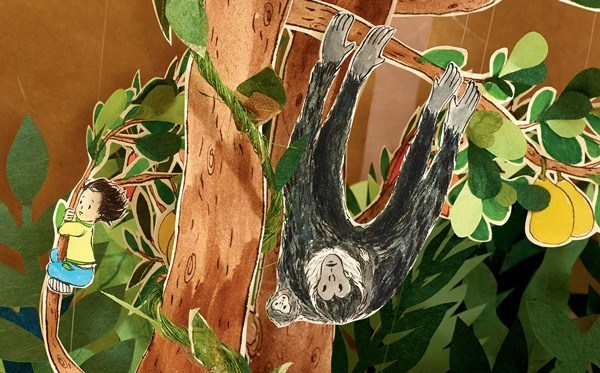
Wild ideas: Let nature inspire your thinking by Elin Kelsey illustrated by Soyeon Kim


... pure magic Quill and Quire

This is a work that will be read and examined again and again, with something new to be discovered at every turn.  Profound and entirely wonderful. Kirkus Star review


Animals, like humans, are ingenious problem solvers. Orangutans weave safe places to rest; Chimpanzees fold leaves to spoon "cool drinks of water"; Humpback whales blow bubbles to "trap tasty fish"; and Ravens use gestures to offer ideas.  I said humans are problem solvers but after reading this book I am certain we all need to observe the natural world more closely because there are important things we need to learn. Take a look here to discover some of the creative ways animals solve problems. There are a wealth of things to explore from this link.

The paperback edition of Wild Ideas has a different cover (I wonder why) but at least, as a paperback, it has a lower cost so if your school library has a limited budget you will be able to add this important title to your collection. I strongly recommend you consider doing this. Here is a detailed lesson plan to use with this book.


My friend from Kinderbookswitheverything has just introduced me to the art of Soyeon Kim. It is utterly wonderful. Soyeon Kim was born in Korea and now lives in Toronto, Canada. I have said this many times but Canadian publishers really do produce some wonderful books. You probably know how much I adore Shelter by Celine Claire illustrated by Qin Leng. Take a look here to see in very fine detail exactly how Soyeon Kim creates her dioramas inside boxes. 

Next month this book will be published it might be a good comparison text to use with Wild Ideas:


Elin Kelsey says:  Soyeon’s dioramas are filled with artistry, feelings, an imagination. She captures the excitement and beauty of what it feels like to have a great idea.  I have added some other books illustrated by Soyeon Kim to my to read list:


Here is another book by science educator Elin Kelsey. In this podcast she talks about her work.

Saturday, February 20, 2021

Lemon Butterfly by Cao Wenxuan illustrated by Roger Mello


The lemon butterfly searches for a field of flowers. The journey is long and dangerous but the lemon butterfly is determined to find the field. After what feels like weeks of flying the lemon butterfly sees the beautiful flowers but:

"The fragrance grows stronger once again. According to the white horse, the field of flowers lies just beyond the low hills. The hills appear before the lemon butterfly. But when it flies over them, what it sees makes it scream. The field is flooded ... the flowers float crystal clear under the water."

How will the fragile butterfly ever reach the flowers? The ending is certain to astonish you.

In 2017 I was able to attend the USBBY National conference held in Seattle at the University of Washington. At this amazing event Cao Wenxuan told us the story of Lemon Butterfly. He spoke in Chinese and his words were translated as he told the story. Then the wonderful Roger Mello showed us all the book. The organisers held an auction of this copy and it was sold for over US$1700.  Of course the real book is no where near as expensive as this. When I came home to Australia I asked the nephew of a friend to try to find the Chinese edition of Lemon Buttterfly for me on his visit to China. I think it cost around AUS$15. At that time this book was not yet translated into English. Last week my English edition arrived. It will be available from 28th February, 2021 here in Australia.  So now I have two, very different copies, of Lemon Butterfly.

More about the story written just after the 2017 USBBY conference (Chinese books for Young Readers Blog)

The second picture book by Cao and Mello is called Lemon Butterfly 柠檬蝶, currently in the original Chinese version only. A lemon butterfly goes on an arduous journey to search for a field of flowers, crossing rivers and mountains and getting lost before it finally reaches the field, only to find that flowers have been submerged under water. The surprise ending gives a philosophical spin to the story, which also presents environmental concerns. Cao told the audience that he studied philosophy for fifteen years, and has found the format of the picture book perfect for expressing philosophical issues.

In the story, the butterfly takes an accidental detour by following the scent of flowers wafting from hoof prints in the mud. Cao revealed the cultural reference behind the scene as a line from Chinese poetry, “Returning from treading on fallen flowers, even horse hooves are scented” (踏花归来马蹄香). The poem famously inspired Chinese brush paintings that depict butterflies dancing around hoof prints.

One of a kind—an intriguing, sophisticated study in contrasts that reimagines the potential of picture-book art. Kirkus Star review

I talked to Roger Mello in Austin, Texas at the next USBBY Conference. He was kind enough to send me the text of the story as sent to him by Cao Wenxuan. This means I have this book in three different formats - the Chinese book which as you can see here spreads right out, the new English edition, and a word document of the original translated text sent to Roger Mello.


Mello made the picture book accordion style, and cut out the shape of butterflies, rather than illustrate them. As he explained, instead of showing butterflies, he decided to portray the absence of them.

About the author:

Cao Wenxuan 曹文轩 is an award winning novelist from Jiangsu Province, China. He is the Vice President of the Beijing Writers’ Association and a professor at Peking University. His works include The Straw House, Dragonfly Eye, and Bronze and Sunflower. He was the first Chinese writer to be awarded the Hans Christian Andersen Award. His novels have been translated into eight languages.

About the illustrator:

Roger Mello is an award winning illustrator and author. He has illustrated over 100 titles, 22 of which he also wrote. His unique style and sense of color continues to push the boundaries of children’s book illustration. He was the first Latin American artist to be awarded the Hans Christian Andersen Award.

The new English edition does not list the translator.  Here are a few samples of the text:

To a butterfly, a field of flowers is the most beautiful thing in the world. And as it moves, the vision of a flower field flashes before its eyes. Scintillating!


Wind whips over the water, nearly crushing the butterfly against the spray, but it perseveres. Perhaps there is a field of flowers ahead. It hears the rumbling of the waters. But the murmuring of its heart is louder. "I must find that field of flowers!"

In Australia the paperback edition of Lemon Butterfly is fairly inexpensive. This book would make a good addition to a Primary or High School library. I also found this alternate Chinese edition. I am not sure of the illustrator:

Friday, February 19, 2021

Too Small Tola by Atinuke


Atinuke has crafted another gem. A small story about a small girl set in a city and country possibly very unfamiliar to most readers. A small story with a HUGE heart. 

"Tola lives in a run-down block of flats in the megacity of Lagos, in the country of Nigeria. She lives with her sister Moji, who is very clever; her brother Dapo, who is very fast and Grandmummy who is very-very bossy."

"Sometimes the electricity words. And sometimes it does not. Sometimes the water runs. And sometimes it does not. Once the lift worked. And now it definitely does not."

There are three short stories in Too Small Tola. All of them would make a terrific class read aloud for a Grade One or Grade Two class but I especially love the final story where little Tola takes on a big responsibility.  Easter is coming and it is nearly the end of Ramadan. People are preparing for the festival of Eid which this year coincides with Easter. Tola and her neighbours do not have much money but they always have new clothes made to wear for Easter Sunday. Tola may be small but she loves maths and she loves numbers and she is skilled with measuring. Mr Abdul, the local tailor, has a bad bicycle accident. Tola, with help from her brother Dapo, take over riding around the city collecting orders and taking those all important measurements. Mr Abdul is a wonderful man. He knows just how to make every one feel terrific even Dapo who is at first very reluctant to help. 

Too Small Tola is the first book in a planned series.  


The setting for Too Small Tola is Nigeria. Kids Book A Day blogger Janet Dawson talked about this book today and she made the comment:

 I was really hoping for a bit of backmatter on Lagos and Nigeria–at least a map.

So I found some maps:


Too Small Tola is a wonderfully warm read. Warm, heartfelt and super lovely. What a brilliant start to a brand new series! My Book Corner

this is a smashing chapter book for newly confident readers. Red Reading Hub

Through the young girl’s experiences, children will learn about life in Lagos, from the bumper-to-bumper traffic on hot, dusty roads to the stark contrast between rich and poor. Readers will also identify with Tola’s universal concerns, such as sibling tensions and facing up to bullies. Book Trust

Can I suggest you visit your school library today to look for other books by Atinuke. These are books that should be part of every primary school library and they should be shared widely.


The Great Smile Robbery by Roger McGough

Friday Old Favourite

This book is just one for fun. It contains wild characters and heaps of jokes (which made me laugh in 1982 and laugh all over again in 2021).

Publisher blurb: "The Stinkers - is there a gang more vile and horrible? No! That's why everybody loves to loathe them."

Emerson is a happy guy. He has his daily routines:

"He brushed his teeth over and under. Washed his face inside and out. Combed his hair through and through until there were no knots. Not any. Not a knot whatsoever on his whatnot. And of course, being the hero of this story, he did all of these things without being told."

The best thing in Emerson's house is his wardrobe of smiles - his smiledrobe. It contains warmhearted, cheeky, shy and sad smiles. Each morning Emerson selects a smile for the day.

Meanwhile we need to meet the horrid Stinkers. Their names are probably descriptive enough - Billy Bogie; King Pong; Sourpuss; Nick O'Teen and Mrs Wobblebottom.

So now the stage is set. The Stinkers decide to rob a bank. Everything goes wrong and Emerson is wrongly accused of the crime. While Emerson waits in jail those wretched Stinkers rob his house and steal all the smiles. Luckily Emerson is the hero of the story (as previously mentioned) and so honesty, truth and justice do win the day and those awful Stinkers get the punishments they deserve.

There are two stories in this series - the second is called Stinkers Ahoy.

This book is long out of print but if you can find a copy it is sure to give you and your young reader a laugh or two. I especially love the cartoon style illustrations by Tony Blundell.

Here is Roger McGough reading one of his poems.


Thursday, February 18, 2021

The Seventh most Important Thing by Shelley Pearsall


"Mr Hampton has made it clear to me that he is not interested in retribution, but in redemption."

Arthur's dad has died. His dad was not perfect. His dad was a wild character who often drank too much but Arthur's dad was deeply loved and so Arthur's grief is very deep. Everything boils over when Arthur sees a local homeless man wearing his dad's old cap. Arthur reaches for a brick and hurls it at the man.

In the court, after three weeks in juvenile detention, Arthur's life changes. He discovers the name of the man he attacked and he is told he will need to complete 120 hours of probationary service working for the old Junk Man.

"According to what I've read about your case, I understand you attacked a man named James Hampton in a vicious and unprovoked manner on November eighth. Is that correct, Mr Owens?' Arthur blinked, momentarily confused by the name. James Hampton? Who was James Hampton? ... Arthur tried not to look surprised by the fact that the man had a real name."

Arthur acknowledges his guilt. Doing 120 hours of work for Mr Hampton will certainly be much better than the alternate possibility of spending more time in 'juvie'. When he finally locates the address supplied by his probation officer - Officer Wanda Billie - he finds a mysterious list. Mr Hampton is not there but the instructions are clear. Arthur as to find:

  • lightbulbs
  • foil
  • mirrors
  • pieces of wood
  • glass bottles
  • coffee cans
  • cardboard

Why does the old man want these things? Can Arthur skip some things on the list? Can he substitute other things? And how does all this link with the word redemption?

This book is brilliant.  It is one of those reading experiences where I want to stand on a mountain and shout out to all young readers aged 10+ to find this book, grab it with both hands and read it now! This book was published in 2016 but I am happy to see it is still in print. 

A vibrant piece of historical fiction based on a true story, this novel will be welcomed by teachers and youth alike. Waking Brain Cells

Luminescent, just like the artwork it celebrates. Kirkus star review

Read about the real James Hampton (1909-1964) and his astonishing art which is display at the Smithsonian American Art Museum in Washington DC. 

"(It is) made from discarded materials and found objects such as old furniture, cardboard cutouts, and light bulbs. All were scavenged from secondhand shops, the streets, or the federal office buildings in which Hampton worked as a janitor. To complete each element, Hampton used shimmering metallic foils and brilliant purple paper to evoke spiritual awe and splendor."

Here is an audio sample from page 23 onwards. Here are some ideas for using this book with a group such as a book club. Even though this is clearly a book with an American setting I am certain it will be enjoyed by readers in Australia. Read more about Shelley Pearsall here

I would pair this book with:


I am now keen to read a new title from Shelley Pearsall:


Wednesday, February 17, 2021

Notable Books CBCA - my predictions


In exactly one week, as I write this post, the CBCA will announce the Notable books for 2021. There are five categories and twelve books will be selected in each category. In April the short list of six titles will be announced and then in August the winners are announced.

Each year I like to make my predictions (mostly I am wrong) but it is fun to review the previous year of reading. I am not going to list 12 books for each category I will just list the titles I hope make 'the cut' and I will only list titles I have actually talked about here on momotimetoread. I am looking forward to discovering some surprises on the Notable lists and then of course discovering more books I need to add to my expansive 'to read' list. My friend at Kinderbookswitheverything and I have created a Pinterest of all the picture books published in 2020. If you take a look you are sure to see some other favourite books you enjoyed in 2020.  Fingers crossed for these books:

Early Childhood Picture Book of the Year

Duck, Apple, Egg by Glenda Millard illustrated by Martina Heiduczek

Ellie's Dragon by Bob Graham

Scary Bird by Michel Streich

I saw Pete and Pete saw me by Maggie Hutchins illustrated by Evie Barrow

Extraordinary by Penny Harrison illustrated by Katie Wilson

Sometimes Cake by Edwina Wyatt illustrated by Tamsin Ainslie


Younger Readers

Across the Risen Sea by Bren McDibble

Zoe Max and the Bicycle Bus by Steven Herrick

We are wolves by Katrina Nannestad

Worse Things by Sally Murphy illustrated by Sarah Davis

Eloise and the Bucket of Stars by Janeen Brian

Bindi by Kirli Saunders illustrated by Dub Leffler

Aster's right good things by Kate Gordon

Catch me if I fall by Barry Jonsberg (might be on the Older readers list)

Pierre's not there by Ursula Dubosarsky

The Book of Chance by Sue Whiting

Her Perilous Mansion by Sean Williams

The secret library of Hummingbird House by Julianne Negri

The Threads of Magic by Alison Crogan


Picture Book of the Year

How to make a bird by Meg McKinlay illustrated by Matt Ottley

A boy and a ball by Phil Cummings illustrated by Phil Lesnie

Anisa's Alphabet by Mike Dumbleton illustrated by Hannah Sommerville

Finding Francois by Gus Gordon

The Biscuit Maker by Sue Lawson  illustrated by Liz Anelli

Heart and Soul by Carol Ann Martin illustrated by Tull Suwannakit