Showing posts with label peer group. Show all posts

Wednesday, June 11, 2025

All the Blues in the Sky Renee Watson


"I didn't know
best friends could die"

"You will miss her every day of your life.
Sometimes, the memories will bring tears and sometimes a smile.
The memories won't always overwhelm you,
they will bring comfort too."

You HAVE to let this novel, which is partly told in free verse, unfold slowly. Yes, on the day of Sage's 13th birthday her best friend has died but the when and where and how why are found in the journey you take as a reader.

Sage is grappling with her grief and the adults don't seem to have any answers:

If I live long enough to be an adult
and if I have children when I am an adult
I will tell them.
And I will tell them that sometimes
you go to sleep crying
and wake up crying
and that life after losing someone you love
feels like one big ocean of sorrow
and you might feel like you are
drowning,
but always there is something 
to hold on to 
to keep you afloat.

Sage meets four other students in her school grief group. Ebony's dad died suddenly from a heart attack; Zay's grandmother died in her sleep after a long illness; Ana's twin sister died from leukemia; and DD's brother was murdered by the police. Sage feels that she can relate to Ebony and DD because in both cases the death came suddenly, and these deaths were totally unfair. Sage is sure the death of HER friend is all her fault but how can a car accident be her fault?

There are two rules in the grief group - everyone shares openly and everyone listens with compassion.

DD's brother was murdered:

Now she is a sister familiar with words she's never had to say
so often, know so well; police brutality, death, rage, injustice, press conference
obituary, funeral, casket, hearse, graveyard, protect, indictment, trial, jury, verdict, guilty, sentence,
involuntary manslaughter, memorial, closure?, closure?,
grief, grief.

Sage has her own set of words such as vehicular manslaughter, hit and run, and criminally negligent homicide.

Blue is the empty chair at the desk in the classroom where my best friend used to sit.
Blue is the ache in my heart when I pick up the phone to call her and remember she's gone.
Blue is Aunt Ini's warm hugs.
Blue is a hot mug of cocoa on a cold stormy day.
Blue is all the calm, all the heartbreak,
all the hope
all the tears, all the laughter. ...
For all the blues in the sky,
there are as many blues in the heart.

Just a warning you will be sobbing by the final pages of this book.

Bookseller blurb: Sage's thirteenth birthday was supposed to be about movies and treats, staying up late with her best friend and watching the sunrise together. Instead, it was the day her best friend died. Without the person she had to hold her secrets and dream with, Sage is lost. In a counseling group with other girls who have lost someone close to them, she learns that not all losses are the same, and healing isn't predictable. There is sadness, loneliness, anxiety, guilt, pain, love. And even as Sage grieves, new, good things enter her life -- and she just may find a way to know that she can feel it all. In accessible, engaging verse and prose, this is an important story of a girl's journey to heal, grow, and forgive herself. To read it is to see how many shades there are in grief, and to know that someone understands.

This is a verse novel from 2025 for sensitive mature readers aged 12+ but sadly here in Australia you will need to wait for the paperback edition - the hardcover will be well beyond the budget of most school libraries. 


The counselling group in All the Blues in the Sky reminded me of this book:


Other books by Renee Watson:


Tuesday, November 1, 2022

Things Seen from Above by Shelley Pearsall


"You can never tell where a simple line may lead."

"I am the artist and no one can tell me what art to make."


One of the best feelings in the world is beginning a wonderful book and then having time to enjoy the whole book,  the whole wonderful story journey, in just one day. I picked up Things Seen from Above this morning to read on the train. I read about 72 pages and then a few more on the way home and then I devoured the remainder of the book (252 pages in total) before dinner.

April is in Grade Six. Her former friend has changed over the summer into someone she no longer recognises. The lunch room feels like a battle ground. To avoid the lunch conflict and the dreadful feeling of not fitting in and having no friends, April volunteers to be a playgound seat friendship buddy. The elementary school in this book is so large that there are several sessions for lunch. April assists the kids from fourth grade during their break while her grade are in the cafeteria. 

There is a new girl in the school called Veena. She has moved to Marshallville from India. The school counsellor suggests Veena and April might work together on the buddy bench.

On her first day in her new role April notices a young boy called Joey Byrd. He is alone and seems to be doing something strange in the playground - drawing patterns and circles using his shoes to scrape the dirt. What is he doing? And why?

"The more I studied Joey, the more things I noticed. I made a mental list of them. How he walked with his hands clenched and his thumbs pointing outward like a hitch-hiker. How his grey sweatpants were way too short and the elastic bunched around his ankles. How his mouth was pressed into such a tight line of concentration, It didn't look like he had lips. What was he concentrating on?"

When the school janitor - the wonderful Mr Ulysses invites the girls to view Joey's work from the school roof they begin to realise the significance and enormity of Joey's art. The three of them agree to keep this a secret but then they accidentally share the information with another student and at this point things begin to spiral out of control.  

"I want to apologise again for what happened. Veena and I think you are a really cool person who does amazing drawings - or tracings, as you call them. You're like ... a star to us."

"Joey's popularity also seemed to pull other forgotten kids out of the shadows. It was as if he shone a bright light on anyone who was hiding in a corner or standing against a wall alone. The outcasts started getting noticed. The excluded were included."


One of the strengths of this book is the beautiful restrained way April approaches Joey. She shows enormous emotional intelligence. She doesn't rush Joey. She listens, observes and waits and then approaches him slowly. I would love to meet April and thank her for her compassion and her wisdom. 

There are alternating chapters in this book where we hear from Joey and are able to experience his different view of the world, his different understandings of human relationships, and his wonderful skill with enormous art pieces. We also glimpse his mother and father and learn a little about their personalities which go some way to explaining Joey's reactions and understandings.  At one point Joey talks about a class reading lesson. Reading is a mystery and a huge effort for Joey and sadly he is regularly expelled from this classroom but in this scene the teacher is reading "The Strange Case Of Origami Yoda".

"It was a very funny story, and Joey really like it. It was the first book he'd every liked - partly because it made him laugh and partly because he didn't have to read it himself. "


You can read the back story for this book on Shelley Pearsall's web page. Things Seen from Above was published in 2020 and it is available in paperback so I highly recommend you add this to your library (and personal) shopping list. Read more of the plot here. 

You can read about another book by Shelley Pearsall The Seventh Most Important Thing:


Here are some companion books to read after Things Seen from Above:


Saturday, July 11, 2020

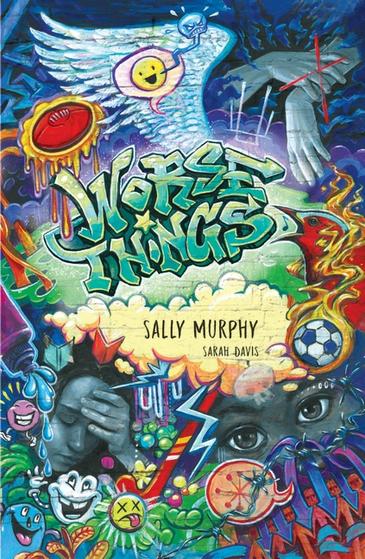
Worse Things by Sally Murphy illustrated by Sarah Davis


Using alternating voices Blake, Jolene and Ahmed share with readers the ups and downs of their daily lives. Blake is a sports star but he now finds himeself on the bench because of a broken arm. Blake feels alone for the first time in his life. He no longer 'fits in'. Jolene is being pressured by her mother to become a hockey star but Jolene does not like hockey. All she wants is for her father, who is a doctor working far away, to come home and spend time with the family. She also wishes her mother would listen and not expect Jolene to fulfill her mother's failed childhood dream. Amed is new. He is a refugee kid with very limited English. Amed would like a friend and he would like to play sport but for him this sport is played with a different ball. For now he quietly observes Blake, who is forced to watch the footy from the sidelines, and Jolene who excels at hockey but who does not seem happy.

Between each voice Sally Murphy supplies some definitions. Here is an example:

ALONE
[uh*lone] (adj.)
Single
sole
solitary
separate
sad.
Set apart
unattached
unaided
unassisted
Un-together.

If I was still working in a school library I would ask my students what they think about this cover. For myself I have walked past this book several times because the cover did not appeal to me. This is a pity because inside this cover is a splendid verse novel. I am not the demographic for this book, however, and that is why I would like to know what readers aged 10+ think about the cover and whether it entices them to pick up Worse Things. (Yes you should pick up Worse Things - it is terrific)

"… this verse novel is stunning in every way.  It is an experience not to be missed. Children’s Book Review"

In this blog post Sally Murphy talks about the cover design, and she reads extracts from her book. 

Here is an interview by Joy Lawn for Paperbark Words. And here is a very detailed set of teaching notes from the publisher Walker Books. These notes also include an extensive list of other terrific verse novels. Click the link on my sidebar for other books in this form.

Here are some other verse novels by Sally Murphy:


Wednesday, July 8, 2020

TrooFriend by Kirsty Applebaum


TrooFriend
YOUR.ONE.TRUE.FRIEND.

I AM A TROOFRIEND
I DO NOT BULLY.
I DO NOT HARM.
I DO NOT LIE.
I DO NOT COVET OR STEAL OR ENVY.
I AM YOUR PERFECT FRIEND.
YOUR
ONE
TROOFRIEND.

Yes, you probably already know I ADORE ADORE  books about robots!  I am not entirely sure why but they often have a slightly 'political' flavour which intrigues me. There is certainly an undercurrent of subversion in TrooFriend.

Sarah has busy parents. She is an only child. Mum and dad decide to buy Sarah a Jenson & Jenson TrooFriend 560 Mark IV.

"Each one of us is unique. We have different skin colours, different eye colours and different hair colours. ... Our clothes are made of TrooCloth. ... It is tear-resistant, water-resistant and crease-resistant."

Sarah names her Troofriend Ivy. The reason for this will give you a smile. Back in the factory Ivy did not have a name she was one android robot Mark IV of one hundred and forty-four. She was number eighty-three.

Sarah does not want an android robot as a friend she tells her parents she wants a dog. Mum insists Ivy will be the perfect 'friend'. Sarah disagrees but over the coming weeks she makes some amazing discoveries about Ivy which cause her to totally rethink her ideas.  Look again at the list of qualities at the beginning of this post. Perhaps these things are not true. Has the factory made a mistake? Do Jenson & Jenson TrooFriend 560 Mark IV robots actually experience emotions and if they do is this dangerous?

This book has some truly funny moments alongside a poignant story about feelings and friendships. I really appreciated the distinct 'voice' Kirsty Applebaum gives to Ivy. It is so funny the way Ivy describes the kitchen appliances such as the dishwasher as inferior robots. Every time she wakes up she states the date and weather. The repetition of this is hilarious. I also loved the way Ivy used her factory specifications to describe the hair and eye colours of each human that she meets:

Sarah eyes Hazel 101 hair Chestnut 29 in a classic collar bone cut.
Keanna eyes Deep Brown 02 hair Darkest Best Brown in a Coily half-up-half-down style.
Milly eyes Mint Green 204 hair too messy to say which Jenson & Jenson standard style it would be.

Here is a description of one of the teachers from the day Sarah takes Ivy to school:

Mrs Vickerman "I look at her hair. Frost Blonde 52 Retro Beehive. It stays completely still when she moves just like the hair on a Jenson & Jenson TrooFriend 560 Mark III. It was considered a sub-standard design aspect on the Jenson & Jenson TrooFriend 560 Mark III, which led to the development of the TrooHair for the Jenson & Jenson Troofriend 560 Mark IV."

Ivy also judges truth and emotions in percentages.
"Rob-Dad's eyebrows scrunch up. It is likely to an accuracy of 74% that he is confused."
"Sarah's eyebrows scrunch up. It is likely to an accuracy of 59% that she is angry and it is also likely to an accuracy of 59% that she is worried."

I think this is a book that any reader aged 9+ will truly enjoy. Well done to publisher Nosy Crow - this book is a winner!

Click these review quotes for more plot details:


I would pair this book with The Wild Robot by Peter Brown and Eager by Helen Fox.


Monday, May 11, 2020

The Unteachables by Gordon Korman


Room 117 is the last classroom in the building. It is the classroom for the left-over students and the place the superintendent sends Mr Zachary Kermit. Mr Kermit is close to retirement after 30 years of teaching. The superintendent is keen to get rid of Mr Kermit because if he retires the school district will have to pay him a pension long into the future - Mr Kermit comes from a family of long livers. Mr Kermit is also haunted by the past when he was accused (wrongly) of aiding a kid - Jake Terramova - with cheating on the National Aptitude Test. The Superintendent will NEVER forgive Zachary Kermit.

Class SCS-8 (Self-Contained Special Grade 8) is a dumping ground for failures plus Kiana.

"They're kids you've given up on. They had their chance in sixth and seventh grade and now you're just warehouseing them until they can be the high school's problem."

"How bad can these Unteachables be? Behaviour issues, learning problems, juvenile delinquents? ... Bad attitudes? The kid hasn't been born with an attitude that's half as bad as mine at this point. Face it, the Unteachables can only hurt you if you try to teach them. I have up on teaching anybody anything decades ago."

Characters:

  • Mr Kermit - the teacher, nickname Ribbit
  • Kiana - who is a bright and compassionate girl in the wrong class or is she?
  • Parker - a boy with a heart of gold and a driving licence (provisional). He also has dyslexia and so far no one has helped him with this
  • Aldo and Elaine - kids with serious anger issues
  • Rahim - great at art but sleeps all day in class
  • Mateo - a boy with an obsession for tv and movie characters
  • Barnstorn - talented football player now on the bench with a broken leg
  • Emma Fontain - the teacher in the room next door. She is enthusiastic, kind and wise beyond her years
  • Jake Terramova - now owns a successful car dealership. Jake truly wants to repair his past errors and help Mr Kermit find forgiveness
  • Dr Thaddeus - school district superintendent
  • Mrs Vargas - school principal


Read these reviews for more plot details:


Why did I pick up this book? Why did I thoroughly enjoy this book?
I have read books by Gordon Korman (Canadian author) in the past.
I really enjoy books which use multiple voices which change with each chapter and give the reader different views of the same incident.
The bright cover caught my eye.
I have been reading Middle Grade books with recent publication dates - this one is 2019.

After reading The Unteachables you might want to pick up Where the Red Fern grows so that you can understand when Aldo says: "It was Ribbit who showed me that teachers aren't always the enemy, even when they make you do work, or yell, ... If it wasn't for Ribbit, I never would have heard of Where the Red Fern grows, which I'd be done with by now if we didn't drop everything to work on the science fair. I can barely picture my life before I knew about Billy, Old Dan, and Little Ann, who feel like real people to me - except Old Dan and Little Ann, who are dogs."


I would follow this book with these:


Sunday, December 29, 2019

Sick Bay by Nova Weetman


"Sick bay is about the size of a child's bedroom. There's a single bed that nobody ever wants to lie on because it's hard to imagine the sheets are changed very often and what if the kid who used it before you had gastro and vomited on the pillows? And there's a pair of armchairs that are too brightly covered in red-and-yellow-patterned vinyl, like they've been stolen from the children's hospital where all the furniture is primary coloured to lift the mood of the patients."

Sick bay is where Meg feels safe. She retreats there when things get tough at school. The office lady is kind and without any discussion allows Meg to stay in the sick bay room. The office lady also gives food to Meg, again without any discussion or interrogation. It is clear Meg needs safety and food but why?  Riley also ends up in sick bay but it is the last place she wants to be. Riley has diabetes but what Riley wants is to fit in - to feel "normal".

Meg and Riley are the alternating voices in this book. Each girl has issues to deal with. Meg's mum has withdrawn from life following the death of her husband. There is no money for food and Meg now wears slippers to school because there is also no money for new shoes. Riley is trying to fit in at this new school. She needs her new group of "friends" to accept her and to perhaps understand some of the difficulties and constraints of living with diabetes. Issues her mother will not let her forget.

The life struggles for these two Grade Six girls are very real but at the heart of this book is the need for friendship. I read Sick Bay in one sitting because I was so desperately hoping Nova Weetman would find a way for Meg and Riley to become friends. At times I thought this was impossible especially when Riley is so terribly cruel to Meg.

"Oh look, Riley, I was right. It is Slipper Girl. How you doing, SG?'
I've been wearing slippers for over a week now, although until Riley commented on them in the locker area last week, the rest of grade six seemed not to have noticed. She must have told Lina about the nickname. I knew it was only a matter of time. 
Riley's broken the allegiance rule of Sick Bay, and it makes my shoulders tense up, so I focus on Lina. 'I faring somewhat better than you are, I'd say.' ... Lina thrives on fear. She's like a tiger patrolling the schoolyard, sniffing out prey."

This is also a book that celebrates courage. The most powerful scenes in this book come during the Birthday pool party which Lina hosts at a posh hotel. Riley wants to attend but eating quantities of junk food and more importantly, taking a swim in the hotel pool, could be life threatening for her.

There were two aspects of this book that I really appreciated. Firstly, anyone reading this book will learn a lot about diabetes but at no time did it feel as though Nova Weetman had this as her agenda. It is estimated 1 in every 430-530 children under 19 have Type 1 diabetes. I know I have taught at least four children over my 30+ years in various schools although none had it quite as severely has Meg. The second 'topic' in this book is depression and anxiety. Again these topics are handled sensitively and in the context of the story.

Here are an excellent set of detailed teachers notes from the Publisher Website.

I remember enjoying The Secrets we keep also by Nova Weetman which also explores the issue of mental illness in a parent.  I would follow Sick Bay with Wish upon a Unicorn by Karen Hesse, Paper Things by Jennifer Richard Jacobson and Absolutely Almost by Lisa Graff.

I am going to make one of my predictions that Sick Bay will be nominated for our CBCA awards in 2020 and I am fairly sure it will also make the final six on the short list. Yes it is THAT good! This book is perfect for Grade Six students, especially girls, as they navigate the end of Primary school and work through the issues of good and bad friendships.

Click on these review quotes for more plot details.

The writing is superb, alternating between each girl’s point of view, drawing you in as more and more of their lives and challenges are revealed. StoryLinks

 An uplifting, multi layered story that will resonate with readers and stay with them long after the last page is read. Reading Time

The plot is gritty, complex and so, so real. This is the kind of book kids can really see themselves in. They will connect with the struggles, understand the challenges and relate to the characters on a deep, deep level.  Kids Book Review

Tuesday, October 22, 2019

Stanza by Jill Esbaum illustrated by Jack E Davis


Tuesday Treasure

"Stanza prowled through the streets ... "  "Folks called him 'Bad doggy!" and other awful names. Stanza may have looked like his rotten brothers - Dirge and Fresco - but looks can be deceiving. At night, out of sight, Stanza liked to write poems.  He wrote about snow, birds and the nearby fire hydrant. He wrote haiku, and sonnets but he worried that one day his brothers might discover his secret passion.

One day, while Stanza is "ripping through town, nipping bottoms and knocking pedestrians down in his usual reckless, unmannerly way" he spies a poster.  Snappers (we discover later this is a brand of dog food that tastes like chicken pot pie) need four rhyming lines for their advertising. The prize is cash.  Stanza is so excited and "his paw fairly tingled just itching to write." Stanza spends the whole night writing his jingle. Finally, after a long wait, the winners are announced. Oh no, Stanza came second and to make matters worse his jingle is on display for anyone to see - including his brothers. Stanza arrives home to find them destroying all his work.

Luckily second prize arrives - a truck load of Snappers. Stanza is happy to share his prize but there is a condition. His brothers have to show off their talents - painting and jazz piano. A wild evening of celebration makes for a happy ending. Make sure you check out the tee-shirts worn by Dirge and Fresco and of course the name 'stanza' is perfect for our poet hero.


Snappers! make my tummy happy,
make my paws go tippy-tappy.
Chewy morsels! Crunchy bits!
Life without them is the pits.
by Stanza

Here is a list of books by Jill Esbaum.  Jill is also the author of some excellent non fiction titles many of which are in our school library. Here are a set of teaching notes.

Here are some of the interesting words used in this book: prowled, scoundrel, haiku, sonnets, stanza, merciless, flabbergasteded,  astounded, dirge, fresco, jeers, exceedingly, boogied, dumbfounded

Here are a few discussion questions:

Why does Stanza keep his talent a secret?
Why did Stanza bully people like his brothers did?
Do you think Stanza was proud of getting second place? Why or why not?

This book is great example of the way text and illustrations should work together. The real energy of this story comes from the wild pictures. Stanza was published in 2009 and it was sadly recently culled from my former school library. If you find a copy in a library or a book sale grab it with both hands - this is a book to treasure.

Here are some other books illustrated by Jack E Davis:


Stanza is the perfect spokesperson for National Poetry Month. He represents all those closet poets who are afraid to strut their stuff for fear of being ostracized or ridiculed.  Jama's Alphabet Soup

Monday, April 29, 2019

The last Fifth Grade of Emerson Elementary by Laura Shovan


August 27
First Day
Rachel Chieko Stein

We only have 180 days
at Emerson Elementary.
When this school year ends,
I will have spent
one thousand days
in this building.
I want a thousand more
so I'll never have to say
goodbye to friends
like Sydney and Katie.
I wish Emerson
could be my school forever,
but everyone is talking about a plan
to tear the building down.


You already know that I adore verse novels so I was excited to begin reading the Last Fifth Grade of Emerson Elementary. I read the whole book in one sitting - yes it is THAT good.

There are 18 kids in this fifth grade class. You might need to explain to an Australian audience that at this school elementary ends with fifth grade and next year these kids will head off to Middle School. This should be an exciting time which culminates in a special ceremony as the fifth graders are clapped along the corridor to the Middle School next door but the school board have decided to sell the old school building and hence the title. Yes this group are indeed the last fifth grade.

The teacher gives every student a notebook where they write poems every day. (There are notes about the poetry forms at the back of the book along with some writing prompts). These poems will go into a time capsule. The plan is to building shopping centre to replace the school so I imagine this time capsule will be placed in the walls of the new supermarket.

Laura Shovan uses poems from each child as a way to share the class journey over the whole year and along the way we also learn so much each individual.   If you have read Because of Mr Terupt you will recognise this concept. And if you have read The Fabled Fourth Graders of Aesop Elementary you know how to follow a book with multiple voices. I found the little illustrations were a great help but I also need to keep flipping back and forth just to catch up on the back story of each child.

The class are studying the US Bill of Rights. It seems obvious they need to present the school board with a petition.

October 24
Speaking my Mind (an extract)
Rennie Rawlins

Maybe it's true
a bunch of fifth graders
have no say in what happens
to our school, but
in fifth grade we're supposed to be
studying democracy
and constitutional rights,
right?
Well, I already know
the First Amendment
is the right to free speech.


Now read on. Here is the poem from the 20th February by Edgar entitled Bad News:

The bad news is, our petition failed.
The Board won't ever know
some fifth graders wanted to save Emerson.

Wait a minute - this is not a spoiler because it is only 20th February.  The US school year runs from August 25th to June 9th. This group of kids are not going to take no for an answer.

Donalyn Miller loved this book - read her review for the Nerdy Book Club.

Here are the publisher's teaching notes. Poetry for Children  also have a teaching ideas page. Here is a review with more plot details.  Here is an interesting podast interview with the author Laura Shovan.   You can see inside this book on the publisher website. In an Australian classroom you could pair this book with Troy Thompson's Excellent Peotry (Poetry) Book.


Listen to an Audio sample which has been made with multiple voices. This might be a useful way to share this  book with a class.


We meet 18 diverse, distinctive, quirky, totally believable kids navigating the changes that come with friendships old and new, first crushes, and other relatable challenges such as divorce and step families, death and illness of family members, being the new kid, homelessness, assimilation and identity. Jama's Alphabet Soup

Thursday, August 2, 2018

The list of real things by Sarah Moore Fitzgerald

"Look at the secrets that lie beneath the surface! Look at the way the world can surprise you!"

When I saw The List of Real Things in a bookstore in London recently I recognised the name Sarah Moore Fitzgerald and her book The Apple Tart of Hope. Some time ago I read The Apple Tart of Hope but I did not talk about it here on my blog and the odd thing is I do remember the plot but I do not own this book, it is not in my school library, all reviewers list it as a YA novel, I rarely select these and so it is mystery when and how I came to read it.

The List of Real things is a little confusing. It is a book about bereavement, about siblings, about fitting in, about difference, but it is also a ghost story and it contains some fantasy elements but I would not classify it as a fantasy because the emotional journey Grace travels is raw and real. Take a look at some of the labels at the end of this post.

This is a book for a sensitive reader who has some degree of reading stamina. While it is not an especially long book (204 pages) the plot moves slowly as Grace tries to make sense of the death of her parents. She has new relationships with her Uncle and Grandfather to navigate but the hardest part of life right now is making sense of her eccentric little sister Bee. This sad time in their lives is told from Grace's point of view but it is little Bee who is (for me) the true hero of this story. 

Read some reviews for more plot details
Catherine Larner
Between the Pages
Goodreads

Here is the blurb:
"Grace knows the difference between what's real and the strange ideas that float around in her little sister's mind. Their parents died - that's real.
A secret hotel on the cliff top where their parents are waiting - definitely NOT real.
When grief strikes again, Grace is determined not to let her sister's outlandish imagination spiral out of control. But the line between truth and fantasy is more complicated than it seems."


This is a boo

Saturday, June 3, 2017

Absolutely almost by Lisa Graff

My whole life I've been an almost. "Almost, Albie." "Almost."

"You can't get where  you're going without being where you've been." Mr Clifton maths teacher


If you plan to write a book about a kid with learning difficulties, a kid who doesn't fit in, a kid with difficult parents - please read this book and use the beautiful Calista as your model.  Albie is the main character in Absolutely Almost but Calista is the hero. Without her kindness, quiet wisdom, understanding and love of Albie this book would have been unbearable.

Albie is really just a normal kid who struggles with spelling, reading and maths. He also struggles with understanding 'cool kids'. Life is tough in Grade 5 at a new school.  His private school have rejected him due to low test scores. Mum is an overachiever, dad is distant and forgetful. Both of them love Albie but they work long hours and perhaps need to spend more time actually talking with their son.  This task is left to Calista his not-a-babysitter, babysitter.  You will know from the beginning that Calista is a special person. She has a little neon pink section in her hair. Albie knows his mum and dad would not approve of this. He knows they have not seen it.  It is clear Albie and Calista will share a lot of things that his parents might not allow him to do - that he will be allowed to take a few risks.

Albie lives in New York city.  If you know the city you will love all the references to the famous sights, parks, zoos and museums.  Albie is half Korean and lives in a high rise apartment building. Luckily his best friend, Erlan Kasteev, lives on the same floor.  Intriguingly Erlan is a triplet and he has a set of triplet sisters too and his family are participating in a reality television show.

Albie also has a special friend at school.  A girl named Betsy who has a terrible stutter.  Albie likes Betsy, she gives him gummy bears at lunch but really his kindness comes naturally.  "I didn't mind that Betsy didn't talk too much. Because it can be heard sometimes, saying what you mean. And I thought maybe I understood her most of the time anyway."  Albie has such deep authentic empathy.  This book might make you cry but you will also cheer when Albie stands up to the bullies and defends his true friend.

Now some advice.  Before you begin reading this book go out a grab a bag of donuts.  The story is full of donuts and you will find yourself wanting to munch them just as much as Albie.  I read this book all in one sitting.  Yes it is long with 288 pages, but the chapters are short (very short) and the pages will fly through your hands.

You can listen to the first chapter.  Lisa Graff has some teaching ideas and discussion questions on her web site.  You could also read my review of A Tangle of Knots also by Lisa Graff.   Here is an excellent audio interview with the author.

Younger readers might also enjoy Like Pickle Juice on a Cookie.  For middle primary I recommend Saraha Special, and My name is Will Thompson.   You might also look for books by Andrew Clements because he is also able to perfectly capture life in a Grade 5 class and Blue Balliett because she also has strong themes of empathy in her books especially in Hold Fast.

Other books to read about kids who face up to problems in real life:


Click these quotes to read some reviews :

Life is not going to be easy for Albie, but thanks to the lessons learned here, you’re confident that he’s gonna make it through. Let’s hope other average kids out there at least take heart from that. A hard book to write. An easy book to read.

In a tale about not being good enough, Graff introduces readers to a young hero who struggles to measure up.

... gentle story invokes evergreen themes of coming to appreciate one’s strengths (and weaknesses), and stands out for its thoughtful, moving portrait of a boy who learns to keep moving forward, taking on the world at his own speed. 


Sunday, April 2, 2017

The thing about jellyfish by Ali Benjamin


As humans we constantly seek answers.  When someone dies, especially a younger person, we want to know why and how and most importantly was there something we should have done to prevent this.

Franny and Suzy had been friends since elementary school.  One day her mum calls her inside and says "Franny Jackson drowned."  Suzy is obsessed by numbers.  These are just three words but these words begin a tumultuous internal dialogue which sees Suzy trying to make peace with her childhood 'friend' and her own mistakes of the past.

"None of it made sense. Not then, and not later that night when the Earth dipped toward the stars. Not the next morning when it rolled back around to sunlight again."

Suzy needs answers so she turns to science she also decides to become silent.  Her self imposed silence means finding the answer to this tragedy become very one sided.  There is no one to collaborate with - no other view points.  Suzy is utterly convinced the culprit is the Irukandji jellyfish and so her scientific mind sets about intensive research to find everything she can about this mysterious creature - hence the title 'The thing about jellyfish.'

The class have to present a science talk on a topic of their own choice.  Each chapter of The thing about Jellyfish begins with an aspect of the scientific method their teacher Mrs Turton expects them to use.  One day she shows the class a set of pictures of earth seen from space.

"Here I was, just one out of seven billion people, and people were just one species out of ten million and those ten million were just a tiny fraction of all the species that ever existed, and somehow all of fit onto that fleck of brown dust on the screen. And we were surrounded by nothingness."

There are three narratives in this story shown with different fonts. The present action where we read about Suzy, her family and her jellyfish research, childhood scenes in happier times when Suzy and Franny were best friends and the recent past when pressures of the peer group and feelings of alienation wrecked everything for Suzy.  The scenes where Franny's new friends reject Suzy and Suzy's own social confusions are quite confronting.

One of the bloggers I follow is Mrs Yingling and the part of her reviews I really appreciate is her final comment "What I really think".

So what do I really think about The thing about Jellyfish.   I knew I would cry in this book but really the tears were not a result of my deep emotional connection with Suzy and her terrible experience of the death of a close friend.  I admire her drive, her attention to detail and her deep research but I remain a little confused about Suzy.  I felt she may be on the autism spectrum because she was so obsessive about numbers and details and so confused by social situations but the final scenes made me revise this idea.  I am sure this is a book that readers over 12 will enjoy and perhaps relate to especially as they navigate their confusion with identity and peer expectations.

My big problem with this book, though,  is with the suggested readership. The New York Times says 9-12.  I totally disagree.  I think this is for very mature senior primary students but really it is even more suitable for junior High School students.  There are references in this book to same sex relationships and after an especially awful scene Suzy, who is twelve, finds her period has started. In contrast Kirkus say 12+ and I agree with this.

Here is an interview with the author.  You might also enjoy Counting by 7s and True (sort of).

Sunday, June 26, 2016

The secrets we keep by Nova Weetman

An astute reader will pick up the early hints about the truth of Clem's life circumstances in this book The Secrets we keep.  You might not completely guess the truth but you may be suspicious that all is not quite as it seems.  Do not flip to the back of the book.  It is worth taking the journey with Clem as she comes to terms with her complex family life and recent tragedy.

"My mum died,' I say, causing Ellie to stop in the middle of the basketball courts.  ... I have a yucky metallic taste in my mouth.  Why did I have to start here?  Why did Mum have to come into my story now?"

Clem (Clementine) is the narrator.  Her house has burned down.  She and her dad have moved into a drab and tiny flat in a new area and Clem has to begin at a new school.  It is near the end of Year Six and she has left behind her best friend and lost all her precious possessions in the fire.  Dad will not talk about mum.  The reasons are complex.  Clem needs to face her fear and find forgiveness.

This is a book about fitting in.  It is also about truth.  Here is the author web site.  For more information read this review.  Older students might like to compare The secrets we keep with The Illustrated mum by Jacqueline Wilson and Starry Nights by Judith Clarke.

Saturday, June 22, 2013

True (sort of) by Katherine Hannigan

Before you read about True (sort of) you might like to read my review of Ida B also by Katherine Hannigan.

True (sort of) is even better.  Delly Pattison is bursting with wonderful ideas about how to have fun and how to have adventures but sadly for Delly every  single time things back fire and Delly ends up in trouble.

"Delly Pattison was tiny.  Her hair curled tight to her head, like a copper halo.  Her voice was raspy, as if a load of gravel lined her throat.  And Delly Pattison was trouble, little trouble on the way to big TROUBLE, and getting closer to it every day."

There are six kids in the Pattison family - Dallas, Tallahasse, Montana, Galveston, Dellaware and RB but it is the mother I loved the most.  She loves her kids and she especially wants happiness for Delly.

While Delly is trying hard to stay out of trouble while still enjoying special dellyventures and waiting for a surpresent a new kid arrives in town.  Her name is Ferris Boyd and there are two things you need to know about her : "Here is the information I shared with the class, before Ms Boyd arrived, which you need to know,' ... 'First, Ms Boyd does not speak.' ... 'She can hear, but she does not speak.  In addition, she must not be touched."  What the teacher (he always addresses the children as Ms and Mr) fails to mention in this strange introduction is that Ferris Boyd is a girl of great patience, wisdom and she has brilliant basketball skills.  It is these skills which bring her to the attention of the third important character in this complex story - Brud Kinney another local boy who lives for basketball.

There are some holes in this story - we never meet the mother of Ferris Boyd and it is very disturbing the way the adults in the town and school seem completely oblivious to the reasons why Ferris is mute.  That to one side I loved Delly and the tender love of her little brother RB.

This is a book for senior students.  It does deal with very sensitive issues but it is also an uplifting story and I am sure these characters will linger with you for a long time.


If you enjoy True (sort of) you should also look for Camo Girl.