Tuesday, August 6, 2024

You Rule! by Rilla Alexander


The subtitle of this book is "A book of possibilities" and that is so true.

How ready are you? 

not at all; thinking about it; just another minute; preparing; ready and willing; on my way; almost there; enthusiastic; can't wait; fired up; rarin' to go

Take a look at these answers - now think about them as a sequence. Can you see how they move from not ready to go go go! To show this progression the author/illustrator uses font size and saturation of the font black from pale to bold. And above the words, the child from the cover with his huge ruler, is climbing up a set of stairs ready to open the door. His small caterpillar companion has his pencil. Meanwhile the dog is not ready because he is digging a hole and heading the other way. 

Turn the page - How big are you?

On this one the sequence is in reverse order from soaring and sky-high down to teeny tiny, sprouting and microscopic. 

The caterpillar stands on the nose of the dog and the boy uses his pencil to mark the height chart.

Turn the page - How strong are you?

This page has fabulous words such as tenacious, robust, indestructible, solid, unsteady, flexible and mighty.

The boy and his dog are playing tug-of-war, and the caterpillar is helping his friend. 

And so we continue - How fast are you? How happy are you? How kind are you? How brave are you? How much do you know? How much do you have? How much can you do? How long will it take? How far can you go? How much do I love you?

Meanwhile the caterpillar is changing until the butterfly arrives on the final pages but wait there is another character. Where did that tiger come from?

Do you love the cover? I do! Turn inside and yes, the end papers are brilliant - at the front is a caterpillar munching a leaf and at the back a tiny butterfly flies off the corner of the page. The full-color illustrations were rendered in rubber stamps and digital collage. And under the dust jacket there is a surprise. It would so be good to add this book to your school library. My friend paid AUS$37 for this book but I have seen it listed for AUS$27 too. Here in Australia, I also found a bargain copy for AUS$15 but you might need to act fast! If I had this book in my classroom, I would display each double page for a week and use it as a discussion starter. There are enough pages to do this for a whole term. And think about all the rich words your group will encounter - diminutive, unsteady, hustling, supersonic, exhilarated, ecstatic, considerate, obliging, heroic, defiant, vulnerable, gutsy, an abundance, and immeasurably.

Bookseller blurb: This is a wonderfully affirmative and aspirational book of possibilities and exploration, a fantastic linguistic calibration/celebration of bravery, kindness, love, and so much more. Within this bright and colorful picture book and energetic glossary of words, Rilla Alexander brilliantly succeeds in measuring the immeasurables of life.

The publisher page says:

  • BUILDS EMOTIONAL LANGUAGE: This book provides the linguistic tools to describe and measure the widest possible emotions and qualities with a rich palette of words saturated in wit, whimsy, and empathy.
  • THE PERFECT GIFT FOR YOUNG AND OLD: Whether you are shopping for a baby gift, a graduation gift, or browsing the library shelves for a book to soothe a child getting ready to start school, this book is for you!
  • A GENTLE MESSAGE OF INSPIRATION AND IMAGINATION: Follow along as a boy and his dog tenderly care for a lost caterpillar until its transformation and release as a glorious butterfly.
  • GORGEOUS, BOLD ILLUSTRATIONS: The author's bright, kid-friendly artwork makes an instant impression-a feast for the mind and the eyes!

Often, responses cavort playfully on pages so readers have to turn the book—or their heads!—to read text, as is the case with the question “How strong are you?” for which answers appear on a rope with which the child plays tug of war with a dog. ...  This unique, clever offering will enhance visual literacy and help readers develop vocabulary. How do you measure a terrific, winning book? By the learning and smiles it will surely generate. Kirkus

Based on the author’s nephew who she features in the book, children will realize that not everything in life can be measured or tracked. Kids like to use rulers to measure things. They like to see how far they can jump, how tall they are, or how far they can throw. But, you can’t really measure how kind you are or how much you are loved. Children's Book Review Sincerely Stacey

Rilla Alexander is an Australian designer, illustrator, and artist whose work has appeared on everything from toys and teacups to buses and buildings. She explores creativity, ideas, and language through simple characters, graphic forms, and bold colors, inspiring both children and adults through books and workshops. Her picture books include The Best Book in the World, You Rule!, Her Idea, The New Rooster, and The Thingamajig. She lives in Los Angeles, USA. You can hear her talking here. (17 minutes talking about how creativity works).

I am very keen to see her other books and I will add her board books to my wish list.


Monday, August 5, 2024

Home for Grace by Kathryn White illustrated by Rachael Dean


Jess and her mum see a lady sitting outside a shop. Jess notices the lady has a sleeping bag, a cup, a glass bottle, a big spoon, a plastic picnic plate and an old cushion. She also has a ginger cat. At first Jess is too shy to talk to the lady but mum discovers her name is Grace and over time Grace shares the contents of her special tin of treasures and through these precious objects Jess and her mum learn a little of Grace's story. Grace is a refugee. She and her twin sister were very young when their mother was forced to flee. In the refugee camp the children learned how to fold paper butterflies - this is just one of the treasures. Each one is part of Grace's story - a photo of a woman and man with two children, three origami butterflies, two tiny cloth dolls, two woven bracelets, a pebble and a pouch of seeds.

The seeds made me think of Amira's Suitcase. 

In an act of kindness Jess and her mum give Grace a different sort of treasure box - with food, a hat, water, a notebook and pen. Jess makes a box for Luna the cat with cat food, a little old warm sweater, a drawing of Luna by Jess and a pom pom on a string. 

We never read about Grace's twin sister or her parents but one day Jess and her mum arrive at the shop and Grace is gone. 

"Each day on my way to school I looked for Grace and Luna. But they never came back. I made a Christmas card for Grace. I left it in the shop doorway, just in case." 

I am not going to tell you what happens next but please consider adding this story of compassion to your school library. It is a perfect book to use when you discuss the Sustainable Development goals - 1. No Poverty.

Andersen Press blurb: No one knows who Grace is. One day, she appeared in a shop doorway in a sleeping bag, with a cat called Luna, surrounded by strange things. When Jess and her mum strike up a friendship with Grace, Jess has questions: why did she leave her home? Does she have enough to eat? And what happens when the cold weather comes?

This is a thirty-two-page picture book, but the story is so powerful that I found myself sobbing by the final pages. When you share this book with a group of older students you might like to talk about the shop doorway. It is a lighting shop - is this symbolic of Grace's search for light, her need for light in her life, her need to find a new home in this new land moving from darkness into light? It is the parts of this story that are left unsaid that make this such a powerful reading experience. 

Kathyrn White’s compassionate characters highlight the issues around refugees arriving in new lands, and how difficult it is to build a new life. The mother and daughter’s generous gestures toward Grace show how wonderful friendships are made in the most complex and harrowing of circumstances.

Love Reading 4Kids have a useful list of books about refugees and the issues around homelessness. You can see other books by UK author Kathryn White here. 

Companion books:


Sunday, August 4, 2024

A Shell is Cozy by Dianna Hutts Aston illustrated by Sylvia Long


A shell is cozy a cozy bony shelter that keeps the soft, delicate parts of 
the shelled animal safely tucked inside. 

Each double page in this book explores a different aspect of shells - a shell is showy; a shell is hatched and protective; a shell is everywhere; a shell is hungry; a shell is athletic; a shell is artistic; a shell is enormous and microscopic; and a shell is treasured.


Bookseller blurb: The newest entry in the bestselling Nature Books series by Dianna Hutts Aston and Sylvia Long, A Shell Is Cozy takes a gorgeous look at the fascinating world of shells. From land snails to sea scallops, giant clams to tiny dwarf shells, an incredible array of shells are showcased in all their splendor. Poetic in voice and elegant in design, this carefully researched book is sure to inspire lively questions and spark the imaginations of young readers. This beautiful volume will be equally at home being read to a child on a parent’s lap as it is in a classroom reading circle.  

On the page which explores shells as treasure you will read about coins dating back to Ancient Roman and Greek times and see examples of shells used as tools from even further back in prehistoric times. 

Review Comments:  Once again this team sends us out into nature with sharper perception. Kirkus

Shells fascinate me. I have a memory from childhood of visiting a beach (it might have been here in Sydney) and the sand was littered with shells shaped like long fingernails. As an adult I have read Junonia by Kevin Henkes three times! And I do live near a beach and so I have a tall display jar filled with shells. Oh and one more thing - my family used to take holidays to a coastal town and they had a quirky little shell museum - I wonder if it is still there? Take a look at this post from my friend at Kinderbookswitheverything about seashell books. 

Apart from the wonderful and colourful and surprising shells in this book I loved learning something new. I had no idea how shells were formed. I guess I have just always taken them for granted and not thought deeply about how they actually came to be formed and how they come in so many sizes and shapes. 

Now I have read this (from a science web page):

Shells are formed through a process called biomineralization. Here's how it happens:

  • Mollusks have a layer of tissue called the mantle. This layer connects the animal to its shell and creates the shell.
  • Specialized cells in the mantle secrete an organic matrix of proteins, carbohydrates, and lipids. This matrix serves as a base for the hard mineral part of the shell.
  • The mineral part of the shell is made from calcium carbonate.
  • Baby mollusks start building their shell shortly after hatching. They use salt, chemicals from the sea, and proteins from their own bodies to construct the shell.
  • Seashells grow in distinct layers through the extracellular secretion of proteins, covered by calcium carbonate.
Read more here. And the Australian Academy of Science have a more in depth explanation. 

And I found this simpler one:

How does something hard like a shell GROW?  There’s more to the mollusk’s magic.  A mollusk takes nutrients and minerals into its body from the things it eats and from the water around it.  These nutrients and minerals then feed into the shell gland, a part of the mollusk’s body that mixes up just the right formula to make a shell.  A mollusk’s shell is mostly made of a mineral called calcium carbonate and also a little protein called chitin.  The shell mixture is released through the mantle, the soft body of the mollusk.  The shell mixture crystallizes, hardens and basically becomes a form of rock! A mollusk’s shell grows only from the edge of the shell.  This means that the tiny center point of a shell is the oldest part, the protoconch, that was there when the mollusk was born.  The rest has grown over time.  If you look closely at a seashell, you can see the “growth rings” where the mollusk has added another layer of growth. When you see a big shell with many rings, it means the mollusk was growing for a long time!

I previously talked about illustrator Sylvia Long. Her art is truly special and I highly recommend you try to find or add some of her books to your reading or library list. Here is her webpage.

Here is the website for Dianna Hutts Aston where you can see all her book titles. These are some of the titles with illustrations by Sylvia Long.


Saturday, August 3, 2024

Meet a few Italian children's book illustrators

Poster artist Alessandro Sanna

The Italian illustrator Alessandro Sanna is the author of the official poster of 2024 IBBY International Congress. First Italian Children’s Laureate in 2020, Sanna is an ambassador of children’s literature, a figure committed to witnessing and promoting the value of books and reading. whose artistic work has always been close and attentive to the world of childhood. We are grateful for his valuable contribution to spreading our call to Join the revolution! and accomplish IBBY’s mission – first and foremost, the right to read and access good books by all children worldwide.

In just under three weeks I will attend the 39th IBBY Congress in Trieste, Italy.  I am hoping there will be a Congress bookshop.  In anticipation I went hunting for Italian children's book illustrators. I am sure some of their work will feature at the congress and I am sure to discover lots of others too. 


Roberto Innocenti is the only Italian illustrator to have been awarded the 2008 Hans Christian Andersen Prize.


Take a look at this post from my friend at Kinderbookswitheverything. 

Here are a few illustrations and book covers which show the variety of work by Italian illustrators:


Antonio Lupatelli


Beni Montresor

Sara Fanelli


I'll take care of you Nicolletta Bertelle


Simona Mulazzani


Simona Mulazzani


Phillip Giordano


Laura Addari (see more books here)

Check out these links from Let's Talk Picture Books:


Francesca Sanna (She talks about her book The Journey)


Each year IBBY select books for their honour book catalogue.  

Here is the 2024 title (for illustration) from Italy illustrated by Mariachiara Di Giorgio.


Mariachiara Di Giorgio
Mr. Lepron is a beautiful hare, he lives in the woods and has a passion for vegetables. 
Every first day of autumn he cooks his famous soup with vegetables from the farmers. 
He is so good that he eventually opens a soup factory. But all that glitters is not gold. 
A modern fairy tale that tells us a lot about our present.


You can see art from the book Rudyard. Il bambino con gli occhiali which was the 2022 book 
selected from Italy for illustration by Cinzia Ghigliano. It is about the life of Rudyard Kipling.


And here is the 2020 honour book for illustration illustrated by 
Irene Penazzi - Nel mio giardino il mondo.


Il libro gatto by Silvia Borando IBBY Honour 2014 

2020 for illustration: Irene Penazzi, Nel mio giardino il mondo, Terre di Mezzo, 2019

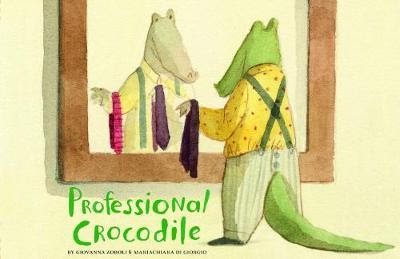
2018 for illustration: Maria Chiara di Giorgio, Professione coccodrillo, Topipittori, 2017


2016 for illustration: Andrea Antinori, This is a Moose? Is this a moose?

2014 category: Silvia Borando, The Cat Book, Minibombo, 2013 translation

2012 illustration category: Fabian Negrin, Call me Sandokan!, Salani, 2011 translation

2010 illustration category: Michele Ferri, Il mondo è anche di Tobias (by Elena Spagnoli Fritze)

2008 illustration category: Beatrice Alemagna, The crows (by Aldous Huxley)

One Round Moon and a Star for me by Ingrid Mennen illustrated by Niki Daly

Do you look like your dad? Do you look like your mum? In a family photo is it easy to see you really belong? 

A new baby arrives in the family. 

Papa "kneels down to look at the baby's tiny hands.
'They look like my hands,' he says.
He looks at the baby's tiny round ears.
'Mama's ears.'
He unwraps the blanket, and there are two small feet with ten tiny toes.
'They will walk well.' Papa nods.
'I'm the baby's father,' says Papa with a smile."

The little boy is confused and perhaps a little bit jealous. He asks the all-important question:

"Papa, are you really my papa too?"

His father gently takes hold of the boy's hands and shows him how they match, how his eyes are also like Mama's eyes. 

"You are your papa's child and you are your mama's child."


Take a look at my previous post from earlier this year about the illustrator Niki Daly. One Round Moon and a Star for me was published in 2004 and so it is now out of print. I picked up my copy at a recent charity book sale.

Blurb from the illustrator: A young African boy watches a shooting star falling for his Mama's new baby. The whole village comes together to provide gifts for mother and child. But when he sees his papa smiling at the baby's tiny hands which are just like Papa's own hands, his heart grows dark, like a night with no moon. At last he asks, "Papa, are you really my Papa too?" Set against the backdrop of a rural South African village, Mennen's lyrical text coupled with Daly's evocative illustrations are filled with light and darkness; friendship and community spirit; love and hope, telling the universal story of a young boy's journey to discover his own place in the world.

When the baby comes her brother places two stalks of yellow grass in the roof above the door. No men are allowed in their hut for many days after the birth. Village women bring water for the baby. Others bring a cake of soap for Mama, a small lamp so the baby has light and fresh cow-dung for their floor. Papa leaves a silver bucket filled with milk at the door of the hut. If you want to share different customs for welcoming a new baby you could compare this text with Baby Business.  


Friday, August 2, 2024

Little Tree and the Wood Wide Web by Lucy Brownridge illustrated by Hannah Abbo


This is a powerful book, that teaches children about a hugely important discovery in contemporary science, about a secret world beneath our feet and most importantly, about the strength that comes with asking for help, and discovering that you are not alone.  Quarto

Children will likely discover hidden treasures each time they read the book—from worms to burrowing moles to buried bones—and these discoveries can expand learning with ecological conversations about subterranean dwellers and decomposers. Importantly, this story calls our attention to organisms often overlooked in our environment—plants and fungi.

The Wood Wide Web is a network made from strands, or hyphae of fungus. It exists under the forest floor and connects a tree's roots to other trees in the forest. The network enables trees to share all sorts of resources and signals with each other.

This book was the 2024 winner of the Giverny Award. 

The Giverny Award is an annual children's science picture book award established in 1998 by Dr. Jim Wandersee and Dr. Elisabeth E. Schussler who was at that time affiliated with the 15º Laboratory at Louisiana State University.

  1. This singular annual award is bestowed to the author and to the illustrator of the chosen book.
  2. The book must be a children's science picture book written in the English language and published within five years of the award date. These books typically have ~ 32 pages and serve children between ages 4-8.
  3. The book must teach its young reader at least one important scientific principle well, or encourage the reader toward specific science-related attitudes, pursuits, or inquiries.
  4. The book's artwork, illustrations, photographs, or graphics must work in harmony with the text to tell an important story well.
  5. The text must have a story with a plot and characters.
  6. All other factors being equal, books about plants and/or plant science or biology will have preference. However, books on geobiology topics are also considered and have been chosen.
  7. A book must be published in the English language to be eligible, but the award is international in scope.

Read the School Library Journal review. And here is the Kirkus review. 

Little Tree and the Wood Wide Web is a nonfiction book [582.16] told in the form of a narrative. It is so important to add books like this to your library collection both as a book for teachers to use but also as a terrific way to share an interesting aspect of nature with young children. I first heard about this phenomenon though, in a fiction story - Mikki and Me and the Out of Tune tree - and then I went on to find other story books linked with this topic:


Previous winners of the Giverny Award:

1998   Common Ground Molly Bang
1999   Sam Plants a Sunflower Kate Petty & Axel Scheffler
2000   A Log's Life Wendy Pfeffer & Robin Brickman
2001   Henry Hikes to Fitchburg D.B. Johnson
2002   Rare Treasure Don Brown
2003   The Hidden Forest Jeannie Baker
2004   Lonesome George Francine Jacobs & Jean Cassels
2005   Squirrel and John Muir Emily Arnold McCully
2006   Daniel and His Walking Stick Wendy McCormick & Constance R. Bergum
2007   The Snail and the Whale Julia Donaldon & Axel Scheffler
2008   The Prince of Butterflies Bruce Covile & John Clapp
2009   Forest Bright/Forest Night Jennifer Ward & Jamichael Henterly 
2010   Redwoods Jason Chin
2011   A Tree for Emmy Mary Ann Rodman & Tatjana Mai-Wyss
2012   Eliza's Cherry Trees Andrea Zimmerman & Ju-Hong Chen
2013   Green Laura Vaccaro Seeger
2014   Maple Lori Nichols
2015   Up in the Garden down in the dirt, Kate Messner & Christopher Silas Neal
2016   Frog in the House David Mather & Stephanie Mirocha   
2017   The Tree Lady H. Joseph Hopkins & Jill McElmurry 
2018   Bat Count: A Citizen Science Story Anna Forrester & Susan Detwiler 
2019   Counting on Katherine: How Katherine Johnson Saved Apollo 13 Helaine Becker    
2020   They All Saw A Cat Brendan Wenzel
2021   Little Turtle and the Changing Sea Becky Davies & Jennie Poh  
2022   Old Rock (is not boring) Deb Pilutti
2023   The River that Wolves Moved Mary Kay Carson & David Hohn
2024   Little Tree and the Wood Wide Web Lucy Brownridge & Hannah Abbo


Thursday, August 1, 2024

The Silver Sword by Ian Serraillier


Publisher blurb: Although the silver sword was only a paper knife, it became the symbol of hope and courage which kept the Balicki children and their orphan friend Jan alive through the four years of occupation when they had to fend for themselves. And afterwards it inspired them to keep going on the exhausting and dangerous journey from war-torn Poland to Switzerland, where they hoped to find their parents.

If you are not familiar with this famous book you can read a full plot summary here. 

This is another title in my series where I am reading and re-reading classic children's books.  I really thought I had read The Silver Sword first published in 1956 but reading it this week none of the plot resonated with me. In my memory this was a solo journey by the boy with the tiny paper knife sword but in fact it is a journey of four children and the determination and kindness of young Ruth is so beautifully explained I am sure I would have remembered her from this book. 

Here are a few of text quotes:

"There was no time for Ruth to dress properly. She put a coat over her nightdress and would a woollen scarf round Bronia ... (Edek) picked up the sobbing Bronia and led the way upstairs. He was wearing his father's thick overcoat over his pyjamas, a pair of stout boots on his bare feet and his rifle slung over his back."

"They must have gone fully a hundred yards when the first explosion shook the air. A sheet of fire leapt up from their home into the frosty night sky. They fell flat in the snow and lay there. The roof shook, the whole city seemed to tremble. Another explosion. Smoke and flames poured from the windows. Sparks showered into the darkness."

"Edek had been their life-line. Food, clothes, money - they depended on his for all these. In the city he had made a home out of a ruin. In the woods no tree gave better shelter than the oak he had chosen. And after dark, when the wind blew cold and the damp oozed out of the ground, none knew better than he how to keep the fire in untended till dawn, so that the glow from the embers should warm them all night as they slept."

From Penguin: Ian Serraillier (September 24, 1912 - November 28, 1994), was a British novelist and poet. Serraillier was best known for his children's books, especially the Silver Sword (Novel) (1956), a wartime adventure story which was adapted for television by the BBC in 1957 and again in 1971. ...  He became an English teacher, first at World War II. It was during this period that his first published work appeared, in the form of poetry for both adults and children. In 1946 his first children's novel was published. It was followed by several more adventure stories of treasure and spies. His best known work, The Silver Sword, was published in 1956 and has become a classic, bringing to life the story of four refugee children and their search for their parents in the chaos of Europe immediately after World War II. As well as children's novels and poetry, Serrailler produced his own retellings of classic tales, in prose and verse, including Beowulf, Chaucer and Greek myth. Together with his wife Anne he founded the New Windmill Series in 1948, published by Heinemann Educational Books, which set out to provide inexpensive editions of good stories. 

If you read this book with a group of students (as many schools still do) it would be good to use one of these as a comparison text: