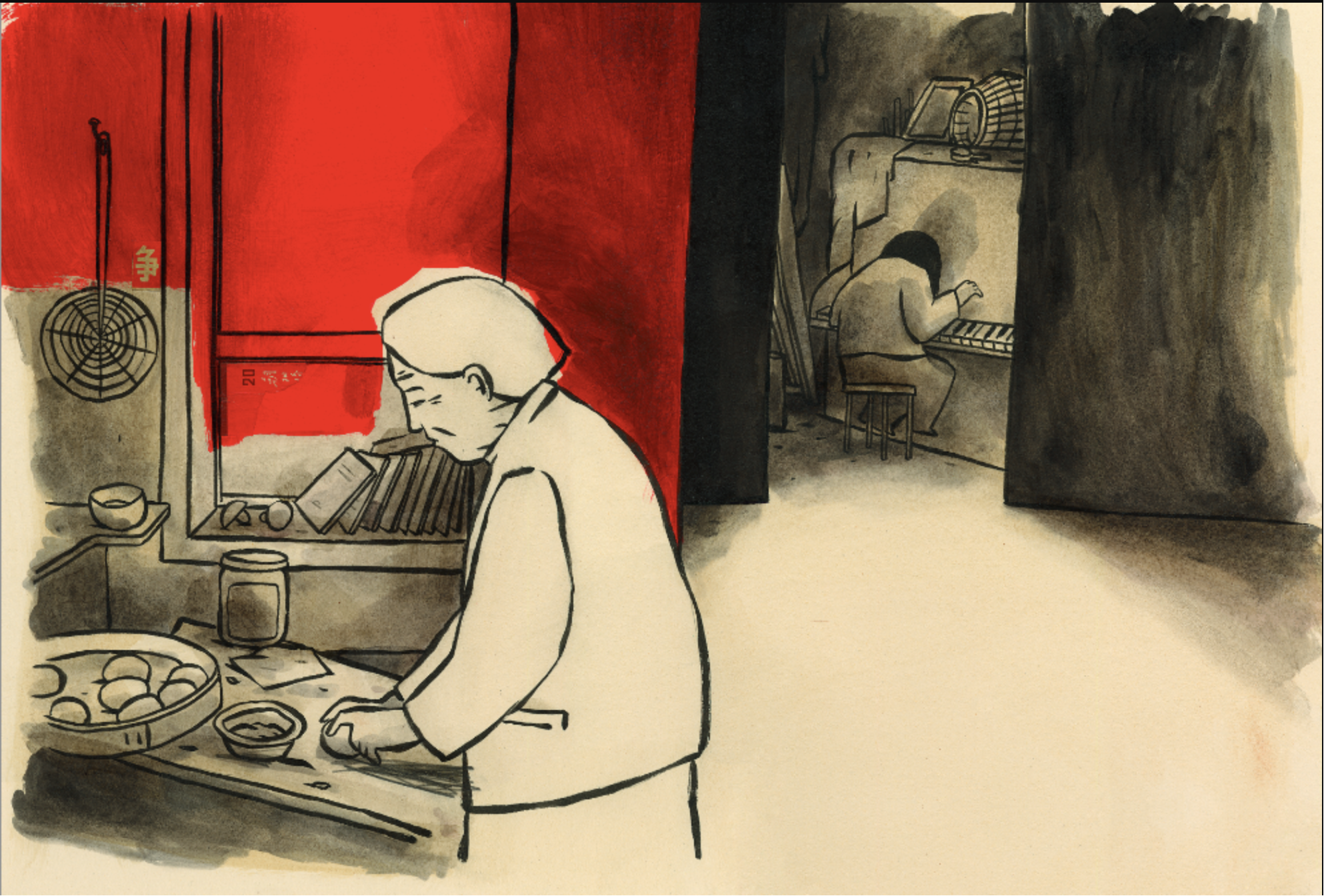
"Yun thought how physically strong Fu was, how practical and dependable, steady as an ox.
Pei was fast, meanwhile, and asked inconvenient questions ... She was a small, angry,
quick-thinking girl in a village that valued none of those things."
"Life was hard. And so unfair. For those without money or consequence, it was a game of chance, not of skill. But the children already knew that, even if they had no words for that knowledge."
"I don't want to be angry, if being angry is a bad thing ... but if I'm not angry, nothing changes. I don't want to be one of those people ... that things are done to. Life seems like a test people like us can never pass because we never know what the rules are, and there are always rules.
I want to know the rules. I want to write the rules."
This story is told in three parts. We meet Pei, Fu and their mother living in a village in China 1951-1958. The family are poor and under the rule of the local landowner but they are happy. Pei and Fu's mother and father are well educated people - different from others in their village. Then two life changing events occur - their father disappears and the feudal system is overturned by communism. Now neighbor is pitted against neighbor, the state demand more and more of their produce and they take away their farm animals and tools. Everyone suffers but they are all powerless.
In part two, after their mother finally succumbs to starvation, the two children set off on a journey to find their father. They have a tiny collection of documents, letters, a menu and one very precious photo. They also have treasures sewn into their worn jackets. Their mother has told them never to part with their jackets and to only use the precious hidden things in an extreme circumstance. These land-based kids have never seen the sea let alone traveled across the vast ocean to an unknown destination in search of one man who they have been told can help them. Hong Kong is huge, confusing and loud and it seems completely impossible that Pei and Fu could ever meet the man who once knew their father and who they have been told can help them reach Australia.
Finally in part three, the two bedraggled children have been able to secure passage on a ship traveling to the land at the bottom of the world and again, luckily, Pei makes a friend. This time it is a wise, kind young Jewish woman. It is a special moment in the story when Miss Ewa offers to teach Pei English.
The cover (by Hana Kinoshita Thomson) and title of this book are such interesting choices. This book is set in China in the 1950s but the cover (to my eye) does not have an Asian or even an historical feel. But I am most curious about the title. I've done a very tiny amount of reading about the Chinese Sparrowhawk bird. Their migration route does not take them to Hong Kong or Australia which are the destinations of Pei and Fu. The lonely sky makes more sense when you think about their long journey first in the sampan and later in the ship across the ocean under an enormous and lonely sky. Also, the way language barriers, loss and separation from loved ones means the children are desperately lonely. On page 74 of the novel their mother says:
‘My two sparrowhawks, my two fierce, bright young birds, carrying a piece of us with you wherever you go.’
Post update! I asked a question about the title on Instagram and Rebecca Lim replied. I was so excited to read her reply. And if I can boast she also thanked me for my 'absorbing and heartfelt' review!!!:
"I have just done an interview with ABC Nightlife where I talk about the title. Chinese Sparrowhawks are native to Southern China and they are common, tough and hardy. I wanted to set something tiny and local to a specific area against the fearsomeness and vastness of the wider world/sky - would such a creature survive."
There is nothing like a well-written, emotionally engaging historical novel to give young readers an understanding about life in a previous time and place. This wonderful story exposes the reality of life under Mao Tse-Tung’s Great Leap Forward, which resulted in the deaths of millions of Chinese, and the institutional racism of the White Australia Policy during the 1950s. Reading Time
The depth of research, emotion and strong characterization (especially of Pei) comes from the personal nature of this story - Rebecca Lim says "I'm trying to set the record a little straighter for my kids, their friends and the people we know, bringing all of us, not just the usual suspects, into the canon of stories that are worthy of telling."
Publisher blurb: Thirteen-year-old Fu, his younger sister, Pei, and their mother live in a small rural community in Southern China that is already enduring harsh conditions when it is collectivised as part of Mao Zedong's Great Leap Forward campaign that ultimately led to economic disaster, widespread famine and millions of deaths. After tragedy strikes, and threatened with separation, Fu and Pei set out on a perilous journey across countries and oceans to find their father, who left for Australia almost a decade ago. With nothing to guide them but a photograph and some documents in a language they cannot read, they must draw on all their courage and tenacity just to survive - and perhaps forge a better life for themselves. An unforgettable story of family, resilience and the complex Asian-Australian experience from the esteemed author of Tiger Daughter, winner of the CBCA Book of the year for Older Readers.
Here are some text quotes which will give you a flavour of this absorbing book. I didn't lift my head over the last couple of days because I needed to make sure Pei and Fu were safe. I was very tempted to skip to the end just to reassure myself but I resisted. There were so many times when I worried that truly terrible things would happen to these young children. Thank goodness for the kindness of strangers.
I also enjoyed the way Rebecca Lim wove the history of The Great Leap Forward (1958–1961) in China and the philosophy of Mao; Refugee and Immigration Policies in China and Australia (The White Australia policy); and early in the story the feudal system in Chinese villages contrasted with the 'new' collective regime. She also touches on child marriage and the powerlessness of women.
"Should we take it all back, good peasants? ... Should we start the agrarian revolution in your own feudal pocket of Southern China?" "Will you apologise to the proletariat who have suffered under your reign like beasts of burden?"
"It was a great tragedy, they all agreed, that the chieftain had to forgo his life for the greater good. But things like class struggle and socialist transformation and revolution had nothing to do with them .... no one will ever go hungry again. But that was not really true."
"All private land holdings, draught animals and tools within this village are now contributed to a single co-operative, for the common good. ... The State now owns all means of production and all means of livelihood."
"The Liang family had no draught animals, so Yun always transported the remains of their harvest divided into two baskets hanging from each end of a long guava-wood pole, balanced across her thin shoulders, staggering under the weight. It was a one-hour trip each way. ... Cutting the hard rice and sorghum stalks in the pelting rain had grazed Pei's fingers and palms, and they stung now with a myriad of tiny cuts, and the cold."
"The people of Long Jing Cun had never seen a female cadre with a rifle in the village before ... Pei's eyes widened. It suddenly occurred to her that this woman was not a famer. Pei had never seen a woman who was not a farmer but rather something else - could you even be something else?"
Descriptions: "Then one day, Ru went out to teach - wearing his old navy officer's cap and threadbare, loose-fitting navy suit, all trace of his former officer status stripped from the shoulders and collar, and his cracked leather shoes that let the water in on rainy days ... And he never came home again."
Notice some of the words used here - threadbare, loose-fitting, cracked leather.
"Yun covered Pei's eyes so quickly that her work hardened hands - nails cracked with dirt and clay - scratched the soft skin of her daughter's face like claws."
Notice the words here too - work-hardened, cracked, soft skin, claws.
"Like her children, she was slender to the point of emaciation, and her eyes were ringed with dark circles. She looked much older than her years."
In this interview for ABC Radio National Rebecca talks about her book. I do wish the interview had asked about the title! Here is a link to the teachers notes written by Rebecca Lim available on the publisher site (Allen and Unwin) and also via Pegi Williams. Here is a review with plot details from The Book Muse.
This exciting and immediately engaging story is rich in memorable characters, full of tension, moments of tenderness and high emotion, with a deep, challenging core questioning our beliefs and prejudices. StoryLinks
I am going to predict we will see this book listed as a Children's Book Council of Australia (CBCA) Notable title and short-listed book for 2024 - possibly in Younger Readers but I think Older Readers might be a better fit. I would highly recommend this book for mature readers aged 11+ - I won't spoil the end but even though many things are resolved for Pei and Fu the ending is also open for readers to imagine a new future for these two children arriving in a new land.
The very best books to pair with this would be these two picture books but there are lots of other suggestions in the teacher notes.
Link this to the line in the book - "He is a leech.
He is a pestilence far worse than sparrows, than locusts." Page 25 Two Sparrowhawk's in a Lonely Sky
"All mosquitoes, rats, flies and sparrows are to be exterminated. Sparrows and rats eat grain! Flies and mosquitoes cause pestilence. ... Take your pots and pans into the fields and clash them loudly
while the sun shines. Drive the pests away." Page 84 wo Sparrowhawk's in a Lonely Sky
Make sure you also read Tiger Daughter.