Showing posts with label Asian setting. Show all posts

Saturday, March 15, 2025

Panda Book Awards


The Panda Book Award, initiated in 2008 by librarian Nadine Dewit Rosevear, invites students and teachers from participating international schools in China and beyond to vote for their favorite book published in the previous two to three school years. Titles chosen for the shortlists of the Panda Book Award meet selection criteria that focus on social justice, diversity and inclusion by up-and-coming authors and illustrators from across the world. There is an added spotlight on titles that feature Asian settings, characters or creators. 

There are six separate title lists according to age level:
  • Early Years Readers (3-5 years) - picture books - Elementary School
  • Younger Readers (5-8 years) – picture books - Elementary School
  • Middle Readers (7 to 11 years) – chapter books - Elementary School/Middle School
  • Middle Readers Graphic Novels (7 to 11 years) - Elementary School/Middle School
  • Older Readers (11 to 14 years) – Middle School
  • Mature Readers (15 to 18 years) – High School


I saw a school library with a group of children using dot stickers to vote for their favourites in the picture book category and I squealed!! when I saw Floof had the MOST votes.


Out of the Jar is interesting because it is the third book in a series. These would be a fabulous addition to your school library. I previously talked about In a Jar. You can see more books by Deborah Marcero here.


Wednesday, November 22, 2023

Paper Dragon - The Fight for the Hidden Realm by Siobhan McDermott


"There are twelve skills needed to become a Cyo B'Ahon. Six to protect those you will watch over and six to achieve immortality. Each question you answered on your entrance exam was linked to one of these skills. Having a natural ability for one over the others is not enough. Without the twelve you will never make it as a Cyo B'Ahon."

Students need a natural aptitude in six areas: climate, calligraphy, concealment, flora, fauna and folklore. And they also need to be able to combine the skills essential for ageshifting - perception, prediction, perseverance, recall, reasoning and rapport.

Ageshifting - "This is one part of being a Cyo B'Ahon that we don't tend to broadcast. We're immortal yes, but not because our bodies are frozen in time. Instead we maintain immortality by ageshifting."

Harry Potter fans might have fun making links between this text and their favourite Harry Potter characters and plot twists.

  • Harry Potter = Zhi Ging - she has a special magical and powerful gift and she has no idea where this came from. There is also a mystery surrounding the fate of her mother.
  • Hogwarts = Hok Woh, the underwater realm of the immortals - a training school run like a boarding school with a cafeteria, classrooms, dorms, eccentric teachers, and range of classmates - some friendly some not. The first-year students are learning to become Silhouettes - many will fail.
  • Quidditch = Dragon boat races 
  • Draco Malfoy = Iridill - we discover she cheated the entrance exam and at every turn she is utterly despicable towards Zhi Ging. 
  • Voldemort = Fui Gwai - and he/she has an army of thralls.

Readers who have strong reading stamina and who enjoy complex stories with lots of characters and dangerous situations might enjoy this book - I suggest age 11+. This first installment does end on a cliff hanger so readers will need to wait for book 2. You will also need reading stamina because this is a long book with a huge cast of characters and to my eye the print size is a little too small, so I found it hard to read for extended periods. The US cover looks more sophisticated and I think better matches the tone of, and audience for, this book. Huge thanks to Three Sparrows for the advance copy of this book which is due for release in February 2024. 

Sadly, I didn't find Paper Dragons: The Fight for the Hidden Realms entirely captured my attention but I found these media reviews:

  • 'A soaring, luminous new world ... An absolute delight!' Jessica Townsend
  • 'An absolute feast for the senses!' Nizrana Farook
  • 'A thrillingly immersive story of courage, self-discovery, and magic' Sinead O'Hart 


The US cover


Publisher blurb: An outsider in her village above the cloud sea, 12-year-old orphan Yeung Zhi Ging’s only hope of escape is to win the single invitation to train as a Silhouette: an apprentice to the immortals. After her ill-fated attempt to impress the Silhouette scout leads to a dragon attack on the jade mountain, Zhi Ging is sure that her chances, and her life, are over. But the scout spots her potential and offers her protection and a second chance. She’s in. In her lessons in Hok Woh, the underwater realm of the immortals, Zhi Ging must face the challenging trials set by her teachers to prove that she’s worthy of being a Silhouette—despite her rivals’ attempts to sabotage her. But as Zhi Ging’s power grows, so do the rumours of the return of the Fui Gwai, an evil spirit that turns people into grey-eyed thralls. When the impossible happens and the Fui Gwai attack the Silhouettes, can Zhi Ging use her newly uncovered talents to save her friends and the world beyond? Or will the grey-eyed spirit consume them all?

About the author: Siobhan McDermott was born in Hong Kong and grew up on a steady stream of stories filled with Chinese legends and Irish folklore from her Chinese mother and Irish father. She now lives in the UK and continues to order dim sum in Cantonese tinged with a distinctly Dublin lilt. She worked in publishing for six years, during which she took part in every event imaginable: from a ‘yoga with your dog’ session in a bookshop to running around Isle of Man in a full unicorn onesie. She is now the PR Lead at BBC Maestro. Paper Dragons is her debut novel and was inspired by moments across her life: from childhood ferry trips between Lantau Island and Hong Kong, to traveling around Taiwan, Italy and Spain.

The publisher suggests Paper Dragon will be enjoyed by fans of Amari and the Night Brothers, Dragon Mountain, Skandar and Eragon.


I didn't finish reading The Lost Ryu by Emi Watanabe Cohen but this could be another book to look for if you enjoy Paper Dragon: The fight for the Hidden realm


Friday, November 17, 2023

Ties that Bind, Ties that Break by Lensey Namioka


Ailin lives in China. The year is 1911. She is part of a large extended family who still follow old customs. At a very young age she is betrothed to a boy in her neighborhood. She is just four years old and the boy is eight. The other tradition is foot binding. Hanwie's family (her betrothed) cannot accept Ailin if her feet are not bound but Ailin's father is progressive in his thinking, and he agrees her feet do not need to suffer this hideously painful process. He also agrees that his daughter can go to school even though girls do not usually receive education beyond the family. 

Her lack of footbinding means Hanwie is no longer engaged to Ailin but attending school means she is able to learn English. When her father sadly dies her bully uncle takes over control of the family. He has dreadul plans for Ailin so it is time for her to leave. She goes to work for a missionary family taking care of their two young children. By doing this she can no longer visit her family. After three years with the Warners she then travels to America so now her family ties are completely broken.  Go back to the title - ties that bind - foot binding and the binding to traditional customs. Ties that break - her cruel uncle and the way she is no longer fit for marriage with her big feet means she has to break away from her family and their traditional customs. Spoiler alert - there is a very happy ending to the story.

Wikipedia have a very detailed plot summary. 

The metaphor of things bound and unbound is a ribbon winding through this vivid narrative; the story moves swiftly, while Ailin is a brave and engaging heroine whose difficult choices reflect her time and her gender. Kirkus

Namioka weaves in just enough political history to help readers understand the turbulent climate, and her writing is so atmospheric and closely informed that it appears to offer an insider's perspective on a vanished way of life. Narrated by Ailin in flashback, this colorful novel has the force and intensity of a memoir. Publisher's Weekly

I picked this slim book up on a sale table in a large city bookstore. I love to look at price stickers on books like this because you can see how long a particular book has languished on the shop shelves. This book has been waiting since June 2017 for a new owner. Why? The cover is appealing to my eye. I think perhaps this book was placed in the wrong section. First off it has the feel of a biography and secondly, even though it only has 150 pages this book is not suitable for younger children. I would place it in the Young Adult section and recommend it for readers aged 13+. Please note there is a mention of suicide in the narrative. This book was published in 2003 but it is still available. 

Listen to an audio sample

Here is an alternate cover:


Companion book:

Friday, October 27, 2023

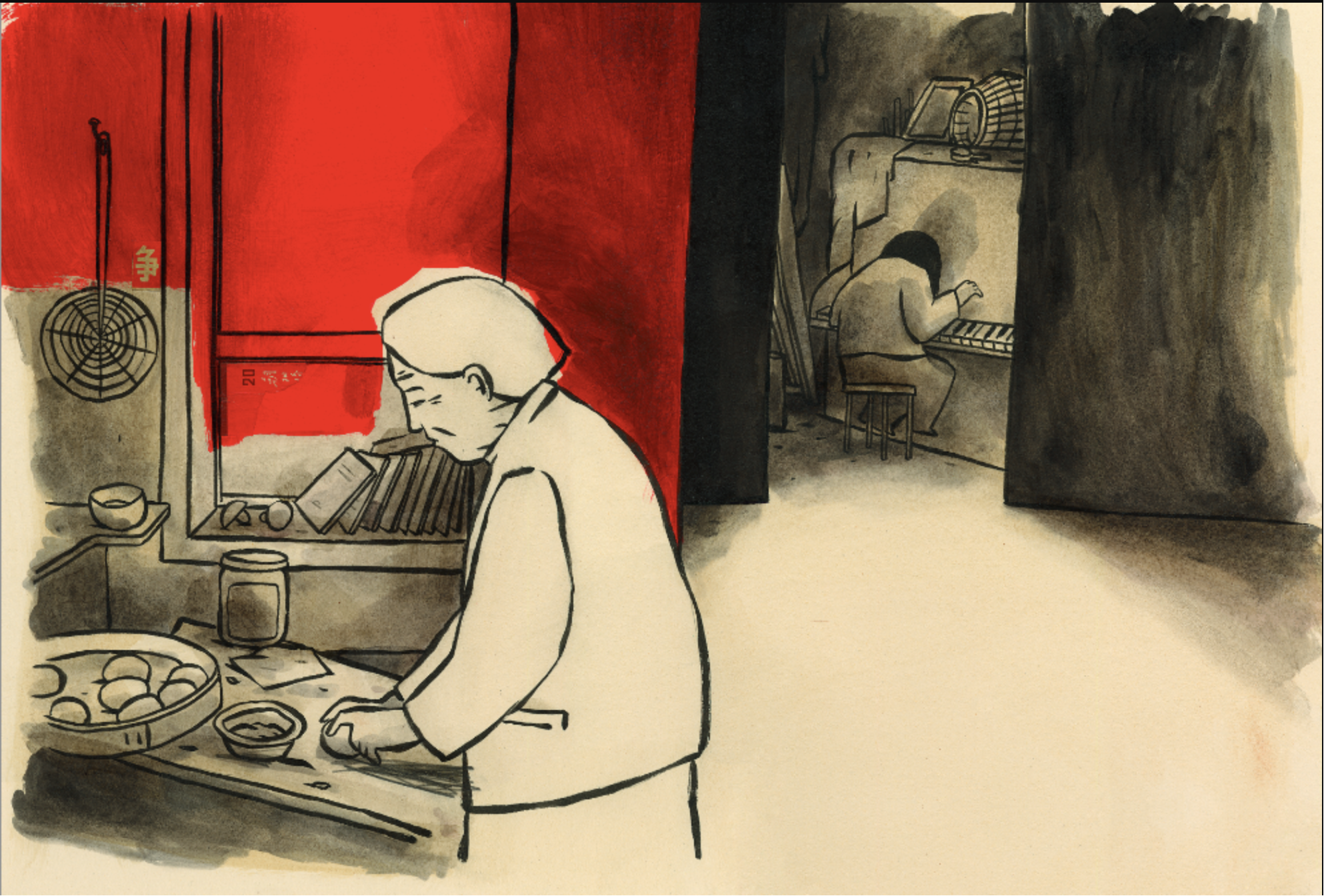
The Red Piano by André Leblanc illustrated by Barroux translated by Justine Werner


"In the hut, the cramped rooms reek of warm sweat, the foul smell of extinguished coal fires and packed earth. Crammed together, the comrades are already sleeping on the bare ground. Taking small careful steps, the young girl leaves the communal house."

"The music rises, free yet encased by the thick walls. Tonight marks the end of her fifth year in exile. ... pianos are criminal. Pianists are criminals. Schools are closed down. The Communist party is re-educating everyone."

How did they manage to bring a piano to this desolate place? How can this little girl practice each evening? Where will she get her music? And - most awful of all - what will happen when she is discovered?

Discover the answers in The Red Piano but be prepared to have your heart broken. 

The Cultural Revolution was started by Chinese leader Mao Tstung in 1966 to make China's people follow his idea of the way they should live. ... Young people left school and became Red Guards, roaming the country to search for and destroy the 'four olds' - old customs, old culture, old habits and old ideas. People, like the little girl in this book, were sent to the countryside to work with the peasants. (from the preamble)

"For seven years now, educated young people have been going to re-education camps, occasionally with enthusiasm but more often under duress. Their mission: to eradicate elitism through manual labour alongside poor farmers and by studying Chairman Mao's political works."

There are several things I miss now that I no longer work in my school library. I desperately miss reading aloud to groups of students. I miss sharing books with individual readers. And I miss creating lessons to unpack complex books like this one which I read to groups of our Grade Six students as a part of their work on Asian studies. Read this review for more plot details

This extraordinary (I don't use that word lightly) story was inspired by the true story of girl who grew up during the Chinese Cultural Revolution. Her name is/was Zhu Xiao-Mei. I first read this book several decades ago but the story has lingered with me. I highly recommend this for readers aged 11+ and for all high school libraries. 

Dazzling collage, pencil and paint illustrations from Barroux create a beautiful chiaroscuro of tension and release. Kirkus


Bookseller blurb: Stirring and inspiring, this picture book relates the story of a gifted young girl's passion for the piano in a time of historic turmoil. During China's Cultural Revolution a young girl is taken from her family and sent to a far-off labor camp. Forbidden to play the piano, she nevertheless finds a way of smuggling handwritten music into the camp and sneaking away at night to practice a piano in a secret location—until, one night, she is caught. Inspired by the amazing true story of international concert pianist Zhu Xiao-Mei, this acclaimed picture book poetically relates an astonishing story of perseverance set against a cataclysmic period of history.

I thought about this book all over again when I recently read Alias Anna because Anna is a musician and while music saves her it continually also threatens to expose her as a Jewish child. I also thought of Mao and the Cultural Revolution when I read Two Sparrowhawk's in a Lonely Sky by Rebecca Lim. And I thought of the similarities of the historical context from The Red Piano when I read My Brigadista Year by Katherine Paterson.

The Red Piano was published in 2008 so yes, it is out of print, but this book is sure to be in many school and public libraries. I picked up my copy at a recent charity book sale.

Saturday, October 14, 2023

Two Sparrowhawk's in a Lonely Sky by Rebecca Lim


"Yun thought how physically strong Fu was, how practical and dependable, steady as an ox. 
Pei was fast, meanwhile, and asked inconvenient questions ... She was a small, angry, 
quick-thinking girl in a village that valued none of those things."

"Life was hard. And so unfair. For those without money or consequence, it was a game of chance, not of skill. But the children already knew that, even if they had no words for that knowledge."

"I don't want to be angry, if being angry is a bad thing ... but if I'm not angry, nothing changes. I don't want to be one of those people ... that things are done to. Life seems like a test people like us can never pass because we never know what the rules are, and there are always rules. 
I want to know the rules. I want to write the rules."

This story is told in three parts. We meet Pei, Fu and their mother living in a village in China 1951-1958. The family are poor and under the rule of the local landowner but they are happy. Pei and Fu's mother and father are well educated people - different from others in their village. Then two life changing events occur - their father disappears and the feudal system is overturned by communism. Now neighbor is pitted against neighbor, the state demand more and more of their produce and they take away their farm animals and tools. Everyone suffers but they are all powerless. 

In part two, after their mother finally succumbs to starvation, the two children set off on a journey to find their father. They have a tiny collection of documents, letters, a menu and one very precious photo. They also have treasures sewn into their worn jackets. Their mother has told them never to part with their jackets and to only use the precious hidden things in an extreme circumstance. These land-based kids have never seen the sea let alone traveled across the vast ocean to an unknown destination in search of one man who they have been told can help them. Hong Kong is huge, confusing and loud and it seems completely impossible that Pei and Fu could ever meet the man who once knew their father and who they have been told can help them reach Australia. 

Finally in part three, the two bedraggled children have been able to secure passage on a ship traveling to the land at the bottom of the world and again, luckily, Pei makes a friend. This time it is a wise, kind young Jewish woman. It is a special moment in the story when Miss Ewa offers to teach Pei English.

The cover (by Hana Kinoshita Thomson) and title of this book are such interesting choices. This book is set in China in the 1950s but the cover (to my eye) does not have an Asian or even an historical feel. But I am most curious about the title. I've done a very tiny amount of reading about the Chinese Sparrowhawk bird. Their migration route does not take them to Hong Kong or Australia which are the destinations of Pei and Fu. The lonely sky makes more sense when you think about their long journey first in the sampan and later in the ship across the ocean under an enormous and lonely sky. Also, the way language barriers, loss and separation from loved ones means the children are desperately lonely. On page 74 of the novel their mother says:

‘My two sparrowhawks, my two fierce, bright young birds, carrying a piece of us with you wherever you go.’ 


Post update! I asked a question about the title on Instagram and Rebecca Lim replied. I was so excited to read her reply. And if I can boast she also thanked me for my 'absorbing and heartfelt' review!!!:

"I have just done an interview with ABC Nightlife where I talk about the title. Chinese Sparrowhawks are native to Southern China and they are common, tough and hardy. I wanted to set something tiny and local to a specific area against the fearsomeness and vastness of the wider world/sky - would such a creature survive."

There is nothing like a well-written, emotionally engaging historical novel to give young readers an understanding about life in a previous time and place. This wonderful story exposes the reality of life under Mao Tse-Tung’s Great Leap Forward, which resulted in the deaths of millions of Chinese, and the institutional racism of the White Australia Policy during the 1950s. Reading Time

The depth of research, emotion and strong characterization (especially of Pei) comes from the personal nature of this story - Rebecca Lim says "I'm trying to set the record a little straighter for my kids, their friends and the people we know, bringing all of us, not just the usual suspects, into the canon of stories that are worthy of telling."

Publisher blurb: Thirteen-year-old Fu, his younger sister, Pei, and their mother live in a small rural community in Southern China that is already enduring harsh conditions when it is collectivised as part of Mao Zedong's Great Leap Forward campaign that ultimately led to economic disaster, widespread famine and millions of deaths. After tragedy strikes, and threatened with separation, Fu and Pei set out on a perilous journey across countries and oceans to find their father, who left for Australia almost a decade ago. With nothing to guide them but a photograph and some documents in a language they cannot read, they must draw on all their courage and tenacity just to survive - and perhaps forge a better life for themselves. An unforgettable story of family, resilience and the complex Asian-Australian experience from the esteemed author of Tiger Daughter, winner of the CBCA Book of the year for Older Readers.

Here are some text quotes which will give you a flavour of this absorbing book. I didn't lift my head over the last couple of days because I needed to make sure Pei and Fu were safe. I was very tempted to skip to the end just to reassure myself but I resisted. There were so many times when I worried that truly terrible things would happen to these young children. Thank goodness for the kindness of strangers. 

I also enjoyed the way Rebecca Lim wove the history of The Great Leap Forward (1958–1961) in China and the philosophy of Mao; Refugee and Immigration Policies in China and Australia (The White Australia policy); and early in the story the feudal system in Chinese villages contrasted with the 'new' collective regime. She also touches on child marriage and the powerlessness of women. 

"Should we take it all back, good peasants? ... Should we start the agrarian revolution in your own feudal pocket of Southern China?" "Will you apologise to the proletariat who have suffered under your reign like beasts of burden?"

"It was a great tragedy, they all agreed, that the chieftain had to forgo his life for the greater good. But things like class struggle and socialist transformation and revolution had nothing to do with them .... no one will ever go hungry again. But that was not really true."

"All private land holdings, draught animals and tools within this village are now contributed to a single co-operative, for the common good. ... The State now owns all means of production and all means of livelihood."

"The Liang family had no draught animals, so Yun always transported the remains of their harvest divided into two baskets hanging from each end of a long guava-wood pole, balanced across her thin shoulders, staggering under the weight. It was a one-hour trip each way. ... Cutting the hard rice and sorghum stalks in the pelting rain had grazed Pei's fingers and palms, and they stung now with a myriad of tiny cuts, and the cold."

"The people of Long Jing Cun had never seen a female cadre with a rifle in the village before ... Pei's eyes widened. It suddenly occurred to her that this woman was not a famer. Pei had never seen a woman who was not a farmer but rather something else - could you even be something else?"

Descriptions: "Then one day, Ru went out to teach - wearing his old navy officer's cap and threadbare, loose-fitting navy suit, all trace of his former officer status stripped from the shoulders and collar, and his cracked leather shoes that let the water in on rainy days ... And he never came home again."

Notice some of the words used here - threadbare, loose-fitting, cracked leather.

"Yun covered Pei's eyes so quickly that her work hardened hands - nails cracked with dirt and clay - scratched the soft skin of her daughter's face like claws."

Notice the words here too - work-hardened, cracked, soft skin, claws.

"Like her children, she was slender to the point of emaciation, and her eyes were ringed with dark circles. She looked much older than her years."

In this interview for ABC Radio National Rebecca talks about her book. I do wish the interview had asked about the title!  Here is a link to the teachers notes written by Rebecca Lim available on the publisher site (Allen and Unwin) and also via Pegi Williams. Here is a review with plot details from The Book Muse

This exciting and immediately engaging story is rich in memorable characters, full of tension, moments of tenderness and high emotion, with a deep, challenging core questioning our beliefs and prejudices. StoryLinks

I am going to predict we will see this book listed as a Children's Book Council of Australia (CBCA) Notable title and short-listed book for 2024 - possibly in Younger Readers but I think Older Readers might be a better fit. I would highly recommend this book for mature readers aged 11+ - I won't spoil the end but even though many things are resolved for Pei and Fu the ending is also open for readers to imagine a new future for these two children arriving in a new land.

The very best books to pair with this would be these two picture books but there are lots of other suggestions in the teacher notes.


Link this to the line in the book - "He is a leech. 
He is a pestilence far worse than sparrows, than locusts." Page 25 Two Sparrowhawk's in a Lonely Sky

"All mosquitoes, rats, flies and sparrows are to be exterminated. Sparrows and rats eat grain! Flies and mosquitoes cause pestilence. ... Take your pots and pans into the fields and clash them loudly 
while the sun shines. Drive the pests away." Page 84 wo Sparrowhawk's in a Lonely Sky


Make sure you also read Tiger Daughter


Tuesday, October 10, 2023

Monsoon by Uma Krishnaswami illustrated by Jmel Akib


The word monsoon comes from an old Arabic word, mausim, meaning 'season'. The monsoon is a season of rain. 

This is a book about anticipation. It made me think of Come on Rain by Karen Hesse. The family go about their daily life, but everyone is sure the big rains are not too far away. They watch the sky and listen to the news. 

"The heat makes me feel like a crocodile crouching snap-jawed."

Then they hear some distant thunder. The grandmother tells stories of the monsoon of the past - wetter, fuller and longer. Then the shape of the clouds change looking like partridge feathers. Then more clouds gather. 


"Suddenly it is still, a stillness filled with promises of dampness in the air."

"Umbrellas turn into walking forests. ... The raindrops make me laugh out loud, thudding on earth and rooftops and on my skin."


This is a perfect book to use for class work about weather, global warming, rain or Asian studies and even though it was published in 2003 it is still available for less than AUS$20.

“The level of anticipation is so high that every engine rumble sounds like thunder….An expressive story about seasons, extremes, and waiting.” Kirkus Reviews

Bookseller blurb: Children play, birds call, and grown-ups go about their business during the hot days of summer in northern India. But in the bustle of the street and marketplace, everyone is watching, waiting for those magical clouds to bring their gift of rain to the land. Through the observations of one young girl, the scents and sounds, the dazzling colors, and the breathless anticipation of a parched cityscape are vividly evoked during the final days before the welcome arrival of the monsoon.

In the library of my friend they are reviewing books with low borrowing rates. Monsoon has only been borrowed by students twice since 2010 but I am sure it has been included in many of the class topic bulk book loans. I was excited to see Uma Krishnaswami on the cover of this book because I loved her little novel The Book Uncle and Me and a few years ago I discovered she lives Victoria, British Columbia, Canada which is where a friend of mine also lives. Uma Krishnaswami also spoke at the USBBY Conference held at Washington University in 2017 - Radical Change Between Borders


Wednesday, December 2, 2020

Rickshaw Girl by Mitali Perkins illustrated by Jamie Hogan


I am always so pleased when my friend - who is a wonderful Teacher-Librarian - asks me to read one of the books from her extensive collection. This is especially exciting when she wants my opinion about a book. You can see from my four stars that this book is terrific.

Blurb from the back cover: "Naima loves to create the traditional alpana patterns Bangladeshi women and girls paint in their homes for special celebrations. Her designs are always the best in the village. But Naima wishes she could help earn money for her family. Her friend Saleem can drive his father's rickshaw. 'If only I had been born a boy,' Naima thinks."

The burb is a good jumping off point to explain this story:

  • Naima is one of two daughters in this family - there are no sons.
  • The roles of boys and girls are strictly defined in this Bangladesh village.
  • Alpana patterns look like this. Creating art is Niama's happy place but she often so busy with household chores there is little time for art and the family are so poor that even sheets of paper are scarce.


  • Naima is so worried about her father. He drives his rickshaw for over 15 hours a day and he is constantly exhausted. The family have gone into debt to buy this new rickshaw which means the family are desperate to repay the loan. So desperate, that Naima's sister Rashida will soon have to leave school as they cannot afford the fee.
  • Saleen is Naima's best friend. Watching him help his family gives Naima an idea. If she disguised herself as a boy she could take over part of her father's shift but when she tries out the rickshaw without permission it crashes and is badly damaged. 
  • There is a new repair place in the next village. Naima is good at art. Can she stay disguised as a boy and offer to work painting rickshaws? When Naima arrives at Hassan's Rickshaw Repair Shop she makes an amazing discovery about the owner.

All of this happens (and more) in just 79 pages. At the back of the book there is a glossary of terms and an author note which explains, in simple terms, microfinance and the way this is used by women in developing nations. Rickshaw Girl was first published in 2008 but I am pleased to see it is still available in paperback. I think this book should be an essential purchase for any Primary school library. It is ideal to use as an Asian focus text which is part of our Australian syllabus but this story also provides an excellent insight into cultural differences and the role of girls in other countries. In 2016 The Bay Area Children's Theatre in Oakland, California presented this story as a theatre production. Here is the web site for Mitali Perkins.

A child-eye’s view of Bangladesh that makes a strong and accessible statement about heritage, tradition and the changing role of women, Naima’s story will be relished by students and teachers alike. Kirkus

I would pair this book with The Paper House.


Another book about working children is this one Silk Umbrellas by Carolyn Marsden. 

You might also read this picture book about microfinance:


Tuesday, June 16, 2020

The Seeing Stick by Jane Yolen illustrated by Daniela Jaglenka Terrazzini


Tuesday Treasure


Hwei - the lightless moon on the last day of the month
Ming - becoming luminous

Hwei Ming is blind. Her father the emperor offers a reward to anyone who can help her to see. Visitors come from all over the kingdom with prayers, potions, pins, incantations and spells. Nothing works. One day an old man hears about the blind princess.  He sets off on a long journey carrying a walking stick made from "a single piece of golden wood."

On arrival at the city gates the guards refuse him entry. He looks so ragged and poor. The old man reaches out to touch the faces of guards and then he sits down with his stick and his whittling knife. He shows the guards his carving of the journey he has made to Peking from his home to these city gates. The guards are entranced. His storytelling and carving are wonderful. They take the old man inside the city to show the guards at the gates to the inner city and from there he is taken to the door of the Imperial Palace.

The guards tell the emperor about the wonderful pictures carved onto the golden stick. Hwei Ming is sitting beside her father and she hears the story. She asks to see the stick.

"The old man leaned forward and petted Hwei Ming's head and caressed her cheek. For though she was a princess, she was still a child."  Placing his fingers on hers he helps her trace the stick and "see" the story. "And the princess' slim fingers felt the carved stick. Then he put her fingers onto his face and traced the same lines there. It was the first time the princess had touched another person's face since she was a very small girl."

This is a pivotal moment. Hwei Ming asks to feel the faces of those around her - the guards who are waiting close by and then her father, the emperor.

"She reached out and her fingers ran eagerly through his hair and down his nose and cheek, and rested curiously on a tear they found there. And that was strange, indeed, for had not the emperor given up crying over such things when he ascended the throne?"

You have probably guessed the rest of the story. The emperor gives the reward to the old man, the old man can now live in the Innermost City but he gives away the fortune in jewels. Have you guessed the most important thing about the old man himself?

Jane Yolen is the author of over 300 books. On her web page she talks about writing or retelling this Chinese fairy tale.

The illustrations in this book by Daniela Jaglenka Terrazzini are exquisite. They begin in black, white and grey but move to full colour as the old man shares his stories. Some of the richest pages are laminated giving them a beautiful texture reminiscent of cloisonne.

Image Source Books4yourkids

If you have been following my blog you will know my Tuesday Treasures are usually books that are now out of print. This edition of The Seeing Stick was first published 2009 and so it is out of print as is the earlier edition from 1977 which had illustrations by Remy Charlip and Demetra Maraslis.

I would pair The Seeing Stick with these:


Sunday, May 21, 2017

Ruby's Wish by Shirin Yim Bridges illustrated by Sophie Blackall

I mentioned in a previous post that we have been exploring picture books with an Asian focus with our senior classes.  One of the first books we looked at was Ruby's Wish and it certainly generated some deep discussions.


Ruby is living in China in the early nineteenth century.  Her grandfather has made his fortune on the Gold Fields or "Gold Mountain.   That was what the Chinese called California when many men left to join the Gold Rush there."  As was the custom of the time, Grandfather has many wives and many sons who also have many wives and they all live together in a magnificent home.  "So at one time, the house was filled with the shrieks and laughter of over one hundred children."

Life is good for Ruby. She like to wear red but this is traditionally meant for celebrations.  This does not deter Ruby who adds a red ribbon to her jet black hair when her mother insists she must wear somber colours.  Grandfather is generous and so all the children are provided with lessons.  In spite of this, though, things are not always equal for boys and girls.  Ruby observes that girls are expected to learn cooking, keeping house and embroidery while the boys are free to play after class.

Ruby is careful with her calligraphy and is noticed by her grandfather.  One day she uses her calligraphy skills to write a heart-felt poem.

Alas bad luck to be born a girl; and worse lucky to be born 
into this house where only boys are cared for.

Her grandfather is given the poem and Ruby is summoned to his office. This is where the real skills of Ruby shine.  Her grandfather asks for examples of this inequality.  Her first example is small and unimportant. The boys get better cakes, Her second is also fairly minor. The boys have splendid lanterns in the shape of goldfish and dragons while the girl's are plain. Finally she makes her most important point :

"the boys will get to go to university, but the girls will be married."

How will her grandfather react?

Here are a set of teaching notes, Kirkus review and illustrator web site.  A note at the end of the book explains that this story was inspired by the author's mother - the real Ruby who did indeed attend university as one of the first female students.  You can see the whole book here.

Monday, April 10, 2017

Sparrow girl by Sara Pennypacker illustrated by Yoko Tanaka


In our library sessions last term my senior classes explored a number of picture books with an Asian setting.  With each book we looked in detail at the author's inspiration, other works by the author and illustrator, background information about the story (many of which were based around real events and people) and took time to talk about cover images and book design.


One of the books that elicited the most discussion was Sparrow Girl.  Just like my students, I had no idea Mao declared war on sparrows along with rats, flies and mosquitoes.  This time was called the four pests campaign.  It is easy to understand the science of why this had such terrible effect. Killing 30 billion sparrows led to a catastrophic famine leaving 30-40 million people dead.  Here are a set of lesson notes for this book.  For more information about this book read this review.

Before reading this book we talked briefly about Mao and his ideas and then watched this short. but disturbing film from Germany where you can see people beating drums and killing the sparrows.

"They're like teardrops. The sky is crying birds." - Ming-Li

The hero of this fictional account by Sara Penny Packer is little Ming-Li.  She cannot understand why the sparrows are considered bad.  With her brother's help she rescues just seven precious birds.  The crops fail.  Ming-Li tells her father her secret.  She has saved a handful of sparrows.

"Your daughter brings us a miracle!' ... From this day, sparrows will be safe in our village. And we will tell everyone we meet from other villages about the wisdom of the Sparrow Girl."

Sara Pennypacker is the author of the terrific junior series Clementine and also the books about Stuart along with the wonderful senior novel Pax.  Yoko Tanaka has done many books but one we are reading at the moment is The Magician's Elephant as we prepare for the visit by Kate DiCamillo to our city next month.

Over the next few days I will talk about some of the other books we explored this term.


Sunday, August 10, 2014

Tua and the elephant by RP Harris illustrated by Taeeun Yoo


If you need to explain determination to a young child look no further than Tua and the elephant.  This is very special little novel which will introduce younger readers to Tua who is determined to protect her new friend - a baby elephant.  This book will also give you a very authentic insight into the culture of Thailand - the sights, sounds and smells.

Tua means peanut but Tua is not a peanut she is a brave little girl who shows enormous courage when she sees a small elephant is being very badly mistreated by some  opportunistic thieves. "These two ... were scruffy as sewer rats, beady eyed and sharp of tooth. Whiskers grew in sparse patches on their cheeks and chins like mildew. They were both shifty, but one was long and lean, and the other was squat and pudgy."

Woven into this story are many Thai words but these are not hard to work out from the context.  There is a glossary but I rarely referred to it.

Tua rescues the elephant whom she names Pohn Pohn which means double happiness. The difficulty is how do you hide an elephant especially when the aforementioned bad guys what this prize possession back.  Tua must use all her courage, commonsense and initiative to take Pohn Pohn on the long journey to an elephant refuge where she knows she will be safe.

Tua and the elephant is a fairly short novel at just 200 pages but there are moments when I simply gasped out loud hoping Tua could escape the two crazy elephant thieves.  In one scene near the end of the book Tua herself is tied up in the hammock where she is sleeping and kidnapped.  This time it is Pohn Pohn who comes to her rescue.

I will admit I might have walked past this little book in the shop if my friend and fellow Teacher-Librarian had not recommended it. Another reason why it is fun to shop for books with a friend. Here is a set of very comprehensive  teaching notes and here is a set of web links to extend your study of the setting and culture of Thailand.  Take a minute to watch this video trailer where you can see some of the illustrations from this book.

If you enjoy Tua and the Elephants I recommend you also look for Silk Umbrellas by Carolyn Marsden.

Tuesday, September 17, 2013

The Book Uncle and me by Uma Krishnaswami

So much about this book intrigues me.  I have questions but my copy of the book cannot answer them.

The Book Uncle and me was the 2011 winner of the Scholastic Asian Book Award (SABA). I have not heard of this award.  Is it open to any book published in Asia? Or only titles from Scholastic?  What is the criteria for this award?  An Asian author, Asian setting, a book in an Asian language?

An internet search reveals SABA is a joint initiative by Scholastic and the National Book Development Council of Singapore, the award is an attempt to recognise and celebrate children’s writers of Asian origin and books that reflect Asian experiences.

Most intriguing of all though, for me, is who did the illustrations for this book - I love them and was this book originally written in English or another language?  The imprint page lists Scholastic as the copyright holder of the illustrations. This does not help me.

Book Uncle is not Yasmin's uncle - Uncle is a title used by the community as a form of respect to an older person.  The Book Uncle is, however, a book person.  In his retirement from teaching he has set up a barrow lending library in a busy Indian city. He happily lends books to anyone for free - the perfect library!  He is also happy to recommend books.  Yasmin herself is the perfect customer.  She has set herself a target of reading "one book every day, forever. I started last year right after I turned eight, which ready feels like a billions years ago, because now I am past four hundred.  Books, I mean."

This book is about activism.  The city planners are now requesting a huge licence fee from the Book Uncle.  He cannot pay this and thus packs up his library and heads home.  Yasmin is devastated.  Then she finds an effective way have this unjust requirement reversed.  In schools we often look for books that show democracy in action and Book Uncle and me is perfect for this purpose.  I really enjoyed Book Uncle and me - it is quick to read, and celebrates a strong sense of community.

If you enjoy this book you might also look for The Battle of the Galah Trees by Christobel Mattingley or My name is Will Thompson by Robert Newton.