Showing posts with label Photos. Show all posts

Thursday, March 13, 2025

These long-loved things by Josh Pyke illustrated by Ronojoy Ghosh


"I snuggle up and read you books that you read to me ... "

"I hold your hand and smile."


The text in this book is an ode to a long relationship which is coming to an end. The older adult or grandparent, is losing their memory, but the grandchild works hard to maintain a connection through shared memories. The memories come from photographs and experiences such as reading books together or eating a delicious cake with cream and jam along with visiting familiar places.

This book is a CBCA 2025 Picture Book Notable title. I think it might have a chance at making the shortlist. 

I love to think about an illustrator receiving the text for a picture book - perhaps on just one sheet of paper. There are no rules or constraints. The illustrator can use their creativity and imagination to add another dimension to the story. Picture books are such a unique art form - the combination of a literary text and art. Ronojoy Ghosh uses so many perspectives in his digital illustrations in this book along with very interesting ways of showing shadows. Each page turn is a total change of scene, colour and text placement. 

Here are some lines of the text that resonated with me:

"Words and songs and names may fade like leaves on a breeze, they might float away ... but the place in your heart where they land remains and when you no longer can, I hold your hand and remember."


Here are the very detailed Scholastic Teachers Notes.

You need to read this book very slowly and in a quiet place - try to set this mood if you are reading this book to a group in your library. This is a book you could read to children from Grade 2 right up to Grade 6. If you can allow the children to touch the cover of this book and talk about why the book designer has decided to deboss the image. With a group of older students you should also notice the dedication by Josh Pyke to his own grandmother Catherine. And talk about why the end papers are filled with autumn leaves. 

Other books about memory loss and the relationship between a child and a grandparent:


Saturday, January 16, 2021

Hike by Pete Oswald


Like the woods, this book is an immersive experience 

that invites repeated visits. Kirkus Star review

It’s a book to read slowly — and read repeatedly. 

Seven Impossible things Before Breakfast

Let's go on a hike.  We've been on a hike before so we know what we need to pack - binoculars; camera; snacks; drinks; rope; hard hats; and walking sticks. BUT why are we hiking?

  • To see beautiful places
  • To marvel at scenery
  • For exercise
  • To spend time with each other (father and child)
  • To enjoy the great outdoors
  • For an adventure

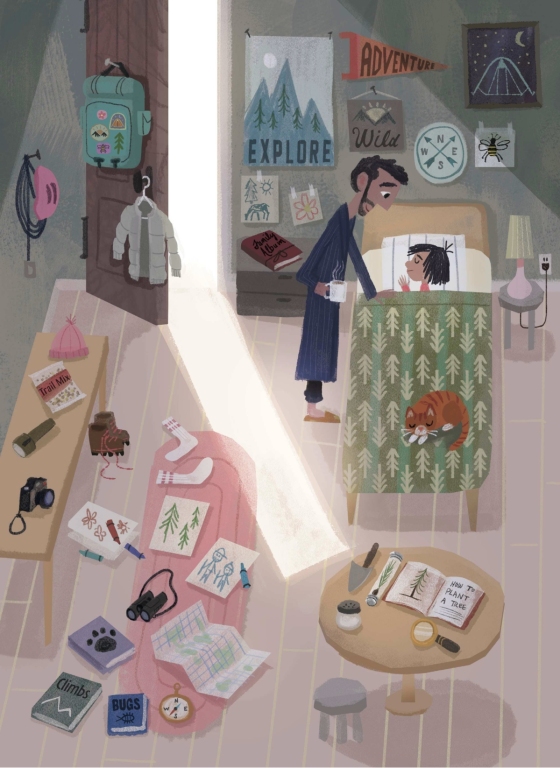
All of these are legitimate reasons but in Hike this pair, father and child, have an extra purpose. If you take a look at the quilt cover on the child's bed you get a small hint. It is covered in a forest of trees. In his bedroom the child has been reading a book - How to Plant a Tree. Do make sure you look at the very last page to see how tree planting has become a family tradition.


Hike is not quite a "silent"  or wordless book although it does appear on most book lists under this heading. 

Here are some of the words used in this book:  miaow; zip; click (coat fastening); munch; knock knock knock (woodpecker); click (camera); cheers; purr.

Plus there are books, labels, posters, signs and words in books such as Black Bear; milk; family album; How to plant a tree; Climbs; Bugs; Expore; Wild; Adventure; Vincent shoes; Anderson Fizz; and Will sports.

I am listing all of these to show that in the context of the IBBY Silent book collection this book probably would not be selected because the intention of this project is:

a collection of silent books (wordless picture books) that could be understood and enjoyed by children regardless of language.

Here is part of a report by IBBY New Zealand who hosted the silent book exhibition in 2020

One thing we noticed as we engaged with the books and spent time with them and visitors to the exhibition, was that not having words allowed us to slow down and spend time noticing details in the illustrations. We also learned how much language is generated when collaborating to make a story from the pictures; quite an irony for a supposedly ‘silent’ picture book. From our experiences we now understand even more clearly how powerful these books will be for generating stories and language from children and adults arriving in Lampedusa with multiple languages.

Even though Hike might not be selected by IBBY it is a truly splendid wordless book to share and re-read many times.  Here is an interview with Pete Oswald where he talks about wordless books and his ideas for Hike. So I tried to make the child more gender neutral. Since this is a wordless book I didn’t have to say ‘he’ or ’she.’ I felt like this idea could work. So the child has cropped hair, a green backpack and wears a pink beanie with knee high socks.


Here is a video of the whole book.

Here are some other books illustrated by Pete Oswald:


Pete Oswald mentioned the illustrator Miroslav SaĊĦek (1916-1980) as someone he admires:


Finally you might like to watch this video made with a gentle sound track and a very personal story commentary.

Tuesday, July 21, 2020

Vanishing by Mike Lucas and Jennifer Harrison


When I picked up this book I will confess I didn't think about why the illustrator placed origami paper cranes on the cover. It was the image on the first page that made me stop and gasp and ask the important question - what's going on here?

Image source Booktopia

Take a look at the elephant. Some thing mechanical or clockwork seems to be part of his ear.

The text says: "There were once great beasts that roamed this empty land."  The key word here is once and notide the use of past tense.

This book is an imaginative photo essay with powerful juxtaposed images that show endangered animals and the possible future of these glorious creatures. Will we only see these creatures in a museum? The book serves as a warning to humans that we need to change our behaviour and urgently implement animal conservation

In the future will we only see:

  • Mechanical/Clockwork elephants
  • Origami cranes
  • Dragonflies as jeweled brooches
  • Lions as statues
  • Penguins in a snow globe


The page near the end that shows a beautiful wild cat standing on a pile of rubbish is especially chilling.  "But each day the ugliness of the changing world crept closer and closer to their vanishing footsteps." The end papers are also very important showing a lush forest scene at the beginning of the book and tree stumps and destruction at the end.

Here is a set of teaching notes from Mike Lucas.


I would use this book with a senior primary group and pair it with these:


Tuesday, January 7, 2020

Red Day by Sandy Fussell


Charlie lives in Cowra. Her High School link up with a school in Japan and they regularly host exchange students. Cowra has historic links with Japan because over 1000 prisoners of war were held there during World War II. In 1944 the prisoners staged a breakout. Over 200 prisoners died.  Today you can visit the Japanese war cemetery and the Japanese Garden.  Charlie is very familiar with these historic sites.  Charlie is not happy that her mother has agreed to host Kenichi, a Japanese exchange student. Charlie is a sensitive girl - she sees the world and people in colours. This is a condition called synaesthesia.

She has no intention of becoming friends with Ken but she begins to have day time flash backs which link to the breakout. Her family are also connected. The museum has a photo of a young man who sheltered at her grandparents farm. At first it seems Ken has no connection to this photo but he is oddly very curious about everything to do with Cowra and gradually the surprising links between this photo and his family are revealed.

If an author wants to tell a story from history they need to find a way to turn facts into a narrative. The whole story can be set during the actual historic event as was the case with a book I talked about recently - Pirate Boy of Sydney Town by Jackie French. Another technique is to take a character back in time often via a portal. A third device is via dreams or visions of the past and that is the device employed by Sandy Fussell in her story about the Cowra breakout. The setting is modern day Australia, but as these High School kids delve into the mystery of the man in the photo we are also given little insights into the actual night of the breakout.

This book will be published in March 2020. Thanks to Beachside Bookshop for my Advanced Reader copy. Read more at Walker Books.

I've been thinking about the audience for this book. When I talked with a fellow children's literature enthusiast she asked "Why would kids want to read about the Cowra breakout?" I have pondered this important question over the last few days. I think the answer is yes. Sandy Fussell says she had a personal fascination with this event in Australian history and this led to spending quite a lot of time exploring historic sites Cowra. Young readers might not be able to do this but I think reading Red Day might mean some readers will then want to discover more about the events of 5th August, 1944. It was the largest prison break during World War II. 

I remember when I read A Blinding Light by Julie Lawson. I had absolutely no idea about the terrible destruction in Halifax Harbor during World War I.  Red Day made me curious about Cowra and this part of Australian history. I think readers aged 10+ who enjoy mysteries, books about friendship and readers who are curious about history will enjoy this book. I found myself racing through the 237 pages keen to solve the mystery alongside Charlie and Ken.

Here is an interview with Sandy from 2011 where she talks about writing Historical fiction.


You can read more at the Cowra visitor site.  Adult readers who are curious about this topic might look for this book by Australian author Thomas Keneally. You can find a list of other titles in this article in The Conversation.


Friday, September 15, 2017

Picture day perfection by Deborah Diesen illustrated by Dan Santat

The funniest book in our school library about class photo day is Crazy Hair Day by Barney Saltzberg but now I have a perfect book to read alongside it - Picture Day Perfection.

I think of all my school photos and only one really pleased me. It was the one taken in my first year of teaching.  I even remember every detail of what I wore that day even though I am not a person who likes photos at all.

Our hero, on the other hand, loves picture day.  He has been marking off the days on the calendar, he has plans to wear his favorite shirt and the family even have a pancake breakfast tradition especially for photo day.

Of course everything goes wrong. He has the worst case of bedhead, his shirt is stained and wrinkled, there are syrup and paint disasters and the word cheese makes him turn pea green.

Yes the photo is a disaster but not in the way you might think.  This book has the perfect twist in the tale and I certainly did not see it coming.

Here is a trailer from the illustrator Dan Santat.  Here are some comprehensive teaching notes and questions. Read this blog post for ideas about how to use your ipad to create your own funny class photos.  I should also mention the end papers are a real treat.  If you have your own copy of this book there is a photo frame at the back where you can paste in your own photo.  Here is the Kirkus review.


Tuesday, April 25, 2017

One photo by Ross Watkins illustrated by Liz Anelli

Dad started doing more funny things, like putting things that belonged in the fridge in the cupboard, and things that belong in the cupboard in the fridge.


There are many difficult subjects that are explored through picture books.  Death of a parent or loved one would be one of the hardest followed closely by the subject of this book - dementia.


You can see some books from our library that deal with this topic but the difference with One Photo is that this is early onset dementia - a father not a grandfather.  The young boy who narrates this story watches as his dad takes photos on an old film camera.  The photos all seem to be of random objects and not the people in his life.


He displays the photos on the window of his study. The collection grows and grows.  Sadly "then, we lost Dad."

The boy and his mum take the final film to be developed - it is just one (important) photo.


I think the most poignant moment in the story comes when Dad has died and a box arrives in the mail with dad's handwriting on the label.  Inside is the camera.  Even through the fog of memory loss and dementia Dad has planned this special way to send a comforting message to the family he loves.  I also appreciate the honest of the emotions in this book for example when Mum becomes frustrated with the photo collection "she yelled at him".

One Photo has been shortlisted for our CBCA Awards.  You might like to read this review.  The illustrator Liz Anelli has made good use of the end papers.  The beginning images are all the usual family photos filled with people.  The final ones are the objects photographed by dad.  Another thing to notice is the tree outside their home.  At the beginning of the book it is covered in leaves - perhaps it is summer or spring.  By the end of the book the leaves have fallen and the garden is looking neglected but while this is a sad book is also a book about healing. There is a sense at the end that the boy and his mum will be okay - they will manage.

Here is an interview with the author Ross Watkins and here are a set of teacher notes.

When we explore this book with our students this term I plan to begin with the wonderful book Wilfrid Gordon McDonald Partridge as a way to talk about memories.

If you want to explore this complex topic with older students here are some other short novels to read.


Friday, December 23, 2016

Half a chance by Cynthia Lord

Lucy has moved to an old house on a lake in New Hampshire - an area where people usually just visit for Summer holidays. Lucy has moved so many times but she still finds making new friends can be hard.  She is also missing her dad who is a photographer.  Lucy herself loves to take photos. She discovers her father is about to judge a photo competition and she knows he has very high standards but she would love him to acknowledge her talent. Her new friend Nate, who is visiting the lake for the summer with his family and grandmother, agrees to help.  The challenge is to take 26 different photos using a list with words such as :

  • Three feet
  • Holding on
  • Lines
  • Out of Place
  • Hope
  • Beyond Reach
  • Wonder
  • Unexpected
  • At the Crossroads

Lucy takes amazing photos - creative and moving. While she explores her new environment and neighbours she realizes, perhaps before the family will admit this themselves, that Nate's grandmother Lilah is loosing her memory. One photo especially captures Lilah's bewilderment but Nate becomes angry and Lucy is not sure what to do.


When an Australian child reads this book they should probably read about Loons and hear the amazing sounds they make.  I have been fascinated by these special birds ever since I heard about them when I lived in Canada. I did enjoy Half a Chance.  It is an easy book to read but with a strong sense of place and even though you may predict the ending, it is still completely heartwarming.  Here is a detailed review of Half a Chance.


You might also enjoy Millie and the Night Heron by Catherine Bateson or Return to Gone-away by Elizabeth Enright.

Wednesday, September 10, 2014

Missy's Super Duper Royal Deluxe Picture Day by Susan Nees

In spite of the very long title - Missy's Super Duper Royal Deluxe Picture Day is a simple junior book. It will only appeal to girls in Grades 1 and 2 and the plot is quite predictable but it did make me smile.

Missy has big plans for class picture day.  She will wear wonderful clothes.  "Missy could not wait until Friday.  Friday was picture day at school.  And Missy was going to dress up Super Duper Royal Deluxe.  She was going to razzle and dazzle! She was going to shimmer and shine!"

Missy is really called Melisa Abigail Rose but everyone calls her Missy.  She has a cat called Pink and everyone calls him "Pink."  On school picture day Missy tries twelve different crazy outfits until she finally settles on the perfect combination which includes all her favourite things - sparkly bag, plaid skirt, dynamite boots and her super duper fuzzy hat.   Missy's mother takes one look at her daughter and their battle begins.  Mum has organised a far more conservative and sensible Picture Day outfit. Mum wins the battle and a very angry Missy heads off to school.  In class Missy sits beside Oscar. Missy is so busy feeling furious and comparing her plain clothes with the sparkles of her class mates she does not really look at Oscar.  He is wearing a plaid vest and a huge green bow tie.  As the two of them wait for their turn Oscar explains his brilliant plan to Missy.  The ending will make you smile.

Here is the web site for the author where you can peek inside other books from this series.  We have all of them in our school library. You might also enjoy the Fancy Nancy series and Eloise.